FORCETALLY
Loading the evidence…
Preparing your view.


Preparing your view.
Anti-tank weaponsIn service
MCLOS wire-guided anti-tank missile of the Soviet Union
3M6 Shmel is documented in the equipment reference catalogue. Reported operators include Cuba, North Korea.
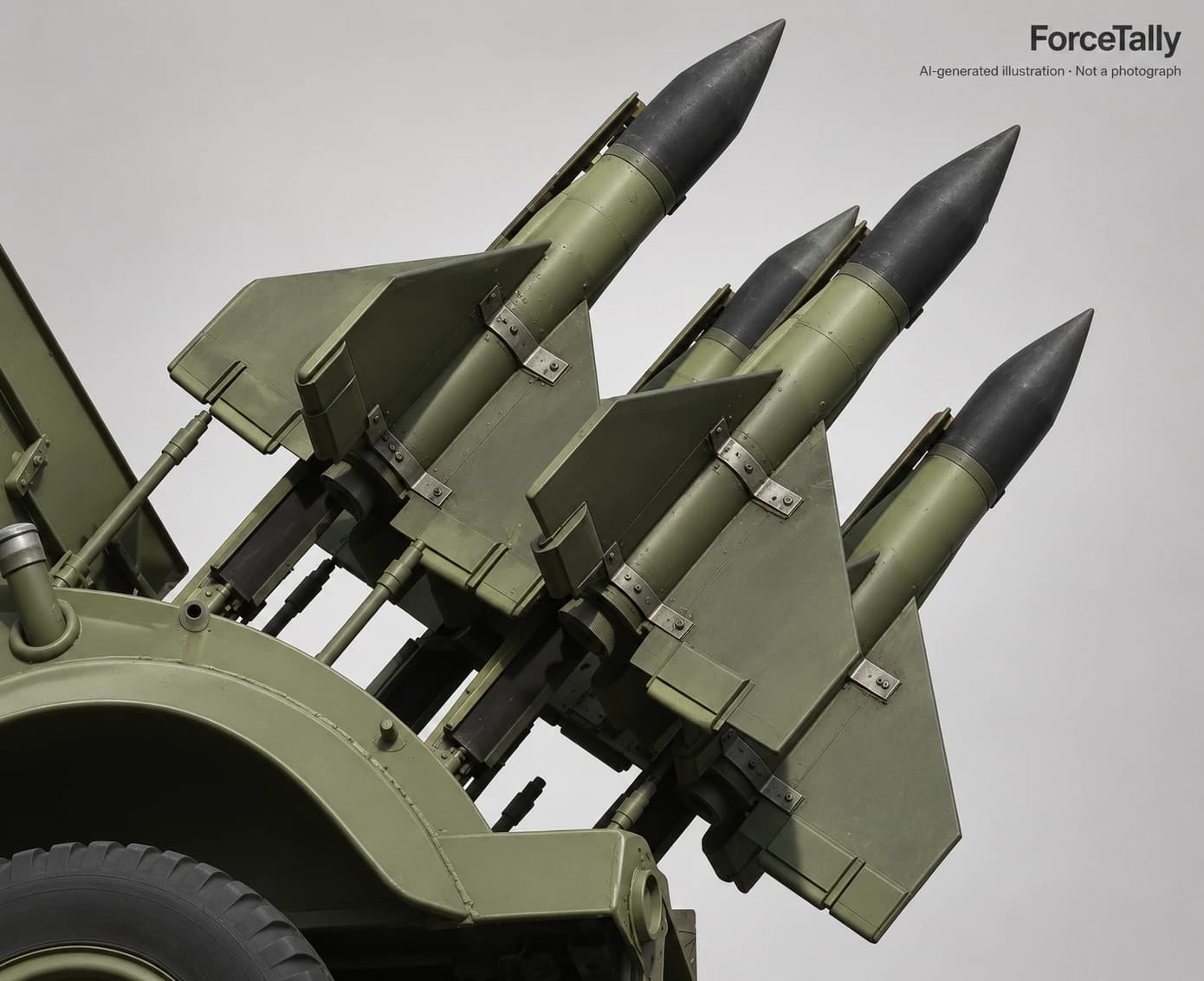
AI-generated illustration · Not a photograph. Source-pictured 3M6 Shmel / AT-1 Snapper mounted-missile display close-up. The carrier is partly outside the frame; hidden geometry, fine hardware, dimensions and operational fit are not verified.
ForceTally · AI-generated illustration · Not a photograph; photographic reference: High Contrast · CC BY 3.0 de · https://creativecommons.org/licenses/by/3.0/de/deed.en · https://commons.wikimedia.org/wiki/File:2P26_Panzerabwehrraketen.JPG. Source-pictured mounted-missile display configuration; newly composed illustration, original photograph retained privately. · AI-generated illustration · All rights reserved · Source ↗ · ModifiedCuba
North Korea
Afghanistan
Algeria
Bulgaria
Cyprus − 80 missiles received in 1973 in violation of the Greek and Turkish Cypriot arms embargo.
Czechoslovakia
East Germany
Egypt
Hungary
Iraq
Israel - Captured units from Egypt and Syria.
Mongolia − 100 missiles received in 1963.
Poland
Romania
Soviet Union
Syria
Yugoslavia - 500 missiles received between 1964 and 1965.
Too large to be man portable, it was typically deployed from specialised vehicles or helicopters. The missile was intended to supplement traditional anti-tank weapons, like the 100 mm anti-tank gun whose accuracy beyond 1,500 m is poor. The missile's accuracy in contrast remained high as far as its maximum range of 2,000 m.
The system would enter service by August 1st, 1960. Later, parade 2P27 vehicles sporting four 2K16 launchers on May 1st, 1962 were noted by Western observers in parade formation, just before the 1962 Moscow Victory Day Parade . The weapon would later be described in the US Army journal Military Review as being 'about the same size' and having 'approximately the same range' as the French SS.11 , later overestimating its range to be from 500 to 3,000 metres.
2P26 Based on the unarmored GAZ-69 light truck - with four backward pointing launch rails. The control station can be deployed up to 30 m away from the launcher vehicle. It entered service in 1960
While a few were used by Egyptian forces during the 1967 Six-Day War and from 1969 in the War of Attrition , only one tank loss was attributed to the system. The system's hit probability is estimated to have been 25% in combat.
One problem with the missile is the amount of time it takes to reach maximum range—around 20 seconds—giving the intended target time to take action, either by retreating behind an obstacle, laying down a smoke screen or firing on the operator. Also, the large size of the missile means that only a few rounds can be carried; the BRDM-1 vehicle can only carry three missiles.
Length : 1150 mm
Length : 1150 mm
Wingspan : 750 mm
Wingspan : 750 mm
Diameter : 136 mm
Diameter : 136 mm
Launch weight : 22.5 kg
Launch weight : 22.5 kg
Speed : 90 to 110 m/s
Range : 500 m to 2.3 km
Range : 500 m to 2.3 km
Time to maximum range : 20 seconds
Warhead : 5.4 kg HEAT 300 mm vs RHA
The 3M6 Shmel ( Russian : Шмель , lit. ' bumblebee ' ) is an MCLOS wire-guided anti-tank missile of the Soviet Union .
The 3M6 Shmel ( Russian : Шмель , lit. ' bumblebee ' ) is an MCLOS wire-guided anti-tank missile of the Soviet Union . Its GRAU designation is "3M6" and its NATO reporting name is AT-1 Snapper .
Launch weight : 22.5 kg
Guidance : wire-guided MCLOS
Soviet Union 0 references
Degtyarev plant 1 reference imported from Wikimedia project Russian Wikipedia Wikimedia import URL https://ru.wikipedia.org/?oldid=115911383
Reference text from Wikipedia contributors, used under CC BY-SA 4.0.
True scale
Sourced dimensions beside a 1.75 m human reference.
3M6 Shmel equipment records. Variants, orders and quantities are shown as reported in each inventory source; coverage is incomplete.
Keep exploring
 Cuba
 North Korea
 France
 Russia
 South Korea