FORCETALLY
Loading the evidence…
Preparing your view.


Preparing your view.
ArtilleryIn serviceProfile in progress
Howitzer
240 mm howitzer M1 is a howitzer originating in United States. Reported operators include United States United Kingdom Philippines Taiwan.
 United States
Technical data
Points represent sourced observations, including revisions. Revisions on the same effective date are not separate inventory events. Ranges appear in the table and are not plotted as exact points.
| Observation / report period | Value | Source | Claim state |
|---|---|---|---|
| 2 Oct 2026 | 8.38 m | Wikipedia contributors | superseded |
Howitzer
United States
1943–1959 (United States) 1958 – present (Taiwan)
United States United Kingdom Philippines Taiwan
World War II Korean War Second Taiwan Strait Crisis
1940–1943
November 1942–1945
315 manufactured by 1945
64,700 lb (29,300 kg) (in action)
27 ft 6 in (8.38 m) L/35
9 ft 2 in (2.79 m)
14
360 lb (160 kg) separate loading, bagged charge
240 mm (9.4 in)
Interrupted screw
Hydro-pneumatic
Split trail with 2 transport wagons
+15° to +65°
22.5° right and left.
1 round per minute (maximum) 30 rounds per hour (sustained)
2,300 ft/s (701 m/s)
14.3 mi (23.1 km)
The 240 mm howitzer M1 , popularly nicknamed the "Black Dragon", was a towed howitzer used by the United States Army .
The 240 mm howitzer M1 is still in service with Taiwan , stationed in hardened bunkers of the frontline Kinmen and Matsu Islands .
The 240 mm howitzer M1 , popularly nicknamed the "Black Dragon", was a towed howitzer used by the United States Army . The 240 mm M1 was designed to replace the World War I era 240 mm howitzer M1918 , which was based on a 1911 French design and was outdated by World War II.
The project to replace the M1918 began in 1941. The 240 mm howitzer was the most powerful weapon deployed by US field artillery units during World War II , able to fire a 360 lb (160 kg) high explosive projectile 25,225 yards (23,066 m). It was the largest field piece used by the US Army during the war except for naval ordnance adapted into railway guns . The weapon addressed the requirement for super-heavy field artillery capable of attacking heavily reinforced targets, like those likely to be found along Germany's Siegfried Line .
The 240 mm howitzer M1 was designed together with the longer-ranged 8-inch gun M1 , and they shared a related carriage. While use of the 8-inch gun was limited due to excessive bore wear and poor accuracy, the howitzer saw considerable action during World War II in Europe due to its effectiveness against difficult targets such as heavy concrete fortifications. It was also used in the Pacific campaign , notably in the recapture of Manila in 1945 , but few targets there were fortified heavily enough to justify its use.
The US Army retained the 240 mm howitzer after World War II, and later deployed it in the Korean War . The howitzer remained in US service until ammunition stocks were exhausted in the late 1950s.
During World War I, the United States Army received several British 9.2-inch (233.7 mm) howitzers , but was more impressed by the French Mortier de 280 modèle 1914 Schneider . 330 of the latter weapon, in a slightly modified form, were built under license by the mid-1920s as the M1918 240 mm howitzer . In 1925, it was concluded that the design was flawed, so it was decided to build a new weapon; design work, however, did not begin until 1934 and resulted in the modification of existing weapons as the M1918A1M1, but the project stalled because of limited funding. In April 1940, another design program was begun, and resulted in the 240 mm Howitzer T1. Production began in November 1942, and the piece was standardized in May 1943 as the 240 mm Howitzer M1 on Carriage M1.
A pair of three-axle, six-wheeled transport wagons were developed – one for the cannon tube, and one for the carriage. These transport wagons were also used with the 8-inch gun. These were standardized as the M2 and M3. The M2 wagon carried the carriage and the M3 wagon carried the barrel and recoil system. This separate configuration required the use of the 20-ton M2 truck-mounted crane for setup. The crane also included a clam-shell bucket that was transported on a trailer and used to dig the recoil pit for the gun. It took about two hours to emplace the gun.
The transport wagons were initially intended to be towed by the Mack NO 7 + 1 ⁄ 2 -ton heavy truck , but it was found that the trucks had problems on soft ground due to their high ground pressure .
The intended replacement was the tracked M6 tractor , which was explicitly designed for towing the 8-inch gun and 240 mm howitzer.
One 240 mm howitzer battalion was deployed to the Pacific in 1945 equipped with these carriages.
The first operational use of the super-heavy 240 mm howitzer was by the 697th and 698th Field Artillery Battalions of the U.S. 5th Army at the Anzio Beachhead in Italy in January 1944.
The 240 mm howitzers and the 8-inch (203 mm) guns of Batteries A and B, 575th Field Artillery Battalion (attached to the 697th and 698th, respectively), were used for counter-battery fire missions against long-range German guns in their class.
In Italy, the 240 mm howitzer was highly valued for its capability to destroy key bridges at long range.
Army ordnance officers credited the "devastating fire power and incredible accuracy" of the 240 mm howitzer in playing a decisive role in the Italian Campaign .
In the Italian theater , a small number of 240 mm howitzers also saw action with the British Eighth Army .
Despite their initial misgivings over the deployment of such a heavy and unwieldy weapon, 5th Army commanders dubbed the 240 mm howitzer as "the most generally satisfactory weapon" in service in 1944.
By November 1944 all 8-inch guns and 240 mm howitzers had been withdrawn from Italy and sent to the Western Front . The 240 mm howitzer saw extensive service in Europe, reducing reinforced targets requiring super-heavy artillery. Fifteen 240 mm howitzer battalions served in the European Theater; the 265th, 266th, 267th , 269th, 270th, 272nd, 277th, 278th, 538th, 539th, 551st, 552nd, 553rd, 697th, and 698th. Five served in the Pacific; the 543rd, 544th, 545th, 778th, and 779th.
During the Korean War , twelve 240 mm howitzers were brought out of " mothballs " and sent to the front lines to deal with deep bunkers and fortifications built by the Chinese that could not be effectively attacked by the smaller artillery weapons then on hand. They were utilized in two units in Korea, the 213th and 159th Field Artillery Battalions. The weapons went into action on 1 May 1953. On that day, the first round was fired by Baker battery of the 213th at a target on top of a hill called "the donut" by aerial observers . The first round was supposed to be just a ceremonial shot; however, it struck an ammo dump directly on top of "the donut" which set off a chain reaction and blew part of the top of the hill off in a spectacular fashion.
The 240 mm howitzer M1 was broken down into two loads for travel (the barrel and recoil mechanism and the carriage), each towed on a six-wheeled wagon by a Mack NO 7½-ton 6x6 truck or another heavy prime mover such as the M33 or M35 . A truck-mounted crane was required to assemble and disassemble the weapon. Due to the problems with moving such a large, heavy weapon, a self-propelled version was made by mounting it on a stretched Heavy Tank T26E3 chassis that featured an extra bogie wheel per side, as the T92 Howitzer Motor Carriage , While 115 were planned, only five were built and the war ended before they could be used and they were later scrapped.
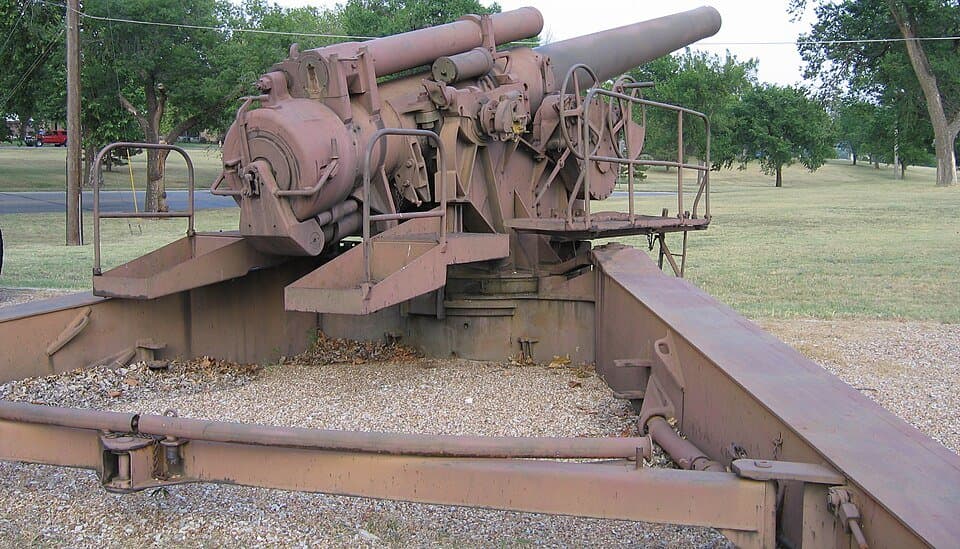
Rear view of a 240mm howitzer at the U.S. Army Field Artillery Museum, Ft. Sill , Oklahoma
Side view of a 240mm howitzer at the U.S. Army Field Artillery Museum, Ft. Sill , Oklahoma
^ a b c "M1 240 mm Howitzer" , Globalsecurity.org , Retrieved on 2007-05-25.
^ Sobiesky, Tony., "240 mm Howitzer: Kiss Of Death" , the KOREAN WAR , Updated on 2014-11-22.
^ M1 240mm Howitzer "Taiwan M1 240mm Howitzer" Archived 2011-05-01 at the Wayback Machine , Retrieved on 2010-02-20.
^ "Kinmen M1 240mm Howitzer firing exercise" , Retrieved on 2010-03-06.
Kaliber 240 mm
Kadenz 1–1,5 Schuss/min
Kaliber 240 mm
Kadenz 1–1,5 Schuss/min
Kaliber 240 mm
Masa 29 347 kg (64 700 funtów)
Peso 29.300 kg in batteria
Lunghezza canna 8,38 m ( 35 calibri )
Calibro 240 mm
重量 64,700磅(29,300公斤)(戰鬥重量)
槍管 长度 27英尺6英寸(8.38米)(35倍徑)
操作人数 14
口径 : 240mm(9.45in)
重量: 29,300kg(64,700lb)
発射速度: 30発/時(持続)
Origin United States
Type Towed howitzer
Crew 14
Weight 29.3 t
Type 240mm L/35 howitzer
Ammunition Separate loading with bagged charges
Breech Interrupted screw
Reference text from Wikipedia contributors, used under CC BY-SA 4.0.
240 mm howitzer M1 equipment records. Variants, orders and quantities are shown as reported in each inventory source; coverage is incomplete.
 Taiwan
Army exact named equipment holdings: M1. Active, operational-reserve and training units excluding equipment in store; November 2025 IISS assessment. Named service only; no parent-force or national total inferred. Source role: ARTILLERY / 240mm. Original estimates, ranges, reporting names, reserve, lease and employment scopes retained; nested included counts are not added. Missile-system quantities mean launchers, not rounds. No readiness, crew, carried weapon, payload, factory-production or future order count inherited.
Barrel length 8.38 m
Muzzle brake No
Muzzle velocity 701 m/s maximum
Elevation +15° to +65°, manual
Traverse 22.5° left and 22.5° right, manual
Type Split trail
Recoil system Hydro-pneumatic
Gun shield No
Fire control Indirect fire sights only
Rate of fire 1 rpm maximum
Rate of fire 1 rpm maximum 0.5 rpm sustained
Range 23.1 klm
Carriage M2 six wheel wagon for the carriage
Carriage M2 six wheel wagon for the carriage M3 six wheel wagon for the gun and recoil system
Carriage M2 six wheel wagon for the carriage M3 six wheel wagon for the gun and recoil system T17 and T17-1 tracked wagons used in small numbers
Towing vehicle Mack NO 7.5t heavy truck
Towing vehicle Mack NO 7.5t heavy truck M6 High Speed Tractor
Towing vehicle Mack NO 7.5t heavy truck M6 High Speed Tractor M33, M34 or M35 prime mover
Crane M2 20-ton truck mounted crane, with bucket excavator attachment
 India
 Singapore
 Canada