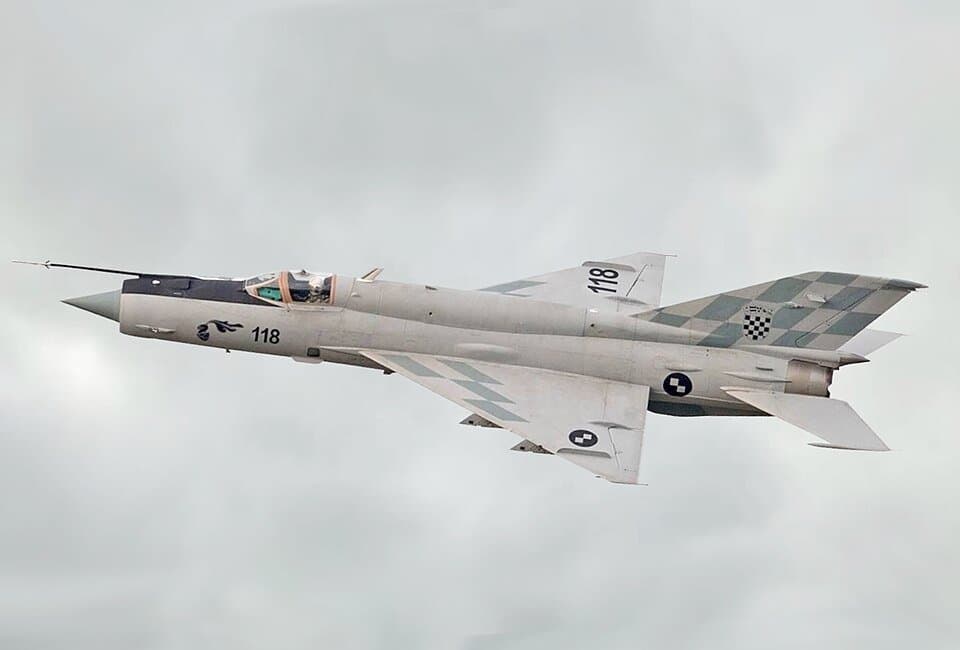
Credit
Gojanovic123456789 · CC BY-SA 4.0 · Resized · CC BY-SA 4.0 · Source ↗ · Modified


Preparing your view.

At a glance
True scale
Side by side. From every angle. A human reference for perspective.
3.31 MB · Loads when you open it| Model | Length | Width / span | Height |
|---|---|---|---|
| Mikoyan-Gurevich MiG-21 | ≈ 14.7 m | ≈ 7.15 m (Wingspan) | ≈ 4.1 m |
| Supermarine Spitfire | ≈ 9.12 m | ≈ 11.23 m (Wingspan) | ≈ 3.48 m |
Scaled uniformly to the sourced length of 14.7 m. The shape was turned square to the axes; the height was fitted to the sourced 4.1 m; the width was fitted to the sourced 7.154 m wingspan. Not an official model or a measured survey.
ForceTally · All rights reserved
Scaled uniformly to the sourced length of 9.12 m. The shape was turned square to the axes; the height was fitted to the sourced 3.48 m; the width was fitted to the sourced 11.23 m wingspan. Not an official model or a measured survey.
ForceTally · All rights reserved
The human reference is a generic 1.75 m figure. Models describe external size, not combat performance.
Measured figures
MiG-21bis · excluding pitot boom
Single source14.7 m (48 ft 3 in) excluding pitot boom[source]
Configuration
| Specification | Mikoyan-Gurevich MiG-21 | Supermarine Spitfire |
|---|---|---|
| Type | Fighter and interceptor aircraft[source] | Fighter / Interceptor aircraft[source] |
| National origin | Soviet Union[source] | United Kingdom[source] |
| Designer | Mikoyan-Gurevich[source] | R. J. Mitchell[source] |
| Status | In service[source] | — |
Spitfire Mk Vb · Length
Single source29 ft 11 in (9.12 m)[source]
Gross; MiG-21bis · with two R-3S missiles
Single sourceMaximum take-off; MiG-21bis · unprepared or metal planking runway
Single source8,725 kg (19,235 lb) with two R-3S missiles[source]
8,800 kg (19,401 lb) unprepared or metal planking runway[source]
5460 кг[source]МиГ-21бис
Empty; Spitfire Mk Vb · Empty weight
Single sourceGross; Spitfire Mk Vb · Gross weight
Single sourceMiG-21bis · clean at 11,000 m (36,000 ft)
Single source660 km (410 mi, 360 nmi) clean at 11,000 m (36,000 ft)[source]
Spitfire Mk Vb · Combat range
Single source248 mi (399 km, 216 nmi)[source]
Spitfire Mk Vb · 1 × Rolls-Royce Merlin 45 V-12 liquid-cooled piston engine
Single source1 × Rolls-Royce Merlin 45 V-12 liquid-cooled piston engine, 1,470 hp (1,100 kW)[source]
MiG-21bis · 1 × Tumansky R-25-300 afterburning turbojet thrust dry
Single sourceMiG-21bis · with afterburner
Single source1 × Tumansky R-25-300 afterburning turbojet, 40.18 kN (9,030 lbf) thrust dry, 69.58 kN (15,640 lbf) with afterburner[source]
Spitfire Mk Vb · 2,600 ft/min (
Single source2,600 ft/min (13 m/s)[source]
Bars compare reported quantities only. A larger figure does not make a system better; configurations and test conditions differ.
| Primary users | Soviet Air Forces (historical) Indian Air Force (historical) North Korean Air Force Angolan Air Force[source] | Royal Air Force Royal Canadian Air Force Free French Air Force United States Army Air Forces[source] |
|---|
| Number built | 11,496 (10,645 produced in the USSR, 840 in India , 194 in Czechoslovakia )[source] | More than 20,351[source] |
|---|
| Manufactured | 1959–1986[source] | 1938–1948[source] |
|---|
| Introduction date | 1959 (MiG-21F)[source] | 4 August 1938[source] |
|---|
| First flight | 14 February 1955 (Ye-2)[source] | 5 March 1936[source] |
|---|
| Variant | Chengdu J-7[source] | — |
|---|
| Guns | 1 × internal 23 mm Gryazev-Shipunov GSh-23 L autocannon with 200 rounds[source] | A wing 8 × .303 in Browning Mk II* machine guns (350 rounds per gun) B wing 2 × 20 mm Hispano Mk II (60 rounds per gun) 4 × .303 in Browning Mk II* machine guns (350 rounds per gun) C wing 4 × 20 mm Hispano Mk II cannon (120 rounds per gun) C wing (Alt.) 2 × 20 mm Hispano Mk II (120 rounds per gun) 4 × .303 in Browning Mk II* machine guns (350 rounds per gun) E wing 2 × 20 mm Hispano Mk II cannon (120 rounds per gun) 2 × .50 in M2 Browning machine guns (250 rounds per gun)[source] |
|---|
| Hardpoints | 5 (4 underwing + 1 ventral, reserved for fuel droptanks) , with provisions to carry combinations of: Rockets: 4 × S-24 or 4× UB-16-57 rocket pods (4×16 57mm rockets) Missiles:[source] | — |
|---|
| Airfoil | root: TsAGI S-12 (4.2%); tip: TsAGI S-12 (5%)[source] | root: NACA 2213 ; tip: NACA 2209.4[source] |
|---|
| Landing speed | 250 km/h (160 mph; 130 kn)[source] | — |
|---|
| Time to altitude | 17,000 m (56,000 ft) in 8 minutes 30 seconds[source] | — |
|---|
| Thrust/weight | 0.76[source] | — |
|---|
| Take-off run | 830 m (2,720 ft)[source] | — |
|---|
| Landing run with SPS and brake parachute | 550 m (1,800 ft)[source] | — |
|---|
| Rockets | 4 × S-24 or 4× UB-16-57 rocket pods (4×16 57mm rockets)[source] | 2 RP-3 rockets (1 under each wing)[source] |
|---|
| Bombs | 2 × 500 kg (1,100 lb) and 2 × 250 kg bombs[source] | — |
|---|
| Former operator · Afghanistan | Afghanistan[source] | — |
|---|
| Former operator · Algeria | Algeria[source] | — |
|---|
| Former operator · Azerbaijan | Azerbaijan[source] | — |
|---|
| Former operator · Bangladesh | Bangladesh[source] | — |
|---|
| Former operator · Belarus | Belarus[source] | — |
|---|
| Former operator · Bulgaria | Bulgaria[source] | — |
|---|
| Former operator · Burkina Faso | Burkina Faso[source] | — |
|---|
| Former operator · Cambodia | Cambodia[source] | — |
|---|
| Former operator · China | China[source] | — |
|---|
| Former operator · Republic of the Congo | Republic of the Congo[source] | — |
|---|
| Former operator · Croatia | Croatia[source] | — |
|---|
| Former operator · Czechoslovakia | Czechoslovakia[source] | — |
|---|
| Former operator · Czech Republic | Czech Republic[source] | — |
|---|
| Former operator · East Germany | East Germany[source] | — |
|---|
| Former operator · Egypt | Egypt[source] | — |
|---|
| Former operator · Eritrea | Eritrea[source] | — |
|---|
| Former operator · Ethiopia | Ethiopia[source] | — |
|---|
| Former operator · Finland | Finland[source] | — |
|---|
| Former operator · Guinea-Bissau | Guinea-Bissau[source] | — |
|---|
| Former operator · Germany | Germany[source] | — |
|---|
| Former operator · Georgia | Georgia[source] | — |
|---|
| Former operator · Hungary | Hungary[source] | — |
|---|
| Former operator · India | India[source] | — |
|---|
| Former operator · Indonesia | Indonesia[source] | — |
|---|
| Former operator · Iran | Iran[source] | — |
|---|
| Former operator · Iraq | Iraq[source] | — |
|---|
| Former operator · Israel | Israel[source] | — |
|---|
| Former operator · ISIL | ISIL[source] | — |
|---|
| Former operator · Kyrgyzstan | Kyrgyzstan[source] | — |
|---|
| Former operator · Laos | Laos[source] | — |
|---|
| Former operator · Madagascar | Madagascar[source] | — |
|---|
| Former operator · Mongolia | Mongolia[source] | — |
|---|
| Former operator · Namibia | Namibia[source] | — |
|---|
| Former operator · Nigeria | Nigeria[source] | — |
|---|
| Former operator · Poland | Poland[source] | — |
|---|
| Former operator · Romania | Romania[source] | — |
|---|
| Former operator · Russia | Russia[source] | — |
|---|
| Former operator · Serbia | Serbia[source] | — |
|---|
| Former operator · Serbia and Montenegro | Serbia and Montenegro[source] | — |
|---|
| Former operator · Slovakia | Slovakia[source] | — |
|---|
| Former operator · Somalia | Somalia[source] | — |
|---|
| Former operator · Soviet Union | Soviet Union[source] | — |
|---|
| Former operator · Syria | Syria[source] | — |
|---|
| Former operator · Tanzania | Tanzania[source] | — |
|---|
| Former operator · Turkmenistan | Turkmenistan[source] | — |
|---|
| Former operator · Uganda | Uganda[source] | — |
|---|
| Former operator · United States Air Force | United States Air Force[source] | — |
|---|
| Former operator · Ukraine | Ukraine[source] | — |
|---|
| Former operator · Vietnam | Vietnam[source] | — |
|---|
| Former operator · Yugoslavia | Yugoslavia[source] | — |
|---|
| Former operator · Zaire | Zaire[source] | — |
|---|
| Former operator · Zambia | Zambia[source] | — |
|---|
| Role | supersonic jet fighter and interceptor aircraft ,[source] | British single-seat fighter aircraft[source] |
|---|
| Source measurement | Development of what would become the MiG-21 began in the early 1950s when Mikoyan OKB finished a preliminary design study for a prototype designated Ye-1 in 1954. This project was very quickly reworked when it was determined that the planned engine was underpowered; the redesign led to the second prototype, the Ye-2. Both these and other early prototypes featured swept wings. The first prototype with the delta wings found on production variants was the Ye-4. It made its maiden flight on 16 June 1955 and its first public appearance during the Soviet Aviation Day display at Moscow's Tushino airfield in July 1956.[source]Mikoyan-Gurevich MiG-21 · Development / Origins; only the objects and conditions stated in this passage This had the effect of making the plane statically unstable to the point of being difficult to control, resulting in an endurance of only 45 minutes in clean condition.[source]Mikoyan-Gurevich MiG-21 · Development / Design; only the objects and conditions stated in this passage These had an increased range of 250 km (155 mi) compared to the MiG-21SM, but at the cost of worsening all other performance figures, such as a lower service ceiling and slower time to altitude.[source]Mikoyan-Gurevich MiG-21 · Development / Design; only the objects and conditions stated in this passage However, the light loading of the aircraft could mean that a climb rate of 235 m/s (46,250 ft/min) was possible with a combat-loaded MiG-21bis, not far short of the performance of the later F-16A .[source]Mikoyan-Gurevich MiG-21 · Development / Design; only the objects and conditions stated in this passage "чрезвычайный режим" - emergency mode)(Emergency Power Rating, EPR in India) booster feature allows the engine to develop 97.4 kilonewtons (21,896 lbf) of thrust under 2,000 meters (6,600 ft) of altitude.[source]Mikoyan-Gurevich MiG-21 · Development / Design; only the objects and conditions stated in this passage The limit of operation is 2 minutes for both practice and actual wartime use, as further use causes the engine to overheat.[source]Mikoyan-Gurevich MiG-21 · Development / Design; only the objects and conditions stated in this passage The use of WEP thrust was limited to 2 minutes to reduce stress on the engines' 750 (250+250+250) flight hours lifetime since every second of super-afterburner counted as several minutes of regular power run due to extreme thermal stress.[source]Mikoyan-Gurevich MiG-21 · Development / Design; only the objects and conditions stated in this passage With WEP on, the MiG-21bis's R-25 engine produced a huge 10–12 meter long blowtorch exhaust, with six or seven brightly glowing rhomboid shock diamonds visible inside the exhaust.[source]Mikoyan-Gurevich MiG-21 · Development / Design; only the objects and conditions stated in this passage A total of 194 MiG-21F-13s were built under licence in Czechoslovakia , and Hindustan Aeronautics Ltd. of India built 657 MiG-21FL, MiG-21M and MiG-21bis (of which 225 were bis)[source]Mikoyan-Gurevich MiG-21 · Development / Production; only the objects and conditions stated in this passage The MiG-21 has a delta wing . The sweep angle on the leading edge is 57° with a TsAGI S-12 airfoil . The angle of incidence is 0° while the dihedral angle is −2°. On the trailing edge there are ailerons with an area of 1.18 m 2 , and flaps with an area of 1.87 m 2 . In front of the ailerons there are small wing fences .[source]Mikoyan-Gurevich MiG-21 · Design; only the objects and conditions stated in this passage The fuselage is semi-monocoque with an elliptical profile and a maximum width of 1.24 m (4 ft 1 in).[source]Mikoyan-Gurevich MiG-21 · Design; only the objects and conditions stated in this passage The cone position for a given speed is calculated by the UVD-2M system using air pressures from in front and behind the compressor of the engine.[source]Mikoyan-Gurevich MiG-21 · Design; only the objects and conditions stated in this passage Later versions shifted the pitot tube attachment point 15 degrees to the right, as seen from the cockpit, and had an emergency pitot head on the right side, just ahead of the canopy and below the pilot's eyeline.[source]Mikoyan-Gurevich MiG-21 · Design; only the objects and conditions stated in this passage The cabin is pressurized and air-conditioned. On variants prior to the MiG-21PFM, the cabin canopy is hinged at the front. When ejecting, the SK-1 ejection seat connects with the canopy to provide a windbreak from the high-speed airflow encountered during high-speed ejections. After ejection, the canopy opens to allow the pilot to parachute to the ground. However, ejecting at low altitudes can cause the canopy to take too long to separate, sometimes resulting in pilot death. The minimum height for ejection in level flight was 110 m. Starting with the MiG-21PFM, a new ejection seat proved to be very reliable and did not need the canopy to protect the pilot which had never been fully satisfactory. The canopy is hinged on the right side of the cockpit.[source]Mikoyan-Gurevich MiG-21 · Design; only the objects and conditions stated in this passage On the underside of the aircraft, there are three air brakes, two at the front and one at the rear. The front air brakes have an area of 0.76 m 2 , and a deflection angle of 35°. The rear air brake has an area of 0.47 m 2 and a deflection angle of 40°. The rear air brake is blocked if the airplane carries an external fuel tank. Behind the air brakes are the bays for the main landing gear . On the underside of the airplane, just behind the trailing edge of the wing are attachment points for two JATO rockets. The front section of the fuselage ends at former #28. The rear section of the fuselage starts at former #28a and is removable for engine maintenance.[source]Mikoyan-Gurevich MiG-21 · Design; only the objects and conditions stated in this passage The empennage of the MiG-21 consists of a vertical stabilizer , a stabilator and a small fin on the bottom of the tail to improve yaw control. The vertical stabilizer has a sweep angle of 60° and an area of 5.32 m 2 (on earlier version 3.8 m 2 ) and a rudder . The stabilator has a sweep angle of 57°, an area of 3.94 m 2 and a span of 2.6 m.[source]Mikoyan-Gurevich MiG-21 · Design; only the objects and conditions stated in this passage The MiG-21 uses a tricycle -type undercarriage. On most variants, the main landing gear uses tires that are 800 mm in diameter and 200 mm in width. Only the MiG-21F variants use tires with the size 660×200 mm. The wheels of the main landing gear retract into the fuselage after rotating 87° and the shock absorbers retract into the wing. The nose gear retracts forward into the fuselage under the radar. The nose wheel can be lowered manually by simply unlocking its hatch from inside the cockpit. Thus, landing with undercarriage locked in the up position due to an internal failure was not a major issue, with a number of such successful landings on the nosewheel and ventral fuel tank or the airbrake.[source]Mikoyan-Gurevich MiG-21 · Design; only the objects and conditions stated in this passage During the Yom Kippur War North Korean veteran pilots, many with more than 2,000 hours flight experience, flew Egyptian and Syrian MiG-21 fighters and engaged Israeli forces multiple times. KPAAF pilots continued to fly Syrian MiG-21s throughout the 1970s and into the 1980s.[source]Mikoyan-Gurevich MiG-21 · Operational history / North Korea; only the objects and conditions stated in this passage The only known combat engagement of the MiG-21s during the Indo-Pakistani war of 1965 took place on the 4 September 1965 when a MiG-21FL of No. 28 Squadron damaged a F-86E with two R-3S missiles. During the Indo-Pakistani war of 1971 , the MiG-21s played a major role for the IAF in to establish air superiority over vital points and areas of conflict. The war witnessed the first supersonic dog fight in the India subcontinent when an Indian MiG-21FL shot a Pakistan Air Force (PAF) Lockheed F-104 Starfighter with its GSh-23 twin-barrelled 23 mm (0.91 in) cannon. The IAF MiG-21FLs had an upper hand in the highly anticipated air combat with the PAF F-104A Starfighters. As per the IAF, the MiG-21s had claimed four F-104As, two Shenyang F-6Cs , one North American F-86F Sabre and one Lockheed C-130E Hercules aircraft of the PAF.[source]Mikoyan-Gurevich MiG-21 · Operational history / India / India-Pakistan Wars; only the objects and conditions stated in this passage Since 1970, more than 170 IAF pilots and 40 civilians were killed in MiG-21 accidents, thus the earning the aircraft the nickname of "flying coffin". Over half of the 840 aircraft built between 1966 and 1984 were lost to crashes. When in afterburner , the engine operates very close to its surge line and the ingestion of a small object led to an engine surge/seizure and flame out. Poor maintenance and quality of replacement parts was considered to be a factor in the crashes. As a result, the IAF announced that it would replace its remaining fleet of MiG-21 Bison aircraft with the indigenous HAL Tejas fighter aircraft in 2023. In October 2023, the aircraft made the final public appearance at the Air Force Day flypast held at Prayagraj . The aircraft were put on standby during the 2025 India–Pakistan conflict , however were not utilised. The aircraft were retired in August 2025 in a ceremony at the Nal Air Force Station in Bikaner , which was the last airbase operating the aircraft. An official farewell ceremony was held at Chandigarh Air Force Station on 26 September 2025.[source]Mikoyan-Gurevich MiG-21 · Operational history / India / Later years; only the objects and conditions stated in this passage Former MiG-17 pilot Nguyen Nhat Chieu and his wingman Tran Ngoc Siu intercepted USAF F-105Ds while on CAP duty over Phuc Yen Airbase (a.k.a. Noi Bai Airbase) on 7 July 1966, shooting down one piloted by Capt. Tomes with a salvo from Tran's UB-16-57 / S-5M unguided rocket-equipped MiG-21; this was the first instance of a VPAF MiG-21 shooting down a piloted enemy aircraft in the Vietnam War. (Flight leader Nguyen was unable to establish a lock on another, wildly-evading F-105 with his R-3S AAM.)[source]Mikoyan-Gurevich MiG-21 · Operational history / Vietnam War; only the objects and conditions stated in this passage Although 13 of North Vietnam's flying aces attained their status while flying the MiG-21 (cf. three in the MiG-17), many VPAF pilots preferred the MiG-17 because the high wing loading of the MiG-21 made it relatively less maneuverable and the lighter framed canopy of the MiG-17 gave better visibility. However, this is not the impression British author Roger Boniface got when he interviewed Pham Ngoc Lan and ace Nguyễn Nhật Chiêu (who scored victories flying both the MiG-17 and MiG-21). Pham Ngoc Lan told Boniface that "The MiG-21 was much faster, and it had two Atoll missiles which were very accurate and reliable when fired between 1,000 and 1,200 yards." And Chiêu asserted that "... for me personally, I preferred the MiG-21 because it was superior in all specifications in climb, speed and armament. The Atoll missile was very accurate and I scored four kills with the Atoll. ... In general combat conditions, I was always confident of a kill over an F-4 Phantom when flying a MiG-21."[source]Mikoyan-Gurevich MiG-21 · Operational history / Vietnam War; only the objects and conditions stated in this passage The B-52 had been above Hanoi at over 30,000 feet (9,100 m) when Major Tuân launched two Atoll missiles from 2 kilometres away and claimed to have destroyed one of the bombers flying in the three-plane formation.[source]Mikoyan-Gurevich MiG-21 · Operational history / Vietnam War / Aerial combat victories 1966–1972; only the objects and conditions stated in this passage The rebels had access to heavy machine guns , different anti-aircraft guns and Russian and Chinese MANPADS , up to modern designs such as the FN-6 . The first loss of a MiG-21 during the Syrian civil war was recorded on 30 August 2012. The MiG, registration number 2271, was likely downed by heavy machine gun fire on takeoff or landing at Abu al-Duhur Military Airbase , under siege by rebels . A few days later, on 4 September 2012, another MiG-21 (registration number 2280) was shot down in similar circumstances at the same base, also likely on takeoff or landing by rebels using by KPV 14.5 mm machine guns; the downing was recorded on video.[source]Mikoyan-Gurevich MiG-21 · Operational history / Syrian civil war; only the objects and conditions stated in this passage On 10 November 2014, Syrian Air Force MiG-21bis number 2204 was shot down, and its pilot killed, by rebels either using a MANPADS or antiaircraft guns, near the town of Sabburah , 45 km east of Hama Airbase where it was likely based. Video and photo evidence of the crash site later emerged.[source]Mikoyan-Gurevich MiG-21 · Operational history / Syrian civil war; only the objects and conditions stated in this passage On 6 November 1981, a Mirage F1CZ achieved South Africa's first confirmed air-to-air kill since the Korean War when it destroyed Cuban Lieutenant Danacio Valdez's MiG-21MF with 30mm cannon fire.[source]Mikoyan-Gurevich MiG-21 · Operational history / Angola; only the objects and conditions stated in this passage Yugoslavia purchased its first batch of MiG-21s in 1962 from the Soviet Union . From 1962 to the early 1980s, Yugoslavia purchased 261 MiG-21s, of ten different variants. There were 41 MiG-21f-13, 36 MiG-21PfM, 25 MiG-21M, 6 MiG-21MF, 46 MiG-21bis, 45 MiG-21bisK, 12 MiG-21R, 18 MiG-21U, 25 MiG-21UM, and 7 MiG-21US. Yugoslav Air force units that operated MiG-21s were the 204th Fighter-Aviation Regiment at Batajnica Air Base (126th, 127th and 128th Fighter-Aviation Squadrons), 117th Fighter-Aviation Regiment at Željava Air Base (124th and 125th Fighter-Aviation Squadron and 352nd Recon Squadron), 83rd Fighter-Aviation Regiment at Slatina Air Base (123rd and 130th Fighter Aviation Squadron), 185th Fighter-Bomber-Aviation Squadron (129th Fighter-Aviation Squadron) at Pula and 129th Training Center at Batajnica Air Base.[source]Mikoyan-Gurevich MiG-21 · Operational history / Yugoslavia; only the objects and conditions stated in this passage In 1962, Romanian Air Force (RoAF) received the first 12 MiG-21F-13, followed by another 12 of the same variant in 1963. Deliveries continued over the next years with other variants: 38 aircraft of MiG-21RFM (PF) variant in 1965, 7 MiG-21U-400/600 in 1965–1968, 56 MiG-21RFMM (PFM) in 1966–1968, 12 MiG-21R in 1968–1972, 68 MiG-21M plus 11 MiG-21US in 1969–1970, 74 MiG-21MF/MF-75 in 1972–1975, and 27 MiG-21UM in 1972–1980 plus another 5 of the same variant in 1990, for a total number of 322 aircraft.[source]Mikoyan-Gurevich MiG-21 · Operational history / Romania; only the objects and conditions stated in this passage In 1995–2002, a total of 111 MiG-21s were modernized, of which 71 were M and MF/MF-75 variants modernized under the LanceR A designation (for ground attack), 14 were UM variant as LanceR B designation (trainer), and another 26 MF/MF-75 variant were modernized under LanceR C designation (air superiority). Today, only 36 LanceRs are operational for the RoAF. It can use both Western and Eastern armament such as the R-60M, R-73, Magic 2, or Python III missiles.[source]Mikoyan-Gurevich MiG-21 · Operational history / Romania; only the objects and conditions stated in this passage Despite being one of the newest MiG-21 fleets in service, the Romanian MiG-21 LanceR fleet was grounded due to difficulties maintaining the aircraft, and since 1996 it has had an accident rate of over 30 per 100,000 hours. Serviceability rates below 50% are not uncommon.[source]Mikoyan-Gurevich MiG-21 · Operational history / Romania; only the objects and conditions stated in this passage For reconnaissance, a regiment received 26 specialized reconnaissance MiG-21Rs in 1962, and in 1969–1970, 19 Fighter Aviation Regiment received 15 MiG-21m aircraft, which operated in 21 Fighter Aviation Regiment and were removed from active service in 1990. An additional 12 MiG-21MF fighters were received in 1974–1975, with a reconnaissance version of the MiG-21MFR provided to the 26th Reconnaissance Regiment and used until 2000, when removed from active service.[source]Mikoyan-Gurevich MiG-21 · Operational history / Bulgaria; only the objects and conditions stated in this passage Besides fighters, the Air Force has received 39 MiG-21U trainers (one in 1966), five MiG-21US in 1969–1970 and 27 MiG-21UM (new) during 1974–1980, another six refurbished ex-Soviet examples in 1990. In 1982, three MiG-21UM trainers were sold to Cambodia and in 1994 another 10 examples. MiG-21UMs were also sold to India. Other training aircraft were removed from active service in 2000. A total of 38 aircraft were lost in the period 1963–2000.[source]Mikoyan-Gurevich MiG-21 · Operational history / Bulgaria; only the objects and conditions stated in this passage Northern most point, MiG-21M at the Kargil War Memorial , Dras .[source]Mikoyan-Gurevich MiG-21 · Aircraft on display; only the objects and conditions stated in this passage Length: 14.7 m (48 ft 3 in) excluding pitot boom[source]Mikoyan-Gurevich MiG-21 · Specifications (MiG-21bis); only the objects and conditions stated in this passage Wingspan: 7.154 m (23 ft 6 in)[source]Mikoyan-Gurevich MiG-21 · Specifications (MiG-21bis); only the objects and conditions stated in this passage Height: 4.1 m (13 ft 5 in)[source]Mikoyan-Gurevich MiG-21 · Specifications (MiG-21bis); only the objects and conditions stated in this passage Wing area: 23 m 2 (250 sq ft)[source]Mikoyan-Gurevich MiG-21 · Specifications (MiG-21bis); only the objects and conditions stated in this passage Gross weight: 8,725 kg (19,235 lb) with two R-3S missiles[source]Mikoyan-Gurevich MiG-21 · Specifications (MiG-21bis); only the objects and conditions stated in this passage Max takeoff weight: 8,800 kg (19,401 lb) unprepared or metal planking runway[source]Mikoyan-Gurevich MiG-21 · Specifications (MiG-21bis); only the objects and conditions stated in this passage 9,800 kg (21,605 lb) paved runway with standard wheels and tyres 10,400 kg (22,928 lb) paved runway with larger wheels and tyres[source]Mikoyan-Gurevich MiG-21 · Specifications (MiG-21bis); only the objects and conditions stated in this passage Powerplant: 1 × Tumansky R-25-300 afterburning turbojet, 40.18 kN (9,030 lbf) thrust dry, 69.58 kN (15,640 lbf) with afterburner[source]Mikoyan-Gurevich MiG-21 · Specifications (MiG-21bis); only the objects and conditions stated in this passage Maximum speed: 2,175 km/h (1,351 mph, 1,174 kn) / M2.05 at 13,000 m (43,000 ft)[source]Mikoyan-Gurevich MiG-21 · Specifications (MiG-21bis); only the objects and conditions stated in this passage 1,300 km/h (810 mph; 700 kn) / M1.06 at sea level[source]Mikoyan-Gurevich MiG-21 · Specifications (MiG-21bis); only the objects and conditions stated in this passage Landing speed: 250 km/h (160 mph; 130 kn)[source]Mikoyan-Gurevich MiG-21 · Specifications (MiG-21bis); only the objects and conditions stated in this passage Range: 660 km (410 mi, 360 nmi) clean at 11,000 m (36,000 ft)[source]Mikoyan-Gurevich MiG-21 · Specifications (MiG-21bis); only the objects and conditions stated in this passage 604 km (375 mi; 326 nmi) at 11,000 m (36,000 ft) with two R-3S missiles 793 km (493 mi; 428 nmi) at 10,000 m (33,000 ft) with two R-3S missiles and 800 L (210 US gal; 180 imp gal) drop-tank[source]Mikoyan-Gurevich MiG-21 · Specifications (MiG-21bis); only the objects and conditions stated in this passage Service ceiling: 17,500 m (57,400 ft)[source]Mikoyan-Gurevich MiG-21 · Specifications (MiG-21bis); only the objects and conditions stated in this passage Time to altitude: 17,000 m (56,000 ft) in 8 minutes 30 seconds[source]Mikoyan-Gurevich MiG-21 · Specifications (MiG-21bis); only the objects and conditions stated in this passage Take-off run: 830 m (2,720 ft)[source]Mikoyan-Gurevich MiG-21 · Specifications (MiG-21bis); only the objects and conditions stated in this passage Landing run with SPS and brake parachute: 550 m (1,800 ft)[source]Mikoyan-Gurevich MiG-21 · Specifications (MiG-21bis); only the objects and conditions stated in this passage Guns: 1 × internal 23 mm Gryazev-Shipunov GSh-23 L autocannon with 200 rounds[source]Mikoyan-Gurevich MiG-21 · Specifications (MiG-21bis); only the objects and conditions stated in this passage Hardpoints: 5 (4 underwing + 1 ventral, reserved for fuel droptanks) , with provisions to carry combinations of: Rockets: 4 × S-24 or 4× UB-16-57 rocket pods (4×16 57mm rockets) Missiles:[source]Mikoyan-Gurevich MiG-21 · Specifications (MiG-21bis); only the objects and conditions stated in this passage Bombs: 2 × 500 kg (1,100 lb) and 2 × 250 kg bombs[source]Mikoyan-Gurevich MiG-21 · Specifications (MiG-21bis); only the objects and conditions stated in this passage | Smith oversaw the Spitfire's development through many variants , from the Mk 1 to the Rolls-Royce Griffon-engined Mk 24, using several wing configurations and guns. The original airframe was designed to be powered by a Rolls-Royce Merlin engine producing 1,030 hp (768 kW). It was strong enough and adaptable enough to use increasingly powerful Merlins, and in later marks, Rolls-Royce Griffon engines producing up to 2,340 hp (1,745 kW). As a result, the Spitfire's performance and capabilities improved over the course of its service life.[source]Supermarine Spitfire · Lead; only the objects and conditions stated in this passage In 1931, the Air Ministry released specification F7/30 , calling for a modern fighter capable of a flying speed of 250 mph (400 km/h) to replace the Gloster Gauntlet biplane. R. J. Mitchell designed the Supermarine Type 224 to fill this role in competition with the Blackburn F.3 and Westland F.7/30 and privately funded designs from Gloster. The 224 was an open-cockpit monoplane with bulky gull wings and a large, fixed, spatted undercarriage powered by the 600-horsepower (450 kW), evaporatively cooled Rolls-Royce Goshawk engine. It made its first flight in February 1934. Of the seven designs tendered to F7/30, the Gloster Gladiator biplane was accepted for service.[source]Supermarine Spitfire · Development and production / Origins; only the objects and conditions stated in this passage The Type 224 was a big disappointment to Mitchell and his design team, who immediately embarked on a series of "cleaned-up" designs, using their experience with the Schneider Trophy seaplanes as a starting point. This led to the Type 300, with retractable undercarriage and a wingspan reduced by 6 ft (1.8 m). This design was submitted to the Air Ministry in July 1934, but was not accepted. It then went through a series of changes, including the incorporation of an enclosed cockpit, oxygen-breathing apparatus, smaller and thinner wings, and the newly developed, more powerful Rolls-Royce PV XII V-12 engine, which was later named the "Merlin". In November 1934, Mitchell, with the backing of Supermarine's owner Vickers-Armstrong , started detailed design work on this refined version of the Type 300.[source] |
|---|
| Manufacturer | Russian Aircraft Corporation MiG[source] Sokol[source] Dux Factory[source] Tbilisi Aircraft Manufacturing[source] AERO Vodochody Aerospace[source] Hindustan Aeronautics Limited[source] Chengdu Aircraft Industry Group[source] | Supermarine[source] |
|---|
| Variants | — | Supermarine Spitfire (Griffon-powered variants) Supermarine Spitfire (early Merlin-powered variants) Supermarine Spitfire (late Merlin-powered variants) Supermarine Seafire[source] |
|---|
| Developed into | — | Supermarine Spiteful[source] |
|---|
| Propellers | — | 3-bladed Rotol constant-speed propeller[source] |
|---|
| Wing loading | — | 27.35 lb/sq ft (133.5 kg/m 2 )[source] |
|---|
| Power/mass | — | 0.22 hp/lb (0.36 kW/kg)[source] |
|---|
| Reported operators |
|
|---|
Maximum take-off; Spitfire Mk Vb · Max takeoff weight
Single sourceOn 1 December 1934, the Air Ministry issued contract AM 361140/34, providing £10,000 for the construction of Mitchell's improved Type 300 design. In April 1935 Ralph Sorley spoke to Mitchell about the new specification F10/35 which called for armament of at least six and preferably eight guns while at the same time removing bomb carry requirement and reducing fuel capacity. Mitchell foresaw no problem adding the guns and welcomed the reduction which would reduce weight. A specification for an eight-gun fighter, F5/34 had come from a recommendation by Squadron Leader Ralph Sorley of the Operational Requirements section at the Air Ministry. In the redesign the change was made from Vickers machine guns to .303 in (7.7 mm) Brownings ), and the fuel tankage dropped to 75 gallons from 94.[source]Supermarine Spitfire · Development and production / Origins; only the objects and conditions stated in this passage
On 5 March 1936, the prototype ( K5054 ) , fitted with a fine-pitch propeller to give more power for take-off, took off on its first flight from Eastleigh Aerodrome . At the controls was Captain Joseph "Mutt" Summers , chief test pilot for Vickers, who is quoted as having said, "don't touch anything" on landing. This eight-minute flight came four months after the maiden flight of the contemporary Hurricane.[source]Supermarine Spitfire · Development and production / Origins; only the objects and conditions stated in this passage
The rudder was oversensitive, and the top speed was just 330 mph (528 km/h), little faster than Sydney Camm 's new Merlin-powered Hurricane.[source]Supermarine Spitfire · Development and production / Origins; only the objects and conditions stated in this passage
A new and better-shaped, two-bladed, wooden propeller allowed the Spitfire to reach 348 mph (557 km/h) in level flight in mid-May, when Summers flew K5054 to RAF Martlesham Heath and handed the aircraft over to Squadron Leader Anderson of the Aeroplane & Armament Experimental Establishment (A&AEE).[source]Supermarine Spitfire · Development and production / Origins; only the objects and conditions stated in this passage
In spite of promises that the factory would be producing 60 per week starting in April, by May 1940, Castle Bromwich had not yet built its first Spitfire. On 17 May, Minister of Aircraft Production Lord Beaverbrook telephoned Lord Nuffield and manoeuvred him into handing over control of the Castle Bromwich plant to his ministry. Beaverbrook immediately sent in experienced management staff and workers from Supermarine, and gave control of the factory to Vickers-Armstrong's. Although resolving the problems took time, in June 1940, 10 Mk IIs were built; 23 rolled out in July, 37 in August, and 56 in September. By the time production ended at Castle Bromwich in June 1945, a total of 12,129 Spitfires, comprising 921 Mk IIs, 4,489 Mk Vs, 5,665 Mk IXs, and 1,054 Mk XVIs had been built.[source]Supermarine Spitfire · Development and production / Manufacturing at Castle Bromwich, Birmingham; only the objects and conditions stated in this passage
During the Battle of Britain, the Luftwaffe made concerted efforts to destroy the main manufacturing plants at Woolston and Itchen , near Southampton. The first bombing raid, which missed the factories, came on 23 August 1940. Over the next month, other raids were mounted, until, on 26 September 1940, both factories were destroyed, with 92 people killed and a large number injured. Most of the casualties were experienced aircraft-production workers.[source]Supermarine Spitfire · Development and production / Production dispersal; only the objects and conditions stated in this passage
Henshaw wrote that he would climb at full throttle at 2,850 rpm to the rated altitude, then dive at full power and 3,000 rpm, and trim the plane to fly by itself at 460 mph (740 km/h).[source]Supermarine Spitfire · Development and production / Flight testing; only the objects and conditions stated in this passage
A production test usually consisted of an initial circuit of under 10 minutes, and a main flight of 20 to 30 minutes.[source]Supermarine Spitfire · Development and production / Flight testing; only the objects and conditions stated in this passage
The wing section used was from the NACA 2200 series , which had been adapted to create a thickness-to-chord ratio of 13% at the root, reducing to 9.4% at the tip. A dihedral of 6° was adopted to give increased lateral stability.[source]Supermarine Spitfire · Design / Elliptical wing design; only the objects and conditions stated in this passage
The trailing edge of the wing twisted slightly upward along its span, the angle of incidence decreasing from +2° at its root to -½° at its tip.[source]Supermarine Spitfire · Design / Elliptical wing design; only the objects and conditions stated in this passage
The Spitfire had detachable wing tips which were secured by two mounting points at the end of each main wing assembly. When the Spitfire took on a role as a high-altitude fighter (Marks VI and VII and some early Mk VIIIs), the standard wing tips were replaced by extended, "pointed" tips which increased the wingspan from 36 ft 10 in (11.23 m) to 40 ft 2 in (12.24 m). The other wing-tip variation, used by several Spitfire variants, was the "clipped" wing; the standard wing tips were replaced by wooden fairings which reduced the span by 3 ft 6 in (1.07 m). The wing tips used spruce formers for most of the internal structure with a light alloy skin attached using brass screws.[source]Supermarine Spitfire · Design / Elliptical wing design; only the objects and conditions stated in this passage
The light alloy split flaps at the trailing edge of the wing were also pneumatically operated via a finger lever on the instrument panel. Only two positions were available; fully up or fully down (85°). Flaps were normally lowered only during the final approach and for landing, and the pilot was to retract them before taxiing.[source]Supermarine Spitfire · Design / Elliptical wing design; only the objects and conditions stated in this passage
As the Spitfire gained more power and was able to manoeuvre at higher speeds, the possibility that pilots would encounter aileron reversal increased, and the Supermarine design team set about redesigning the wings to counter this. The original wing design had a theoretical aileron reversal speed of 580 mph (500 kn; 930 km/h), which was somewhat lower than that of some contemporary fighters. The Royal Aircraft Establishment noted that, at 400 mph (350 kn; 640 km/h) indicated airspeed , roughly 65% of aileron effectiveness was lost due to wing twist.[source]Supermarine Spitfire · Design / Improved late wing designs; only the objects and conditions stated in this passage
The new wing of the Spitfire F Mk 21 and its successors was designed to help alleviate this problem. Its stiffness was increased by 47%, and a new aileron design using piano hinges and geared trim tabs meant the theoretical aileron reversal speed was increased to 825 mph (717 kn; 1,328 km/h). Alongside the redesigned wing, Supermarine also experimented with the original wing, raising the leading edge by 1 inch (25 mm), with the hope of improving pilot view and reducing drag. This wing was tested on a modified F Mk 21, also called the F Mk 23, (sometimes referred to as "Valiant" rather than "Spitfire"). The increase in performance was minimal and this experiment was abandoned.[source]Supermarine Spitfire · Design / Improved late wing designs; only the objects and conditions stated in this passage
Supermarine developed a new laminar-flow wing based on new aerofoil profiles developed by the National Advisory Committee for Aeronautics in the United States, with the objective of reducing drag and improving performance. These laminar-flow airfoils were the Supermarine 371-I used at the root and the 371-II used at the tip. Supermarine estimated that the new wing could give an increase in speed of 55 mph (48 kn; 89 km/h) over the Spitfire Mk 21. The new wing was initially fitted to a Spitfire Mk XIV. Later, a new fuselage was designed, with the new fighter becoming the Supermarine Spiteful .[source]Supermarine Spitfire · Design / Improved late wing designs; only the objects and conditions stated in this passage
Even if the eight Brownings worked perfectly, pilots soon discovered that they were not sufficient to destroy larger aircraft. Combat reports showed that an average of 4,500 rounds were needed to shoot down an enemy aircraft. The main cause of this was the way the guns were mounted in the wing, allowing a dispersion of 1.1 metres at only 100 metres range. Perfectly aimed fire just missed the target because of this. In November 1938, tests against armoured and unarmoured targets had already indicated that the introduction of a weapon with a calibre of at least 20 mm was urgently needed. A variant on the Spitfire design with four 20 mm Oerlikon cannon had been tendered to specification F37/35, but the order for prototypes had gone to the Westland Whirlwind in January 1939.[source]Supermarine Spitfire · Design / Armament; only the objects and conditions stated in this passage
In June 1939, a Spitfire was fitted with a drum-fed Hispano in each wing, an installation that required large blisters on the wing to cover the 60-round drum, reducing speed by 8 mph (7.0 kn; 13 km/h). The cannon suffered frequent stoppages, mostly because the guns were mounted on their sides to fit as much of the magazine as possible within the wing. In January 1940, P/O George Proudman flew this prototype in combat, but the starboard gun stopped after firing a single round, while the port gun fired 30 rounds before seizing.[source]Supermarine Spitfire · Design / Armament; only the objects and conditions stated in this passage
In the Mediterranean, the Spitfire blunted the heavy attacks on Malta by the Regia Aeronautica and Luftwaffe, and from early 1943, helped pave the way for the Allied invasions of Sicily and Italy. On 7 March 1942, 15 Mk Vs carrying 90 imp gal (410 L; 110 US gal) fuel tanks under their bellies took off from HMS Eagle off the coast of Algeria on a 600-mile (970 km) flight to Malta. Those Spitfire Vs were the first to see service outside Britain. The Spitfire served on the Eastern Front with the Soviet Air Force (VVS) . The first deliveries of the Spitfire Mk VB variant took place at the start of 1943, with the first batch of 35 aircraft delivered via sea to the city of Basra , Iraq. A total of 143 aircraft and 50 furnished hulls (to be used for spare parts) followed by March of the same year. Though some aircraft were used for front line duty in 1943, most of them saw service with the Protivo-Vozdushnaya Oborona (English: "Anti-air Defence Branch").[source]Supermarine Spitfire · Operational history / Service operations; only the objects and conditions stated in this passage
Tobin, reached 606 mph (527 kn; 975 km/h) (Mach 0.891) in a 45° dive.[source]Supermarine Spitfire · Operational history / Speed and altitude records; only the objects and conditions stated in this passage
Martindale blacked out under the 11 g loading, but when he resumed consciousness, he found the aircraft at about 40,000 feet with its (originally straight) wings now slightly swept back.[source]Supermarine Spitfire · Operational history / Speed and altitude records; only the objects and conditions stated in this passage
Martindale successfully glided the Spitfire 20 mi (32 km) back to the airfield and landed safely.[source]Supermarine Spitfire · Operational history / Speed and altitude records; only the objects and conditions stated in this passage
RAE Bedford (RAE) modified a Spitfire for high-speed testing of the stabilator (then known as the "flying tail") of the Miles M.52 supersonic research aircraft. RAE test pilot Eric Brown stated that he tested this successfully during October and November 1944, attaining Mach 0.86 in a dive.[source]Supermarine Spitfire · Operational history / Speed and altitude records; only the objects and conditions stated in this passage
On 5 February 1952, a Spitfire 19 of 81 Squadron based at Kai Tak in Hong Kong reached probably the highest altitude ever achieved by a Spitfire. The pilot, Flight Lieutenant Edward "Ted" Powles , was on a routine flight to survey outside air temperature and report on other meteorological conditions at various altitudes in preparation for a proposed new air service through the area. He climbed to 50,000 ft (15,000 m) indicated altitude, with a true altitude of 51,550 ft (15,710 m). The cabin pressure fell below a safe level, and in trying to reduce altitude, he entered an uncontrollable dive which shook the aircraft violently. He eventually regained control somewhere below 3,000 ft (900 m) and landed safely with no discernible damage to his aircraft. Evaluation of the recorded flight data suggested he achieved a speed of 690 mph (600 kn; 1,110 km/h), (Mach 0.96) in the dive, which would have been the highest speed ever reached by a propeller-driven aircraft if the instruments had been considered more reliable.[source]Supermarine Spitfire · Operational history / Speed and altitude records; only the objects and conditions stated in this passage
Different wings, featuring a variety of weapons, were fitted to most marks; the A wing used eight .303 in (7.7 mm) machine guns, the B wing had four .303 in (7.7 mm) machine guns and two 20 mm (.79 in) Hispano cannons , and the C, or universal, wing could mount either four 20 mm (.79 in) cannons or two 20 mm (.79 in) and four .303 in (7.7 mm) machine guns.[source]Supermarine Spitfire · Variants / Overview; only the objects and conditions stated in this passage
Another armament variation was the E wing which housed two 20 mm (.79 in) cannons and two .50 in (12.7 mm) Browning machine guns .[source]Supermarine Spitfire · Variants / Overview; only the objects and conditions stated in this passage
The first Rolls-Royce Griffon-engined Mk XII flew in August 1942, and first flew operationally with 41 Squadron in April 1943. This mark could nudge 400 mph (350 kn; 640 km/h) in level flight and climb to an altitude of 33,000 ft (10,000 m) in under nine minutes.[source]Supermarine Spitfire · Variants / Griffon-engined variants; only the objects and conditions stated in this passage
In late 1962, Air Marshal Sir John Nicholls instigated a trial when he flew Spitfire PM631 , a PR Mk 19 in the custody of the Battle of Britain Memorial Flight , against an English Electric Lightning F 3 (a supersonic jet-engined interceptor) in mock combat at RAF Binbrook .[source]Supermarine Spitfire · Variants / Griffon-engined variants; only the objects and conditions stated in this passage
At the end of the trials, RAF pilots found that Firestreak infra-red guided missiles had trouble acquiring the Spitfire due to a low exhaust temperature, and decided that the twin ADEN 30 mm (1.2 in) cannons were the only weapons suited to the task, which was complicated by the tight turning circle of the Spitfire, and the Lightning's proclivity for over-running the Spitfire.[source]Supermarine Spitfire · Variants / Griffon-engined variants; only the objects and conditions stated in this passage
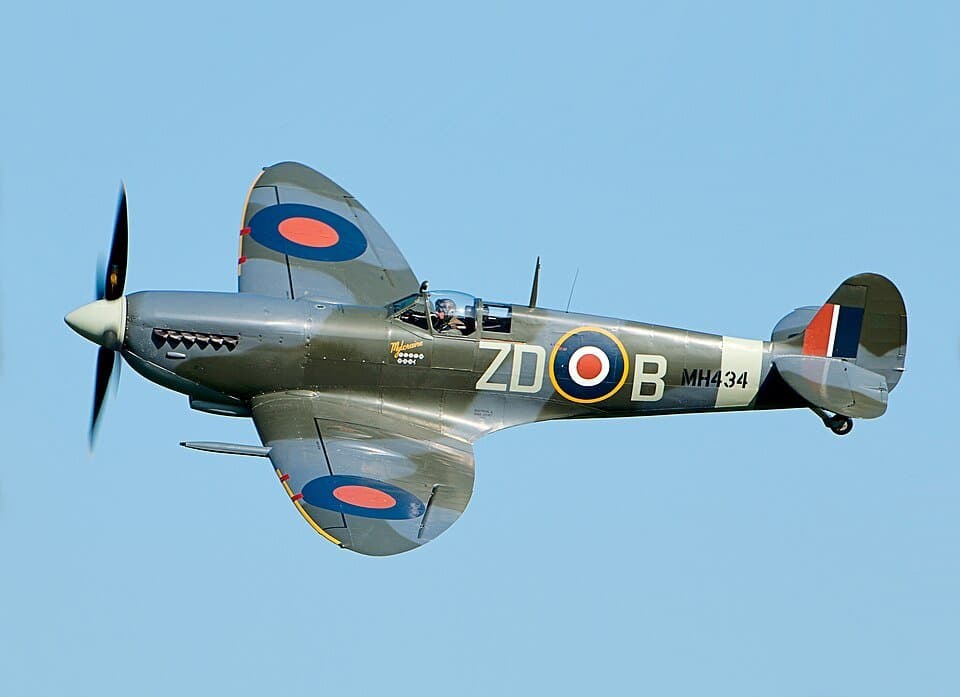
Length: 29 ft 11 in (9.12 m)[source]Supermarine Spitfire · Specifications (Spitfire Mk Vb); only the objects and conditions stated in this passage
Wingspan: 36 ft 10 in (11.23 m)[source]Supermarine Spitfire · Specifications (Spitfire Mk Vb); only the objects and conditions stated in this passage
Height: 11 ft 5 in (3.48 m)[source]Supermarine Spitfire · Specifications (Spitfire Mk Vb); only the objects and conditions stated in this passage
Wing area: 242.1 sq ft (22.49 m 2 )[source]Supermarine Spitfire · Specifications (Spitfire Mk Vb); only the objects and conditions stated in this passage
Empty weight: 5,065 lb (2,297 kg)[source]Supermarine Spitfire · Specifications (Spitfire Mk Vb); only the objects and conditions stated in this passage
Gross weight: 6,622 lb (3,004 kg)[source]Supermarine Spitfire · Specifications (Spitfire Mk Vb); only the objects and conditions stated in this passage
Max takeoff weight: 6,700 lb (3,039 kg)[source]Supermarine Spitfire · Specifications (Spitfire Mk Vb); only the objects and conditions stated in this passage
Powerplant: 1 × Rolls-Royce Merlin 45 V-12 liquid-cooled piston engine, 1,470 hp (1,100 kW)[source]Supermarine Spitfire · Specifications (Spitfire Mk Vb); only the objects and conditions stated in this passage
Maximum speed: 370 mph (600 km/h, 320 kn)[source]Supermarine Spitfire · Specifications (Spitfire Mk Vb); only the objects and conditions stated in this passage
Range: 479 mi (771 km, 416 nmi)[source]Supermarine Spitfire · Specifications (Spitfire Mk Vb); only the objects and conditions stated in this passage
Combat range: 248 mi (399 km, 216 nmi)[source]Supermarine Spitfire · Specifications (Spitfire Mk Vb); only the objects and conditions stated in this passage
Ferry range: 1,100 mi (1,800 km, 960 nmi) with fuel tank[source]Supermarine Spitfire · Specifications (Spitfire Mk Vb); only the objects and conditions stated in this passage
Service ceiling: 36,500 ft (11,100 m)[source]Supermarine Spitfire · Specifications (Spitfire Mk Vb); only the objects and conditions stated in this passage
Rate of climb: 2,600 ft/min (13 m/s)[source]Supermarine Spitfire · Specifications (Spitfire Mk Vb); only the objects and conditions stated in this passage
Guns: A wing 8 × .303 in Browning Mk II* machine guns (350 rounds per gun) B wing 2 × 20 mm Hispano Mk II (60 rounds per gun) 4 × .303 in Browning Mk II* machine guns (350 rounds per gun) C wing 4 × 20 mm Hispano Mk II cannon (120 rounds per gun) C wing (Alt.) 2 × 20 mm Hispano Mk II (120 rounds per gun) 4 × .303 in Browning Mk II* machine guns (350 rounds per gun) E wing 2 × 20 mm Hispano Mk II cannon (120 rounds per gun) 2 × .50 in M2 Browning machine guns (250 rounds per gun)[source]Supermarine Spitfire · Specifications (Spitfire Mk Vb); only the objects and conditions stated in this passage