FORCETALLY
Loading the evidence…
Preparing your view.


Preparing your view.
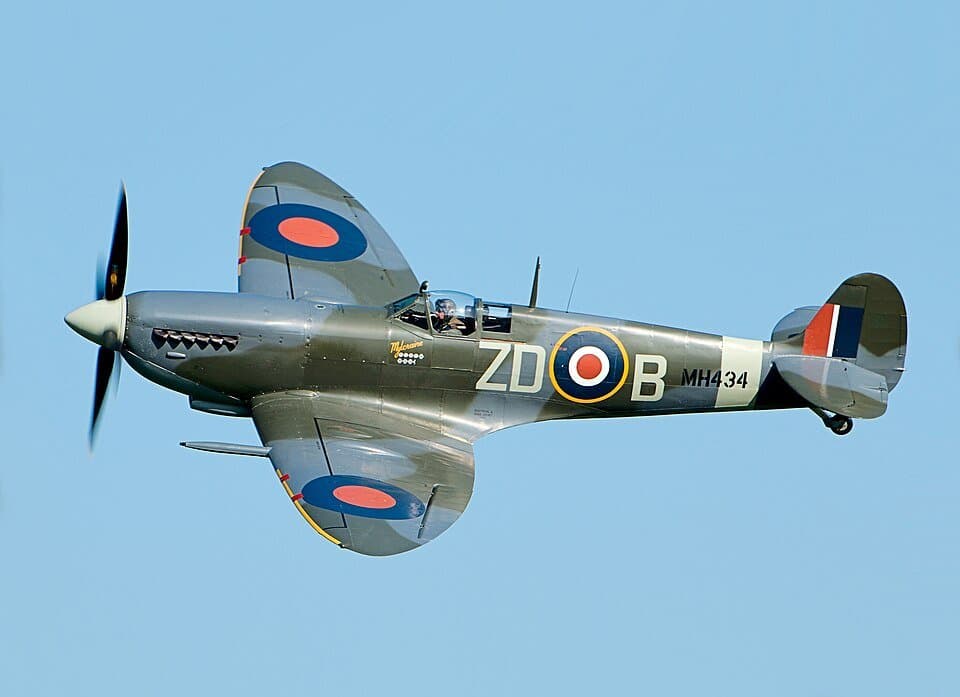
Combat aircraftIn service
Fighter / Interceptor aircraft
Supermarine Spitfire is a fighter / Interceptor aircraft originating in United Kingdom. It was built by Supermarine. Reported operators include Royal Air Force Royal Canadian Air Force Free French Air Force United States Army Air Forces.
 United Kingdom
Fighter / Interceptor aircraft
United Kingdom
Supermarine
R. J. Mitchell
Royal Air Force Royal Canadian Air Force Free French Air Force United States Army Air Forces
More than 20,351
1938–1948
4 August 1938
5 March 1936
Supermarine Spitfire (Griffon-powered variants) Supermarine Spitfire (early Merlin-powered variants) Supermarine Spitfire (late Merlin-powered variants) Supermarine Seafire
Supermarine Spiteful
1
29 ft 11 in (9.12 m)
36 ft 10 in (11.23 m)
11 ft 5 in (3.48 m)
242.1 sq ft (22.49 m 2 )
root: NACA 2213 ; tip: NACA 2209.4
5,065 lb (2,297 kg)
6,622 lb (3,004 kg)
6,700 lb (3,039 kg)
1 × Rolls-Royce Merlin 45 V-12 liquid-cooled piston engine, 1,470 hp (1,100 kW)
3-bladed Rotol constant-speed propeller
370 mph (600 km/h, 320 kn)
479 mi (771 km, 416 nmi)
248 mi (399 km, 216 nmi)
1,100 mi (1,800 km, 960 nmi) with fuel tank
36,500 ft (11,100 m)
2,600 ft/min (13 m/s)
27.35 lb/sq ft (133.5 kg/m 2 )
0.22 hp/lb (0.36 kW/kg)
A wing 8 × .303 in Browning Mk II* machine guns (350 rounds per gun) B wing 2 × 20 mm Hispano Mk II (60 rounds per gun) 4 × .303 in Browning Mk II* machine guns (350 rounds per gun) C wing 4 × 20 mm Hispano Mk II cannon (120 rounds per gun) C wing (Alt.) 2 × 20 mm Hispano Mk II (120 rounds per gun) 4 × .303 in Browning Mk II* machine guns (350 rounds per gun) E wing 2 × 20 mm Hispano Mk II cannon (120 rounds per gun) 2 × .50 in M2 Browning machine guns (250 rounds per gun)
2 RP-3 rockets (1 under each wing)
Australia
Belgium
Burma
Canada
Czechoslovakia
Denmark
Egypt
France
Free France
Greece
Hong Kong
India
Indian Empire
Ireland
Israel
Kingdom of Italy
Italy (Italian Republic)
Netherlands
New Zealand
Norway
Pakistan
Poland
Portugal
Southern Rhodesia
South Africa
Soviet Union
Sweden
Syria
Thailand
Turkey
United Kingdom
United States
Yugoslavia
The Supermarine Spitfire is a British single-seat fighter aircraft that was used by the Royal Air Force and other Allied countries before, during, and after World War II .
Smith oversaw the Spitfire's development through many variants , from the Mk 1 to the Rolls-Royce Griffon-engined Mk 24, using several wing configurations and guns. The original airframe was designed to be powered by a Rolls-Royce Merlin engine producing 1,030 hp (768 kW). It was strong enough and adaptable enough to use increasingly powerful Merlins, and in later marks, Rolls-Royce Griffon engines producing up to 2,340 hp (1,745 kW). As a result, the Spitfire's performance and capabilities improved over the course of its service life.
In 1931, the Air Ministry released specification F7/30 , calling for a modern fighter capable of a flying speed of 250 mph (400 km/h) to replace the Gloster Gauntlet biplane. R. J. Mitchell designed the Supermarine Type 224 to fill this role in competition with the Blackburn F.3 and Westland F.7/30 and privately funded designs from Gloster. The 224 was an open-cockpit monoplane with bulky gull wings and a large, fixed, spatted undercarriage powered by the 600-horsepower (450 kW), evaporatively cooled Rolls-Royce Goshawk engine. It made its first flight in February 1934. Of the seven designs tendered to F7/30, the Gloster Gladiator biplane was accepted for service.
The Type 224 was a big disappointment to Mitchell and his design team, who immediately embarked on a series of "cleaned-up" designs, using their experience with the Schneider Trophy seaplanes as a starting point. This led to the Type 300, with retractable undercarriage and a wingspan reduced by 6 ft (1.8 m). This design was submitted to the Air Ministry in July 1934, but was not accepted. It then went through a series of changes, including the incorporation of an enclosed cockpit, oxygen-breathing apparatus, smaller and thinner wings, and the newly developed, more powerful Rolls-Royce PV XII V-12 engine, which was later named the "Merlin". In November 1934, Mitchell, with the backing of Supermarine's owner Vickers-Armstrong , started detailed design work on this refined version of the Type 300.
On 1 December 1934, the Air Ministry issued contract AM 361140/34, providing £10,000 for the construction of Mitchell's improved Type 300 design. In April 1935 Ralph Sorley spoke to Mitchell about the new specification F10/35 which called for armament of at least six and preferably eight guns while at the same time removing bomb carry requirement and reducing fuel capacity. Mitchell foresaw no problem adding the guns and welcomed the reduction which would reduce weight. A specification for an eight-gun fighter, F5/34 had come from a recommendation by Squadron Leader Ralph Sorley of the Operational Requirements section at the Air Ministry. In the redesign the change was made from Vickers machine guns to .303 in (7.7 mm) Brownings ), and the fuel tankage dropped to 75 gallons from 94.
On 5 March 1936, the prototype ( K5054 ) , fitted with a fine-pitch propeller to give more power for take-off, took off on its first flight from Eastleigh Aerodrome . At the controls was Captain Joseph "Mutt" Summers , chief test pilot for Vickers, who is quoted as having said, "don't touch anything" on landing. This eight-minute flight came four months after the maiden flight of the contemporary Hurricane.
The rudder was oversensitive, and the top speed was just 330 mph (528 km/h), little faster than Sydney Camm 's new Merlin-powered Hurricane.
A new and better-shaped, two-bladed, wooden propeller allowed the Spitfire to reach 348 mph (557 km/h) in level flight in mid-May, when Summers flew K5054 to RAF Martlesham Heath and handed the aircraft over to Squadron Leader Anderson of the Aeroplane & Armament Experimental Establishment (A&AEE).
In spite of promises that the factory would be producing 60 per week starting in April, by May 1940, Castle Bromwich had not yet built its first Spitfire. On 17 May, Minister of Aircraft Production Lord Beaverbrook telephoned Lord Nuffield and manoeuvred him into handing over control of the Castle Bromwich plant to his ministry. Beaverbrook immediately sent in experienced management staff and workers from Supermarine, and gave control of the factory to Vickers-Armstrong's. Although resolving the problems took time, in June 1940, 10 Mk IIs were built; 23 rolled out in July, 37 in August, and 56 in September. By the time production ended at Castle Bromwich in June 1945, a total of 12,129 Spitfires, comprising 921 Mk IIs, 4,489 Mk Vs, 5,665 Mk IXs, and 1,054 Mk XVIs had been built.
During the Battle of Britain, the Luftwaffe made concerted efforts to destroy the main manufacturing plants at Woolston and Itchen , near Southampton. The first bombing raid, which missed the factories, came on 23 August 1940. Over the next month, other raids were mounted, until, on 26 September 1940, both factories were destroyed, with 92 people killed and a large number injured. Most of the casualties were experienced aircraft-production workers.
Henshaw wrote that he would climb at full throttle at 2,850 rpm to the rated altitude, then dive at full power and 3,000 rpm, and trim the plane to fly by itself at 460 mph (740 km/h).
A production test usually consisted of an initial circuit of under 10 minutes, and a main flight of 20 to 30 minutes.
The wing section used was from the NACA 2200 series , which had been adapted to create a thickness-to-chord ratio of 13% at the root, reducing to 9.4% at the tip. A dihedral of 6° was adopted to give increased lateral stability.
The trailing edge of the wing twisted slightly upward along its span, the angle of incidence decreasing from +2° at its root to -½° at its tip.
The Spitfire had detachable wing tips which were secured by two mounting points at the end of each main wing assembly. When the Spitfire took on a role as a high-altitude fighter (Marks VI and VII and some early Mk VIIIs), the standard wing tips were replaced by extended, "pointed" tips which increased the wingspan from 36 ft 10 in (11.23 m) to 40 ft 2 in (12.24 m). The other wing-tip variation, used by several Spitfire variants, was the "clipped" wing; the standard wing tips were replaced by wooden fairings which reduced the span by 3 ft 6 in (1.07 m). The wing tips used spruce formers for most of the internal structure with a light alloy skin attached using brass screws.
The light alloy split flaps at the trailing edge of the wing were also pneumatically operated via a finger lever on the instrument panel. Only two positions were available; fully up or fully down (85°). Flaps were normally lowered only during the final approach and for landing, and the pilot was to retract them before taxiing.
As the Spitfire gained more power and was able to manoeuvre at higher speeds, the possibility that pilots would encounter aileron reversal increased, and the Supermarine design team set about redesigning the wings to counter this. The original wing design had a theoretical aileron reversal speed of 580 mph (500 kn; 930 km/h), which was somewhat lower than that of some contemporary fighters. The Royal Aircraft Establishment noted that, at 400 mph (350 kn; 640 km/h) indicated airspeed , roughly 65% of aileron effectiveness was lost due to wing twist.
The new wing of the Spitfire F Mk 21 and its successors was designed to help alleviate this problem. Its stiffness was increased by 47%, and a new aileron design using piano hinges and geared trim tabs meant the theoretical aileron reversal speed was increased to 825 mph (717 kn; 1,328 km/h). Alongside the redesigned wing, Supermarine also experimented with the original wing, raising the leading edge by 1 inch (25 mm), with the hope of improving pilot view and reducing drag. This wing was tested on a modified F Mk 21, also called the F Mk 23, (sometimes referred to as "Valiant" rather than "Spitfire"). The increase in performance was minimal and this experiment was abandoned.
Supermarine developed a new laminar-flow wing based on new aerofoil profiles developed by the National Advisory Committee for Aeronautics in the United States, with the objective of reducing drag and improving performance. These laminar-flow airfoils were the Supermarine 371-I used at the root and the 371-II used at the tip. Supermarine estimated that the new wing could give an increase in speed of 55 mph (48 kn; 89 km/h) over the Spitfire Mk 21. The new wing was initially fitted to a Spitfire Mk XIV. Later, a new fuselage was designed, with the new fighter becoming the Supermarine Spiteful .
Even if the eight Brownings worked perfectly, pilots soon discovered that they were not sufficient to destroy larger aircraft. Combat reports showed that an average of 4,500 rounds were needed to shoot down an enemy aircraft. The main cause of this was the way the guns were mounted in the wing, allowing a dispersion of 1.1 metres at only 100 metres range. Perfectly aimed fire just missed the target because of this. In November 1938, tests against armoured and unarmoured targets had already indicated that the introduction of a weapon with a calibre of at least 20 mm was urgently needed. A variant on the Spitfire design with four 20 mm Oerlikon cannon had been tendered to specification F37/35, but the order for prototypes had gone to the Westland Whirlwind in January 1939.
In June 1939, a Spitfire was fitted with a drum-fed Hispano in each wing, an installation that required large blisters on the wing to cover the 60-round drum, reducing speed by 8 mph (7.0 kn; 13 km/h). The cannon suffered frequent stoppages, mostly because the guns were mounted on their sides to fit as much of the magazine as possible within the wing. In January 1940, P/O George Proudman flew this prototype in combat, but the starboard gun stopped after firing a single round, while the port gun fired 30 rounds before seizing.
In the Mediterranean, the Spitfire blunted the heavy attacks on Malta by the Regia Aeronautica and Luftwaffe, and from early 1943, helped pave the way for the Allied invasions of Sicily and Italy. On 7 March 1942, 15 Mk Vs carrying 90 imp gal (410 L; 110 US gal) fuel tanks under their bellies took off from HMS Eagle off the coast of Algeria on a 600-mile (970 km) flight to Malta. Those Spitfire Vs were the first to see service outside Britain. The Spitfire served on the Eastern Front with the Soviet Air Force (VVS) . The first deliveries of the Spitfire Mk VB variant took place at the start of 1943, with the first batch of 35 aircraft delivered via sea to the city of Basra , Iraq. A total of 143 aircraft and 50 furnished hulls (to be used for spare parts) followed by March of the same year. Though some aircraft were used for front line duty in 1943, most of them saw service with the Protivo-Vozdushnaya Oborona (English: "Anti-air Defence Branch").
Tobin, reached 606 mph (527 kn; 975 km/h) (Mach 0.891) in a 45° dive.
Martindale blacked out under the 11 g loading, but when he resumed consciousness, he found the aircraft at about 40,000 feet with its (originally straight) wings now slightly swept back.
Martindale successfully glided the Spitfire 20 mi (32 km) back to the airfield and landed safely.
RAE Bedford (RAE) modified a Spitfire for high-speed testing of the stabilator (then known as the "flying tail") of the Miles M.52 supersonic research aircraft. RAE test pilot Eric Brown stated that he tested this successfully during October and November 1944, attaining Mach 0.86 in a dive.
On 5 February 1952, a Spitfire 19 of 81 Squadron based at Kai Tak in Hong Kong reached probably the highest altitude ever achieved by a Spitfire. The pilot, Flight Lieutenant Edward "Ted" Powles , was on a routine flight to survey outside air temperature and report on other meteorological conditions at various altitudes in preparation for a proposed new air service through the area. He climbed to 50,000 ft (15,000 m) indicated altitude, with a true altitude of 51,550 ft (15,710 m). The cabin pressure fell below a safe level, and in trying to reduce altitude, he entered an uncontrollable dive which shook the aircraft violently. He eventually regained control somewhere below 3,000 ft (900 m) and landed safely with no discernible damage to his aircraft. Evaluation of the recorded flight data suggested he achieved a speed of 690 mph (600 kn; 1,110 km/h), (Mach 0.96) in the dive, which would have been the highest speed ever reached by a propeller-driven aircraft if the instruments had been considered more reliable.
Different wings, featuring a variety of weapons, were fitted to most marks; the A wing used eight .303 in (7.7 mm) machine guns, the B wing had four .303 in (7.7 mm) machine guns and two 20 mm (.79 in) Hispano cannons , and the C, or universal, wing could mount either four 20 mm (.79 in) cannons or two 20 mm (.79 in) and four .303 in (7.7 mm) machine guns.
Another armament variation was the E wing which housed two 20 mm (.79 in) cannons and two .50 in (12.7 mm) Browning machine guns .
The first Rolls-Royce Griffon-engined Mk XII flew in August 1942, and first flew operationally with 41 Squadron in April 1943. This mark could nudge 400 mph (350 kn; 640 km/h) in level flight and climb to an altitude of 33,000 ft (10,000 m) in under nine minutes.
In late 1962, Air Marshal Sir John Nicholls instigated a trial when he flew Spitfire PM631 , a PR Mk 19 in the custody of the Battle of Britain Memorial Flight , against an English Electric Lightning F 3 (a supersonic jet-engined interceptor) in mock combat at RAF Binbrook .
At the end of the trials, RAF pilots found that Firestreak infra-red guided missiles had trouble acquiring the Spitfire due to a low exhaust temperature, and decided that the twin ADEN 30 mm (1.2 in) cannons were the only weapons suited to the task, which was complicated by the tight turning circle of the Spitfire, and the Lightning's proclivity for over-running the Spitfire.
Length: 29 ft 11 in (9.12 m)
Wingspan: 36 ft 10 in (11.23 m)
Height: 11 ft 5 in (3.48 m)
Wing area: 242.1 sq ft (22.49 m 2 )
Empty weight: 5,065 lb (2,297 kg)
Gross weight: 6,622 lb (3,004 kg)
Max takeoff weight: 6,700 lb (3,039 kg)
Powerplant: 1 × Rolls-Royce Merlin 45 V-12 liquid-cooled piston engine, 1,470 hp (1,100 kW)
Maximum speed: 370 mph (600 km/h, 320 kn)
Range: 479 mi (771 km, 416 nmi)
Combat range: 248 mi (399 km, 216 nmi)
Ferry range: 1,100 mi (1,800 km, 960 nmi) with fuel tank
Service ceiling: 36,500 ft (11,100 m)
Rate of climb: 2,600 ft/min (13 m/s)
Guns: A wing 8 × .303 in Browning Mk II* machine guns (350 rounds per gun) B wing 2 × 20 mm Hispano Mk II (60 rounds per gun) 4 × .303 in Browning Mk II* machine guns (350 rounds per gun) C wing 4 × 20 mm Hispano Mk II cannon (120 rounds per gun) C wing (Alt.) 2 × 20 mm Hispano Mk II (120 rounds per gun) 4 × .303 in Browning Mk II* machine guns (350 rounds per gun) E wing 2 × 20 mm Hispano Mk II cannon (120 rounds per gun) 2 × .50 in M2 Browning machine guns (250 rounds per gun)
Reference text from Wikipedia contributors, used under CC BY-SA 4.0.
True scale
Sourced dimensions beside a 1.75 m human reference.
Points represent sourced observations, including revisions. Revisions on the same effective date are not separate inventory events. Ranges appear in the table and are not plotted as exact points.
| Observation / report period | Value | Source | Claim state |
|---|---|---|---|
| 28 Sept 2026 | 9.12 m | Wikipedia contributors | superseded |
| 28 Sept 2026 | 9.12 m | Wikipedia contributors | approved |
| 28 Sept 2026 | 9.12 m | Wikipedia contributors | superseded |
Supermarine Spitfire equipment records. Variants, orders and quantities are shown as reported in each inventory source; coverage is incomplete.
 Australia
 Belgium
 Canada
 Denmark
 Egypt
Egypt France
 Greece
 India
India Ireland
 Israel
 Italy
Italy Myanmar
 Netherlands
 New Zealand
 Norway
 Pakistan
 Poland
 Portugal
 South Africa
 Sweden
 Syria
Syria Thailand
 Türkiye United Kingdom
Reported count for Supermarine Spitfire. Service scope: Royal Air Force; does not replace a national total. 1 distinct count cell(s) from the same source list; shared rowspan cells counted once. Retired, wholly reserve and on-order rows are excluded; the reported count retains any explicitly mixed stock scope in the quoted row. Count column(s): total: 6. Origin: United Kingdom. The listed variants/roles are the scope, not an immediately deployable count. The components do not establish one inventory census date; the stored date is the retrieved source snapshot.
 United States
Royal Air Force Royal Canadian Air Force Free French Air Force United States Army Air Forces
Equipment reference ↗Reported count for Supermarine Spitfire. Service scope: Royal Air Force; does not replace a national total. 1 distinct quantity component(s) from the same source list; shared rowspan cells counted once. Explicit source inventory scope: active; no other stock status or total inferred. Count column(s): in service: 5. Origin: United Kingdom. The listed variants/roles are the scope, not an immediately deployable count. The components do not establish one inventory census date; the stored date is the retrieved source snapshot.