





Preparing your view.

At a glance
Measured figures
Length
Single source15.96 m (52 ft 4 in)[source]
Su-30MKM · Length
Single sourceConfiguration
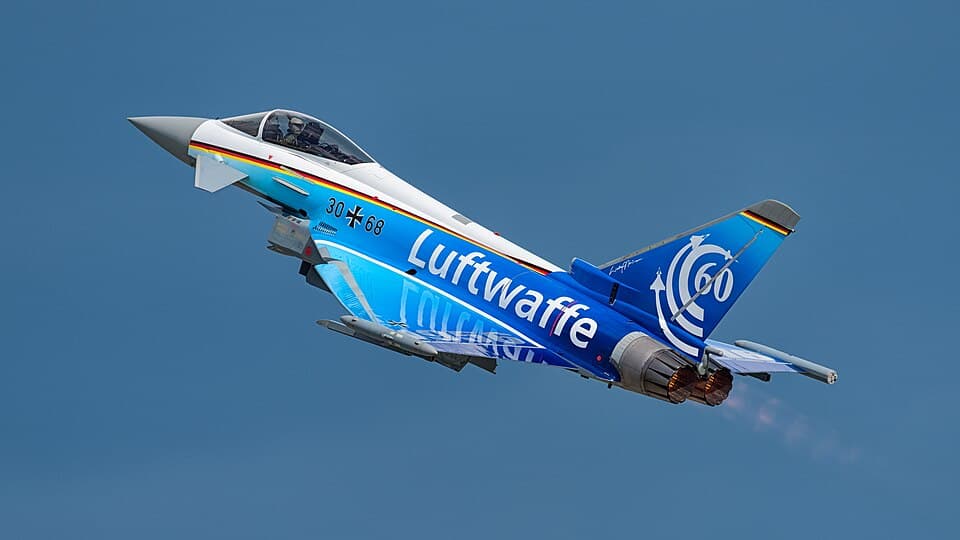
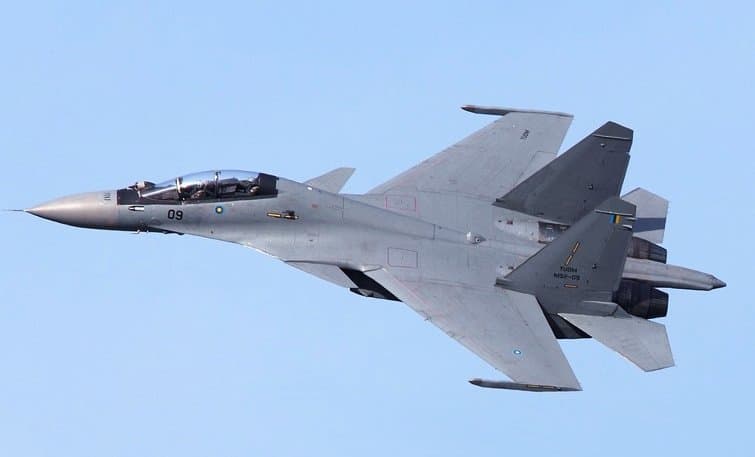
| Specification | Eurofighter Typhoon | Sukhoi Su-30MKM |
|---|---|---|
| Type | Air superiority fighter with multirole capabilities[source] | Air superiority fighter , Multirole fighter[source] |
| National origin | Multinational[source] | Russia[source] |
| Manufacturer | Eurofighter GmbH[source] | Yakovlev Corporation[source] |
| Status | In service[source] | In service |
21.935 m (72 ft 0 in)[source]
Empty; Empty weight
Single sourceGross; Gross weight
Single sourceMaximum take-off; Max takeoff weight
Single source11,000 kg (24,251 lb)[source]
16,000 kg (35,274 lb)[source]
23,500 kg (51,809 lb)[source]
Empty; Su-30MKM · Empty weight
Single sourceGross; Su-30MKM · typical mission weight
Single sourceMaximum; at 11 km altitude — or Mach 2.35
Single sourceMaximum; at sea level — or Mach 1.25 Supercruise: Mach 1.5
Single source2,495 km/h (1,550 mph, 1,347 kn) at 11 km altitude — or Mach 2.35 1,530 km/h (950 mph; 830 kn) at sea level — or Mach 1.25 Supercruise: Mach 1.5[source]
Maximum; Su-30MKM · / M 2.0 at high altitude
Single source2,120 km/h (1,320 mph, 1,140 kn) / M 2.0 at high altitude[source]
ground attack, hi-lo-hi
Single sourceground attack, lo-lo-lo
Single source1,389 km (863 mi, 750 nmi) ground attack, hi-lo-hi 601 km (325 nmi; 373 mi) ground attack, lo-lo-lo[source]
2 × Eurojet EJ200 afterburning turbofan engines thrust each dry
Single sourcewith afterburner
Single source2 × Eurojet EJ200 afterburning turbofan engines, 60 kN (13,500 lbf) thrust each dry, 90 kN (20,200 lbf) with afterburner[source]
Su-30MKM · 2 × Lyulka AL-31FP afterburning turbofan engines with afterburner
Single source2 × Lyulka AL-31FP afterburning turbofan engines, 123 kN (28,000 lbf) with afterburner[source]
air-defence loiter at 1,389 km (750 nmi; 863 mi)
Single sourcecombat air patrol (air defence) at 185 km (100 nmi; 115 mi)
Single source3 hours combat air patrol (air defence) at 185 km (100 nmi; 115 mi) 10 minutes air-defence loiter at 1,389 km (750 nmi; 863 mi)[source]
Bars compare reported quantities only. A larger figure does not make a system better; configurations and test conditions differ.
| Primary users | Royal Air Force German Air Force Italian Air Force Spanish Air and Space Force See Operators below for others[source] | — |
|---|
| Number built | 611 + 7 prototypes as of June 2026[source] | 18[source] |
|---|
| Manufactured | 1994–present[source] | — |
|---|
| Introduction date | 4 August 2003[source] | 2007[source] |
|---|
| First flight | 27 March 1994[source] | August 2003 ( 2003-08 )[source] |
|---|
| Developed from | British Aerospace EAP[source] | Sukhoi Su-30 Sukhoi Su-30MKI[source] |
|---|
| Fuel capacity | Internal 4,500 kg (9,900 lb) (approx), including external stores 7,600 kg (16,800 lb).[source] | — |
|---|
| Guns | 1 × 27 mm Mauser BK-27 revolver cannon with 150 rounds[source] | 1 × 30 mm Gryazev-Shipunov GSh-30-1 autocannon[source] |
|---|
| Hardpoints | Total of 13: 8 × under-wing; and 5 × under-fuselage pylon stations; holding in excess of 9,000 kg (19,800 lb) of payload Typical multi-role configuration for a Tranche 2-P1E would be 4 × AMRAAM, 2×ASRAAM/IRIS-T, 4 × EGBU-16/Paveway-IV, 2 × 1000-litre supersonic fuel tanks and a targeting pod.[source] | 12 hardpoints (2 × wingtip AAM rails, 6 × under-wing pylons, 2 × pylon under-engine nacelles , and 2 × pylons in tandem in the "arch" between the engines. It can be increased to 14 using multiple ejector racks.) with a capacity of up to 8,130 kg (17,920 lb), with provisions to carry combinations of:[source] |
|---|
| Supercruise | Mach 1.5[source] | — |
|---|
| Max flight altitude | 20,000 m (65,000 ft)[source] | — |
|---|
| g limits | + 9 / - 3[source] | + 9g[source] |
|---|
| Wing loading | 312 kg/m 2 (64 lb/sq ft)[source] | 401 kg/m 2 (82 lb/sq ft)[source] |
|---|
| Thrust/weight | 1.15 (interceptor configuration)[source] | 0.96[source] |
|---|
| Brakes-off to Take-off acceleration | <8 s[source] | — |
|---|
| Brakes-off to supersonic acceleration | <30 s[source] | — |
|---|
| Brakes-off to Mach 1.6 at 11,000 m (36,000 ft) | <150 s[source] | — |
|---|
| Rockets | LAU-131 rocket pod (each with 7 × Hydra 70 APKWS rockets)[source] | 4 × B-8 rocket pods for 80 × S-8 rockets 4 × B-13 rocket pods for 20 × S-13 rockets[source] |
|---|
| Missiles | Air-to-air missiles : AIM-120 AMRAAM MBDA Meteor IRIS-T AIM-132 ASRAAM AIM-9 Sidewinder Advanced Precision Kill Weapon System Air-to-surface missiles : Storm Shadow/Scalp EG Brimstone AGM-88 HARM Taurus KEPD 350 SPEAR 3 (in progress) Anti-ship missiles : Marte ER (up to 6 Marte ER anti-ship missiles at 6 hardpoints)[source] | Air-to-air missiles : 10 × R-77 6 × R-27ER/ET 2 × R-27R/T 6 × R-73 Air-to-surface missiles : 3 × Kh-59ME 6 × Kh-29T/L Anti-ship missiles : 3 × Kh-59MK 4 × Kh-31A Anti-radiation missiles : 6 × Kh-31P[source] |
|---|
| Air-to-air missiles | AIM-120 AMRAAM MBDA Meteor IRIS-T AIM-132 ASRAAM AIM-9 Sidewinder Advanced Precision Kill Weapon System[source] | — |
|---|
| Air-to-surface missiles | Storm Shadow/Scalp EG Brimstone AGM-88 HARM Taurus KEPD 350 SPEAR 3 (in progress)[source] | — |
|---|
| Anti-ship missiles | Marte ER (up to 6 Marte ER anti-ship missiles at 6 hardpoints)[source] | — |
|---|
| Bombs | Paveway II/III/Enhanced Paveway series of laser-guided bombs (LGBs) 500-lb Paveway IV Small Diameter Bomb (planned for P2E) Joint Direct Attack Munition (JDAM), work started in 2018 HOPE/HOSBO , in the future Spice 250[source] | 8 × KAB-500L laser-guided bombs 3 × KAB-1500L laser-guided bombs 8 × FAB-500T bombs 28 × OFAB-250-270 bombs 32 × OFAB-100-120 bombs 4 × GBU-12 Paveway II laser-guided bomb[source] |
|---|
| Others | Up to 3 × 1000L drop tanks for ferry flight or extended range/loitering time Conformal fuel tanks on Tranche 3 or later[source] | — |
|---|
| Captor-M | Solid-state, mechanically scanned array radar[source] | — |
|---|
| European Common Radar System (ECRS) Mk0 | Active electronically scanned array (AESA) radar developed by the original four Eurofighter consortium members. Commonly referred to as the Captor-E. Fitted to Qatari and Kuwaiti Eurofighters.[source] | — |
|---|
| ECRS Mk1 | Upgraded Mk0, manufactured by Hendsoldt and Airbus. To be fitted to existing German and Spanish Eurofighters.[source] | — |
|---|
| ECRS Mk2 | New (AESA) radar with additional electronic warfare capabilities. Manufactured in Edinburgh by Leonardo UK. To be fitted to existing Tranche 3 UK Eurofighters.[source] | — |
|---|
| Country of origin | United Kingdom / Germany / Italy / Spain[source] | — |
|---|
| Designer | — | Sukhoi[source] |
|---|
| Built by | — | Irkut Corporation[source] |
|---|
| Primary user | — | Royal Malaysian Air Force[source] |
|---|
| Role | — | twin-engine supermaneuverable fighter of the Royal Malaysian Air Force (RMAF)[source] |
|---|
| Source measurement | — | The Sukhoi Su-30MKM ( NATO reporting name : Flanker-H ) is a twin-engine supermaneuverable fighter of the Royal Malaysian Air Force (RMAF). It is a variant of the Su-30 series fighters, with many significant improvements over the original Su-30MK export version. The Su-30MKM was developed by the Sukhoi Design Bureau and is based on the Su-30MKI of the Indian Air Force . Both aircraft have common airframe , thrust vectoring engines and a digital fly-by-wire system, however the MKM version differs from the MKI mainly in the composition of the onboard avionics . It can carry up to 8,000 kg (17,637 lb) payload over a 1,296 km (805 mi; 700 nmi) un-refueled combat radius.[source]Sukhoi Su-30MKM · Lead; only the objects and conditions stated in this passage According to Malaysian defense Minister Mohamad Sabu, Malaysia has grounded 14 of 18 Su-30MKM due to engine problems and unavailability of spare parts in 2018. To overcome this problem and increase the readiness of the Su-30MKM fleets, Malaysia has approved the budget worth RM2.2 billion for the Su-30MKM to be upgraded locally by Aerospace Technology Systems Corporation . The first upgraded aircraft was received in 2019 in LIMA 2019 exhibition. The program was completed in January 2025.[source]Sukhoi Su-30MKM · Development; only the objects and conditions stated in this passage The Su-30MKM was developed by the Sukhoi Design Bureau and is based on the Su-30MKI . The MKM version differs from the MKI mainly in the composition of its onboard avionics . Thales Group supplies the Head-up display (HUD), navigational forward-looking IR system NAVFLIR and the Damocles targeting pod . The aircraft carries missile approach warning sensor (MAWS) and laser warning sensor (LWS) manufactured by Avitronics (South Africa). It can carry up to 8,000 kg/ 17,650 lb of weapons and payloads over 700 nmi unrefueled combat radius.[source]Sukhoi Su-30MKM · Design; only the objects and conditions stated in this passage The Su-30MKM can legitimately claim super-maneuverability via digital fly-by-wire, canards , and two Saturn AL-31 FP engines with thrust vectoring producing 27,500 lb thrust each with afterburners. This gives them an edge in close-in dogfights, allowing the pilot to rapidly point the plane at potential targets to draw them within the AA-11/ R-73 Archer’s wide infrared seeker cone, then launch and quickly change energy state and direction.[source]Sukhoi Su-30MKM · Design; only the objects and conditions stated in this passage The electronic warfare (EW) systems, phased array radars , and optical-location systems with laser rangefinder were all produced by leading Russian manufacturers. At that time, officers from the RMAF formed a Su-30MKM Project Team which was based in Moscow; the team actively participated in the integration of all the avionics systems. The aircraft is capable of conducting SEAD missions when equipped with two KNIRTI SAP-518 jamming pods and Kh-31P anti-radiation missiles. The KNIRTI SAP-518 covers NATO surface-to-air and air-to-air threats in the G-J bands. It is equipped with NIIP N011M phased array radar for long range aerial combat which can track up to 15 targets and engage four targets simultaneously. It can also be equipped with a Thales Damocles Laser Designation surveillance and targeting Pod for precision ground attack. It has a rear-facing radar, Thales HUD, and French NAVFLIR (Navigation Forward Looking Infra-red). Missile Approach Warning System (MAWS) and laser warning sensor (LWS) are supplied by Avitronics of South Africa.[source]Sukhoi Su-30MKM · Design; only the objects and conditions stated in this passage Length: 21.935 m (72 ft 0 in)[source]Sukhoi Su-30MKM · Specifications (Su-30MKM); only the objects and conditions stated in this passage Wingspan: 14.7 m (48 ft 3 in)[source]Sukhoi Su-30MKM · Specifications (Su-30MKM); only the objects and conditions stated in this passage Height: 6.36 m (20 ft 10 in)[source]Sukhoi Su-30MKM · Specifications (Su-30MKM); only the objects and conditions stated in this passage Wing area: 62 m 2 (670 sq ft)[source]Sukhoi Su-30MKM · Specifications (Su-30MKM); only the objects and conditions stated in this passage Empty weight: 18,400 kg (40,565 lb)[source]Sukhoi Su-30MKM · Specifications (Su-30MKM); only the objects and conditions stated in this passage Gross weight: 26,090 kg (57,519 lb) typical mission weight[source]Sukhoi Su-30MKM · Specifications (Su-30MKM); only the objects and conditions stated in this passage Max takeoff weight: 38,800 kg (85,539 lb)[source]Sukhoi Su-30MKM · Specifications (Su-30MKM); only the objects and conditions stated in this passage Powerplant: 2 × Lyulka AL-31FP afterburning turbofan engines, 123 kN (28,000 lbf) with afterburner[source]Sukhoi Su-30MKM · Specifications (Su-30MKM); only the objects and conditions stated in this passage Maximum speed: 2,120 km/h (1,320 mph, 1,140 kn) / M 2.0 at high altitude[source]Sukhoi Su-30MKM · Specifications (Su-30MKM); only the objects and conditions stated in this passage 1,350 km/h (840 mph; 730 kn) / M1.09 at low altitude[source]Sukhoi Su-30MKM · Specifications (Su-30MKM); only the objects and conditions stated in this passage Range: 3,000 km (1,900 mi, 1,600 nmi) at high altitude[source]Sukhoi Su-30MKM · Specifications (Su-30MKM); only the objects and conditions stated in this passage 1,270 km (790 mi; 690 nmi) at low altitude[source]Sukhoi Su-30MKM · Specifications (Su-30MKM); only the objects and conditions stated in this passage Ferry range: 8,000 km (5,000 mi, 4,300 nmi) with two in-flight refuellings[source]Sukhoi Su-30MKM · Specifications (Su-30MKM); only the objects and conditions stated in this passage Service ceiling: 17,300 m (56,800 ft)[source]Sukhoi Su-30MKM · Specifications (Su-30MKM); only the objects and conditions stated in this passage g limits: + 9g[source]Sukhoi Su-30MKM · Specifications (Su-30MKM); only the objects and conditions stated in this passage Rate of climb: 300 m/s (59,000 ft/min) +[source]Sukhoi Su-30MKM · Specifications (Su-30MKM); only the objects and conditions stated in this passage Guns: 1 × 30 mm Gryazev-Shipunov GSh-30-1 autocannon[source]Sukhoi Su-30MKM · Specifications (Su-30MKM); only the objects and conditions stated in this passage Hardpoints: 12 hardpoints (2 × wingtip AAM rails, 6 × under-wing pylons, 2 × pylon under-engine nacelles , and 2 × pylons in tandem in the "arch" between the engines. It can be increased to 14 using multiple ejector racks.) with a capacity of up to 8,130 kg (17,920 lb), with provisions to carry combinations of: Rockets: 4 × B-8 rocket pods for 80 × S-8 rockets 4 × B-13 rocket pods for 20 × S-13 rockets Missiles: Air-to-air missiles : 10 × R-77 6 × R-27ER/ET 2 × R-27R/T 6 × R-73 Air-to-surface missiles : 3 × Kh-59ME 6 × Kh-29T/L Anti-ship missiles : 3 × Kh-59MK 4 × Kh-31A Anti-radiation missiles : 6 × Kh-31P Bombs: 8 × KAB-500L laser-guided bombs 3 × KAB-1500L laser-guided bombs 8 × FAB-500T bombs 28 × OFAB-250-270 bombs 32 × OFAB-100-120 bombs 4 × GBU-12 Paveway II laser-guided bomb[source]Sukhoi Su-30MKM · Specifications (Su-30MKM); only the objects and conditions stated in this passage |
|---|
Maximum take-off; Su-30MKM · Max takeoff weight
Single source