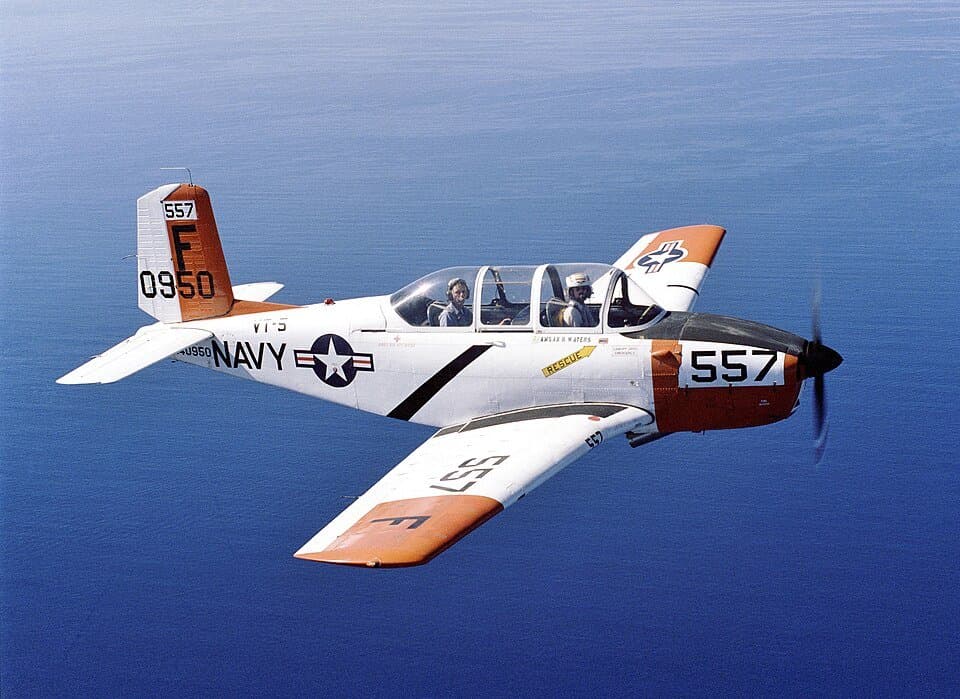

Credit
PHCS R. L. LAWSON · Public domain · Resized · Public domain · Source ↗ · Modified


Preparing your view.

At a glance
True scale
Side by side. From every angle. A human reference for perspective.
3.26 MB · Loads when you open it| Model | Length | Width / span | Height |
|---|---|---|---|
| Beechcraft T-34 Mentor | ≈ 8.75 m | ≈ 10.16 m (Wingspan) | ≈ 2.92 m |
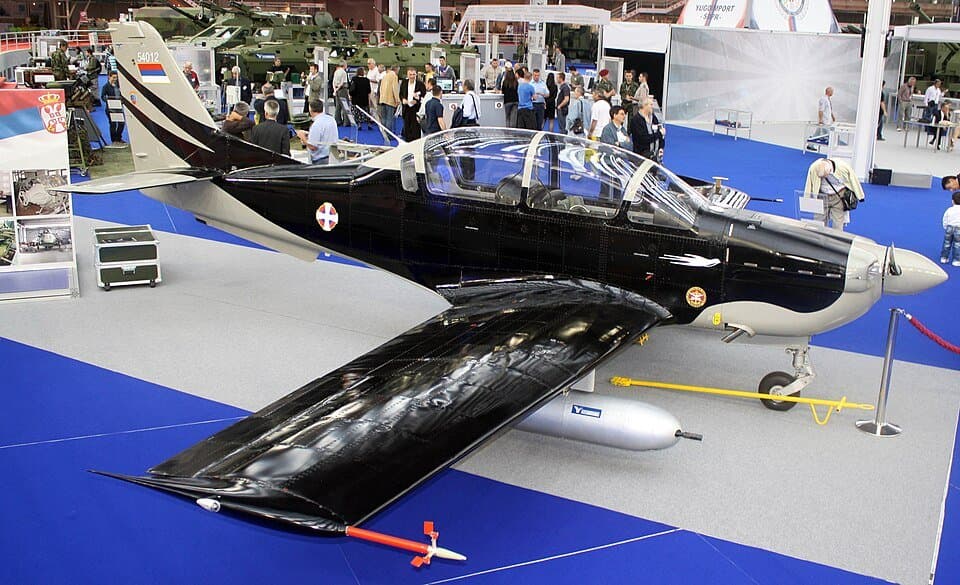
| Utva Lasta | ≈ 7.96 m | ≈ 9.7 m (Wingspan) | ≈ 3.12 m |
Scaled uniformly to the sourced length of 8.75 m. The shape was turned square to the axes; the height was fitted to the sourced 2.92 m; the width was fitted to the sourced 10.157 m wingspan. Not an official model or a measured survey.
ForceTally · All rights reserved
Scaled uniformly to the sourced length of 7.965 m. The shape was turned square to the axes; the width was fitted to the sourced 9.7 m wingspan. Not an official model or a measured survey.
ForceTally · All rights reserved
The human reference is a generic 1.75 m figure. Models describe external size, not combat performance.
Measured figures
T-34C · Length
Single source28 ft 8 + 1 ⁄ 2 in (8.750 m)[source]
Configuration
| Specification | Beechcraft T-34 Mentor | Utva Lasta |
|---|---|---|
| Type | Trainer aircraft[source] | Trainer aircraft[source] |
| National origin | United States[source] | — |
| Manufacturer | Beechcraft[source] | Utva Aviation Industry[source] |
| Primary users | United States Air Force United States Navy Japan Air Self-Defense Force Republic of China Air Force[source] | Serbian Air Force Iraqi Air Force[source] |
Lasta 95N · Length
7.965 m (26 ft 2 in)[source]
Empty; T-34C · Empty weight
Single sourceMaximum take-off; T-34C · Max takeoff weight
Single sourceMaximum take-off; T-34C · T-34C-1 weapons trainer
Single source2,960 lb (1,343 kg)[source]
4,300 lb (1,950 kg) (T-34C-1 weapons trainer 5,500 lb (2,500 kg))[source]
Empty; Lasta 95N · Empty weight
Single sourceGross; Lasta 95N · Gross weight
Single sourceCruise; T-34C · at 17,000 ft (5,200 m) (max cruise)
Single source214 kn (246 mph, 396 km/h) at 17,000 ft (5,200 m) (max cruise)[source]
T-34C · at 180 kn (210 mph; 330 km/h) and 20,000 ft (6,100 m)
Single source708 nmi (815 mi, 1,311 km) at 180 kn (210 mph; 330 km/h) and 20,000 ft (6,100 m)[source]
T-34C · 1 × Pratt & Whitney Canada PT6 A-25 turboprop , 550 shp (
Single source1 × Pratt & Whitney Canada PT6 A-25 turboprop , 550 shp (410 kW)[source]
Lasta 95N · 1 × Lycoming AEIO-580-B1A 6-cyl. air-cooled horizontally-opposed piston engine
Single source1 × Lycoming AEIO-580-B1A 6-cyl. air-cooled horizontally-opposed piston engine, 232 kW (311 hp)[source]
Bars compare reported quantities only. A larger figure does not make a system better; configurations and test conditions differ.
| Number built | 2,300+[source] | 37[source] |
|---|
| Manufactured | 1953–1959 1975–1990[source] | — |
|---|
| Introduction date | 1953[source] | 2010[source] |
|---|
| First flight | 2 December 1948[source] | Lasta 1 prototype: 2 September 1985 Lasta 95: 26 February 2009[source] |
|---|
| Developed from | Beechcraft Bonanza[source] | — |
|---|
| Developed into | Fuji LM-1 Nikko[source] | — |
|---|
| Fuel capacity | 130 US gal (110 imp gal; 490 L)[source] | — |
|---|
| Propellers | 3-bladed Hartzell constant-speed[source] | 2-bladed HARTZELL HC-C2YR-4CF/FC 8475-8 constant speed propeller, 1.98 m (6 ft 6 in) diameter[source] |
|---|
| Stall speed | 53 kn (61 mph, 98 km/h) (flaps down, power off)[source] | 95 km/h (59 mph, 51 kn)[source] |
|---|
| Never exceed speed | 280 kn (320 mph, 520 km/h)[source] | 425 km/h (264 mph, 229 kn)[source] |
|---|
| g limits | +6, -3[source] | +6 -3 g[source] |
|---|
| Hardpoints | 4 with a capacity of 600 lb (272 kg) inner, 300 lb (136 kg) outer, 1,200 lb (544 kg) total[source] | 2 with a capacity of 100 kg (220 lb) bombs, 7.62 mm (0.300 in) or 12.7 mm (0.500 in) calibre machine-gun pods or 57 mm (2.244 in) rocket pods (7 rockets each)[source] |
|---|
| Role | American propeller-driven, single-engined, military trainer aircraft derived[source] | — |
|---|
| Source measurement | Three initial design concepts were developed for the Model 45, including one with the Bonanza's signature V-tail , but the final design that emerged in 1948 incorporated conventional tail control surfaces for the benefit of the more conservative military (featuring a relatively large unswept vertical fin that would find its way onto the Travel Air twin-engine civil aircraft almost ten years later). The Bonanza's fuselage with four-passenger cabin was replaced with a narrower fuselage incorporating a two-seater tandem cockpit and bubble canopy , which provided greater visibility for the trainee pilot and flight instructor. Structurally, the Model 45 was much stronger than the Bonanza, being designed for +10 g and −4.5 g , while the Continental E-185 engine of 185 horsepower (hp) at takeoff (less than a third of the power of the T-6's engine) was the same as that fitted to contemporary Bonanzas.[source]Beechcraft T-34 Mentor · Design and development; only the objects and conditions stated in this passage The Model 73 Jet Mentor shared many components with the piston-engined aircraft; major visual differences were the redesigned cockpit which was moved forward in the fuselage and the air intakes for the jet engine in the wing roots , supplying air to a single 920 lbf (4.1 kN) Continental J69 jet engine in the rear fuselage.[source]Beechcraft T-34 Mentor · Design and development / Model 73 Jet Mentor; only the objects and conditions stated in this passage Equipped with hardpoints for training or light attack, able to carry 1,200 lb (540 kg) of weapons on four underwing pylons. The armament could include flares, incendiary bombs, rocket or gun pods and antitank missiles. Widely exported.[source]Beechcraft T-34 Mentor · Variants; only the objects and conditions stated in this passage Powered by a 920 lbf (4.09 kN) Continental J69-T-9 turbojet engine . The sole aircraft first flew on 18 December 1955.[source]Beechcraft T-34 Mentor · Variants; only the objects and conditions stated in this passage Argentine Naval Aviation – 15 T-34C-1 in 1978.[source]Beechcraft T-34 Mentor · Operators / Military operators; only the objects and conditions stated in this passage Colombian Air Force – Purchased 50 T-34s in 1954, with six more acquired in 1970 and 10 in 1977. The final T-34 was retired in December 2013.[source]Beechcraft T-34 Mentor · Operators / Military operators; only the objects and conditions stated in this passage Length: 28 ft 8 + 1 ⁄ 2 in (8.750 m)[source]Beechcraft T-34 Mentor · Specifications (T-34C); only the objects and conditions stated in this passage Wingspan: 33 ft 3 + 7 ⁄ 8 in (10.157 m)[source]Beechcraft T-34 Mentor · Specifications (T-34C); only the objects and conditions stated in this passage Height: 9 ft 7 in (2.92 m)[source]Beechcraft T-34 Mentor · Specifications (T-34C); only the objects and conditions stated in this passage Wing area: 179.6 sq ft (16.69 m 2 )[source]Beechcraft T-34 Mentor · Specifications (T-34C); only the objects and conditions stated in this passage Empty weight: 2,960 lb (1,343 kg)[source]Beechcraft T-34 Mentor · Specifications (T-34C); only the objects and conditions stated in this passage Max takeoff weight: 4,300 lb (1,950 kg) (T-34C-1 weapons trainer 5,500 lb (2,500 kg))[source]Beechcraft T-34 Mentor · Specifications (T-34C); only the objects and conditions stated in this passage Powerplant: 1 × Pratt & Whitney Canada PT6 A-25 turboprop , 550 shp (410 kW)[source]Beechcraft T-34 Mentor · Specifications (T-34C); only the objects and conditions stated in this passage Cruise speed: 214 kn (246 mph, 396 km/h) at 17,000 ft (5,200 m) (max cruise)[source]Beechcraft T-34 Mentor · Specifications (T-34C); only the objects and conditions stated in this passage Stall speed: 53 kn (61 mph, 98 km/h) (flaps down, power off)[source]Beechcraft T-34 Mentor · Specifications (T-34C); only the objects and conditions stated in this passage Never exceed speed : 280 kn (320 mph, 520 km/h)[source]Beechcraft T-34 Mentor · Specifications (T-34C); only the objects and conditions stated in this passage Range: 708 nmi (815 mi, 1,311 km) at 180 kn (210 mph; 330 km/h) and 20,000 ft (6,100 m)[source]Beechcraft T-34 Mentor · Specifications (T-34C); only the objects and conditions stated in this passage Service ceiling: 30,000 ft (9,100 m)[source]Beechcraft T-34 Mentor · Specifications (T-34C); only the objects and conditions stated in this passage Rate of climb: 1,480 ft/min (7.5 m/s)[source]Beechcraft T-34 Mentor · Specifications (T-34C); only the objects and conditions stated in this passage Hardpoints: 4 with a capacity of 600 lb (272 kg) inner, 300 lb (136 kg) outer, 1,200 lb (544 kg) total[source]Beechcraft T-34 Mentor · Specifications (T-34C); only the objects and conditions stated in this passage | — |
|---|
| Country of origin | United States[source] | Serbia[source] |
|---|
| Designer | — | Military Technical Institute[source] |
|---|
| Status | — | In service[source] |
|---|
| Aspect ratio | — | 6.3[source] |
|---|
| Reported operators | — |
|---|
Maximum take-off; Lasta 95N · unarmed
Single source