FORCETALLY
Loading the evidence…
Preparing your view.


Preparing your view.
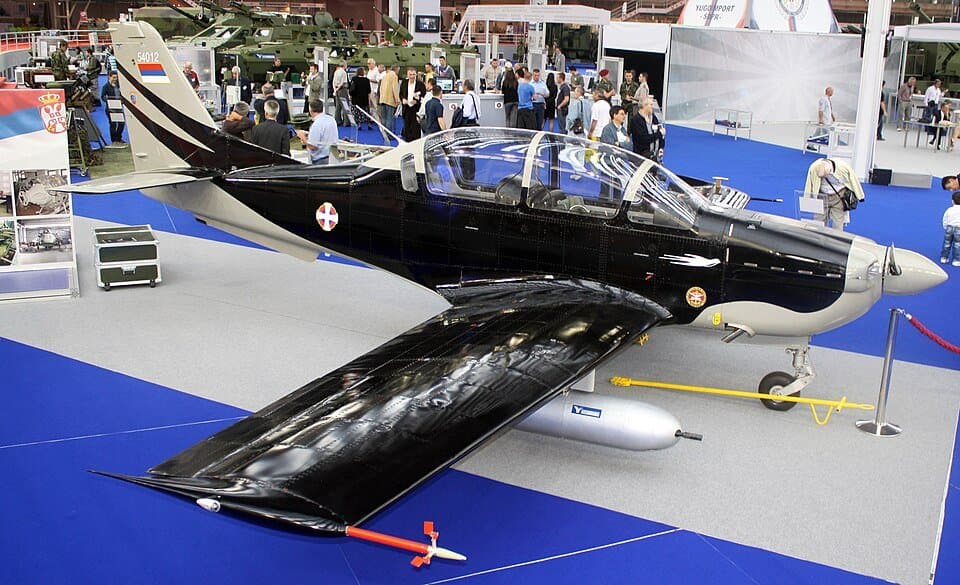
Trainer aircraftIn service
Trainer aircraft
Utva Lasta is a trainer aircraft. It was built by Utva Aviation Industry. Reported operators include Serbian Air Force Iraqi Air Force.
 Serbia
Technical data
True scale
Sourced dimensions beside a 1.75 m human reference.
Points represent sourced observations, including revisions. Revisions on the same effective date are not separate inventory events. Ranges appear in the table and are not plotted as exact points.
| Observation / report period | Value | Source | Claim state |
|---|---|---|---|
| 29 Sept 2026 | 7.965 m | Wikipedia contributors | superseded |
| 29 Sept 2026 | 7.965 m | Wikipedia contributors | superseded |
| 29 Sept 2026 | 7.965 m | Wikipedia contributors | approved |
| 29 Sept 2026 | 7.965 m | Wikipedia contributors | superseded |
Trainer aircraft
Utva Aviation Industry
Military Technical Institute
In service
Serbian Air Force Iraqi Air Force
37
2010
Lasta 1 prototype: 2 September 1985 Lasta 95: 26 February 2009
2
7.965 m (26 ft 2 in)
9.7 m (31 ft 10 in)
2.84 m (9 ft 4 in)
12.9 m 2 (139 sq ft)
6.3
888 kg (1,958 lb)
1,145 kg (2,524 lb)
1,210 kg (2,668 lb) unarmed
1 × Lycoming AEIO-580-B1A 6-cyl. air-cooled horizontally-opposed piston engine, 232 kW (311 hp)
2-bladed HARTZELL HC-C2YR-4CF/FC 8475-8 constant speed propeller, 1.98 m (6 ft 6 in) diameter
345 km/h (214 mph, 186 kn)
280 km/h (170 mph, 150 kn)
95 km/h (59 mph, 51 kn)
425 km/h (264 mph, 229 kn)
1,160 km (720 mi, 630 nmi)
1,160 km (720 mi, 630 nmi)
6,000 m (20,000 ft)
+6 -3 g
8.5 m/s (1,670 ft/min)
2 with a capacity of 100 kg (220 lb) bombs, 7.62 mm (0.300 in) or 12.7 mm (0.500 in) calibre machine-gun pods or 57 mm (2.244 in) rocket pods (7 rockets each)
Iraq
Serbia
The Utva Lasta 95 (from Serbian : утва , lit. ' shelduck ' , and ласта , lit. ' barn swallow ') is a Serbian light military trainer aircraft produced by Utva Aviation Industry , a subsidiary of Yugoimport SDPR . It is a tandem two-seater low-wing trainer with a metal airframe. The aircraft is capable of basic training functions including aerobatics, instrument and tactical flying, as well as basic training in use of weapons. The first prototype of Lasta 1 flew on 2 September 1985, while the first prototype of the current version, Lasta 3 , flew on 26 February 2009.
Reference text from Wikipedia contributors, used under CC BY-SA 4.0.
Utva Lasta equipment records. Variants, orders and quantities are shown as reported in each inventory source; coverage is incomplete.
 Iraq Serbia
Air Force and Air Defence exact named equipment holdings: Lasta 95. Active, operational-reserve and training units excluding equipment in store; November 2025 IISS assessment. Named service only; no parent-force or national total inferred. Source role: AIRCRAFT / TRG. Original estimates, ranges, reporting names, reserve, lease and employment scopes retained; nested included counts are not added. Missile-system quantities mean launchers, not rounds. No readiness, crew, carried weapon, payload, factory-production or future order count inherited.
Reported count for Utva Lasta · Lasta 95V. Service scope: Serbian Air Force and Air Defence; does not replace a national total. 1 distinct quantity component(s) from the same source list; shared rowspan cells counted once. Explicit source inventory scope: active; no other stock status or total inferred. Count column(s): in service: 14. Origin: Serbia. The listed variants/roles are the scope, not an immediately deployable count. Dates are the count-cell citations' stated source period (2024), not the article revision. 2024 cited publication year. Edition or publication years do not claim an exact inventory census day.
Reported count for Utva Lasta · Lasta 95V. Service scope: Serbian Air Force and Air Defence; does not replace a national total. 1 distinct count cell(s) from the same source list; shared rowspan cells counted once. Retired, wholly reserve and on-order rows are excluded; the reported count retains any explicitly mixed stock scope in the quoted row. Count column(s): in service: 14. Origin: Serbia. The listed variants/roles are the scope, not an immediately deployable count. Dates are the count-cell citations' stated source period (2024), not the article revision. 2024 cited publication year. Edition or publication years do not claim an exact inventory census day.