
Credit
Музей отечественной военной истории · CC BY-SA 4.0 · Resized · CC BY-SA 4.0 · Source ↗ · Modified


Preparing your view.
At a glance
Measured figures
Length
Single source7.05 m (23 ft 2 in)[source]
ZPU-2 · Length
Single sourceConfiguration
| Specification | 85 mm air defense gun M1939 (52-K) | ZPU-2 |
|---|---|---|
| Type | Anti-aircraft gun Tank gun[source] | Towed anti-aircraft gun[source]ZPU-2 2x 14.5mm KPV heavy machine gun[source]ZPU-2 2 wheel detachable carriage[source]ZPU-2 |
| Place of origin | Soviet Union[source] | — |
| Wars | World War II[source] | — |
3.54 m[source]ZPU-2
combat
Single sourcetravel
Single sourcecombat: 4,500 kg (9,921 lbs) travel: 4,500 kg (9,921 lbs)[source]
ZPU-2 · including carriage
Single sourceZPU-2 · Weight
Single source55 Calibers
Single source4.7 m (15 ft 5 in) 55 Calibers[source]
Rate of fire
Single source10-12 rounds per minute[source]
Muzzle velocity
Single source792 m/s (2,598 ft/s)[source]
Bars compare reported quantities only. A larger figure does not make a system better; configurations and test conditions differ.
| Produced |
|---|
1939–1945[source] |
| — |
| Shell | 85×629 mmR[source] | — |
|---|
| Shell weight | 9.2 kg (20 lb 5 oz)[source] | — |
|---|
| Breech | Vertical sliding-wedge[source] | — |
|---|
| Recoil | Hydro-pneumatic[source] | — |
|---|
| Carriage | 2-axle and 4-wheeled with outriggers[source] | — |
|---|
| Elevation | -3° to 82°[source] | -7 to +90°, manual[source]ZPU-2 |
|---|
| Traverse | 360°[source] | 360°, manual[source]ZPU-2 |
|---|
| Source measurement | The 85 mm air defense gun M1939 (52-K) ( Russian : 85-мм зенитная пушка обр. 1939 г. (52-К) ) was an 85 mm (3.3 in) Soviet anti-aircraft gun , developed under guidance of leading Soviet designers M. N. Loginov and G. D. Dorokhin. This gun was successfully used throughout the Second World War against level bombers and other high- and medium-altitude targets. In emergencies they were utilized as powerful anti-tank weapons. The barrel of the 52-K was the basis for the family of 85-mm Soviet tank guns. After the war some 52-Ks were refitted for peaceful purposes as anti-avalanche guns in mountainous terrain.[source]85 mm air defense gun M1939 (52-K) · Lead; only the objects and conditions stated in this passage Virtually every country behind the Iron Curtain received this gun after World War II for their air defense . In the Soviet Union itself, these guns were largely superseded by the 100 and 130 mm guns.[source]85 mm air defense gun M1939 (52-K) · Lead; only the objects and conditions stated in this passage Adopted in 1939, the 85-mm M1939, like its German counterpart the 88-mm Flak 18/36/37 , was meant for air defense . Like many anti-aircraft (AA) guns of the era it was also provided with anti-tank ammunition in the event a tank should appear.[source]85 mm air defense gun M1939 (52-K) · Description; only the objects and conditions stated in this passage 85-mm M1939 guns were organized into heavy anti-aircraft regiments of 16 guns. The regiments were organized into divisions of the field anti-aircraft forces.[source]85 mm air defense gun M1939 (52-K) · Organization; only the objects and conditions stated in this passage By 1942, the 76.2mm F-34 tank gun of the T-34 medium tank was found to be lacking in range and penetration compared to the German 75 mm Pak 40 anti-tank gun, new mounted on the Stug III and Panzer IV , and markedly inferior to the 88-mm gun of the Tiger I . Military planners directed the design bureaus of both Gen. Vasiliy Grabin and Gen. Fyodor Petrov to modify the 85mm anti-aircraft gun for use as an anti-tank weapon.[source]85 mm air defense gun M1939 (52-K) · Tank guns; only the objects and conditions stated in this passage Petrov's bureau developed the D-5 85mm gun. Though much too large for the T-34 turret, it could be mounted in the chassis of the SU-122 self-propelled gun to create a tank destroyer. This was done, and the SU-85 tank destroyer went into production. Meanwhile, efforts were underway to redesign the T-34 turret to make it large enough to accommodate the newly developed gun.[source]85 mm air defense gun M1939 (52-K) · Tank guns; only the objects and conditions stated in this passage Grabin, who had been working on a second 85mm gun, the ZiS-53, at Joseph Stalin Factory No. 92 in Gorky near Moscow, was reassigned to the Central Artillery Design Bureau (TsAKB) in Moscow. His project was turned over to 23-year-old A. Savin. A third team led by K. Siderenko was assigned to yet another 85mm gun project, and developed the S-18, to be used in the modified T-34 turret.[source]85 mm air defense gun M1939 (52-K) · Tank guns; only the objects and conditions stated in this passage Savin was put to work modifying Grabin's gun to fit the new turret and incorporate other improvements. His initial was added to his gun's designation in recognition of his contribution: the ZiS-S-53. From T-34/85 Model 1944 onwards, all T-34/85s used Savin's ZiS-S-53. It went into production in the spring of 1944. A new antitank gun was then developed, the 100 mm field gun M1944 (BS-3) .[source]85 mm air defense gun M1939 (52-K) · Tank guns; only the objects and conditions stated in this passage | ZPU-2[source]ZPU-2 · System Towed Anti-Aircraft Gun[source]ZPU-2 · System INA[source]ZPU-2 · System less than 5 minutes[source]ZPU-2 · System less than 5 minutes[source]ZPU-2 · System 3.54[source]ZPU-2 · Dimensions · units: m 1.36[source]ZPU-2 · Dimensions · units: m 649 |
|---|
| Manufacturer | № 8 ( Калининград )[source]52-К complete guns; historical producer identity at the source-named factory/location, not a new production quantity or current inventory observation № 8 (Свердловск)[source]52-К complete guns; historical producer identity at the source-named factory/location, not a new production quantity or current inventory observation | ZiD (ZPU-2)[source]ZPU-2 · ZPU-2 · Overview · Producer · Soviet Union |
|---|
| Variant description | — | ZPU-2[source]Only the source-declared variant ZPU-2 |
|---|
| Country of origin | — | Russia (RUS)[source]ZPU-2 |
|---|
| Producer | — | Soviet Union - ZiD (ZPU-2) Soviet Union - No. 525 Metallist plant (ZU-2) China Poland[source]ZPU-2 · ZPU-2 · Overview · Producer |
|---|
| Origin | — | Soviet Union[source]ZPU-2 |
|---|
| Ammunition | — | 2x 150 round belt[source]ZPU-2 |
|---|
| Sights | — | APO-14,5 (upon introduction)[source]ZPU-2 ZAPP-2 (introduced in 1950's)[source]ZPU-2 |
|---|
| Gun shield | — | No[source]ZPU-2 |
|---|
| Tire size | — | 6.5 x20[source]ZPU-2 |
|---|
| Tread | — | 1.4 m[source]ZPU-2 |
|---|
| Ground clearance | — | 0.3 m[source]ZPU-2 |
|---|
| Towing vehicle | — | 4x4 light truck[source]ZPU-2 |
|---|
| Autonomous mobility | — | Can be manhandled over short distances[source]ZPU-2 |
|---|
994 kg including carriage[source]ZPU-2
639 kg[source]ZPU-2
1.4 km vs aircraft[source]ZPU-2
Up to 2 km vs ground targets[source]ZPU-2
5 km slant range[source]ZPU-2
621[source]ZPU-2 · Dimensions · units: kg
0.27[source]ZPU-2 · Dimensions · units: m
INA[source]ZPU-2 · Fire Control
No[source]ZPU-2 · Fire Control
Yes[source]ZPU-2 · Fire Control
Yes[source]ZPU-2 · Fire Control
ZPU-2[source]ZPU-2 · Main Weapon System · System · Name
2 x Model KPV machine guns mounted on a two-wheel carriage.[source]ZPU-2 · Main Weapon System · System · Type
14.5 mm[source]ZPU-2 · Main Weapon System · System · Caliber
2[source]ZPU-2 · Main Weapon System · System · Barrels · units: ea
14.5-mm; fitted w/flash hiders[source]ZPU-2 · Main Weapon System · System · Bore
1,000[source]ZPU-2 · Main Weapon System · System · Muzzle Velocity · units: m/s
5,000[source]ZPU-2 · Main Weapon System · System · Maximum Vertical Range · units: m
8,000[source]ZPU-2 · Main Weapon System · System · Maximum Horizontal Range · units: m
1,400[source]ZPU-2 · Main Weapon System · System · Effective Vertical Range · units: m
+85[source]ZPU-2 · Main Weapon System · System · Max Elevation · units: deg
-15[source]ZPU-2 · Main Weapon System · System · Min Elevation · units: deg
360[source]ZPU-2 · Main Weapon System · System · Traverse Range · units: deg
180[source]ZPU-2 · Main Weapon System · System · Traverse Right · units: deg
180[source]ZPU-2 · Main Weapon System · System · Traverse Left · units: deg
600 rds/min[source]ZPU-2 · Main Weapon System · System · Cyclic Rate of Fire
150 rds/min[source]ZPU-2 · Main Weapon System · System · Practical Rate of Fire
BS.41[source]ZPU-2 · Main Weapon System · Ammunition (Option 1) · Name
API[source]ZPU-2 · Main Weapon System · Ammunition (Option 1) · Type
14.5[source]ZPU-2 · Main Weapon System · Ammunition (Option 1) · Caliber · units: mm
Tungsten carbide core[source]ZPU-2 · Main Weapon System · Ammunition (Option 1) · Core
64.4 g[source]ZPU-2 · Main Weapon System · Ammunition (Option 1) · Projectile Weight
1,000[source]ZPU-2 · Main Weapon System · Ammunition (Option 1) · Muzzle Velocity · units: m/s
Armor-penetration at 500 m (550 yd) is 32 mm (1.3 in) of RHA at 90 degrees.[source]ZPU-2 · Main Weapon System · Ammunition (Option 1) · Armor Penetration
INA[source]ZPU-2 · Main Weapon System · Ammunition (Option 1) · Basic Load
BZT[source]ZPU-2 · Main Weapon System · Ammunition (Option 2) · Name
API-T[source]ZPU-2 · Main Weapon System · Ammunition (Option 2) · Type
14.5[source]ZPU-2 · Main Weapon System · Ammunition (Option 2) · Caliber
Steel Core[source]ZPU-2 · Main Weapon System · Ammunition (Option 2) · Core
59.56 g[source]ZPU-2 · Main Weapon System · Ammunition (Option 2) · Projectile Weight
1,005[source]ZPU-2 · Main Weapon System · Ammunition (Option 2) · Muzzle Velocity · units: m/s
Tracer burns to at least 2,000 m (2,200 yd).[source]ZPU-2 · Main Weapon System · Ammunition (Option 2) · Tracer Burns
INA[source]ZPU-2 · Main Weapon System · Ammunition (Option 2) · Basic Load
ZP[source]ZPU-2 · Main Weapon System · Ammunition (Option 3) · Name
I-T (Instantaneous Incendiary)[source]ZPU-2 · Main Weapon System · Ammunition (Option 3) · Type
14.5[source]ZPU-2 · Main Weapon System · Ammunition (Option 3) · Caliber · units: mm
INA[source]ZPU-2 · Main Weapon System · Ammunition (Option 3) · Core
60.0 g[source]ZPU-2 · Main Weapon System · Ammunition (Option 3) · Projectile Weight
I-T (ZP) – "Instantaneous Incendiary" bullet with internal fuze, incendiary in tip, tracer container in base.[source]ZPU-2 · Main Weapon System · Ammunition (Option 3) · Note
INA[source]ZPU-2 · Main Weapon System · Ammunition (Option 3) · Basic Load
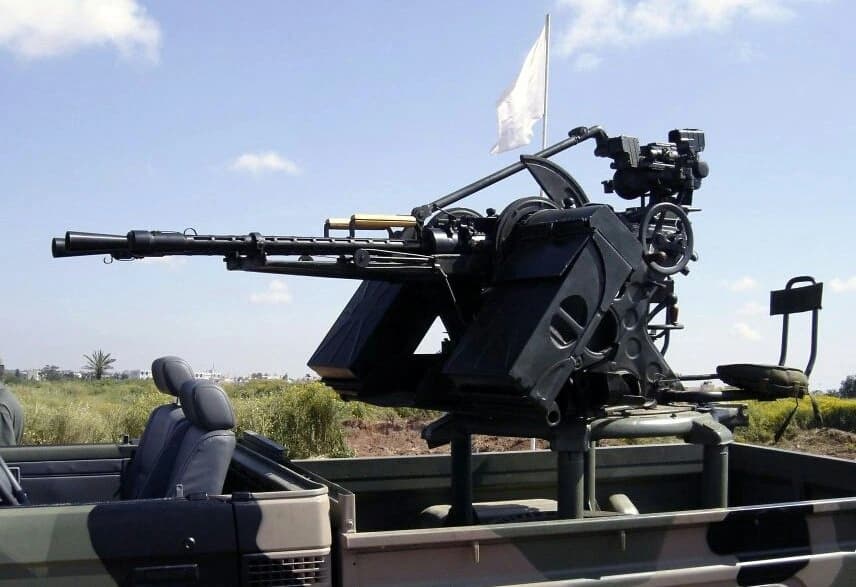
The ZPU-2 is an early Cold War era anti-aircraft gun of Soviet origin. It was developed in the late 1940's and introduced at the same time as the larger four-barrel ZPU-4. The introduction of the jet aircraft made the ZPU-2 quickly obsolete as an anti-aircraft gun. However, the ZPU-2 did prove capable against helicopters and ground targets. Nowadays the ZPU-2 is mostly used as heavy armament on fast and mobile all terrain vehicles.[source]ZPU-2 · ZPU-2 · Overview · Introduction
The ZPU-2 is a twin barrel anti-aircraft gun. It is based on a triangular chassis with outriggers. The turntable mounts two KPV heavy machine guns, two belt boxes, a gun sight and two seats. A two wheel detachable trailer reminiscent of the Nazi German 2cm Flak-38 is used. For airborne forces the UZPU-2, later renamed ZU-2, was developed. This uses a rearranged and updated mount with faster traverse rate and much lighter trailer. The ZU-2 replaced the early model ZPU-2 in production and became the most common model. Both models are often called the ZPU-2.[source]ZPU-2 · ZPU-2 · Overview · Design
The two KPV heavy machine gun fires the 14.5x114mm round at a cyclic rate of fire of 600 rpm. The combined cyclic rate of fire is 1.200 rpm. When firing in short bursts the effective rate of fire is 300 rpm. The maximum effective anti-aircraft range is only 1.4 km, although its slant range is about 5 km. The ZPU-2 is very effective against ground targets due to its volume of fire. It has the ability to pierce the armor of most Cold War era armored personnel carriers.[source]ZPU-2 · ZPU-2 · Overview · Firepower
The ZPU-2 is rather mobile due to its limited weight and size. It can be manhandled over short distances and may be towed by light vehicles. The early model carriage allowed for a high speed on road and in the field, but was rather heavy. The ZU-2 reduced the weight in travel configuration by more than a third. This made it far more useful for airborne forces and it replaced the early model ZPU-2 on the production line.[source]ZPU-2 · ZPU-2 · Overview · Mobility