FORCETALLY
Loading the evidence…
Preparing your view.


Preparing your view.
At a glance
2K12 Kublarger figure on 0 of 6
S-125 Neva/Pechoralarger figure on 6 of 6
Measured figures
Length
Single source5,800 mm[source]
Length
Single sourceConfiguration
| Specification | 2K12 Kub | S-125 Neva/Pechora |
|---|---|---|
| Speed | Mach 2.8[source] | — |
| Type | Tracked medium-range surface-to-air missile system[source] | Short-range SAM system[source] |
| Place of origin | Soviet Union[source] | Soviet Union[source] |
| In service | 1967–present[source] | 1961 –present |
Counts only measures both sources give with the same scope. A larger figure is not a better system.
6,090 mm[source]
Bars compare reported quantities only. A larger figure does not make a system better; configurations and test conditions differ.
| Used by | See list of operators[source] | See list of present and former operators[source] |
|---|
| Wars | List Yom Kippur War Angolan Civil War Chadian Civil War Western Sahara War Iran–Iraq War 1982 Lebanon War Gulf War Yugoslav wars Kosovo War Syrian Civil War Russo-Ukrainian War Russian invasion of Ukraine Yemeni Civil War (2014–present) 2020 Nagorno-Karabakh war[source] | War of Attrition Yom Kippur War Angolan Civil War Uganda–Tanzania War Iran–Iraq War Gulf War NATO bombing of Yugoslavia Syrian Civil War 2020 Nagorno-Karabakh conflict Tigray conflict Russian Invasion of Ukraine 2025 India–Pakistan conflict[source] |
|---|
| Designer | NIIP / Vympel MMZ ( GM chassis )[source] | Almaz Central Design Bureau[source] |
|---|
| Designed | 1958–1967[source] | 1950s[source] |
|---|
| Manufacturer | Ulyanovsk Mechanical Plant (SURNs) ZiK (TELs)[source] | JSC Defense Systems (Pechora-M)[source] |
|---|
| Produced | 1968–1985[source] | 1961–present[source] |
|---|
| No. built | 500 launchers, 10,000 missiles[source] | — |
|---|
| Variants | 2K12 Kub, 2K12E Kvadrat (export version), 2K12M3, 2K12M4[source] | Neva, Pechora, Volna, Neva-M, Neva-M1, Volna-M, Volna-N, Volna-P, Pechora 2, Pechora 2M, Newa SC, Pechora-M[source] |
|---|
| Main armament | 3 3M9M4(or variants) guided missiles[source] | — |
|---|
| Engine | Integral rocket motor/ ramjet booster and sustainer motor[source] | — |
|---|
| Guidance system | Command guidance with terminal semi-active radar homing (SARH)[source] | RF CLOS[source] |
|---|
| Warhead | Frag-HE[source] | Frag-HE[source] |
|---|
| Detonation mechanism | Contact and proximity[source] | Proximity fuse[source] |
|---|
| Propellant | integral rocket motor/ramjet booster and sustainer motor[source] | Solid propellant rocket motor[source] |
|---|
| Flight altitude | Max. 14,000 metres (46,000 ft) Min. 100 metres (330 ft)[source] | 18,000 metres (59,000 ft)[source] |
|---|
| Launch platform | 2P25 TEL[source] | — |
|---|
| Former operator · Afghanistan | — | Afghanistan[source] |
|---|
| Former operator · Belarus | — | Belarus[source] |
|---|
| Former operator · Cambodia | — | Cambodia[source] |
|---|
| Former operator · Czechoslovakia | — | Czechoslovakia[source] |
|---|
| Former operator · Czech Republic | — | Czech Republic[source] |
|---|
| Former operator · East Germany | — | East Germany[source] |
|---|
| Former operator · Finland | — | Finland[source] |
|---|
| Former operator · Georgia | — | Georgia[source] |
|---|
| Former operator · Hungary | — | Hungary[source] |
|---|
| Former operator · Iraq | — | Iraq[source] |
|---|
| Former operator · Islamic State | — | Islamic State[source] |
|---|
| Former operator · Libya | — | Libya[source] |
|---|
| Former operator · Mali | — | Mali[source] |
|---|
| Former operator · Mozambique | — | Mozambique[source] |
|---|
| Former operator · North Yemen | — | North Yemen[source] |
|---|
| Former operator · Russia | — | Russia[source] |
|---|
| Former operator · Serbia and Montenegro | — | Serbia and Montenegro[source] |
|---|
| Former operator · Slovakia | — | Slovakia[source] |
|---|
| Former operator · Somalia | — | Somalia[source] |
|---|
| Former operator · South Yemen | — | South Yemen[source] |
|---|
| Former operator · Soviet Union | — | Soviet Union[source] |
|---|
| Former operator · Tanzania | — | Tanzania[source] |
|---|
| Former operator · Tigray People's Liberation Front | — | Tigray People's Liberation Front[source] |
|---|
| Former operator · Yemen | — | Yemen[source] |
|---|
| Former operator · Yugoslavia | — | Yugoslavia[source] |
|---|
| Role | — | Soviet surface-to-air missile system[source] |
|---|
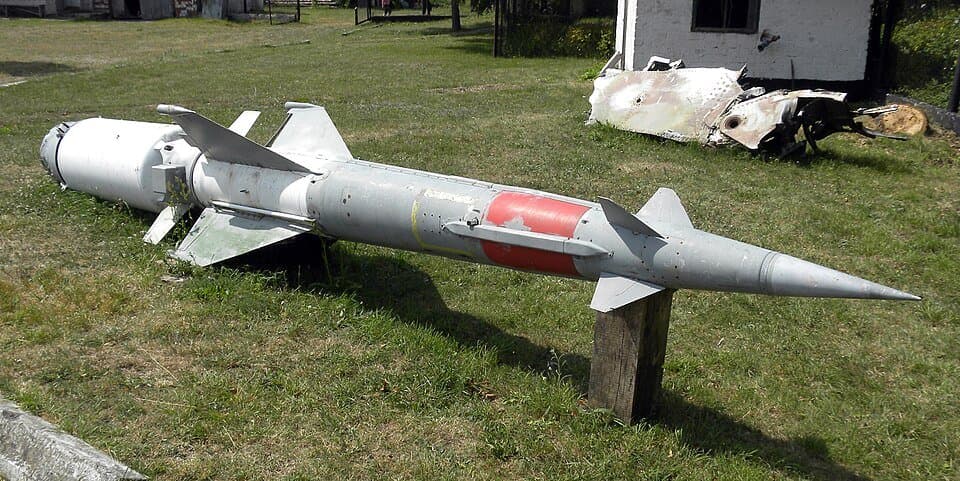
| Source measurement | — | The S-125 Neva/Pechora ( Russian : С-125 "Нева"/"Печора" , NATO reporting name SA-3 Goa ) is a Soviet surface-to-air missile system that was designed by Aleksei Isaev to complement the S-25 and S-75 . It has a shorter effective range and lower engagement altitude than either of its predecessors and also flies slower, but due to its two-stage design it is more effective against more maneuverable targets. It is also able to engage lower flying targets than the previous systems, and being more modern it is much more resistant to ECM than the S-75. The 5V24 (V-600) missiles reach around Mach 3 to 3.5 in flight, both stages powered by solid fuel rocket motors . The S-125, like the S-75 , uses radio command guidance. The naval version of this system has the NATO reporting name SA-N-1 Goa and original designation M-1 Volna (Russian Волна – wave ).[source]S-125 Neva/Pechora · Lead; only the objects and conditions stated in this passage The S-125 was first deployed between 1961 and 1964 around Moscow , augmenting the S-25 and S-75 sites already ringing the city, as well as in other parts of the USSR . In 1964, an upgraded version of the system, the S-125M "Neva-M" and later S-125M1 "Neva-M1" was developed. The original version was designated SA-3A by the US DoD and the new Neva-M named SA-3B and (naval) SA-N-1B . The Neva-M introduced a redesigned booster and an improved guidance system. The S-125 was not used against U.S. forces in Vietnam , because the Soviets feared that China (after the souring of Sino-Soviet relations in 1960), through which most, if not all of the equipment meant for North Vietnam had to travel, would try to copy the missile.[source]S-125 Neva/Pechora · Operational history / Soviet Union; only the objects and conditions stated in this passage A Yugoslav Army 250th Air Defense Missile Brigade 3rd battery equipped with S-125 system shot down a F-117 Nighthawk stealth attack aircraft on March 27, 1999 during the Kosovo War (the only recorded downing of a stealth aircraft) near village Buđanovci , about 45 km from Belgrade. The pilot LT.COL. Darrell Patrick Zelko ejected and was later found by US search and rescue forces. An S-125 also shot down a NATO F-16 fighter on May 2 (its pilot; Lt. Col David L. Goldfein , the commander of 555th Fighter Squadron , managed to eject and was later rescued by a combat search-and-rescue (CSAR) mission).[source]S-125 Neva/Pechora · Operational history / Kosovo War; only the objects and conditions stated in this passage V-600 (or 5V24 ) has the smallest warhead with 60 kg of high explosive. It has a range of about 15 km.[source]S-125 Neva/Pechora · Description / Missile; only the objects and conditions stated in this passage V-601 (or 5V27 ): the upgraded S-125M (1970) system uses the 5V27 missile, with a length of 6.09 m, a wing span of 2,200 mm and a body diameter of 375 mm. This missile weighs 953 kg at launch, and has a 70 kg warhead containing 33 kg of HE and 4,500 fragments. The minimum range is 3.5 km, and the maximum is 35 km (with the Pechora 2A). The intercept altitudes are between 100 m and 18 km. Other sources claim the intercept altitudes between 20 m and 14 km. The minimum range is 2.5 km, and the maximum is 22 km[source]S-125 Neva/Pechora · Description / Missile; only the objects and conditions stated in this passage P-15 radar (NATO codename "Flat Face") or P-15M(2) (NATO codename "Squat Eye") 380 kW C-band target acquisition radar (also used by the 2K12 Kub and 9K33 Osa , range 250 km/155 miles)[source]S-125 Neva/Pechora · Description / Radars; only the objects and conditions stated in this passage SNR-125 (NATO codename "Low Blow") 250 kW I/D-band tracking, fire control and guidance radar (range 40 km/25 miles, second mode 80 km/50 miles) Its parts: An UV-10, 3 cm wavelength, narrow beam transmitter/receiver antenna; 2 pcs of UV-11, 3 cm wavelength, wide beam receiver antenna for target tracking, an UV-12, decimeter wavelength, missile command transmitter antenna and a 9Sh33A camera (optical channel).[source]S-125 Neva/Pechora · Description / Radars; only the objects and conditions stated in this passage The P-15 is mounted on a van (P-15M(2) on a taller mast for better performance against low-altitude targets) and also an IFF (Identifies Friend or Foe), SNR-125 on a trailer and PRV-11 on a box-bodied trailer.[source]S-125 Neva/Pechora · Description / Radars; only the objects and conditions stated in this passage Work on a naval version M-1 Volna (SA-N-1) started in 1956, along with work on a land version. It was first mounted on a rebuilt Kotlin class destroyer (Project 56K) Bravyi and tested in 1962. In the same year, the system was accepted. The basic missile was a V-600 (or 4K90) (range: from 4 to 15 km, altitude: from 0.1 to 10 km). Fire control and guidance is carried out by 4R90 Yatagan radar, with five parabolic antennas on a common head. Only one target can be engaged at a time (or two, for ships fitted with two Volna systems). In case of emergency, Volna could be also used against naval targets, due to short response time.[source]S-125 Neva/Pechora · Variants and upgrades / Naval version; only the objects and conditions stated in this passage The first launcher type was the two-missile ZIF-101, with a magazine for 16 missiles. In 1963 an improved two-missile launcher, ZIF-102, with a magazine for 32 missiles, was introduced to new ship classes. In 1967 Volna systems were upgraded to Volna-M (SA-N-1B) with V-601 (4K91) missiles (range: 4–22 km, altitude: 0.1–14 km).[source]S-125 Neva/Pechora · Variants and upgrades / Naval version; only the objects and conditions stated in this passage In 1974 - 1976 some systems were modernized to Volna-P standard, with an additional TV target tracking channel and better resistance to jamming. Later, improved V-601M missiles were introduced, with lower minimal attack altitude against aerial targets (system Volna-N ).[source]S-125 Neva/Pechora · Variants and upgrades / Naval version; only the objects and conditions stated in this passage It is also possible to fire the Pechora-2M system against cruise missiles . Deployment time 25 minutes, protected from the active interference, and anti-radiation missiles (total in practical shooting)[source]S-125 Neva/Pechora · Variants and upgrades / Modern upgrades; only the objects and conditions stated in this passage Early warning radar is replaced by anti-stealth radar Kasta 2E 2, target distance at 2.5–32 km, target altitude - 0.02–20 km, missile launchers can be positioned at up to 10 kilometers away from the control center. Speed up to 1000 m/s (target), Used rocket 5V27DE, by weight the warhead + 50% range of flight splinters + 350%. Probability of hitting the target 1st rocket: at a distance up to 25 km - 0,72-0,99, detection range with the radar cross section = 2 sq meters about 100 km, with RCS = 0.15 sq m - about 50 km, with no interference. When using active jamming - 40 km. ADMS "Pechora-2M" has the ability to interfacing with higher level command post and radar remote using telecode channels. Is equally effective at any time during the day and at night (optical location, daytime and nighttime, and also thermal imager) was awarded a contract to overhaul Egypt's S-125 SAM system. These refurbished weapons have been reintroduced as the S-125 Pechora 2M.[source]S-125 Neva/Pechora · Variants and upgrades / Modern upgrades; only the objects and conditions stated in this passage In October 2010, Ukrainian Aerotechnica announced a modernized version of S-125 named S-125-2D Pechora . As of 2018 according to the UkrOboronProm, the S-125 surface-to-air missile underwent an integrated modification of all elements, including modernization of missiles, as well as the use of a new radar station built on solid-state elements. The distance of the Ukrainian S-125 modernization's engagement area, 40 km, is greater than that of the Russian one.[source]S-125 Neva/Pechora · Variants and upgrades / Modern upgrades; only the objects and conditions stated in this passage |
|---|
| Reported operators |
|
|
|---|