FORCETALLY
Loading the evidence…
Preparing your view.


Preparing your view.
Ballistic missilesIn service
Hypersonic anti-ship ballistic missile
YJ-21 is a hypersonic anti-ship ballistic missile originating in China. It was built by CALT ?/ SAST ?. Reported operators include People's Liberation Army Navy.
 China
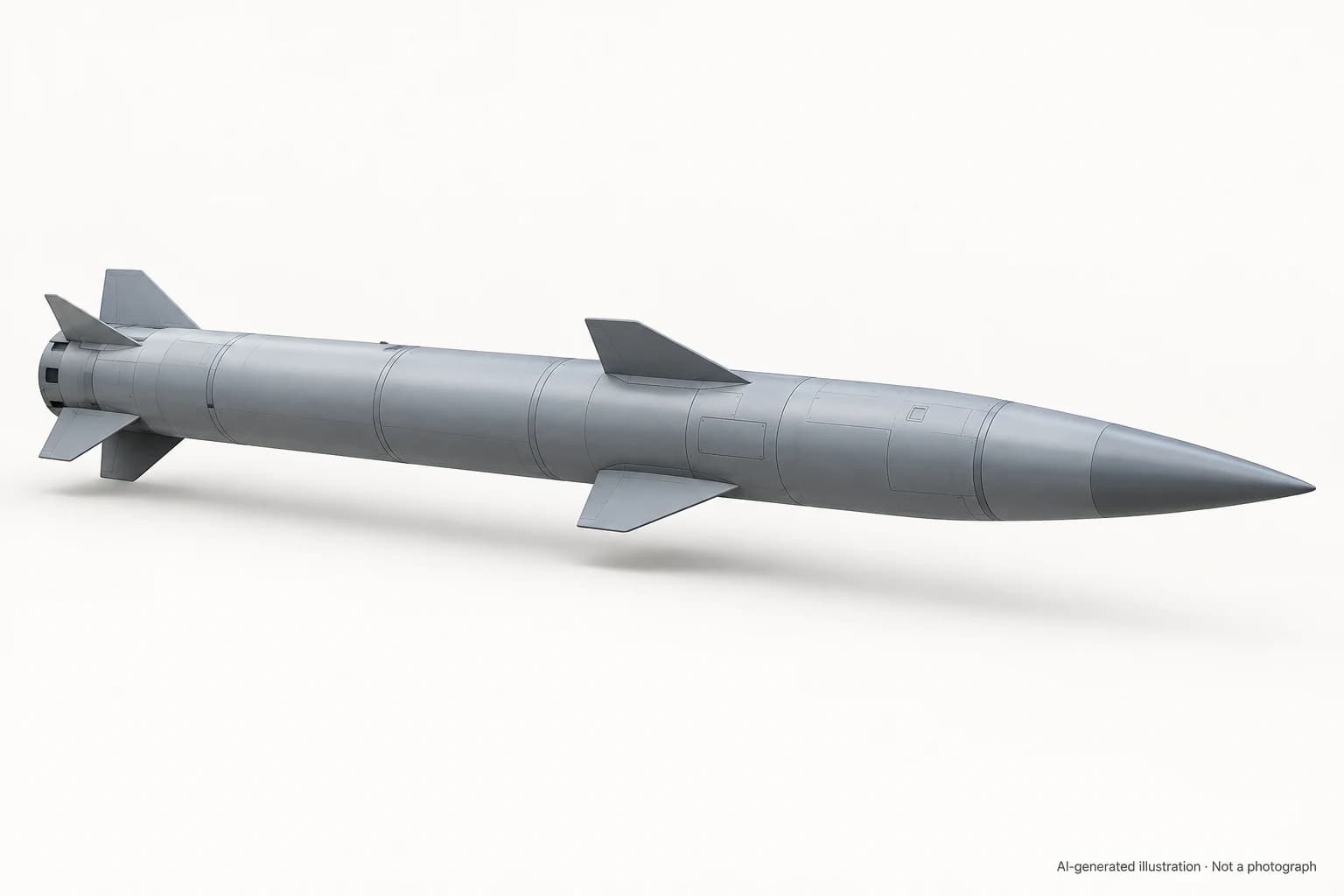
AI-generated illustration · Not a photograph — Representative YJ-21 exterior; illustrative geometry is not evidence for specifications.
ForceTally · AI-generated illustration · Not a photograph · AI-generated · OpenAI output terms · Source ↗ · ModifiedTechnical data
Hypersonic anti-ship ballistic missile
China
2022–present
People's Liberation Army Navy
CALT ?/ SAST ?
approx. 8.3 metres (27 ft)
Conventional
approx. 1,500 kilometres (930 mi) (claimed)
Mach 6 – Mach 10 (7,400–12,300 km/h) (claimed)
Sea platform: Type 055 destroyer Aerial platform: Xian H-6K
China People's Liberation Army Navy People's Liberation Army Air Force
In 2022, an unidentified hypersonic missile was revealed by the Chinese Navy ahead of its 73rd anniversary, launching from a universal vertical launch system of the Type 055 destroyer . The Chinese Navy did not reveal the missile's designation, but defense analysts believed it to be the ship-launched version of the YJ-21. However, with the emergence of the YJ-20 hypersonic missile in 2025, having a more closely aligned profile to the missile launched by Type 055 in 2022, analysts believed these were two separate missile developments.
According to a 2023 People's Liberation Army Strategic Support Force article, the missile has a cruise speed of Mach 6, and a terminal speed of Mach 10. The missile could be launched from China's Type 055 destroyer or the H-6 bomber.
The YJ-21E is an export variant of the YJ-21 missile. It has a cylindrical mid-body design with a double-cone-shaped nose section and four control tailfins. It appears that the missile is optimized for use from fighters and UCAVs.
YJ-21; YJ - Ying Ji; Eagle Strike
Medium-Range Ballistic Missile
China Aerospace Science and Technology Corporation (CASC)
There is no evidence that the missile has any form of airbreathing propulsion, and is believed to be powered by only a single-stage solid-propellant rocket motor.
The missile is controlled by four trapezoidal tailfins.
Guidance is believed to be provided by an inertial navigation system (INS) aided by a global navigation satellite system (GNSS), GPS, and the BeiDou system.
The missile is expected to feature a conventional warhead, which could be used against high-value surface targets. The training version lacks a warhead and instead carries a dummy payload to replicate the flight and endgame.
Reference text from Wikipedia contributors, used under CC BY-SA 4.0.
True scale
Sourced dimensions beside a 1.75 m human reference.
The details of the seeker are not known. However, for anti-ship operations, the missile configuration is probably equipped with an active radar seeker.
Mach 10 (est)
1,000–1,500 km (est)
7.0 m
750 mm
3.0 tons
China, People's Republic of
YJ-21 equipment records. Variants, orders and quantities are shown as reported in each inventory source; coverage is incomplete.
Keep exploring
 Iran
 Israel
 Russia
 India
 Pakistan
 North Korea