FORCETALLY
Loading the evidence…
Preparing your view.


Preparing your view.
Small armsIn service
Semi-automatic pistol
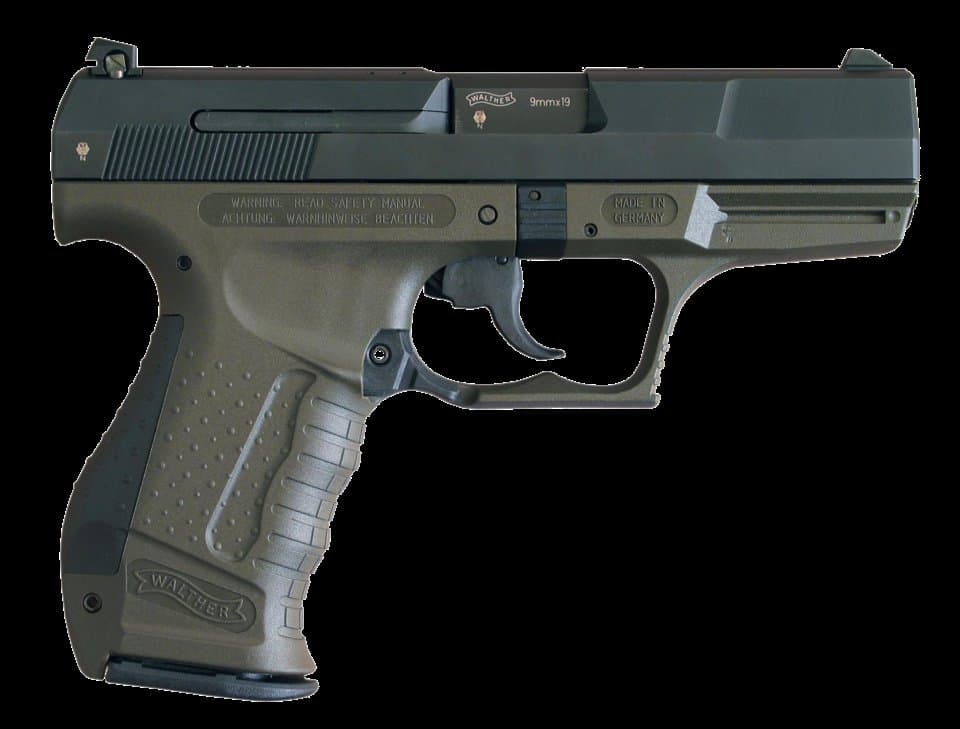
Walther P99 is a semi-automatic pistol originating in Germany. It was built by Carl Walther GmbH Sportwaffen. Reported operators include Finland, Germany, Ireland, North Macedonia, Malaysia, Netherlands, Poland, Portugal, Serbia, Spain, Türkiye, Ukraine, United Kingdom.
 Germany
Semi-automatic pistol
Germany
1997–current
See Users
Horst Wesp
1994–1996
Carl Walther GmbH Sportwaffen
1997–2023
P99QPQ, P99 Military, P990 (P99DAO), P99QA, P99QNL, P99AS, P99TA, P99C, P99C AS, P99C QA, P99C DAO, P99 RAD, P99Q and SW99
630 g (22 oz) (9×19mm) 655 g (23.1 oz) (.40 S&W)
180 mm (7.1 in) (9×19mm) 184 mm (7.2 in) (.40 S&W)
102 mm (4.0 in) (9×19mm) 106 mm (4.2 in) (.40 S&W)
29 mm (1.1 in) (9×19mm) 32 mm (1.3 in) (.40 S&W)
135 mm (5.3 in)
9×19mm Parabellum .40 S&W 9×21mm IMI
Short recoil operated , locked breech
408 m/s (1,339 ft/s) (9×19mm) 344 m/s (1,129 ft/s) (.40 S&W)
50 m (55 yd) (9×19mm)
9×19mm: 10-, 15-, 17- or 20-round detachable box magazine .40 S&W: 10-, 12-, or 14-round box magazine
Interchangeable 3-dot notch sight
Finland Finnish Defence Forces , designated as the PIST 2003 ( Pistooli 2003 ) Law enforcement in Finland Police of Finland Finnish Customs Finnish Border Guard
Germany
Ireland Garda Síochána National Surveillance Unit National Bureau of Criminal Investigation Drugs and Organised Crime Bureau Special Detective Unit Garda Emergency Response Unit
North Macedonia
Malaysia Royal Malaysian Police Royal Malaysian Navy
Netherlands National Police Corps
Poland Police
Portugal Polícia de Segurança Pública Autoridade de Segurança Alimentar e Económica Grupo de Intervenção e Operações Especiais da GNR
Serbia
Spain Guàrdia Urbana de Barcelona
Turkey Turkish Armed Forces : The Canik TP9 is a service pistol. General Directorate of Security : Canik TP9 is a service pistol.
Ukraine Security Service of Ukraine
United Kingdom Nottinghamshire Police
Canada Service de police de la Ville de Montréal
Estonia In 2014, the Police and Border Guard Board started to be armed with the P99Q, as a replacement for the currently used Makarov pistol . After just two years in service the Estonian Police and Border Guard have started replacing the Walther P99Q with a custom Glock 19 Gen 4 variant. This was due to issues with the P99Q malfunctioning during training and duty use. Up to 1000 Walther P99Q pistols are expected to remain in service during the transition period.
The Walther P99 ( German: [ˈvaltɐ] ) is a semi-automatic pistol developed by the German company Carl Walther GmbH Sportwaffen of Ulm for law enforcement, security forces and the civilian shooting market.
When the P99 was introduced the magazine capacities were 16 rounds for 9×19mm Parabellum and 12 rounds for .40 S&W.
Magazines had witness holes on both sides. Later the magazine capacities were reduced to 15 rounds for 9×19mm Parabellum and 11 rounds for .40 S&W while witness holes were introduced at the rear of the magazine to view the loading condition.
The P99Q is a designated police pistol, which has been certified according to the Technical Specifications (TR) of the German Police (Technische Richtlinie Pistolen im Kaliber 9mm x 19, Revision January 2008).
Trigger travel is approximately 13 mm (0.5 in ) with a trigger reset of 6 mm (0.2 in) and a trigger pull of approximately 32 N (7.2 lb f ). The trigger pull is consistent in length and force from the first shot to the last.
The Technical Specifications (TR 2008) of the German Police also demand an accuracy of fire for a 10-shot group with German Police certified 9×19mm Parabellum ammunition at 25 m (27 yd) (R 100 ) of ≤ 16 cm (6.3 in ).
This equals an accuracy of fire of ≤ 22 minute of angle (MOA) or ≤ 6.4 mrad .
All 9mm P99s have always been completely German made. Some P99 .40 components are manufactured under license by S&W.
The slide and other metal parts of the pistol are Tenifer treated (a nitriding process also used on Glock pistols). The Tenifer finish is between 0.04 and 0.05 mm (0.002 and 0.002 in) in thickness, and is characterized by extreme resistance to wear and corrosion; it penetrates the metal, and treated parts have similar properties even below the surface to a certain depth.
The original, first-generation P99 had a traditional Double-Action/Single-Action trigger with a decocker . When the slide is racked completely to the rear upon loading, the trigger remains in the forward position for the first shot and the Anti-Stress mode is activated, where the striker is cocked but the trigger has the length of pull of the double-action mode. The trigger travel is 14 mm (0.55 in) long in the Anti-Stress mode, but most of the length is slack and is similar in feel to a two-stage rifle trigger.
At the end of the anti-stress travel, the pressure noticeably increases to 4.5 pounds and the user experiences a crisp trigger break and an extremely short trigger reset of about .1 inches. All subsequent shots are fired in standard single action mode, where the slack on the trigger is much shorter, but the point of release feels the same.
The pistol is now in Double-Action mode with a pull 7.9 pounds for the full length of the .55 inch pull. After firing the first shot in Double-Action, the pistol will be fired in Single-Action for all subsequent shots.
The P99 feeds from staggered-column or double-stack magazines of varying capacity. Walther also offers staggered-column magazines with a +2 baseplate that add 2 rounds to the magazine capacity at the expense of extending the grip and the pistol height by approximately 18 mm (0.7 in).
The .40 S&W caliber models incorporate a slightly larger slide in order to preserve the same recoil spring assembly used in its 9mm counterpart.
Fixed metal 3-dot iron sights, fixed tritium night sights, adjustable sports iron sights, adjustable optic fibre iron sights, laser pointers , tactical lights , magazine flashlight adapters, holsters, magazines, magazine loaders, grip extenders and a suppressor kit with a 117 mm (4.6 in) barrel and protective cap for the muzzle threads and a silencer that reduces the sound signature by 33 dB(A) are offered as factory accessories.
In Double-Action mode the internal striker is at rest with no pre-load and the trigger travel is 14 mm (0.55 in) long at approximately 38 N (8.5 lb f ) trigger pull. When the slide is racked completely to the rear upon (re)loading, the internal striker is manually pre-cocked to Single-Action mode and the trigger remains in the forward position for the first shot and the Anti Stress mode is activated.
The trigger travel is 14 mm (0.55 in) long in the Anti Stress mode at approximately 20 N (4.5 lb f ) trigger pull.
On all subsequent shots, the P99AS is automatically pre-cocked and the trigger travel is reduced to 8 mm (0.31 in) at the same 20 N (4.5 lb f ) trigger pull.
The Anti Stress mode can also be manually activated by moving the slide approximately 10 mm (0.39 in) back.
The internal striker is at rest with no pre-load. The trigger travel is approximately 14 mm (0.55 in) with a trigger pull of approximately 38 N (8.5 lb f ).
The trigger travel is approximately 8 mm (0.31 in) with a trigger pull of approximately 38 N (8.5 lb f ). The trigger pull is consistent in length and force from the first shot to the last.
The P99RAM is a training and simulation pistol, equipped with a CO 2 blow-back system. It fires low-cost Paint- and Rubberball ammunition in caliber .43 in (11 mm).
The P99 RAD pistol is available with the DAO trigger mechanism with a trigger pull of approximately 39 N (8.8 lb f ) and the QA trigger mechanism with a trigger pull of approximately 32 N (7.2 lb f ).
For its part, Magnum Research Inc. produced a 416 stainless steel slide and 4140 CrMo steel barrel in their Pillager, MN factory in the United States.The MR Eagle series pistols were available in 9×19mm Parabellum (MR9) and .40 S&W (MR40).
The Canik TP9 series is a family of semi-automatic pistols manufactured by Turkish firearms company Canik Arms , designed primarily for military, law enforcement, and civilian use. Chambered in 9mm , the TP9 series is known for its affordability, reliability, and advanced features, often found in more expensive handguns. The series draws significant design influence from the Walther P99, particularly in its early models, and also incorporates elements seen in other popular polymer-framed striker-fired pistols such as those from Glock, H&K, and CZ.
Reference text from Wikipedia contributors, used under CC BY-SA 4.0.
True scale
Sourced dimensions beside a 1.75 m human reference.
See it in your room. Scan with your phone to open this model in 3D, then place it in your space.
Points represent sourced observations, including revisions. Revisions on the same effective date are not separate inventory events. Ranges appear in the table and are not plotted as exact points.
| Observation / report period | Value | Source | Claim state |
|---|---|---|---|
| 28 Sept 2026 | 0.102 m | Wikipedia contributors | superseded |
| 28 Sept 2026 | 0.102 m | Wikipedia contributors | superseded |
| 28 Sept 2026 | 0.102 m | Wikipedia contributors | superseded |
| 28 Sept 2026 | 0.102 m | Wikipedia contributors | approved |
Walther P99 equipment records. Variants, orders and quantities are shown as reported in each inventory source; coverage is incomplete.
 Finland Germany
 Ireland
 Malaysia
 Netherlands
 North Macedonia
 Northern Cyprus
 Poland
Approximate count for P99 · P99 QA. Service scope: Polish Land Forces; does not replace a national total. 1 distinct count cell(s) from the same source list; shared rowspan cells counted once. Excludes retired/reserve/on-order rows. Count column(s): quantity: ~500. Origin: Germany. The listed variants/roles are the scope, not an immediately deployable count. The components do not establish one inventory census date; the stored date is the retrieved source snapshot.
 Portugal
 Serbia
 Spain
 Syria
 Türkiye
 Ukraine
 United Kingdom
Finland, Germany, Ireland, North Macedonia, Malaysia, Netherlands, Poland, Portugal, Serbia, Spain, Türkiye, Ukraine, United Kingdom
Equipment reference ↗