Design and configuration
A long monohull carries a forward gun, integrated superstructure and stern flight deck. The mission bay is a distinguishing part of the design’s internal arrangement.1


Preparing your view.
WarshipsFrom 2028 (planned)Profile in progress
Type 26 is the Royal Navy’s new anti-submarine frigate class. The design combines escort sensors and aviation facilities with space for adaptable mission equipment.
 United Kingdom
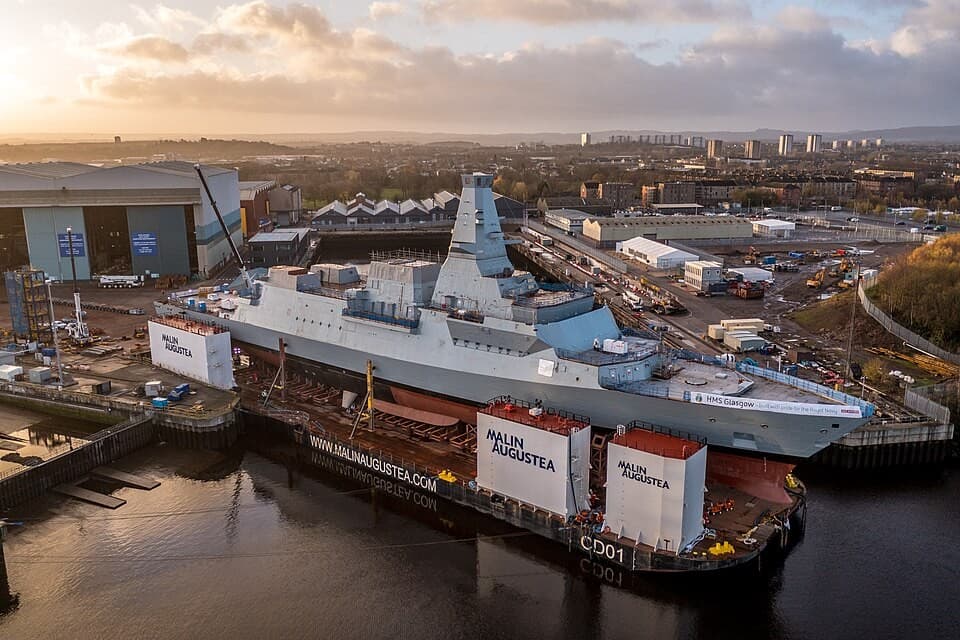
HMS Glasgow preparing to leave Govan for the first time, rolled onto the Malin Augstea semi-submersible launch barge CD01, to be towed down river to the Firth of Clyde and up Loch Long to the Glen Mallan jetty for its launch using the "float off" method. Historical equipment reference photograph. It does not establish current availability or every detail of the named variant.
Ian Dick from Glasgow, UK · CC BY 2.0 · Wikimedia Commons · CC BY 2.0 · Source ↗ · ModifiedNo check recorded yet.
No check recorded yet.
No check recorded yet.
No check recorded yet.
No check recorded yet.
Type 26 frigate
BAE Systems Maritime – Naval Ships
Royal Navy Royal Australian Navy Royal Canadian Navy Royal Norwegian Navy
Type 23 frigate ( RN ) Anzac -class frigate ( RAN ) Halifax -class frigate and Iroquois -class destroyer ( RCN ) Fridtjof Nansen -class frigate ( RNoN )
Hunter -class frigate ( RAN ) River-class destroyer ( RCN )
UK Batch 1: £ 1.31 billion (2022) (equivalent to £ 1.46 billion in 2024) per unit (est.) UK Batch 2: £ 4.2 billion (2022) (equivalent to £ 4.67 billion in 2024) for 5 units (est.) Australia: A$ 35 billion (2018) for 9 units + ToT (est.) Canada: CA$ 69.8 billion (2019) for 15 units + ToT (est.) Norway: £ 10 billion (2025) for at least 5 units + ToT (est.)
Contract award announced 2 July 2017
From 2028 (planned)
34 total: 8 (RN) 6 (RAN) 15 (RCN) At least 5 (RNoN)
7 (5 x RN, 1 x RAN, 1 x RCN )
3 (RAN)
Anti-submarine warfare frigate
7,700 tonnes (7,600 long tons; 8,500 short tons) light shipweight 8,000 tonnes (7,900 long tons; 8,800 short tons) full load
149.9 m (491 ft 10 in)
20.8 m (68 ft 3 in)
CODLOG configuration: 1 × Rolls-Royce MT30 gas turbine 4 × MTU Type 20V 4000 M53B high-speed diesel generators 2 × electric motors
In excess of 26 knots (48 km/h; 30 mph)
In excess of 7,000 nmi (13,000 km) in electric-motor (EM) drive
2
157 (capacity for 208)
Type 997 Artisan 3D radar Kelvin Hughes SharpEye navigation radar Terma SCANTER 6000 2D X-Band navigation radar Sonar 2087 (towed array sonar) Ultra Electronics Type 2150 bow sonar SCOT-5 satcom
IRVIN-GQ DLF decoys MEWSIC [1] Ancilia Decoy Launcher System Naval Decoy IDS300 Surface Ship Torpedo Defence (SSTD)
12 - cell VLS for: 48 x CAMM (missile family) anti-air missiles (Sea Ceptor system) 1 × 24 - cell multi-purpose Mark 41 VLS for: Future Cruise/Anti-Ship Weapon (FC/ASW) 1 × 5-inch 62-calibre Mk 45 naval gun 2 × 30 mm DS30M Mk2 guns 2 × Phalanx CIWS 4 × General purpose machine guns or 0.50 calibre heavy machine guns
Wildcat or AgustaWestland Merlin
Accommodation for two helicopters, Chinook -capable flight deck, Enclosed hangar and Facilities for UAVs
Flexible mission bay
The Type 26 frigate , also known as City-class frigate , is a class of frigates and destroyers being built for the United Kingdom 's Royal Navy , with variants also being built for the Australian, Canadian and Norwegian navies.
In early 2006 the MoD started a Sustained Surface Combatant Capability (S2C2) programme which explored synergies between the FSC and other needs, for minesweepers , patrol ships and survey ships . By early 2007 this had crystallised into the three requirements; C1, C2 and C3. The C1 was to be an anti-submarine warfare task group-enabled platform and would displace around 6,000 tonnes. C2 was to be a more general purpose platform displacing somewhere in the region of 4–5,000 tonnes, and C3 was to be a Global Corvette to replace a larger number of smaller vessels in service, such as minesweepers, patrol and survey ships. The Global Corvette was to displace around 2–3,000 tonnes.
The C3 concept began in early 2004 when the MoD issued a Request for Information (RFI) for a smaller class of ship known as the Global Corvette. Low running costs and the ability to operate forward in shallow, coastal areas where larger ships cannot were both important. BAE Systems , VT Group , Thales and Rolls-Royce responded in the autumn of 2004 with concepts ranging from a well-equipped Offshore Patrol Vessel (OPV) of 1,500 tonnes to an advanced and very capable "corvette" of 3,000 tonnes, along the lines of the USN's Littoral Combat Ship programme (LCS).
BAE Systems' original working baseline for the Global Combat Ship design was a vessel 141 metres long with a displacement of 6,850 tonnes and a range of 7,000 nautical miles at 18 knots. On 30 November 2010 however, it was reported that the specifications had been pared down, in effort to reduce the cost from £500M to £250–350M per ship. Subsequently, new specification details began to emerge of a smaller 5,400 tonne ship emphasising flexibility and modularity.
Although a decision was made in November 2010 to reduce the specifications and capability requirements of the Global Combat Ship design, BAE Systems' design concepts by 2014 had returned to their original working baseline of a large 6,900 tonne warship. In February 2015, the MoD and BAE Systems signed a £859 million contract to continue development and progress towards manufacturing. A 12-month demonstration phase began on 1 April 2015 and, after a 12-month extension in March 2016, was scheduled to be completed in June 2017.
As of 2017 , BAE Systems' website suggests a displacement of 6,900 tonnes, a length of 149.9 m (492 ft) a beam of 20.8 m (68 ft) and a top speed in excess of 26 knots (48 km/h). The Global Combat Ship will have a core crew of 157 with room for a total of 208.
The Global Combat Ship is designed for up to 60 days' endurance and a range of approximately 7,000 nautical miles (13,000 km). Located at the stern are facilities allowing for the deployment of rigid-hulled inflatable boats, unmanned surface vehicles or a towed array sonar. A large Integrated Mission Bay and hangar is located amidship, enabling a variety of missions and associated equipment. Aircraft similar in size to the Boeing Chinook can be flown off the large flight deck, and the hangar can accommodate up to two helicopters the size of an AgustaWestland AW159 Wildcat or AgustaWestland Merlin . The hangar also has space to accommodate unmanned aerial vehicles .
Instead of the RN's current 4.5-inch Mark 8 naval gun , the Global Combat Ship will be equipped with a NATO-standard BAE 5-inch, 62-calibre Mark 45 naval gun .
Smaller guns include two Phalanx CIWS (which can be replaced with SeaRAM), two 30mm DS30M Mark 2 Automated Small Calibre Guns and a number of miniguns and general-purpose machine guns .
The propulsion system of the RN ships will consist of a gas turbine direct drive and four high speed diesel generators driving two electric motors in a combined diesel-electric or gas (CODLOG) configuration. In 2012 Rolls-Royce repackaged the MT30 used in the Queen Elizabeth -class aircraft carriers so that it would fit into smaller ships. The MT30 will be used in the Type 26. BAE Systems has suggested that some customers will install gas turbine engines and others will prefer to sacrifice 2–3 knots of speed by choosing cheaper diesel engines. The CODLOG configuration for propulsion is a simpler version of the Combined diesel-electric and gas (CODLAG) propulsion used on the Type 23 which this ship is to replace, and both of the Global Combat Ship's design contemporaries – the Queen Elizabeth -class aircraft carrier and the Type 45 destroyer – use integrated electric propulsion (IEP).
In July 2017 BAE Systems stated that the Type 26 programme currently employs more than 1,200 people in the UK supply chain, and in the future, the programme would secure more than 3,400 jobs across BAE Systems and the wider UK maritime supply chain. It was also stated in July 2017, coinciding with the announcement of additional contracts, total investment in the Type 26 supply chain had reached £500 million. The 14 companies awarded contracts in the July announcement include Babcock for the helicopter landing grid, MSI Defence Systems for the small calibre gun, and Thales for the towed array system. The largest of the July-announced contracts are for the procurement of structural steel for the first three ships from UK and European steel mills by Dent Steel Services Ltd.
Cammell Laird in Birkenhead, which has delivered large modular blocks for HMS Belfast , as well as a 1,000-tonne consolidated hull section for HMS Birmingham , and a bow section delivered on 7 March 2026.
Type 26 frigate 5 (+ options) United Kingdom Illustration Anti-submarine warfare (ASW) frigate – – 2030 8,000 tonnes
Reference text from Wikipedia contributors, used under CC BY-SA 4.0.
The system in detail
A long monohull carries a forward gun, integrated superstructure and stern flight deck. The mission bay is a distinguishing part of the design’s internal arrangement.1
Artisan radar supports surveillance while the ship’s main specialism is anti-submarine work. Helicopter and boat arrangements extend the ship’s reach beyond its hull-mounted equipment.1
The cited Royal Navy page describes ships entering the fleet in the future. This record does not classify the whole programme as operational merely because hulls have been launched.1
Published displacement and rounded length depend on source convention. Compare a named national design; Canadian and Australian derivatives are not identical Royal Navy ships.1
Royal Navy Royal Australian Navy Royal Canadian Navy Royal Norwegian Navy
Equipment reference ↗