FORCETALLY
Loading the evidence…
Preparing your view.


Preparing your view.
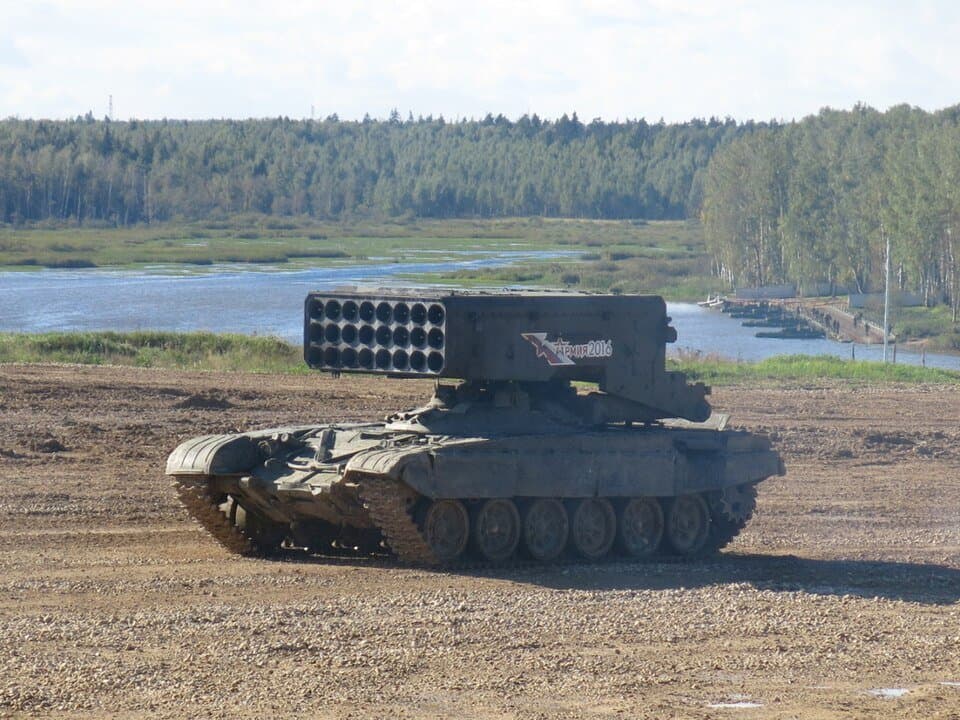
Rockets & launchersIn service
Multiple rocket launcher
TOS-1 is a multiple rocket launcher originating in Soviet Union. The cited manufacturer or builder is Uralvagonzavod.
True scale
Sourced dimensions beside a 1.75 m human reference.
Points represent sourced observations, including revisions. Revisions on the same effective date are not separate inventory events. Ranges appear in the table and are not plotted as exact points.
| Observation / report period | Value | Source | Claim state |
|---|---|---|---|
| 28 Sept 2026 | 220 mm | Wikipedia contributors | superseded |
Multiple rocket launcher
Soviet Union
1988–present
Soviet Union (historically), Russia , Azerbaijan , Armenia , Algeria , Syria , Iraq , Ukraine (captured from Russia)
Soviet–Afghan War Nagorno-Karabakh conflict Second Chechen War War in Iraq (2013–2017) Syrian Civil War War in Donbas Second Nagorno-Karabakh War Russo-Ukrainian war
Omsk Transmash Design Bureau
1988
Uralvagonzavod
TOS-1: 1987–present TOS-1A: 2003–present
TOS-1A
45.3 t (100,000 lb)
9.5 m (31 ft 2 in)
3.6 m (11 ft 10 in)
2.22 m (7 ft 3 in)
3
220 mm (8.7 in)
30 rounds /15 s
.5-3 km (TOS-1) 10 km (TOS-1A)
V-84 diesel 840 hp (630 kW)
550 km (340 mi)
60 km/h (37 mph)
Algeria
Armenia
Azerbaijan
Iraq
Kazakhstan
Russia
Saudi Arabia
Tajikistan
Syria
Ukraine
Soviet Union – Passed on to Russia.
TOS-1 Buratino ( Russian : тяжёлая огнемётная система (ТОС-1) , romanized : Tyazhyelaya ognemyetnaya sistema (TOS-1) , Heavy Flamethrower System (TOS-1)) is a Soviet 220 mm 30-barrel (original system, Object 634 or TOS-1M ) or 24-barrel ( Object 634B or TOS-1A Solntsepyok ) multiple rocket launcher capable of using thermobaric warheads , mounted on a T-72 / T-90 tank chassis . TOS-1 was designed to attack enemy fortified positions and lightly armored vehicles and transports, particularly in open terrain. The system’s first combat tests took place in 1988 and 1989 in the Panjshir Valley during the Soviet–Afghan War . The TOS-1 was shown for the first time in public in 1999 in Omsk .
The TOS-1 Buratino is intended to engage military personnel, equipment, and buildings, including fortified constructions. The nickname " Buratino " originates with the name of the hero of a Russian retelling of the Pinocchio tale (by Alexey Tolstoy ), given the perception of the big "nose" of the launcher (in the original Italian text of Pinocchio , the protagonist is a " burattino ", the Italian word for " puppet "). The combat vehicle acts within the combat order of infantry and tanks. The large mass of the launcher, combined with the short range of rockets launches (3,500 metres, 3,800 yards), forced an increase in the level of armor and use the chassis of the T-72 main battle tank. The TZM reloading vehicle was built on the chassis of a KrAZ-255 B cross-country truck and equipped with a crane for loading/unloading of the launcher. Production of KrAZ-255B has officially stopped in 1994. Therefore, TZM-T for later Soltsepyok was created based on the chassis of a T-72 variation T-72A .
In 2003, the improved TOS-1A Solntsepyok ("Scorching sunlight") system entered service with the range extended to 6 kilometres (6,600 yd) and a better ballistic computer.
In March 2020, Russia introduced a new rocket for the TOS-1A with a range of 10 kilometres (11,000 yd), achieved in part by weight and size reductions of a new fuel air explosive mixture in the warhead, while also increasing its power. Minimum range is extended from 400 to 1,600 metres (440 to 1,750 yd), so the shorter-range M0.1.01.04M rocket will be retained for close combat environments. In 2018, Russian NBC Protection Troops received 30 TOS-1A Solntsepyok (Sunburn) 220 mm multiple rocket launchers.
The Soviets used TOS-1 in 1989 during the Soviet withdrawal from Afghanistan . Russia used them during the Second Chechen War , where they performed well in urban and mountainous terrain.
The TOS-1 was used in Syria on 10 October 2015, by Syrian Army forces against rebel forces in Hama. In 2016, it was used against rebel forces in the Latakia mountains, with at least one being destroyed by a rebel Kornet ATGM near Northern Aleppo. It was used again by the Syrian Arab Army in April 2017 in the area of Palmyra, and later in the same month to destroy an ISIS camp. In November 2018, the system was deployed by the SAA against ISIS in Al-Safa region.
Improved MO.1.01.04 with heavier warhead and a longer range of 6,000 m (20,000 ft). Detonation produces a peak temperature of 3,700 °C (6,690 °F), and high heat persists after the blast.
TOS-1 Buratino ( Russian : тяжёлая огнемётная система (ТОС-1) , romanized : Tyazhyelaya ognemyetnaya sistema (TOS-1) , Heavy Flamethrower System (TOS-1)) is a Soviet 220 mm 30-barrel (original system, Object 634 or TOS-1M ) or 24-barrel ( Object 634B or TOS-1A Solntsepyok ) multiple rocket launcher capable of using thermobaric warheads , mounted on a T-72 / T-90 tank chassis . TOS-1 was designed to attack enemy fortified positions and lightly armored vehicles and transports, particularly in open terrain. The system’s first combat tests took place in 1988 and 1989 in the Panjshir Valley during the Soviet–Afghan War . The TOS-1 was shown for the first time in public in 1999 in Omsk .
TOS-1 Buratino ( Russian : тяжёлая огнемётная система (ТОС-1) , romanized : Tyazhyelaya ognemyetnaya sistema (TOS-1) , Heavy Flamethrower System (TOS-1)) is a Soviet 220 mm 30-barrel (original system, Object 634 or TOS-1M ) or 24-barrel ( Object 634B or TOS-1A Solntsepyok ) multiple rocket launcher capable of using thermobaric warheads , mounted on a T-72 / T-90 tank chassis . TOS-1 was designed to attack enemy fortified positions and lightly armored vehicles and transports, particularly in open terrain. The system’s first combat tests took place in 1988 and 1989 in the Panjshir Valley during the Soviet–Afghan War . The TOS-1 was shown for the first time in public in 1999 in Omsk .
Reference text from Wikipedia contributors, used under CC BY-SA 4.0.
TOS-1 equipment records. Variants, orders and quantities are shown as reported in each inventory source; coverage is incomplete.
 Algeria
Army exact named equipment holdings: TOS-1A. Active, operational-reserve and training units excluding equipment in store; November 2025 IISS assessment. Named service only; no parent-force or national total inferred. Source role: ARTILLERY / 220mm. Original estimates, ranges, reporting names, reserve, lease and employment scopes retained; nested included counts are not added. Missile-system quantities mean launchers, not rounds. No readiness, crew, carried weapon, payload, factory-production or future order count inherited.
 Armenia
 Azerbaijan
Army exact named equipment holdings: TOS-1A. Active, operational-reserve and training units excluding equipment in store; November 2025 IISS assessment. Named service only; no parent-force or national total inferred. Source role: ARTILLERY / 220mm. Original estimates, ranges, reporting names, reserve, lease and employment scopes retained; nested included counts are not added. Missile-system quantities mean launchers, not rounds. No readiness, crew, carried weapon, payload, factory-production or future order count inherited.
 Iraq
Army exact named equipment holdings: TOS-1A. Active, operational-reserve and training units excluding equipment in store; November 2025 IISS assessment. Named service only; no parent-force or national total inferred. Source role: ARTILLERY / 220mm. Original estimates, ranges, reporting names, reserve, lease and employment scopes retained; nested included counts are not added. Missile-system quantities mean launchers, not rounds. No readiness, crew, carried weapon, payload, factory-production or future order count inherited.
 Kazakhstan
Army exact named equipment holdings: TOS-1A. Active, operational-reserve and training units excluding equipment in store; November 2025 IISS assessment. Named service only; no parent-force or national total inferred. Source role: ARTILLERY / 220mm. Original estimates, ranges, reporting names, reserve, lease and employment scopes retained; nested included counts are not added. Missile-system quantities mean launchers, not rounds. No readiness, crew, carried weapon, payload, factory-production or future order count inherited.
 Russia
Army exact named equipment holdings: TOS-1A. Active, operational-reserve and training units excluding equipment in store; November 2025 IISS assessment. Named service only; no parent-force or national total inferred. Source role: ARTILLERY / 220mm. Original estimates, ranges, reporting names, reserve, lease and employment scopes retained; nested included counts are not added. Missile-system quantities mean launchers, not rounds. No readiness, crew, carried weapon, payload, factory-production or future order count inherited.
 Saudi Arabia
Army exact named equipment holdings: TOS-1A. Active, operational-reserve and training units excluding equipment in store; November 2025 IISS assessment. Named service only; no parent-force or national total inferred. Source role: ARTILLERY / 220mm. Original estimates, ranges, reporting names, reserve, lease and employment scopes retained; nested included counts are not added. Missile-system quantities mean launchers, not rounds. No readiness, crew, carried weapon, payload, factory-production or future order count inherited.
 Syria
 Tajikistan
 Ukraine
Soviet Union (historically), Russia , Azerbaijan , Armenia , Algeria , Syria , Iraq , Ukraine (captured from Russia)
Equipment reference ↗Keep exploring
Airborne Forces exact named equipment holdings: TOS-1A. Active, operational-reserve and training units excluding equipment in store; November 2025 IISS assessment. Named service only; no parent-force or national total inferred. Source role: ARTILLERY / 220mm. Original estimates, ranges, reporting names, reserve, lease and employment scopes retained; nested included counts are not added. Missile-system quantities mean launchers, not rounds. No readiness, crew, carried weapon, payload, factory-production or future order count inherited.
 China
 South Africa