FORCETALLY
Loading the evidence…
Preparing your view.


Preparing your view.
Cruise & anti-ship missilesIn service
Cruise missile Anti-ship missile (Block V & TASM variants) Submarine-launched cruise missile Land-attack missile Surface-to-surface missile
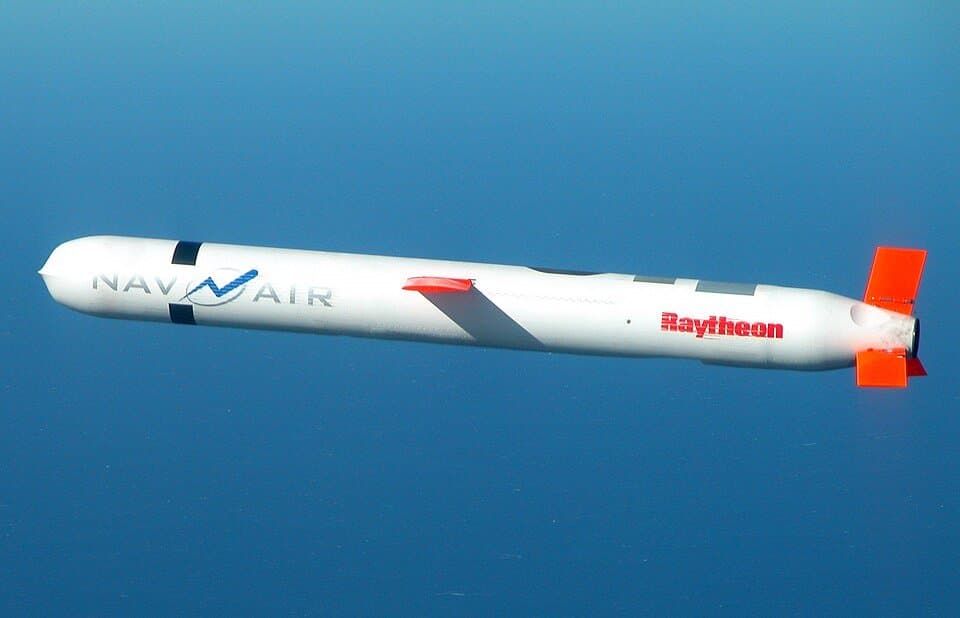
Tomahawk missile is a cruise missile Anti-ship missile (Block V & TASM variants) Submarine-launched cruise missile Land-attack missile Surface-to-surface missile originating in United States. The cited manufacturer or builder is General Dynamics (initially) McDonnell Douglas Hughes Aircraft Company Raytheon Missiles & Defense. Published specifications list wingspan 2.67 m; the configuration for each measurement is shown below.
 United States
Tomahawk missile
U.S. Navy derivative work: The High Fin Sperm Whale · Public domain · Resized · Public domain · Source ↗ · ModifiedTechnical data
Cruise missile Anti-ship missile (Block V & TASM variants) Submarine-launched cruise missile Land-attack missile Surface-to-surface missile
United States
1983–present
United States United Kingdom Australia Netherlands Japan
General Dynamics (initially) McDonnell Douglas Hughes Aircraft Company Raytheon Missiles & Defense
$3.1M (FY1986) $1.87M (FY2017) (Block IV) $2.5M (FY2026) (Block V) Export cost: $4M (FY2023)
2,900 lb (1,300 kg); 3,500 lb (1,600 kg) with booster
18 ft 3 in (5.56 m) without booster; 20 ft 6 in (6.25 m) with booster
20.4 in (0.52 m)
8 ft 9 in (2.67 m)
BGM-109A : 1,000 lb (450 kg) conventional Bullpup or W80 nuclear warhead (yield 5 to 200 kilotonnes of TNT (21 to 837 TJ)) (retired) BGM-109C/E : WDU-36/B 690 lb (310 kg) unitary warhead containing 265 lb (120 kg) of PBXN-107 high explosive BGM-109D : submunitions dispenser with 166 BLU-97/B Combined Effects Bomblets with 287 grams (0.633 lb) Cyclotol high explosive per munition
True scale
Sourced dimensions beside a 1.75 m human reference.
See it in your room. Scan with your phone to open this model in 3D, then place it in your space.
Points represent sourced observations, including revisions. Revisions on the same effective date are not separate inventory events. Ranges appear in the table and are not plotted as exact points.
| Observation / report period | Value | Source | Claim state |
|---|---|---|---|
| 28 Sept 2026 | 0.52 m | Wikipedia contributors | superseded |
FMU-148 since TLAM Block III, others for special applications
Williams International F107-WR-402 turbofan using TH-dimer fuel and a solid-fuel rocket booster
Block II TLAM-N: 1,350 nmi (1,550 mi; 2,500 km) Block III TLAM-C, Block IV TLAM-E: 900 nmi (1,000 mi; 1,700 km) Block III TLAM-D: 700 nmi (810 mi; 1,300 km) Block IV: 864 nmi (994 mi; 1,600 km) Block Vb: >900 nmi (>1036 mi; >1666 km) (exact range is classified) RGM/UGM-109B TASM: 250 nmi (460 km)
98–164 ft (30–50 m) AGL
Subsonic; ~Mach 0.74, about 570 mph (500 kn; 920 km/h)
GPS , INS , TERCOM , DSMAC , active radar homing (RGM/UGM-109B)
Mark 41 Vertical Launching System Torpedo tubes Surface ships Submarines TELs
The BGM-109 Tomahawk Land Attack Missile ( TLAM ) is an American long-range, all-weather, jet-powered, subsonic cruise missile that is used by the United States Navy , Royal Australian Navy , Royal Netherlands Navy and Royal Navy in ship and submarine-based land-attack operations.
BGM-109G Gryphon Ground Launched Cruise Missile (GLCM) – with a W84 nuclear warhead; withdrawn from service in 1991 to comply with the INF Treaty .
BGM-109C Tomahawk Land Attack Missile – Conventional (TLAM-C Block II) with WDU-25/B unitary warhead also used on the AGM-12B Bullpup . The WDU-25/B warhead weighed 992 pounds (450 kg) and contained 378 pounds (171 kg) of Picratol and Composition H-6 high explosives. Starting in May 1993, the WDU-25/B warhead was replaced by the lighter WDU-36/B warhead weighing 690 pounds (310 kg) and filled with 265 pounds (120 kg) of PBXN-107 high explosive. The smaller warhead allowed the fuel tank to be enlarged, increasing the maximum range. This version was given the designation TLAM-C Block III.
BGM-109D Tomahawk Land Attack Missile – Dispenser (TLAM-D) with a submunitions dispenser that carried 166 BLU-97/B Combined Effects Bomblets with 287 grams (0.633 lb) Cyclotol high explosive per munition
AGM-109H/L Medium Range Air-to-Surface Missile (MRASM) – a shorter-range, turbojet powered air-launched cruise missile with conventional non-nuclear warheads intended for USAF and Navy. AGM-109H for USAF, 5.84 m (19 ft 2 in) long, with TERCOM en-route and DSMAC terminal guidance, and payload of runway cratering submunitions for use against airfields. AGM-109L for US Navy, 4.87 m (16 ft 0 in) long, with unitary warhead for use against ships or high value land targets, and imaging infra-red seeker and datalink. Never entered service, cost US$ 569,000 (1999).
BGM-109G Gryphon Ground Launched Cruise Missiles (GLCM) and their truck-like launch vehicles were employed at bases in Europe; they were withdrawn from service to comply with the 1987 Intermediate-Range Nuclear Forces Treaty .
A supersonic version of the Tomahawk is under consideration for development with a ramjet to increase its speed to Mach 3. A limiting factor to this is the dimensions of shipboard launch tubes. Instead of modifying every ship able to carry cruise missiles, the ramjet-powered Tomahawk would still have to fit within a 21-inch (530 mm) diameter and 20-foot (6.1 m) long tube.
Block Va: Block V anti-ship version, capable of hitting moving targets at sea. Block Va's range is shorter than the Block V's, due to the extra space for the new navigation/sensor/passive radar needs. Estimate the Block Va's range is 310 to 430 mi (500 to 700 km)
After achieving flight, the missile's wings are unfolded for lift, the airscoop is exposed and the turbofan engine is employed for cruise flight . Over water, the Tomahawk uses inertial guidance or GPS to follow a preset course; once over land, the missile's guidance system is aided by terrain contour matching (TERCOM). Terminal guidance is provided by the Digital Scene Matching Area Correlation ( DSMAC ) system or GPS, producing a claimed circular error probable of about 30 feet (10 m).
250 per year: the 1-8-5 production rate (1 shift per day, 8 hours a day, 5 days a week).
The Air Force is a former operator of the nuclear-armed version of the Tomahawk, the BGM-109G Gryphon .
20 August 1998: 79 Tomahawk missiles were fired simultaneously at two targets in Afghanistan and Sudan in retaliation for the bombings of American embassies by Al-Qaeda .
The school was located approximately 100 meters from an IRGC facility also struck in the attack.
In April 2004, the UK and US governments reached an agreement for the British to buy 64 of the new generation of Tomahawk missile—the Block IV or TacTom missile. It entered service with the Royal Navy on 27 March 2008, three months ahead of schedule. In July 2014 the US approved the sale to the UK of a further 65 submarine-launched Block IV's at a cost of US$140m including spares and support; as of 2011 the Block III missiles were on British books at £1.1m and the Block IV at £0.87m including VAT.
To comply with the 1987 Intermediate-Range Nuclear Forces Treaty (INF Treaty), all nuclear and conventional ground-launched ballistic missiles , cruise missiles, and missile launchers with ranges of 310 to 620 miles (500 to 1,000 km) (short to medium-range) and 620 to 3,420 miles (1,000 to 5,500 km) (intermediate-range) were dismantled or withdrawn from Europe by the treaty's deadline of 1 June 1991.
Reference text from Wikipedia contributors, used under CC BY-SA 4.0.
Tomahawk equipment records. Variants, orders and quantities are shown as reported in each inventory source; coverage is incomplete.
United States United Kingdom Australia Netherlands Japan
Equipment reference ↗Keep exploring
Cruise missile Air-launched cruise missile Anti-ship missile Land-attack missile Surface-to-surface missile Submarine-launched cruise missile
Cruise missile Air-launched cruise missile Submarine-launched cruise missile Anti-ship missile Surface-to-surface missile Land-attack missile
Anti-ship cruise missile Surface-to-surface missile Submarine-launched cruise missile
Cruise missile Air-launched cruise missile Air-to-surface missile Anti-ship missile Land-attack missile
Cruise missile Land-attack missile Air-launched cruise missile Anti-ship missile Submarine-launched cruise missile
 China
Air-to-surface Surface-to-surface missile Cruise missile Anti-ship missile Land-attack missile