FORCETALLY
Loading the evidence…
Preparing your view.


Preparing your view.
Radar & sensorsIn service
pulse-radar fire control system
Super Fledermaus is a pulse-radar fire control system.
 Switzerland
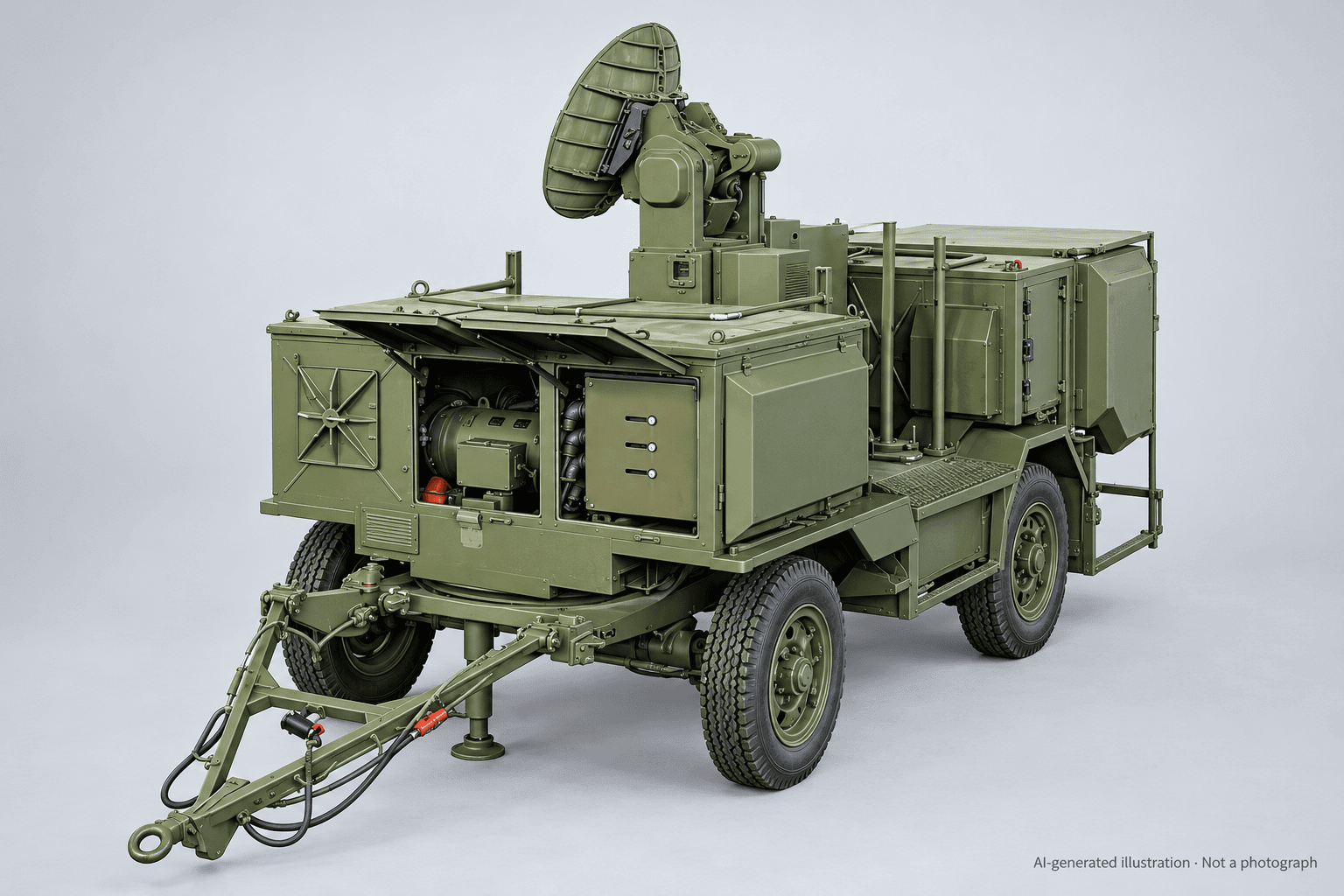
AI-generated illustration — Not an official photograph — Super Fledermaus
ForceTally · AI-generated illustration · Exterior reference: Alf van Beem (CC0) · AI-generated illustration · OpenAI terms · Source ↗is a pulse-radar fire control system
Under the lead of Contraves
111 of these systems were in service with the Swiss Air Force from 1965 to 1977
Doppler radar in the E / F-band with a range of 15 kilometers
pulse Doppler Rader in the J band, again with a 15 kilometer range
Range: 40km
Frequency: 8600–9600 MHz
Transmit pulse power: 150 kW
Weight: 5400kg
The Super Fledermaus (literally Super Bat), known in Swiss service as the Feuerleitgerät 63 , Flt Gt 63 (fire control radar unit 63), is a pulse-radar fire control system, 111 of these systems were in service with the Swiss Air Force from 1965 to 1977.
Under the lead of Contraves , the Super Fledermaus fire control system was jointly developed and produced by ten companies.
The Flt Gt 63 comprises a towed trailer, a Doppler radar in the E / F-band with a range of 15 kilometers and a pulse Doppler Rader in the J band, again with a 15 kilometer range, it can simultaneously control two Oerlikon 35 mm twin anti-aircraft mountings . In use the system's E/F band search radar monitors the airspace scanning for targets; once targets have been identified the target can be tracked and engaged either visually or by radar.
Range: 40km
Frequency: 8600–9600 MHz
Transmit pulse power: 150 kW
Weight: 5400kg
Under the lead of Contraves , the Super Fledermaus fire control system was jointly developed and produced by ten companies.
Super Fledermaus Switzerland Mobile pulse-radar and fire control system ~ 75 The Super Fledermaus is a Swiss-designed short-range X-band fire-control radar originally developed by Oerlikon Contraves for gun-based air-defence systems. It was introduced into South African service in the late 1960s and served as the primary fire-control radar for 35 mm GDF anti-aircraft gun batteries. Range & Tracking: Effective detection range of ~15 km against low-altitude aircraft; tracking range of ~10 km with capability to control engagements against up to two targets Frequency: X-band pulse-Doppler fire-control radar with integrated IFF Mk X and automated gun-laying computation Mobility: Towed or vehicle-supported deployment for battery-level air-defence integration The Super Fledermaus served as South Africa's first modern radar-directed gun fire-control system and formed the backbone of Air Defence Artillery operations for several decades before being gradually replaced by modern Skyshield -based systems.
Reference text from Wikipedia contributors, used under CC BY-SA 4.0.
Points represent sourced observations, including revisions. Revisions on the same effective date are not separate inventory events. Ranges appear in the table and are not plotted as exact points.
| Observation / report period | Value | Source | Claim state |
|---|---|---|---|
| 29 Sept 2026 | 8.6–9.6 GHz | Wikipedia contributors | superseded |
| 29 Sept 2026 | 8.6–9.6 GHz | Wikipedia contributors | approved |
Super Fledermaus equipment records. Variants, orders and quantities are shown as reported in each inventory source; coverage is incomplete.
 South Africa
Approximate count for Super Fledermaus. Service scope: South African Army; does not replace a national total. 1 distinct count cell(s) from the same source list; shared rowspan cells counted once. Retired, wholly reserve and on-order rows are excluded; the reported count retains any explicitly mixed stock scope in the quoted row. Count column(s): number: ~ 75. Origin: Switzerland. The listed variants/roles are the scope, not an immediately deployable count. The components do not establish one inventory census date; the stored date is the retrieved source snapshot.
Keep exploring
 United States
 India
 Russia