FORCETALLY
Loading the evidence…
Preparing your view.


Preparing your view.
SubmarinesIn service
Submersible , diver propulsion vehicle
SEAL Delivery Vehicle is a submersible , diver propulsion vehicle. It was built by The Columbia Group. Reported operators include United States Navy Royal Navy.
 United States
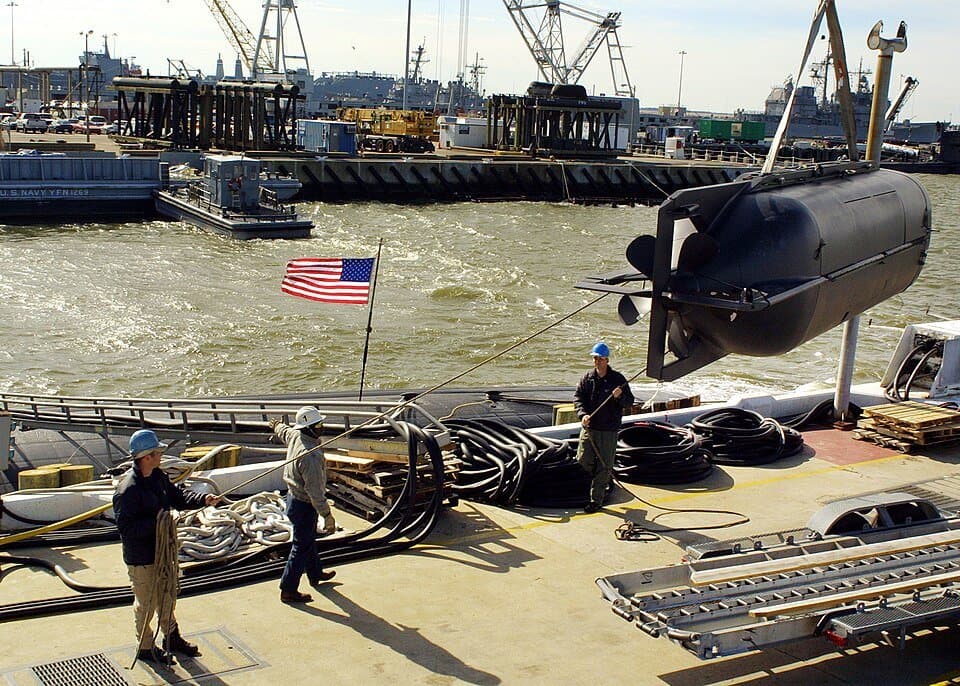
Mark 8 SEAL Delivery Vehicle being loaded aboard USS Dallas
U.S. Navy photo by Chief Journalist Dave Fliesen · Public domain · Resized · Public domain · Source ↗ · ModifiedThe Columbia Group
United States Navy Royal Navy
Shallow Water Combat Submersible (planned)
Since 1983
Submersible , diver propulsion vehicle
17 tons (15.4 tonnes)
6.7 meters (22 ft)
1.8 meters (5.9 ft)
Silver-zinc batteries powering an electric motor and single screw propeller
6 kn (11 km/h) (top speed) 4 kn (7.4 km/h) (cruising speed)
15 to 18 nmi (28 to 33 km) with diving team 36 nmi (67 km) without
8 to 12 hours
6 meters (20 ft)
6 (2 crew, 4 passengers)
Doppler Inertial Navigation System , high frequency sonar for obstacle/mine avoidance and navigation, GPS
SEAL team personal weapons, limpet mines
Specifications are given for Mark 8 SDV
SDVs carry a pilot, co-pilot, and four person combat swimmer team and their equipment to and from maritime mission objectives on land or at sea.
The Mark 8 Mod 1 SDV has an endurance of about eight to 12 hours, giving it a range of 15 to 18 nmi (28 to 33 km) with a diving team or 36 nmi (67 km) without. The main limiting factor on endurance is not batteries or breathing gas for the SEALs, but water temperature: humans can only spend so much time in cold water, even with wetsuits , before their blood pressure drops and they become dehydrated from losing blood volume and body fluids, respectively.
Despite being a development of the Mark 8 SDV, the Mark 9 is a very different vehicle, designed for attacking surface ships rather than deploying SEAL teams on clandestine operations. Indeed, the Mark 9 and Mark 8 share very few common parts. The Mark 9 carries two SEALs, a pilot and a navigator, and two Mark 31 or Mark 37 torpedoes for standoff attacks against ships. These torpedoes can travel up to 3 nautical miles (5.6 km) in a straight line, carry a 330-pound (150 kg) warhead, and are capable of sinking ships as large as cruisers . In addition to torpedoes, the Mark 9 also carried limpet mines and satchel charges in a large cargo compartment aft of the pilot and co-pilot.
The Mark 9's sleek profile and independent diving planes enabled it to be especially agile. It was also faster than the Mark 8, reaching speeds of 7–9 knots (13–17 km/h), owing to its twin screw propellers and high-performance silver-zinc batteries . Its speed and agility led operators to compare it to flying a fighter jet or driving a sports car.
In one example, the Navy wanted to use an SDV to get a closer look at a Soviet ship anchored in a Cuban harbor 18 miles (29 km) upriver from the Caribbean Sea .
The SDV suffered from reliability concerns early in its lifespan. LCDR Doug Lowe, a member of SDV Team 1 in the 1980s, reported that his team's SDVs were operational less than 50 percent of the time. However, reliability improved with usage: LCDR Lowe later commanded SDV Team 2 in the 1990s and reported that his subs were ready more than 90 percent of the time.
1 x Rechargeable Silver-Zinc Battery-powered Motor; 1 x shaft. Propulsion
18.0 kts 20.7 mph Surface Speed
4 Personnel Complement
15.4 ft 4.69 meters O/A Length
6.2 ft 1.89 meters Beam
0.2 ft 0.00 meters Draught
The SEAL Delivery Vehicle (SDV) MK VIII was developed in 1975 by United States UDT
Reference text from Wikipedia contributors, used under CC BY-SA 4.0.
True scale
Sourced dimensions beside a 1.75 m human reference.
Points represent sourced observations, including revisions. Revisions on the same effective date are not separate inventory events. Ranges appear in the table and are not plotted as exact points.
| Observation / report period | Value | Source | Claim state |
|---|---|---|---|
| 29 Sept 2026 | 1.8 m | Wikipedia contributors | approved |
SEAL Delivery Vehicle equipment records. Variants, orders and quantities are shown as reported in each inventory source; coverage is incomplete.
Keep exploring
Submersible , diver propulsion vehicle
United Statessubmersible
Deep-submergence rescue vehicle
Submarine with air-independent propulsion (AIP)
 Spain
Diesel submarine
 North Korea
Diesel-electric submarine
United StatesCompare with SEAL Delivery Vehicle