FORCETALLY
Loading the evidence…
Preparing your view.


Preparing your view.
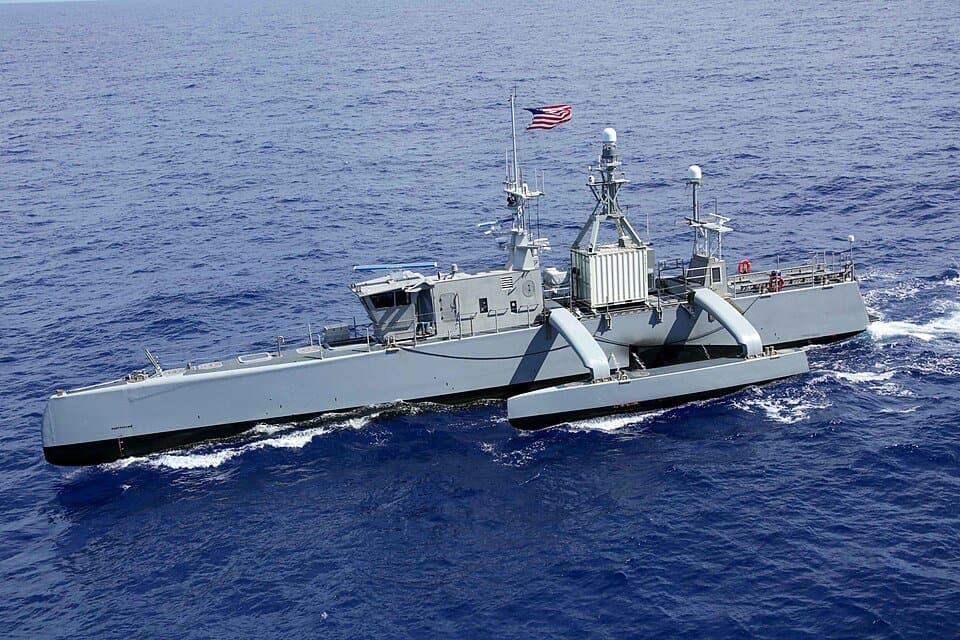
Uncrewed maritime systemsIn service
Unmanned surface vehicle
Sea Hunter is a unmanned surface vehicle. It was built by Leidos Christensen Shipyards Vigor Industrial.
 United States
Sea Hunter
Mass Communication Specialist 3rd Class Aleksandr Freutel · Public domain · Resized · Public domain · Source ↗ · ModifiedSea Hunter
Leidos Christensen Shipyards Vigor Industrial
April 2016
MMSI number : 369970970
in service
Unmanned surface vehicle
135 tons (standard) 145 tons (full load)
132 ft (40 m)
2x Diesel engines
27 knots (50 km/h; 31 mph)
10,000 nautical miles (12,000 mi; 19,000 km)
30–90 day without supply
None
None
Sea Hunter is an autonomous unmanned surface vehicle (USV) launched in 2016 as part of the DARPA Anti-Submarine Warfare Continuous Trail Unmanned Vessel ( ACTUV ) program.
Sea Hunter is an autonomous unmanned surface vehicle (USV) launched in 2016 as part of the DARPA Anti-Submarine Warfare Continuous Trail Unmanned Vessel ( ACTUV ) program. The ship was christened 7 April 2016 in Portland, Oregon . It was designed and built by Leidos , with manufacturing subcontracted to Christensen Shipyards (and later Vigor Industrial after Christensen went into receivership ). The vessel continues the line of experimental "Sea" ships, including Sea Shadow , Sea Fighter , Sea Jet , and Sea Slice . Sea Hunter is classified as a Class III USV and designated the Medium Displacement Unmanned Surface Vehicle ( MDUSV ).
The initially unarmed prototype, built at a cost of $20 million, is a 132-foot (40 meter)-long trimaran (a central hull with two outriggers). It is an unmanned self-piloting craft with twin screws, powered by two diesel engines with a top speed of 27 knots (31 mph; 50 km/h). Her weight is 135 tons, including 40 tons of fuel, adequate for a 70-day cruise. Cruising range is "transoceanic," 10,000 nautical miles (12,000 mi; 19,000 km) at 12 knots (14 mph; 22 km/h) fully fueled with 14,000 U.S. gallons (53,000 L) of diesel, enough "to go from San Diego to Guam and back to Pearl Harbor on a tank of gas." Sea Hunter has a full load displacement of 145 tons and is intended to be operational through Sea State 5, waves up to 6.5 ft (2.0 m) high and winds up to 21 knots (24 mph; 39 km/h), and survivable through Sea State 7, seas up to 20 ft (6.1 m) high. The trimaran hull provides increased stability without requiring a weighted keel , giving her a higher capacity for linear trajectories and better operations in shallow waters, though the greater width decreases maneuverability.
The craft is expected to undergo two years of testing before being placed in service with the U.S. Navy . If tests are successful, future craft of this type may be armed and used for anti-submarine and counter-mine duties, operating at a cost of $15,000–20,000 per day, a fraction of the cost of a destroyer at $700,000 per day (in 2015, equivalent to $950,793 in 2025); it could operate with Littoral Combat Ships , becoming an extension of the LCS ASW module. Deputy U.S. Defense Secretary Robert Work said that if weapons are added to the ship, a human would always remotely make the decision to use lethal force.
beam 14 metre 0 references
country of origin United States 0 references
Reference text from Wikipedia contributors, used under CC BY-SA 4.0.
True scale
Sourced dimensions beside a 1.75 m human reference.
See it in your room. Scan with your phone to open this model in 3D, then place it in your space.
Points represent sourced observations, including revisions. Revisions on the same effective date are not separate inventory events. Ranges appear in the table and are not plotted as exact points.
| Observation / report period | Value | Source | Claim state |
|---|---|---|---|
| 5 Oct 2026 | 14 m | Wikidata contributors | approved |
Sea Hunter equipment records. Variants, orders and quantities are shown as reported in each inventory source; coverage is incomplete.
United StatesUS Navy exact named equipment holdings: Sea Hunter. Active, operational-reserve and training units excluding equipment in store; November 2025 IISS assessment. Named service only; no parent-force or national total inferred. Source role: UNINHABITED MARITIME PLATFORMS / Medium. Original estimates, ranges, reporting names, reserve, lease and employment scopes retained; nested included counts are not added. Missile-system quantities mean launchers, not rounds. No readiness, crew, carried weapon, payload, factory-production or future order count inherited.
 Türkiye
 Israel