Design and configuration
A streamlined single-hull exterior carries a forward sail and conventional stern surfaces. The selected baseline illustration is not a dimensional model of every exported boat.1


Preparing your view.
Submarines2005–presentProfile in progress
Scorpène is a family of conventional attack submarines adapted for different national customers. Hull length, energy storage and onboard equipment vary between those designs.
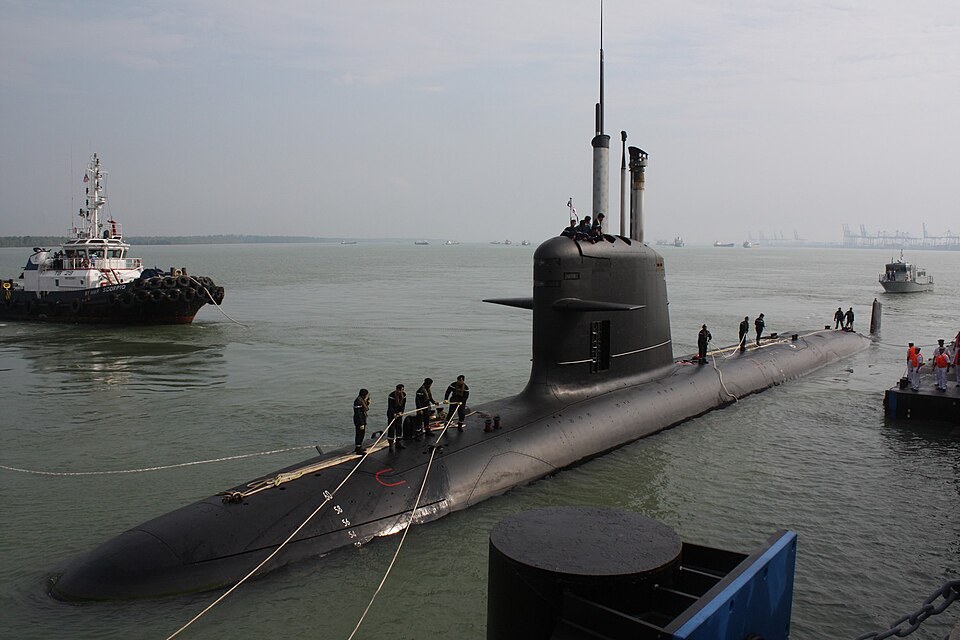
Malaysia's first Scorpene-class diesel-electric submarine docked at its Naval base in Port Klang on the outskirts of Kuala Lumpur on September 3, 2009. Historical equipment reference photograph. It does not establish current availability or every detail of the named variant.
Mak Hon Keong · CC BY-SA 3.0 · Wikimedia Commons · CC BY-SA 3.0 · Source ↗ · ModifiedTechnical data
The system in detail
A streamlined single-hull exterior carries a forward sail and conventional stern surfaces. The selected baseline illustration is not a dimensional model of every exported boat.1
Naval Group’s combat-system architecture supports torpedo and selected missile integrations. Those installations depend on the customer contract and acceptance standard.1
This entry is a programme overview with a baseline illustrative model. Brazilian extended hulls and the newer Scorpène Evolved lithium-ion design require their own dimensions.1
Compare named national variants rather than a blended specification. Battery chemistry, patrol duration and submerged endurance need explicit operating assumptions.1
Scorpène class
Naval Group Navantia Mazagon Dock Limited Itaguaí Construções Navais PAL Indonesia
Chilean Navy Royal Malaysian Navy Indian Navy Brazilian Navy Indonesian Navy (In Production)
Agosta class Sindhughosh class (India) Shishumar class (India)
S-80 Plus class Marlin class Project 75I class (India)
Kalvari class Riachuelo class CA-2000 CM-2000 AM-2000
US$450 million
1999–present
2005–present
20
2
14
4
13
Submarine
1,565 t (1,540 long tons ) (CM-2000) 1,870 t (1,840 long tons) (AM-2000) 1,900 t (1,900 long tons) (S-BR)
61.7 m (202 ft 5 in) (CM-2000) 70 m (229 ft 8 in) (AM-2000) 70.62 m (231 ft 8 in) (S-BR)
6.2 m (20 ft 4 in)
5.8 m (19 ft 0 in)
Diesel-electric Batteries Air-independent propulsion (AIP) MESMA AIP (Naval Group models) DRDO PAFC Fuel Cell AIP ( Kalvari class)
20 knots (37 km/h; 23 mph) (submerged) 12 kn (22 km/h; 14 mph) (surfaced)
6,500 nmi (12,000 km) at 8 kn (15 km/h; 9.2 mph) (surfaced) 550 nmi (1,020 km; 630 mi) at 5 kn (9.3 km/h; 5.8 mph) (submerged)
40 days (compact) 50 days (normal) 50 + 21 days (AIP)
>350 m (1,150 ft)
31
6 × 533 mm (21 in) torpedo tubes for 18 Whitehead Alenia Sistemi Subacquei Black Shark heavyweight torpedoes, SM-39 Exocet anti-ship missiles, and A3SM ( MICA ) anti-air missiles and 30 mines in place of torpedoes
Reference text from Wikipedia contributors, used under CC BY-SA 4.0.
Scorpène equipment records. Variants, orders and quantities are shown as reported in each inventory source; coverage is incomplete.
 Chile
ChileReported count for Scorpène class. Service scope: Chilean Navy; does not replace a national total. 1 distinct count cell(s) from the same source list; shared rowspan cells counted once. Excludes retired/reserve/on-order rows. Count column(s): in service: 2. Origin: unstated. The listed variants/roles are the scope, not an immediately deployable count. The components do not establish one inventory census date; the stored date is the retrieved source snapshot.
 Malaysia
Reported count for Perdana Menteri. Service scope: Royal Malaysian Navy; does not replace a national total. 1 distinct count cell(s) from the same source list; shared rowspan cells counted once. Excludes retired/reserve/on-order rows. Count column(s): quantity: 2. Origin: France. The listed variants/roles are the scope, not an immediately deployable count. The components do not establish one inventory census date; the stored date is the retrieved source snapshot.
Chilean Navy Royal Malaysian Navy Indian Navy Brazilian Navy Indonesian Navy (In Production)
Equipment reference ↗