FORCETALLY
Loading the evidence…
Preparing your view.


Preparing your view.
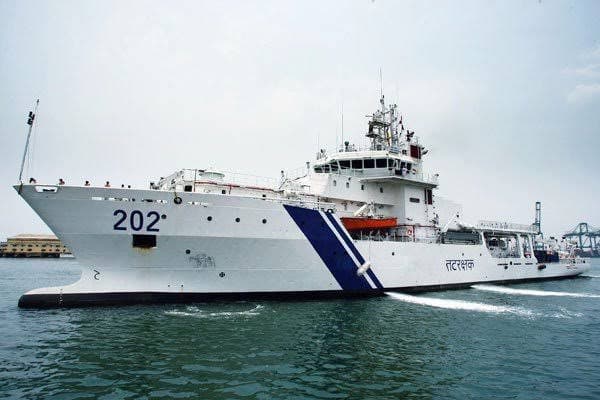
Naval support & landing craftIn service
Pollution control vessel
Samudra-class pollution control vessel is a pollution control vessel. It was built by ABG Shipyard. Reported operators include Indian Coast Guard.
 India
Samudra-class pollution control vessel
Indian Coast Guard · GODL-India · Resized · GODL-India · Source ↗ · ModifiedSamudra class
ABG Shipyard
Indian Coast Guard
GSL class
3
3
3
Pollution control vessel
3,946 t (3,884 long tons )
94 m (308 ft 5 in)
15.5 m (50 ft 10 in)
4.5 m (14 ft 9 in)
2 x Bergen Diesel B32, 40 L6P (3,000 kW (4,000 hp) each) 1 x 883 kW (1,184 hp) UlsteinAquamaster bow thruster
26 knots (48 km/h; 30 mph)
6,000 nmi (11,000 km; 6,900 mi)
20 days
10 officers and 100 sailors
1 × CRN 91 naval gun 2 × 12.7 mm HMG
The Samudra-class pollution control vessel is a class of three patrol vessels built by ABG Shipyard in Gujarat , India, for the Indian Coast Guard .
The ships have been designed by Rolls-Royce Holdings and have the type number UT 517. The vessels are 94 metres (308 ft 5 in) long, with a maximum draught of 4.5 metres (14 ft 9 in) and a displacement of 3,300 tonnes (3,200 long tons ). The vessels are designed to attain speed of 20.5 knots (38.0 km/h; 23.6 mph). They have an endurance of 6,500 nautical miles (12,000 km; 7,500 mi) nautical miles at economical speed and can stay at sea for 20 days. The ships are crewed by 10 officers and 100 sailors specialized in various streams.
The equipment on board is used for containment, recovery, separation and dispersal of pollutants. Control systems enable simultaneous tasks to be performed by a single operator. The vessel is fitted with latest pollution control equipment including two rigid sweeping arms enabling it to contain oil spill whilst in motion. An advanced software would assist in predicting the spread of the complex oil spill pattern. The vessel is designed to recover the lightest to the most viscous oil at the rate of 300 t (300 long tons; 330 short tons) per hour. The contaminated water can be pumped on board and analysed in a laboratory. The oil can then be separated and held in storage tanks of 300 t (300 long tons; 330 short tons) capacity or 1,000 t (980 long tons; 1,100 short tons) in inflatable barges which can be towed behind the vessel to free up deck space. The vessel is also equipped with firefighting and marine salvage systems.
Samudra class India 2010–present 3,960 tons 3
Samudra class India 2010–present 3,960 tons 3
Reference text from Wikipedia contributors, used under CC BY-SA 4.0.
True scale
Sourced dimensions beside a 1.75 m human reference.
Samudra-class pollution control vessel equipment records. Variants, orders and quantities are shown as reported in each inventory source; coverage is incomplete.
IndiaReported count for Samudra class. Service scope: Indian Coast Guard; does not replace a national total. 1 distinct count cell(s) from the same source list; shared rowspan cells counted once. Retired, wholly reserve and on-order rows are excluded; the reported count retains any explicitly mixed stock scope in the quoted row. Count column(s): vessels: 3. Origin: India. The listed variants/roles are the scope, not an immediately deployable count. The components do not establish one inventory census date; the stored date is the retrieved source snapshot.
Keep exploring
 Italy
 Spain
 United Kingdom
 Malaysia