FORCETALLY
Loading the evidence…
Preparing your view.


Preparing your view.
Small armsIn service
Sniper rifle
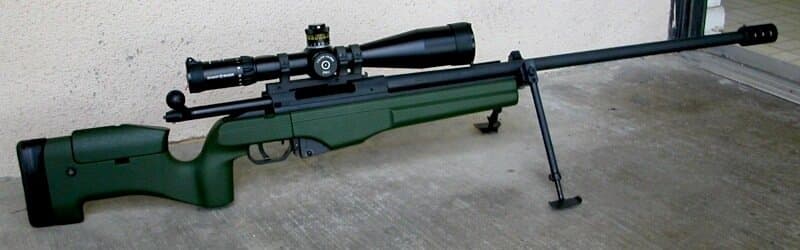
Sako TRG is a sniper rifle originating in Finland. It was built by Sako.
 Finland
Sako TRG
Francis Flinch at English Wikipedia · Public domain · Resized · Public domain · Source ↗ · ModifiedTechnical data
Sniper rifle
Finland
2000–present
See Users
War in Afghanistan (2001–2021) Iraq War Russian Invasion of Ukraine
1989 (TRG-21 / TRG-41) 1999 (TRG-22 / TRG-42) 2011 (TRG M10) 2024 (TRG-62 A1)
Sako
1989–1999 (TRG-21 / TRG-41) 1999–present (TRG-22 / TRG-42) 2011–present (TRG M10) 2024–present (TRG-62 A1)
See Variants
4.7 kg (10.4 lb) empty (TRG-22 black) 4.9 kg (10.8 lb) empty (TRG-22 green/tan/dark earth) 5.2 kg (11.5 lb) empty (TRG-22 fold. stock 510 mm barrel) 5.4 kg (11.9 lb) empty (TRG-22 fold. stock 660 mm barrel) 5.1 kg (11.2 lb) empty (TRG-42 black) 5.3 kg (11.7 lb) empty (TRG-42 green/tan/dark earth) 5.8 kg (12.8 lb) empty (TRG-42 fold. stock 690 mm barrel) 7.0 kg (15.4 lb) empty (TRG-62 A1)
1,000 mm (39.37 in) (TRG-22 510 mm barrel) 1,150 mm (45.28 in) (TRG-22) 1,020 mm (40.16 in) (TRG-42 folded stock 510 mm barrel) 1,200 mm (47.24 in) (TRG-42)
510 mm (20.08 in) (TRG-22 and TRG-42 folded stock) 660 mm (25.98 in) (TRG-22) 690 mm (27.17 in) (TRG-42)) 762 mm (30.00 in) (TRG-62 A1)
.260 Remington (TRG-22) 6.5mm Creedmoor (TRG-22 A1) .308 Winchester ( 7.62×51mm NATO ) (TRG-21, TRG-22) .300 Winchester Magnum (TRG-41, TRG-42) .338 Lapua Magnum (TRG-41, TRG-42) .375 CheyTac (9.5×77mm) (TRG-62 A1)
Bolt-action
800 m (875 yd) (TRG-22 .308 Winchester) 1,100 m (1,203 yd) (TRG-42 .300 Winchester Magnum) 1,500 m (1,640 yd) (TRG-42 .338 Lapua Magnum) 2,000 m (2,187 yd) (TRG-62 A1 .375 CheyTac)
5-round detachable box magazine (.338 Lapua Magnum) 7-round detachable box magazine (.300 Winchester Magnum and .375 CheyTac) 10-round detachable box magazine (.308 Winchester)
Aperture rear (with flip-up open tritium night/combat sight); day or night optics
The Sako TRG (short for Finnish : " T arkkuuskivääri R iihimäki G -sarja ", " Riihimäki Precision Rifle G-series") is a bolt-action sniper rifle line designed and manufactured by Finnish firearms manufacturer SAKO of Riihimäki .
The TRG-21 and TRG-22 (A1) are designed to fire standard .308 Winchester ( 7.62×51mm NATO ) sized cartridges, while the TRG-41 and TRG-42 (A1) are designed to fire more powerful and dimensionally larger .300 Winchester Magnum (7.62×67mm) and .338 Lapua Magnum (8.6×70mm) cartridges. They are available with olive drab green, desert tan/coyote brown , dark earth or black stocks, and are also available with a folding stock . The TRG-62 A1 was added to the product range as the third and largest iteration, designed to fire the even more powerful and dimensionally larger .375 CheyTac (9.5×77mm) cartridge.
Even though the TRG-21 obtained its origins from the successful Sako TR-6 target rifle and 1984–1986 development work for the hardly produced Valmet Sniper M86 rifle by the former Finnish state firearms company Valmet which merged with Sako, the 4.7 kg (10 lb 6 oz) TRG-21 was designed as a result of a thorough study of sniper requirements.
In 1989 Sako Ltd. (Riihimäki, Finland) introduced the TRG-21 precision rifle as a sniper rifle model chambered in .308 Winchester . With the introduction of the TRG bolt-action , Sako moved away from the modified two-lug Mauser bolt-actions, favoured during the past, to an action with a symmetrical three-lug bolt of 19 mm (0.75 in) diameter, displaying a locking surface of 75 mm 2 (0.116 in 2 ). The TRG-21 action was designed for a maximum cartridge length of 75 mm (2.95 in). The evolution of this design continues to the present and can be found in Sako's hunting rifle offerings, the Sako 75 and the Sako 85. Subsequently, a second precision/sniper rifle with a 20 mm (0.79 in) longer scaled up magnum action emerged as the TRG-41 in order to take advantage of the .338 Lapua Magnum cartridge.
A more hunting oriented variation of the TRG was introduced in 1992 as the TRG-S M995 and TRG-S M995 Magnum, which both use the same scaled up magnum action and bolt (different bolt handle) as the TRG-41 with the exception that the receiver is open at the top with an integral Sako-type wedged dovetail rail rather than possessing a cartridge ejection port on the right side and a parallel 17 mm (0.67 in) integral dovetail rail as found with the TRG-41.
All TRG-S M995 rifles utilized the same stock and receiver designed for a maximum cartridge length of 95 mm (3.74 in).
A carbine variant of the TRG-S was also produced that according to Sako literature featured a 520 mm (20.5 in) long barrel.
However, M995 carbines imported to the United States featured a 495 mm (19.5 in) barrel and were chambered in .375 H&H Magnum only.
Sako planned to produce a short action TRG-S M975 designed for a maximum cartridge length of 75 mm (2.95 in), that would have been based on the TRG-21.
The bolts of the TRG A1 models all feature double plunger ejectors introduced earlier for the .338 Lapua Magnum TRG-42 and the TRG-22 A1 model expands the chambering palette with 6.5mm Creedmoor .
In 2024 the TRG-62 A1 was added to the A1 range as the third and largest iteration, as its action was designed for a maximum cartridge length of well over 95 mm (3.74 in).
The up to 113.40 mm (4.46 in) long .375 CheyTac (9.5×77mm) cartridge was selected and introduced to the TRG range to extend the achievable effective range up to 2,000 m (2,187 yd), without having to deal with substantial bolt thrust or breech pressure increase related drawbacks.
The TRG-62 A1 uses the trigger unit used in the A1 range and TRG-10 and 350 or 380 gr (22.7 or 24.6 g) 9.5×77mm associated ammunition.
The muzzle brake was revised to a four-chamber set up for the new dimensionally larger and more powerful 9.5×77mm chambering.
A future TRG-62 A1 variant chambered for the up to 115.50 mm (4.55 in) long .408 CheyTac (10.36×77mm) cartridge is under development.
Sako never totally forgot the target rifle origins of the TRG system. The necessary accessories to attach sighting components such as match grade peep sights or target aperture sights and a mirage strap are all available. Equipped with these accessories the TRG can be used for non military or law enforcement tasks such as 300 m UIT standard rifle competition, CISM competition or other kinds of full bore target shooting. The rifle is commonly seen in long-range competition where it has done very well. Besides civilian target shooting the TRG system can and is sometimes used for hunting.
The "resistance free" bolt has three massive lugs and requires a 60-degree bolt rotation and a 98 mm (3.86 in) bolt throw for the short and 118 mm (4.65 in) bolt throw for the long bolt-action; these features should be appreciated by the shooter during multiple firings that require rapid projectile placement on the target.
On top of the receiver a 17 mm (0.67 in) integral dovetail rail with shape connection drillings for one or more recoil lugs provides for fixing mounting components to accommodate different types of optical or electro-optical sights.
The free-floating , heavy, chrome moly barrels ( chrome moly barrels resist throat erosion better offering a longer accuracy life than stainless steel barrels ) for the available cartridge chamberings all have a different length, groove cutting and rifling twist rate optimised for their respective chambering and intended ammunition. The .260 Remington, .308 Winchester, .300 Winchester Magnum and .338 Lapua Magnum chamberings are available with barrels of common length for sniper rifles and relatively short 510 mm (20.08 in) long barrels. On special order TRG sniper rifles can also be supplied with stainless steel barrels. Two types of flash eliminator/muzzle brakes are available as an accessory with one being threaded to accommodate a sound-suppressor.
For the .260 Remington chambering a non-traditional 203 mm (1 in 8 inch) or 31.2 calibres right-hand twist rate optimised to stabilise longer, heavier very-low-drag bullets was selected over the standard 229 mm (1 in 9 inch) or 35.2 calibres twist rate. The TRG-22 can be ordered cambered for the .260 Remington cartridge as of May 2011. The introduction of the .260 Remington (6.5×51mm) chambering does not introduce major technical changes for the TRG system since the .260 Remington is essentially a necked down 6.5 mm (.264 in) variant of the .308 Winchester (7.62×51mm) cartridge, meaning these cartridges can be used in .308 Winchester chambered rifles only requiring different barrels.
The 6.5 Creedmoor chambering has the traditional 203 mm (1 in 8 inch) or 31.2 calibres right-hand twist rate shares the relative ease of chambering it in arms designed for .308 Winchester sized cartridges, though the 6.5 Creedmoor (6.5×49mm) maximal overall length is 0.64 mm (0.025 in) longer compared to the .308 Winchester.
For the .308 Winchester chambering the 280 mm (1 in 11 inch) or 36.7 calibres right-hand twist rate with four grooves was selected over the 305 mm (1 in 12 inch) or 40 calibres, traditionally found for the .308 Winchester, as a compromise when switching between supersonic and subsonic cartridges.
The .300 Winchester Magnum chambering also has a non-traditional 280 mm (1 in 11 inch) or 36.7 calibres right-hand twist rate. Due to the .300 Winchester Magnum cartridge dimensions it is a long TRG-41/TRG-42 bolt-action chambering.
For the .338 Lapua Magnum chambering a non-traditional 305 mm (1 in 12 inch) or 36.4 calibres right-hand twist rate was selected to optimise the rifle for firing 16.2 gram (250 grain) .338-calibre very-low-drag bullets. As of 2009 .338 Lapua Magnum barrels can also be supplied with a 254 mm (1 in 10 inch) or 30.3 calibres twist rate optimised to stabilise longer, heavier very-low-drag bullets like the Sierra HPBT MatchKing and Lapua Scenar .338-calibre 19.44 gram (300 grain) bullets. The traditional 254 mm (1 in 10 inch) has since become the standard twist rate for the .338 Lapua Magnum chambering. Due to the .338 Lapua Magnum cartridge dimensions it is a long TRG-41/TRG-42 bolt-action chambering.
The two-stage trigger mechanism displays an adjustable trigger pull weight of 1 to 2.5 kgf (2.2 to 5.5 lbf) and can be adjusted for length, horizontal and vertical pitch. The advantage of these features is to prevent trigger movement in an inappropriate direction that would cause the rifle to move off target. Trigger travel is short with no noticeable over-travel. The trigger mechanism can be removed without additional disassembling of the rifle. The firing pin travel is 6.5 mm (0.26 in). The trigger guard is dimensioned to allow easy access with gloved fingers.
The safety lever is located in front of the trigger inside of the trigger guard and can be operated without producing mechanical noise. The two-position safety locks the trigger mechanism, locks the bolt in closed position and blocks the firing pin . The safety is on when it is in its rearmost position. It is off when it is pushed to its most forward position. When the weapon is cocked the firing pin protrudes 1.6 mm (0.06 in) from the rear of the bolt-action, making it possible to feel if the weapon is ready to fire or not in poor visibility.
The TRG stock design is besides sniping requirements, designed to conform to both UIT and CISM regulations. Sako offers black, green, desert tan or dark earth coloured stock variants and the green, desert tan or dark earth stock variants are 0.2 kg (0.4 lb) heavier than the black variants. In 2011 Sako also began offering stocks in several styles of digital camouflage . The base of the ergonomic injection-moulded polyurethane forestock is made of aluminium and encompasses the bedding block with the bedding block serving as a point of attachment for a bipod. The polyurethane buttstock with its pistol grip and integrated aluminium skeleton to add strength, is designed for right- and left-handed shooters. The rear of the buttstock possesses a series of spacer and angle plates to regulate the length of pull and curvature adjustments that can be tailored for the individual shooter. The buttplate is adjustable for both height and pitch. Finally, the cheek-piece is adjustable for both height and pitch as well.
A folding skeleton type buttstock designed for right- and left-handed shooters is also available. The folding stock is 0.5 kg (1.1 lb) heavier than the non-folding green, desert tan or dark earth stock variants and is hinged behind the pistol grip; it folds to the left side and locks into position. When folded, the rifle becomes 250 mm (9.84 in) shorter. The steel parts of the folding stock are manganese phosphatised and the polyurethane parts are coloured olive drab or desert tan. The rear of the buttstock is adjustable for length of pull and height. The cheek-piece and rear support are also adjustable for height. These adjustment options allow shooters of various sizes and shapes to tailor the TRG folding stock to their personal preferences, which is an uncommon feature for folding stocks. The pistol grip body has a steel loop for a hook type military sling swivel. Sako TRG folding stock rifles are supplied with a Picatinny rail for mounting aiming optics.
The Sako TRG-21 (1989) is designed to chamber the .308 Winchester (7.62×51mm NATO) cartridge.
The Sako TRG-22 (1999) is an upgraded and improved variant of the TRG-21 with a new stock design and a maximum cartridge length of 75 mm (2.95 in). An American Sako vendor also commissioned a special limited production run of the TRG-22 chambered in .260 Remington cartridge.
The Sako TRG-42 (1999) is an upgraded and improved variant of the TRG-41 with a new stock design and a maximum cartridge length of 95 mm (3.74 in).
The Sako TRG-62 A1 (2024) is a variant for longer range chambered for .375 CheyTac (9.5×77mm).
The Sako TRG M10 Sniper Weapon System was unveiled by Sako in October 2011. It was designed as a user configurable modular system and does not share its receiver and other technical features with the preceding models in the Sako TRG line. It can switch between .308 Winchester (7.62×51mm NATO), .300 Winchester Magnum and .338 Lapua Magnum chamberings by changing the bolts, magazines, forends and barrels, to adapt to various requirements in the field. When it was first introduced, it was marketed for "military and law enforcement only".
The TRG M10 is a manually operated bolt action sniper rifle that uses a rotary bolt with three radial locking lugs at the front. It features a steel receiver, a Picatinny rail on top of its receiver for mounting various optical sights and on the stock bottom for bipod mounting. The barrel is a free floating barrel that can be equipped with special muzzle brakes that have a mounting interface for quick detachable suppressors. It is offered in various barrel lengths of 16-, 20- and 26-inch for the .308 Winchester (7.62×51mm NATO), 23.5- and 27-inch for the .300 Winchester Magnum, and 20- and 27-inch for the .338 Lapua Magnum. Ammunition feeding is by a double-stack detachable box magazine which is marked with appropriate number of large dots that are embossed into the sides of the polymer baseplate and that holds 11 rounds of .308 Winchester (7.62×51mm NATO), 7 rounds of .300 Winchester Magnum, or 8 rounds of .338 Lapua Magnum. Alternatively, cartridges can be singly loaded directly into the chamber.
A 2019 TRG M10 spare parts catalologue offered accessories in black or coyote brown coloured surface finishes and accessories for using the 6.5mm Creedmoor and .300 Norma Magnum chamberings.
6.5 Creedmoor , .260 Remington , .308 Winchester / 7.62×51mm NATO
Reference text from Wikipedia contributors, used under CC BY-SA 4.0.
True scale
Sourced dimensions beside a 1.75 m human reference.
See it in your room. Scan with your phone to open this model in 3D, then place it in your space.
Points represent sourced observations, including revisions. Revisions on the same effective date are not separate inventory events. Ranges appear in the table and are not plotted as exact points.
| Observation / report period | Value | Source | Claim state |
|---|---|---|---|
| 28 Sept 2026 | 0.51 m | Wikipedia contributors | superseded |
| 28 Sept 2026 | 0.51 m | Wikipedia contributors | superseded |
| 28 Sept 2026 | 0.51 m | Wikipedia contributors | superseded |
| 28 Sept 2026 | 0.51 m | Wikipedia contributors | approved |
Sako TRG equipment records. Variants, orders and quantities are shown as reported in each inventory source; coverage is incomplete.
 Albania
 Armenia
 Azerbaijan
 Bulgaria
 Canada
Number column of the Wikipedia list table under "Sniper rifles". The list's own wording applies; it is a compiled secondary source, not an official census.
 Croatia
 Czechia
 Denmark
 Estonia Finland
 France
 Georgia
 Greece
 Indonesia
 Italy
 Jordan
 Lithuania
 Malaysia
 North Macedonia
 Poland
Reported count for Sako TRG · TRG M10 · TRG M10. Service scope: Polish Land Forces; does not replace a national total. 1 distinct quantity component(s) from the same source list; shared rowspan cells counted once. Explicit source inventory scope: total; no other stock status or total inferred. Count column(s): quantity: 150. Origin: Finland. The listed variants/roles are the scope, not an immediately deployable count. Explicitly named source subset; this is not a whole-family total and does not cover other listed designs. The components do not establish one inventory census date; the stored date is the retrieved source snapshot.
 Serbia
 Singapore
 Slovakia
 Slovenia
 Sweden
 Türkiye
 Ukraine
Reported count for Sako TRG · TRG-22 · TRG-22. Service scope: Polish Land Forces; does not replace a national total. 1 distinct quantity component(s) from the same source list; shared rowspan cells counted once. Explicit source inventory scope: total; no other stock status or total inferred. Count column(s): quantity: 206. Origin: Finland. The listed variants/roles are the scope, not an immediately deployable count. Explicitly named source subset; this is not a whole-family total and does not cover other listed designs. The components do not establish one inventory census date; the stored date is the retrieved source snapshot.
Reported count for Sako TRG · TRG-21 · TRG-21. Service scope: Polish Land Forces; does not replace a national total. 1 distinct quantity component(s) from the same source list; shared rowspan cells counted once. Explicit source inventory scope: total; no other stock status or total inferred. Count column(s): quantity: 40. Origin: Finland. The listed variants/roles are the scope, not an immediately deployable count. Explicitly named source subset; this is not a whole-family total and does not cover other listed designs. The components do not establish one inventory census date; the stored date is the retrieved source snapshot.
 United Kingdom
 Germany
 Austria