FORCETALLY
Loading the evidence…
Preparing your view.


Preparing your view.
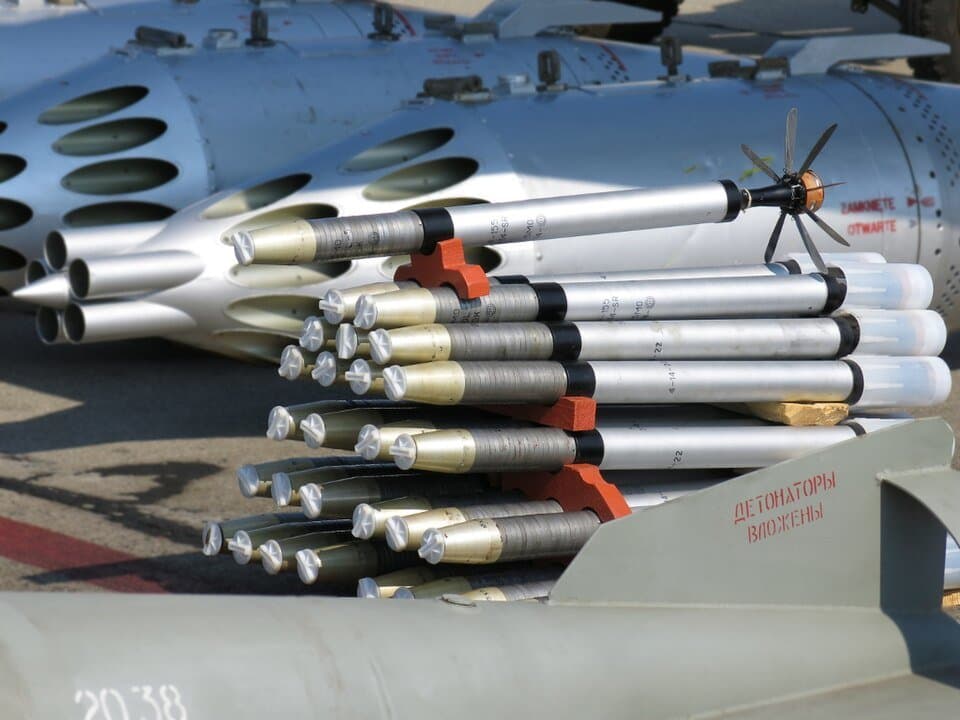
Rockets & launchersIn service
rocket weapon
S-5 rocket is a rocket weapon.
Technical data
True scale
Sourced dimensions beside a 1.75 m human reference.
Points represent sourced observations, including revisions. Revisions on the same effective date are not separate inventory events. Ranges appear in the table and are not plotted as exact points.
| Observation / report period | Value | Source | Claim state |
|---|---|---|---|
| 1 Oct 2026 | 55 mm | Wikipedia contributors | superseded |
| 1 Oct 2026 | 55 mm | Wikipedia contributors | approved |
The S-5 (first designated ARS-57 ) is a rocket weapon
developed by the Soviet Air Force
It is in service with the Russian Aerospace Forces and various export customers.
Each rocket is about 1.4 meters (4 feet 7 inches) long
weighs about 5 kg (11 lb), depending on warhead and fuze
Range is 3 to 4 kilometres (1.9 to 2.5 mi)
The S-5 is a 55 mm (2.2 in) calibre unguided rocket
calibre unguided rocket
It is used by fighter bombers and helicopters
a steel body containing a solid fuel rocket
It is produced in a variety of sub-types with different warheads , including HEAT anti-armour (S-5K), high-explosive fragmentation (S-5M/MO), smoke, and incendiary rounds. Each rocket is about 1.4 meters (4 feet 7 inches) long and weighs about 5 kg (11 lb), depending on warhead and fuze. Range is 3 to 4 kilometres (1.9 to 2.5 mi).
In 1946 the Soviet Nudelman Precision Engineering Design Bureau (then designated OKB-16) undertook technical research of unguided air to air missiles in aircraft armament. As part of the bureaus research, captured examples of the German 55mm R4M "Orkan" (Engl: Hurricane) unguided air to air missile were closely studied. After 5 years, the Soviet ministry of defense finally provided official status and funding of the project in 1951, originally as part of the air-to-air AS-5 weapon system for the MiG-19 . The rockets were tested in a series of configurations on MiG-15bis and MiG-17 jets, with the final tests complete on a MiG-17 PF in January 1955. The tests revealed that the rockets did not perform as expected against aerial targets. The rocket ARS-57 was accepted into service in April 1955, with a military designation S-5.
In late 2019, Russia announced it would resume production of the S-5 rocket for the first time since production ceased in 1990. The improved S-5U is 1,090 mm (3.58 ft) long and weighs 6 kg (13 lb), making it longer and heavier than the previous S-5M, though it is compatible with older rocket pods. It runs on composite propellant rather than a solid fuel motor and is spin-stabilized through four curved fins wrapped around the rocket nozzle to match its diameter when stored. Effective range remains between 0.5–4 km (0.31–2.49 mi), but lethality is increased by a heavier 0.8 kg (1.8 lb) warhead. It features a universal warhead that can penetrate 150 mm (5.9 in) of armor, explode into 500 2 g (0.071 oz) splinters, and has incendiary elements; combat efficiency is claimed to be comparable to the S-8 rocket .
The S-5 is a 55 mm (2.2 in) calibre unguided rocket fired from a 57 mm calibre tube. It is used by fighter bombers and helicopters . It consists of a steel body containing a solid fuel rocket, and a high-explosive warhead with a mechanical impact fuse. At the rear of the rocket is an elongated exhaust nozzle, with eight attached forward folding fins. The fins fold around the rocket when it is stowed in its launch tube; they spring back as soon as the rocket leaves the launch tube. In flight, the very slightly angled fins exert a stabilizing spin to the rocket, turning at approximately 750 rpm. The solid rocket motor burns for just 1.1 seconds, during which time it covers about 300 meters (980 feet).
The S-5 is carried in rocket pods, with between four and 32 rockets. The first were ORO-57 launchers , made in variants with capacity of four, eight and 16 rockets. The most typical became the ORO-57K for eight rockets, used especially on the MiG-19 . Then, beginning in the early 1960s, the typical launcher became the UB-16-57 , with 16 rockets, developed in several variants, for helicopters and planes. UB stands for "universal block" ( universalnyi blok ), as it could be carried on conventional bomb hardpoints, "57" refers to the actual diameter of the launch tube (the diameter of the rocket plus 2 mm). The first variant and UB-16-57U had a conical forward part while the next variant UB-16-57D had a blunt forward part. Starting in 1968, the UB-16-57UMP variant was produced, with a conical forward part and five protruding inner tubes. In the 1970s, the UB-32 was developed with 32 rockets, carried by heavier aircraft.
The 57mm S-5 rockets were used by the Pakistan Air Force with their Shenyang F-6s against Indian ground targets at Shakargarh sector during the Battle of Shakargarh in 1971. In total, 188 rockets were fired from the F-6s ORO-57K launcher.
The 57mm rockets were used during Russian invasion of Ukraine as improvised ground-launched MLRS (multiple launch rocket system) by the Ukrainians. On 18 June 2023, a Russian BTR-80 APC that had two UB-32 rocket pods attached to it was sighted and damaged by loitering drones . In 2026, FP-2 drones equipped with 8 rockets began being used.
length × diameter: 1,447 × 220 mm
weight, empty: 33 kg
weight, loaded: 74 kg
length × diameter: 1,880 × 335 mm
weight, empty: 57 kg
weight, loaded: 138 kg
length × diameter: 2,080 × 481 mm
weight, empty: 103 kg
weight, loaded: 264 kg
rockets: 8
rockets: 16
rockets: 32
Soviet Union 0 references
country of origin Soviet Union 1 reference imported from Wikimedia project Ukrainian Wikipedia Wikimedia import URL https://uk.wikipedia.org/w/index.php?title=НАР_С-5&oldid=19447717
country of origin Soviet Union 1 reference imported from Wikimedia project Ukrainian Wikipedia Wikimedia import URL https://uk.wikipedia.org/w/index.php?title=НАР_С-5&oldid=19447717
S-5 Soviet Union 57 mm Also used in a ground-ground multiple rocket launcher role.
S-5 rocket Rocket USSR S-5 is carried by Vietnamese Mi-8/17, Su-22 or L-39/L-39NG. Additionally, the S-5 is also used on Yak-130, but it is rarely used.
Reference text from Wikipedia contributors, used under CC BY-SA 4.0.
S-5 rocket equipment records. Variants, orders and quantities are shown as reported in each inventory source; coverage is incomplete.
 Georgia
 Serbia
 Ukraine
 Vietnam