Design and configuration
A bulbous forward fuselage houses equipment while a dorsal engine intake leads to the rear-mounted turbofan. The slender wing spans much farther than the fuselage length.1


Preparing your view.

Drones & UAVsIn serviceProfile in progress
The RQ-4B is a large high-altitude remotely piloted reconnaissance aircraft. Its long wing and jet propulsion support prolonged wide-area surveillance missions.
 United States
Northrop Grumman RQ-4 Global Hawk
U.S. Air Force photo by Bobbi Zapka · Public domain · Resized · Public domain · Source ↗ · ModifiedTechnical data
No check recorded yet.
No check recorded yet.
No check recorded yet.
No check recorded yet.
No check recorded yet.
Unmanned surveillance and reconnaissance aerial vehicle
United States
Northrop Grumman
In service
United States Air Force NASA NATO
42 RQ-4Bs as of FY2013
1998–present
November 2001
28 February 1998
Northrop Grumman MQ-4C Triton
0 onboard (3 remote: Launch and Recovery Element (LRE) pilot; Mission Control Element (MCE) pilot and sensor operator)
3,000 lb (1,360 kg)
47 ft 7 in (14.5 m)
130.9 ft (39.9 m)
15.3 ft (4.7 m)
14,950 lb (6,781 kg)
32,250 lb (14,628 kg)
1 × Rolls-Royce F137-RR-100 turbofan engine, 7,600 lbf (34 kN) thrust
391 mph (629 km/h, 340 kn)
357 mph (570 km/h, 310 kn)
14,200 mi (22,800 km, 12,300 nmi)
34+ hours
60,000 ft (18,000 m)
33
Reference text from Wikipedia contributors, used under CC BY-SA 4.0.
The system in detail
A bulbous forward fuselage houses equipment while a dorsal engine intake leads to the rear-mounted turbofan. The slender wing spans much farther than the fuselage length.1
Sensor arrangements differ between blocks, including radar and other intelligence systems. Ground control, communications and processing are part of the overall system.1
This profile covers RQ-4B. Fleet reductions and block retirements must be dated; the Navy MQ-4C Triton should not be counted as the same variant.1
Compare sensor fit, altitude and useful collection time. Aircraft endurance does not directly describe data-processing capacity, weather penetration or fleet readiness.1
Visual reference
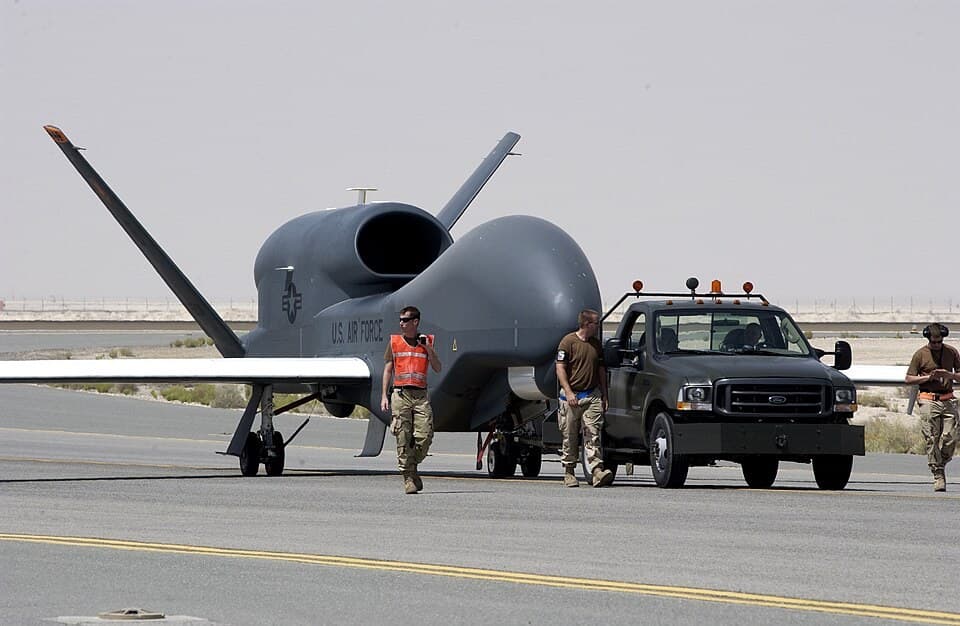
A Global Hawk maintenance team tows an unmanned Global Hawk aircraft at a theater in Southwest Asia. The aircraft has collected more than 96 percent of the target deck – nearly five thousand images of enemy locations, resources and personnel. Historical equipment reference photograph. It does not establish current availability or every detail of the named variant.
Staff Sgt. Christopher Matthews · Public domain · Wikimedia Commons · Public domain · Source ↗ · ModifiedRQ-4 Global Hawk equipment records. Variants, orders and quantities are shown as reported in each inventory source; coverage is incomplete.
 Bulgaria
Number column of the Wikipedia list table under "NATO shared aircraft". The list's own wording applies; it is a compiled secondary source, not an official census.
 Denmark
Number column of the Wikipedia list table under "Reconnaissance and survaillance". The list's own wording applies; it is a compiled secondary source, not an official census.
 Germany
Reported count for Northrop Grumman RQ-4 Global Hawk · RQ-4D Phoenix (Block 40). Service scope: Aircraft of the German Air Force; does not replace a national total. 1 distinct quantity component(s) from the same source list; shared rowspan cells counted once. Explicit source inventory scope: active; no other stock status or total inferred. Count column(s): in service: 5. Origin: United States. The listed variants/roles are the scope, not an immediately deployable count. The components do not establish one inventory census date; the stored date is the retrieved source snapshot.
 Japan
Air Self-Defense Force exact named equipment holdings: RQ-4B Global Hawk. Active, operational-reserve and training units excluding equipment in store; November 2025 IISS assessment. Named service only; no parent-force or national total inferred. Source role: UNINHABITED AERIAL VEHICLES / Heavy. Original estimates, ranges, reporting names, reserve, lease and employment scopes retained; nested included counts are not added. Missile-system quantities mean launchers, not rounds. No readiness, crew, carried weapon, payload, factory-production or future order count inherited.
 Luxembourg
 Montenegro
NATO Alliance Ground Surveillance exact named equipment holdings: RQ-4D Phoenix. Active, operational-reserve and training units excluding equipment in store; November 2025 IISS assessment. Named service only; no parent-force or national total inferred. Source role: UNINHABITED AERIAL VEHICLES / Heavy. Original estimates, ranges, reporting names, reserve, lease and employment scopes retained; nested included counts are not added. Missile-system quantities mean launchers, not rounds. No readiness, crew, carried weapon, payload, factory-production or future order count inherited.
 Romania
 South Korea
Air Force exact named equipment holdings: RQ-4B Global Hawk. Active, operational-reserve and training units excluding equipment in store; November 2025 IISS assessment. Named service only; no parent-force or national total inferred. Source role: UNINHABITED AERIAL VEHICLES / Heavy. Original estimates, ranges, reporting names, reserve, lease and employment scopes retained; nested included counts are not added. Missile-system quantities mean launchers, not rounds. No readiness, crew, carried weapon, payload, factory-production or future order count inherited.
United StatesUS Air Force (USAF) exact named equipment holdings: RQ-4B Global Hawk. Active, operational-reserve and training units excluding equipment in store; November 2025 IISS assessment. Named service only; no parent-force or national total inferred. Source role: UNINHABITED AERIAL VEHICLES / Heavy. Original estimates, ranges, reporting names, reserve, lease and employment scopes retained; nested included counts are not added. Missile-system quantities mean launchers, not rounds. No readiness, crew, carried weapon, payload, factory-production or future order count inherited.