FORCETALLY
Loading the evidence…
Preparing your view.


Preparing your view.
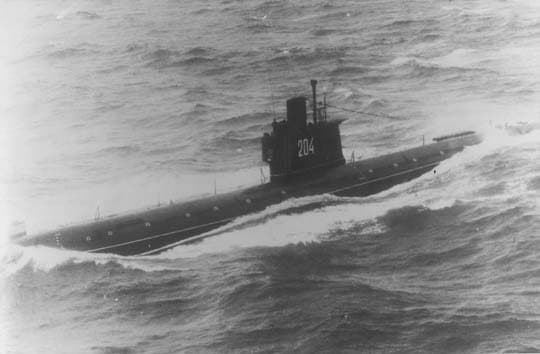
SubmarinesIn service
class of Soviet diesel-electric submarine ,
Romeo-class submarine is a class of Soviet diesel-electric submarine ,. It was built by Krasnoye Sormovo Shipyard , Gorky Wuchang Shipyard ( Wuhan ) Guangzhou Shipyard ( Canton ) Jiangnan Shipyard ( Shanghai ) Bohai Shipyard ( Huludao ) Mayang-do Naval Shipyard ( North Korea ) - Assembly site of North Korean kits from China .. Reported operators include Soviet Navy (Historical) People's Liberation Army Navy (Historical) Korean People's Navy Bulgarian Navy (Historical) Syrian Navy (Historical) Egyptian Navy Algerian National Navy (historical).
Romeo-class submarine
photograph was taken by the US navy · Public domain · Resized · Public domain · Source ↗ · ModifiedTechnical data
Krasnoye Sormovo Shipyard , Gorky Wuchang Shipyard ( Wuhan ) Guangzhou Shipyard ( Canton ) Jiangnan Shipyard ( Shanghai ) Bohai Shipyard ( Huludao ) Mayang-do Naval Shipyard ( North Korea ) - Assembly site of North Korean kits from China .
Soviet Navy (Historical) People's Liberation Army Navy (Historical) Korean People's Navy Bulgarian Navy (Historical) Syrian Navy (Historical) Egyptian Navy Algerian National Navy (historical)
Whiskey-class submarine
Foxtrot-class submarine Type 035 submarine
133
109
2
1,475 tons surfaced 1,830 tons submerged
76.6 m (251 ft 3 in)
6.7 m (22 ft)
5.2 m (17 ft 1 in)
Two diesels delivering 2.94 MW (4000 shp) with two electric motors driving two shafts.
15.2 knots (28.2 km/h) surfaced 13 knots (24 km/h) submerged
14,484km (9,000 miles) at 9 knots (17 km/h)
True scale
Sourced dimensions beside a 1.75 m human reference.
See it in your room. Scan with your phone to open this model in 3D, then place it in your space.
Points represent sourced observations, including revisions. Revisions on the same effective date are not separate inventory events. Ranges appear in the table and are not plotted as exact points.
| Observation / report period | Value | Source | Claim state |
|---|---|---|---|
| 28 Sept 2026 | 6.7 m | Wikipedia contributors | superseded |
54 men (10 officers)
sonar and radar
MRP 11-14
8 × 533 mm (21 in) torpedo tubes. Six located in the bow and two in the stern. 14 × 533 mm (21 in) anti-ship or anti-submarine torpedoes (including Yu-4 and Yu-1 torpedoes) or 28 mines
Egypt operates four of an original eight Romeo class submarines that are upgraded variants of the Chinese design.
North Korea operates 20 Romeo class submarines. Seven were imported from China between 1973 and 1975, and the remainder locally assembled with Chinese supplied parts between 1976 and 1995. One apparently sank in an accident in 1985. Four Chinese imported units are based on the western coast.
Algeria had two Romeo class ex-Soviet Navy submarines: S-10 and S-11. Delivered in 1982 and in 1983, they were decommissioned in 1989 and scrapped.
Bulgaria operated four Romeo class submarines (S-81 Pobeda , S-41 Viktoriya , S-83 Nadezhda , S-84 Slava ). All have been decommissioned: Pobeda in 1990, Viktoriya in 1992, Nadezhda in 2008, and Slava in 2011. All but Slava were scrapped. Slava is conserved as a museum ship, moored at Beloslav .
China has operated an estimated 84 of the Type-33 submarine (Romeo) during the Cold War.
Russia and the Soviet Union had 20 Romeo class vessels in service. These vessels are no longer used as combat vessels in the Russian Navy , although one or two may used as immobile training facilities.
Syria received three Romeo class submarines built in 1961 from the Soviet Navy: S-1, S-53, S-101. All were decommissioned in the mid 1990s and sold for scrap in 1996.
The Project 633 class (known in the West by its NATO reporting name as the Romeo class ) is a class of Soviet diesel-electric submarine , built between 1957 and 1961.
ES5A : Upgraded Type 033, with improvements mainly involving the replacement of equipment of Soviet origin with domestic Chinese systems, which includes: QZHA―10 (Type 779) attack periscope and QDYA―10 (Type 778) general purpose periscope. Addition of H/SQG-2 ranging sonar, Type 063 communication systems, and countermeasure systems. Domestic Chinese Type 801 sonar replaced the original Soviet MARS-24 sonar. The only difference between the Type 801 sonar and the MARS-24 sonar is that there are 24 transducer elements for the Type 801 as opposed to 12 in the original MARS 24, so the Chinese sonar had better accuracy. Domestic Chinese H/SQZ-D reconnaissance sonar (with Type 105 transducers) replaced the original Soviet system, the performance of the SQZ-D is almost identical to the original Soviet sonar it was developed from, except for the sector of scan, which is increased by 15 degrees. Additional noise reduction measures were also adopted. This is the type China originally sold to Egypt in the 1980s.
Type 033G : Development of the ES5A, with the incorporation of the capability to launch acoustic homing torpedoes ; analog computers installed to achieve automation of, and speeding up of, torpedo fire control calculations that were previously manually calculated. All Chinese Romeos were converted to this standard. The NATO reporting name for this type is rumored to be the Wuhan class .
Type 033G1 : A single Type 033G was modified to carry 6 YJ-1 (CSS-N-4) anti-ship missiles, this variant is called Type 033G1, with the rumored NATO reporting name of Wuhan A . The missile had to be fired while the boat was surfaced, with a total exposure time on the surface of less than 7 minutes. The most significant improvement, however, is the reduction of noise level by 12 dB.
ES5B : Development of the Type 033G, primarily intended for export. This is an upgrade package for Romeo submarine users. The primary improvement of this class is the ability to launch wire guided torpedoes and anti-ship missiles (AShM) while submerged. The program originally began in the mid-1980s, and Egypt was reported to be the only customer when China won a contract to upgrade its Romeo-class submarine fleet, including both Soviet built and Chinese built units. This is the last type of Chinese Romeo class submarine; with noise reduction of 20 dB to 140 dB in comparison to the 160 dB of the original Soviet Project 633 submarines acquired by China.
{"datatype": "wikibase-item", "datavalue": {"type": "wikibase-entityid", "value": {"entity-type": "item", "id": "Q15180", "numeric-id": 15180}}, "hash": "128186894bf5c025c6a6a74248caa5aefad97f59", "property": "P495", "snaktype": "value"}
Reference text from Wikipedia contributors, used under CC BY-SA 4.0.
Romeo-class submarine equipment records. Variants, orders and quantities are shown as reported in each inventory source; coverage is incomplete.
 China
 Egypt
Naval inventory of the source class and listed configurations; excludes orders and construction. Source-year holdings, not immediately deployable strength.
 North Korea
Navy exact named equipment holdings: Type-033 (Romeo). Active, operational-reserve and training units excluding equipment in store; November 2025 IISS assessment. Named service only; no parent-force or national total inferred. Source role: SUBMARINES / SSK. Original estimates, ranges, reporting names, reserve, lease and employment scopes retained; nested included counts are not added. Missile-system quantities mean launchers, not rounds. No readiness, crew, carried weapon, payload, factory-production or future order count inherited.
Soviet Navy (Historical) People's Liberation Army Navy (Historical) Korean People's Navy Bulgarian Navy (Historical) Syrian Navy (Historical) Egyptian Navy Algerian National Navy (historical)
Equipment reference ↗Keep exploring
Diesel-electric submarine
 United States
Diesel-electric submarine
United StatesDiesel-electric submarine
 Australia
Diesel-electric attack submarine
 Netherlands
Diesel-electric attack submarine
 Taiwan
Diesel-electric attack submarine
Taiwan