FORCETALLY
Loading the evidence…
Preparing your view.


Preparing your view.
Protective equipmentIn service
Future soldier program
Ratnik (program) is a future soldier program originating in Russia. It was built by TsNIITochMash. Reported operators include Egypt, Fiji, Russia.
 Russia
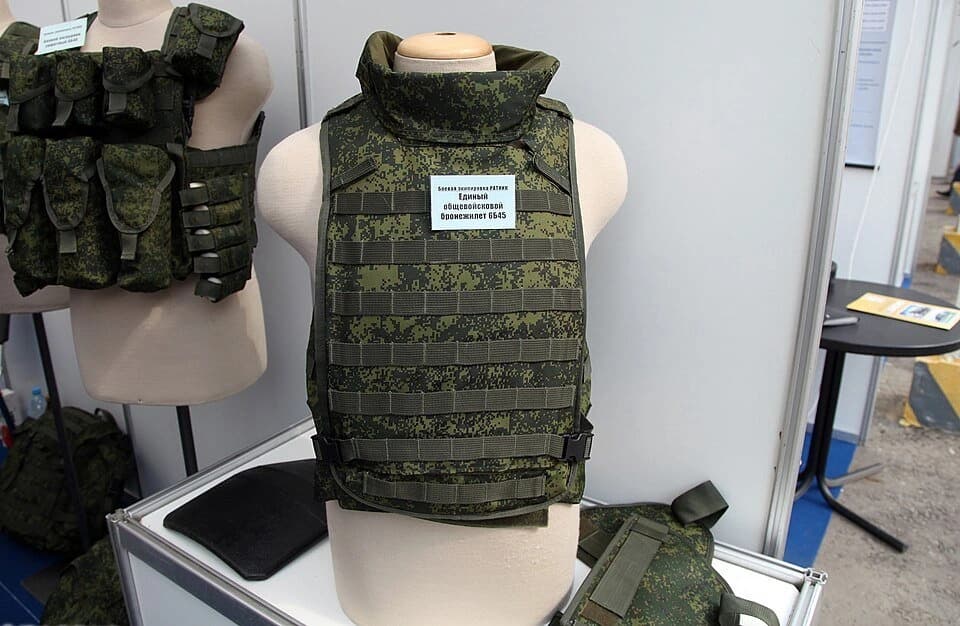
6B45 body-armour vest, a protective component of the Ratnik equipment system; the photograph does not show the complete soldier kit.
Vitaly V. Kuzmin · CC BY-SA 4.0 · Resized / optimised · CC BY-SA 4.0 · Source ↗ · ModifiedFuture soldier program
Russia
2015–present
See Users
Annexation of Crimea by the Russian Federation Syrian civil war Russo-Ukraine War
TsNIITochMash
2013-present
TsNIITochMash
2013-Present
Egypt
Fiji
Russia
The "Strelets" ("Musketeer"/ Стрельцы) system provides voice and video communication. The system includes a GLONASS navigation module so that a squad leader can see the location of each soldier on his small, book-sized, computer. With this computer, he also can give orders to his squad, and send videos and photos to headquarters. As well as this, each soldier has their own smaller telephone-sized tactical computer. The Strelets command, control, and intelligence (C2I) system was operated in the Syrian conflict to send target data to strike aircraft. The use of the Strelets in conjunction with the Su-24M frontline bomber provides almost 100% accuracy.
Ratnik protects almost 90% of a soldier's body. The main body armor with plates, designated 6B45 '6Б45', is rated at protection class 6, according to GOST R 50744-95, and weighs 7.5 kg (with the Assault variant weighing up to 15 kg). The main body armor fully protects from 7.62×39mm rounds from assault rifles, and 7.62×54mmR from sniper rifles, including the increased penetration of hardened rounds, and can survive hits from repeated shots in these calibers conducted at close range. It is claimed that the 6B47 helmet protects a soldier's head 40 percent more than NATO analogs.
The weight of the full Ratnik infantry system with the special thigh and shoulder bulletproof shields is 19–20 kg. Basic Ratnik gear (for engineers and medics) weighs 15 kg (without thigh and shoulder guards). Ratnik gear is made of a special fabric that prevents troops from being detected by infrared devices.
Russia’s TsNIITochMash (part of the Rostec defence conglomerate) has developed more powerful 7N39 ‘Igolnik’ 5.45×39mm cartridge and its 7N40 variant, with an increased density of fire and bullet penetration during its work on the Ratnik soldier gear. Russia’s holding company Shvabe has developed a new, lighter version of the thermal night vision weapon sight, which is to complement the soldier’s field combat gear Ratnik. Russia’s holding company Shvabe also created the technology increasing aiming distance.
Prototype Ratnik kits were initially distributed to selected units in the Ground Forces in 2013 according to Oleg Martyanov, a member of Russia's Military-Industrial Commission , which acts as the government's liaison with the defense industry. Initially only elite troops will receive the AK-12 as part of the Ratnik system, while the rest of the Ground Forces will continue using the AK-74M into the 2020s.
Serial deliveries and batch production of Ratnik began in the first half of 2015. About 300,000 Ratnik sets have been delivered as of December 2020. Russia’s Ground Forces and the Navy’s coastal brigades are practically fully equipped with the Ratnik combat gear in March 2019. 18,000 sets delivered in 2019 in basic, commander, sniper, machine-gunner, gunner and tank man versions and 18,000 more in 2020. A new version for mountainous-desert terrain begun to be delivered in July 2021. Work was carried out in 2021 to include mini-and micro-UAVs, wearable robotic complexes, as well as exoskeletons. The Novosibirsk Instrument Making Plant has developed augmented reality glasses that are integrated into the Ratnik. The estimated cost of one set of glasses is over 500 thousand rubles, or $6,000 USD, $2,000 more than a second generation Microsoft Hololens. 2022 Ratnik deliveries were reportedly completed ahead of time.
The weight of the full Ratnik infantry system with the special thigh and shoulder bulletproof shields is 19–20 kg. Basic Ratnik gear (for engineers and medics) weighs 15 kg (without thigh and shoulder guards). Ratnik gear is made of a special fabric that prevents troops from being detected by infrared devices.
The weight of the full Ratnik infantry system with the special thigh and shoulder bulletproof shields is 19–20 kg. Basic Ratnik gear (for engineers and medics) weighs 15 kg (without thigh and shoulder guards). Ratnik gear is made of a special fabric that prevents troops from being detected by infrared devices.
Ratnik protects almost 90% of a soldier's body. The main body armor with plates, designated 6B45 '6Б45', is rated at protection class 6, according to GOST R 50744-95, and weighs 7.5 kg (with the Assault variant weighing up to 15 kg). The main body armor fully protects from 7.62×39mm rounds from assault rifles, and 7.62×54mmR from sniper rifles, including the increased penetration of hardened rounds, and can survive hits from repeated shots in these calibers conducted at close range. It is claimed that the 6B47 helmet protects a soldier's head 40 percent more than NATO analogs.
Ratnik protects almost 90% of a soldier's body. The main body armor with plates, designated 6B45 '6Б45', is rated at protection class 6, according to GOST R 50744-95, and weighs 7.5 kg (with the Assault variant weighing up to 15 kg). The main body armor fully protects from 7.62×39mm rounds from assault rifles, and 7.62×54mmR from sniper rifles, including the increased penetration of hardened rounds, and can survive hits from repeated shots in these calibers conducted at close range. It is claimed that the 6B47 helmet protects a soldier's head 40 percent more than NATO analogs.
Ratnik protects almost 90% of a soldier's body. The main body armor with plates, designated 6B45 '6Б45', is rated at protection class 6, according to GOST R 50744-95, and weighs 7.5 kg (with the Assault variant weighing up to 15 kg). The main body armor fully protects from 7.62×39mm rounds from assault rifles, and 7.62×54mmR from sniper rifles, including the increased penetration of hardened rounds, and can survive hits from repeated shots in these calibers conducted at close range. It is claimed that the 6B47 helmet protects a soldier's head 40 percent more than NATO analogs.
Reference text from Wikipedia contributors, used under CC BY-SA 4.0.
Ratnik (program) equipment records. Variants, orders and quantities are shown as reported in each inventory source; coverage is incomplete.
Keep exploring
protective clothing system
 United States
Protective mask
modular protective vest
United StatesBulletproof vest
United StatesBulletproof vest
Bulletproof vest
 Egypt
 Fiji