FORCETALLY
Loading the evidence…
Preparing your view.


Preparing your view.
Communications & electronic warfareIn service
microwave transmission station
R-905 is a microwave transmission station.
 Switzerland
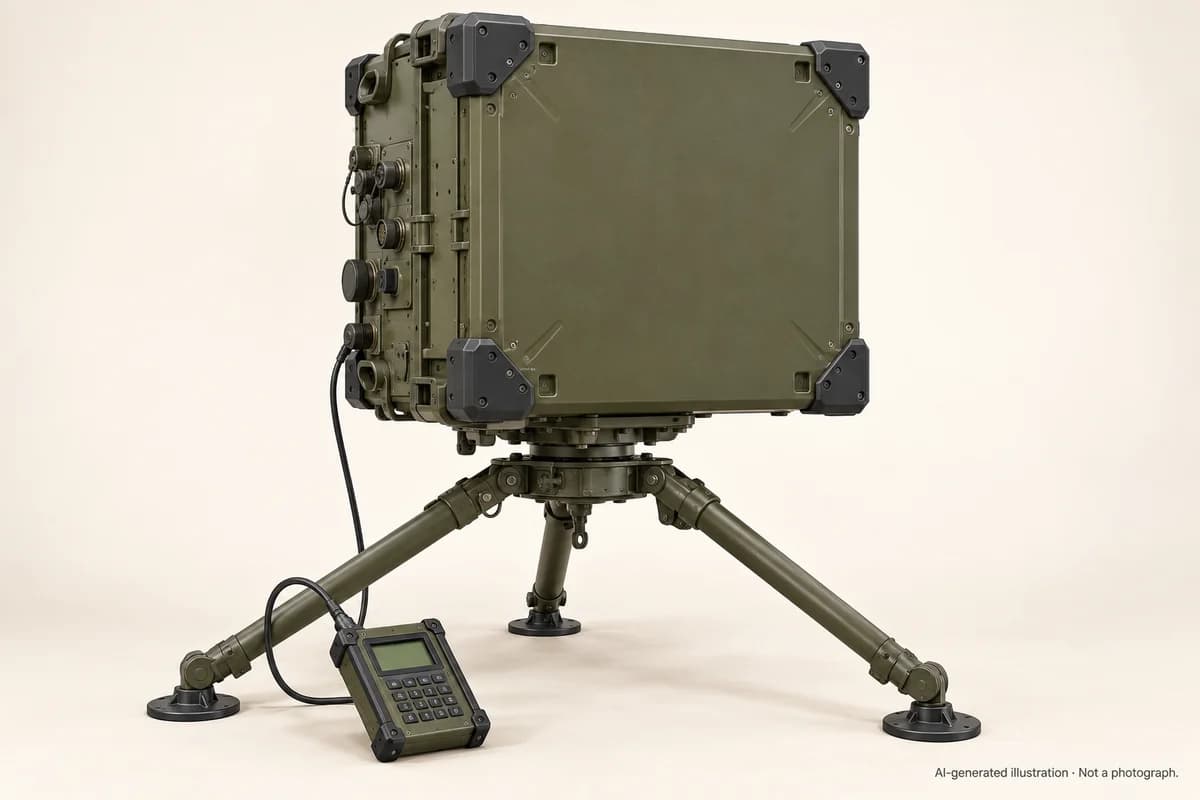
AI-generated illustration · Not a photograph. Representative exterior illustration; details are illustrative and do not establish specifications. Principal SE R-905 radio unit and tripod; the full station equipment/material set is not depicted.
ForceTally · AI-generated illustration · Not a photograph · AI-generated · OpenAI output terms · Source ↗ · Modifiedis a microwave transmission station
used in the Swiss Army
transmitting and receiving device (SE R-905) - in which the antenna reflector is also integrated - the operator terminal (BT) - a handset with keypad and LCD - and a supply equipment (SA 95/1)
There is a 24V battery
adds up to about 230 kg
Over a maximum of 4 km of optical fiber cable
usable bitrate of either 2 or 8 Mbit/s
frequency range is from 14.64 to 17 GHz
frequency separation of at least 150 MHz
maximum range is about 55 km
The R-905 is a microwave transmission station that is used in the Swiss Army . The directional station consists of a transmitting and receiving device (SE R-905) - in which the antenna reflector is also integrated - the operator terminal (BT) - a handset with keypad and LCD - and a supply equipment (SA 95/1). There is a 24V battery , a tripod with strap-down ropes and a camouflage net. All mentioned equipment and material adds up to about 230 kg but can be carried by troops separately, or can be loaded on to a mule.
Over a maximum of 4 km of optical fiber cable an "intermediary unit" (BSG 93) is connected to the SE. The link has an usable bitrate of either 2 or 8 Mbit/s.
The frequency range is from 14.64 to 17 GHz, with a frequency separation of at least 150 MHz between Transmit (TX) and Receive (RX) channels.
The maximum range is about 55 km. The total range can be increased by using up to two R-905 as relay stations. A relay station consists of two R-905s, which are interconnected with an optical fiber cable.
Hersteller Thales Suisse SA
Einsatz bei der Truppe ab 2001
Beschaffung 2001 - 2004 2004 - 2005
Zuteilung Richtstrahlkompanien
Einsatz in Kombination mit BSG 93 , IMFS-Vm, LWL-1
Vorgängergerät(e) R-902 , R-916
Entwicklung bei Thales Suisse SA
Entwicklungsjahr(e) 1994 - 1997
Produktionsjahr(e) 1999 - 2005
Leitungscode(s) optisch
R-905 Richtstrahlstation 905 Switzerland Tactical directional radio relay 1,100 2000 1,100 The system includes: R905 directional communication module BSG 93 encryption system (Omnisec SA) Fibre optic cable rollers (Brugg Telecom SA) Orders through armament programmes : 1998, 700 R-905, 125 BSG 93, 2,400 fibre optic rollers 2002, 400 R-905, unknown quantity of BSG 93, 205 fibre optic rollers. Being replaced by the R-990 - Thales TRC-4100.
Reference text from Wikipedia contributors, used under CC BY-SA 4.0.
Points represent sourced observations, including revisions. Revisions on the same effective date are not separate inventory events. Ranges appear in the table and are not plotted as exact points.
| Observation / report period | Value | Source | Claim state |
|---|---|---|---|
| 29 Sept 2026 | 14.64–17 GHz | Wikipedia contributors | superseded |
| 29 Sept 2026 | 14.64–17 GHz | Wikipedia contributors | approved |
Bitrate(n) 8000 kbit/s
Absetzbarkeit (von Vermittler) 4 km mit optischen Feldkabel LWL-1
Frequenzbereich(e) 14.6 - 15.2 GHz
Frequenzwahl durchstimmbar
Antenne(n) Parabolspiegel 45 cm Durchmesser, im Gehäuse integriert
Planungsreichweite 45 km
R-905 equipment records. Variants, orders and quantities are shown as reported in each inventory source; coverage is incomplete.
SwitzerlandReported count for R-905 Richtstrahlstation 905. Service scope: Swiss Army; does not replace a national total. 1 distinct count cell(s) from the same source list; shared rowspan cells counted once. Retired, wholly reserve and on-order rows are excluded; the reported count retains any explicitly mixed stock scope in the quoted row. Count column(s): quantity (2024): 1,100. Origin: Switzerland. The listed variants/roles are the scope, not an immediately deployable count. The components do not establish one inventory census date; the stored date is the retrieved source snapshot.
Keep exploring
Jamming station
 Poland
Radiolocation station support
Polandactive missile decoy
 Australia
mobile truck-mounted electronic warfare jamming communication station
 Russia
small short-range half-duplex UHF transmitter/receiver
 United Kingdom
portable radio transceiver
 South Korea