FORCETALLY
Loading the evidence…
Preparing your view.


Preparing your view.
Cruise & anti-ship missilesIn service
Anti-ship missile Cruise missile
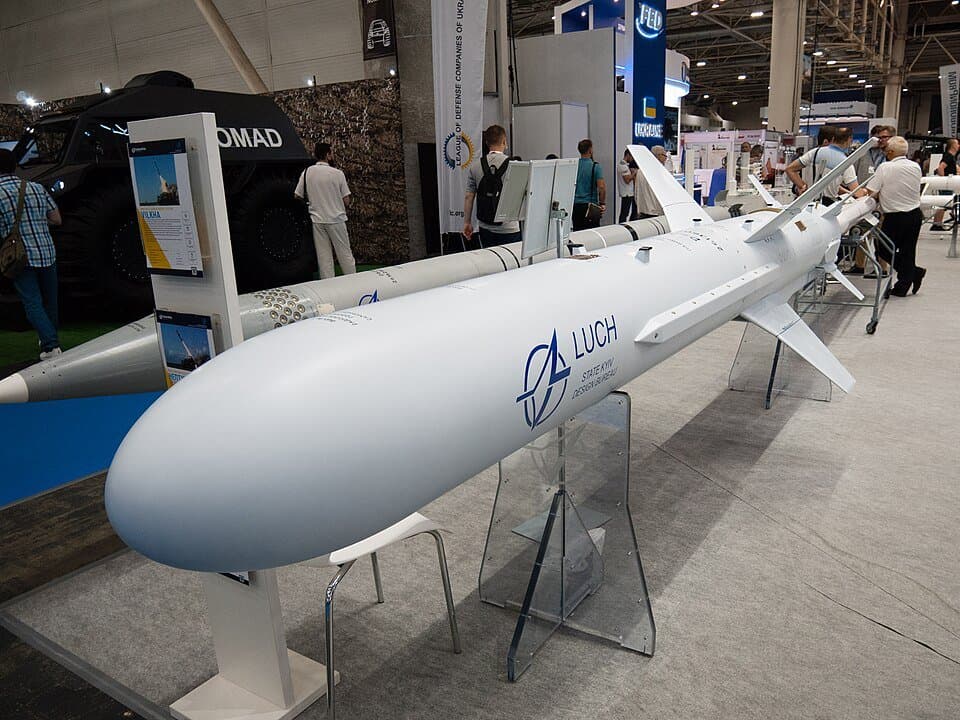
R-360 Neptune is a anti-ship missile Cruise missile originating in Ukraine. Reported operators include Ukrainian Navy.

True scale
Sourced dimensions beside a 1.75 m human reference.
Points represent sourced observations, including revisions. Revisions on the same effective date are not separate inventory events. Ranges appear in the table and are not plotted as exact points.
| Observation / report period | Value | Source | Claim state |
|---|---|---|---|
| 28 Sept 2026 | 0.38 m | Wikipedia contributors | superseded |
| 28 Sept 2026 | 0.38 m | Wikipedia contributors | superseded |
| 28 Sept 2026 | 0.38 m | Wikipedia contributors | approved |
Anti-ship missile Cruise missile
Ukraine
2021–present
Ukrainian Navy
Russo-Ukrainian War
Luch Design Bureau
870 kg (1,920 lb)
5.05 m (16.6 ft)
38 cm (15 in)
Neptune 150 kg (330 lb) Long Neptune 260 kg (570 lb)
Motor Sich MS400 turbofan
Over 280 km (170 mi) up to 1,000 km (620 mi) for Long Neptune
Subsonic
The R-360 Neptune ( Ukrainian : Р-360 «Нептун» , romanized : R-360 "Neptun" ) is a Ukrainian family of subsonic cruise missiles with all-weather capabilities developed by the Luch Design Bureau in Kyiv as an anti-ship missile , with a later variant for land attack.
The R-360 Neptune ( Ukrainian : Р-360 «Нептун» , romanized : R-360 "Neptun" ) is a Ukrainian family of subsonic cruise missiles with all-weather capabilities developed by the Luch Design Bureau in Kyiv as an anti-ship missile , with a later variant for land attack. Neptune's design is based on the Soviet Kh-35 subsonic anti-ship missile, with substantially improved range, targeting and electronics equipment. It has a range of over 200 kilometres.
The system requirement was for a single missile to defeat surface warships and transport vessels with a displacement of up to 9,000 tonnes, either in convoys or moving individually. The first training missile divizion (battalion) entered service with the Ukrainian Navy in March 2021, with the first operational naval use in 2022. The land-attack variant has a new guidance system and was first fielded and used in 2023. "Long Neptune", an extended range land-attack variant with a claimed 1,000 km range, was first used in 2025, according to Ukrainian president Volodymyr Zelenskyy .
The first tests of the system were conducted on 22 March 2016, attended by Secretary of the National Security and Defense Council (NSDC) Oleksandr Turchynov . In mid-2017, Neptune missiles were tested concurrently with Vilkha launchers and missiles. The test results and capabilities of the Neptune were not made public, unlike those of the Vilkha. According to the press service of the NSDC, the first successful flight tests of the system took place on 30 January 2018. On 17 August 2018, the missile successfully hit a target at a range of 100 kilometres (62 mi) during test firings in southern Odesa Oblast . On 6 April 2019, the missile was again successfully tested, hitting targets during tests near Odesa . According to President Petro Poroshenko , the Neptune system would be delivered to the Ukrainian military in December 2019.
On 15 March 2025, President Zelenskyy claimed that the new Long Neptune missile can reach targets up to 1,000 km away, which is further than the 500 km range of the Taurus cruise missile .
A land attack variant was being designed and, as of April 2023, was close to completion. The Neptune missile was initially designed to hit ships at sea. According to a Ukrainian official: "Ukraine is working to modify Neptune missile to strike land targets ... A new guiding/homing system is required, but Ukrainians are working on that ... Once we get that, the Neptunes can hit targets 360 km (about 225 miles) away. We are pretty close."
In April 2024, Ukraine was working on extending the range of the missile to 1,000 km (620 mi), while increasing production tenfold.
Images of the Long Neptune were released. Roughly one and a half metres longer than the R-360 version, the fuselage of the missile has been expanded from 38 cm to about 50 cm. Enlarged as well are the wing and tail surfaces. The warhead appears the same as the original R-360 version.
On 15 September 2026, the Atlant Aero drone factory in Taganrog was struck by Neptune missiles, resulting in damage that collapsed a section of roof some 70 × 40 meters.
The Neptune uses a solid-fuel booster rocket to launch it into the air. After the fuel is expended the rocket stage falls away and the jet engine takes over, providing the necessary thrust. A Neptune missile, including rocket motor, is 5.05 metres (16 ft 7 in) in length, with a cross-shaped hard wing. They are designed to be housed in transport and launch containers with dimensions 5.3 by 0.6 by 0.6 metres (209 in × 24 in × 24 in). The system has a maximum range of about 300 kilometres (190 mi). A single missile weighs 870 kilograms (1,920 lb), of which 150 kilograms (330 lb) is the warhead. It uses a Motor Sich MS400 engine which has a high thrust-to-weight ratio .
When deployed, a Neptune coastal defence system comprises a truck-based USPU-360 mobile launcher, four missiles, a TZM-360 transport/reload vehicle, a RCP-360 command and control vehicle, and a special cargo vehicle. Czech Tatra T815-7 trucks replaced prototype KrAZ vehicles. The system is designed to operate inland up to 25 kilometres (16 mi) from the coastline.
Anti-ship variant, capable of ground attack as well, carrying a 150-kilogram warhead. Range is said to be 280 kilometres.
Extended range variant, capable of flying up to 1,000 kilometers and armed with a 260-kilogram warhead. Capable of striking land and sea targets, operating without satellite navigation and "terrain-following flight".
On 7 October 2025, a new version of the Neptune was revealed. It is believed to be a version in between the range of 280 kilometres for the original R-360 anti-ship missile and the 1,000 kilometres range for the Long Neptune. Notable features include side bulges from the fuselage, believed to be fuel tanks.
{"datatype": "wikibase-item", "datavalue": {"type": "wikibase-entityid", "value": {"entity-type": "item", "id": "Q3543800", "numeric-id": 3543800}}, "hash": "da67c7e0e799eee80dee3004d12bcb741463d0bb", "property": "P176", "snaktype": "value"}
Система наведения: активная радиолокационная ГСН
Reference text from Wikipedia contributors, used under CC BY-SA 4.0.
R-360 Neptune equipment records. Variants, orders and quantities are shown as reported in each inventory source; coverage is incomplete.
Keep exploring
 Iran
 Japan
 China
 France
 Russia