FORCETALLY
Loading the evidence…
Preparing your view.


Preparing your view.
MissilesIn service
Long range air-to-air missile
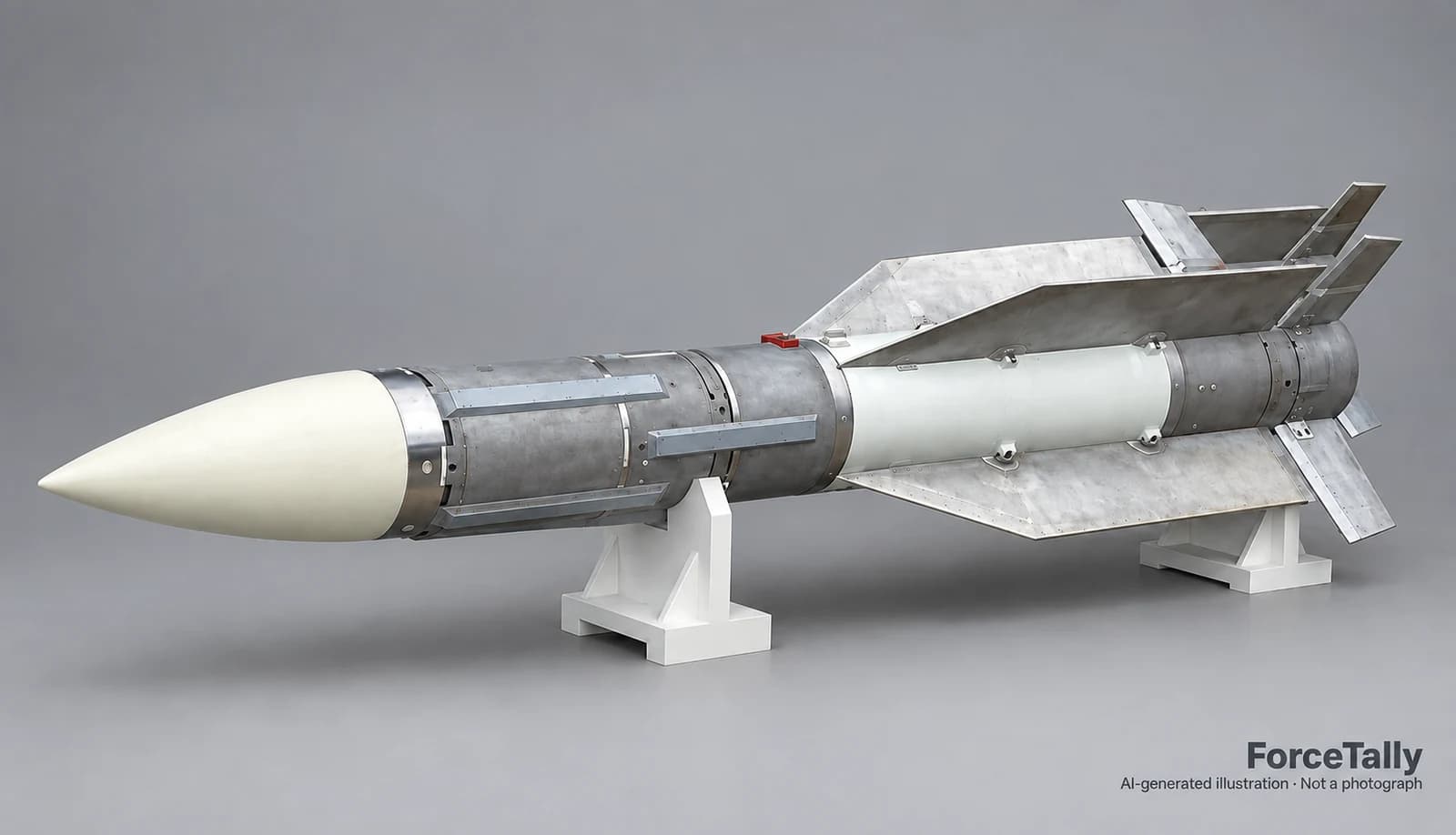
R-33 (missile) is a long range air-to-air missile originating in Soviet Union.
AI-generated illustration · Not a photograph · Source-pictured foreground R-33 air-to-air missile exhibition example on simple display cradles, pointed pale radome facing left, silver forward exterior sections, pale cylindrical rear body, four large swept mid/rear fins and smaller aft control surfaces, matching this exact visible display configuration. Exterior details are illustrative, not specification evidence.
ForceTally · AI-generated illustration · Not a photograph; adapted from Missilery.info / retained source photographer unspecified · Copyright retained by original rights holder; private reference only · https://missilery.info/missile/r33 · ForceTally · All rights reserved · Source ↗ · ModifiedLong range air-to-air missile
Soviet Union
490 kg (1,080 lb)
4.14 m (13 ft 7 in)
380 mm (15 in)
1.12 m (3 ft 8 in)
47.5 kg (105 lb)
solid fuel rocket
120 km (75 mi) - 1981 160 km (99 mi) - 1999 304 km (189 mi) - 2012
Mach 4.5 (R-37)
inertial and semi-active radar homing .
The R-33 ( Russian : Вымпел Р-33 , NATO reporting name : AA-9 Amos ) is a long-range air-to-air missile developed by Vympel .
The missile design was significantly altered later in 1972. The seeker and warhead were enlarged, the span of the control fins was reduced from 1100 mm to 900 mm. Further, the mounting system was revised to include new under-fuselage slipper pylons, akin to the Phoenix mount on the American F-14 , and the missile was reoriented, so it mounted with the fins cruciform rather than diagonal; the fins on the mounting (dorsal) side were made to fold to the side, to lie flush against the belly of the carrying aircraft. Consequently, the missile launch method also needed to be changed. Rather than launching directly from the mounting pylon, the redesigned missile used drop-launch, with the missile being jettisoned from the pylon on launch, and its rocket motor igniting on a time-delay.
Development continued in 1976, including launches at PRM-2 parachute targets in April. Factory tests were completed in 1977 with 32 launches from the MiG-31 prototype, the first launch being against a MiG-17 drone on 26 March 1977). The guidance systems were improved during 1978, and the radar/missile combination performed a simultaneous launch at 4 targets in August.
Vympel 1 reference imported from Wikimedia project French Wikipedia
Reference text from Wikipedia contributors, used under CC BY-SA 4.0.
True scale
Sourced dimensions beside a 1.75 m human reference.
See it in your room. Scan with your phone to open this model in 3D, then place it in your space.
Points represent sourced observations, including revisions. Revisions on the same effective date are not separate inventory events. Ranges appear in the table and are not plotted as exact points.
| Observation / report period | Value | Source | Claim state |
|---|---|---|---|
| 28 Sept 2026 | 0.38 m | Wikipedia contributors | superseded |
| 28 Sept 2026 | 0.38 m | Wikipedia contributors | superseded |
| 28 Sept 2026 | 0.38 m | Wikipedia contributors | approved |
R-33 (missile) equipment records. Variants, orders and quantities are shown as reported in each inventory source; coverage is incomplete.
Keep exploring
Long range air-to-air missile
Long-range air-to-air missile
Long range BVR air-to-air missile
 United States
Very long-range air-to-air missile
 Russia
long-range air-to-surface missile
 Israel
Short-range air-to-air missile
 France