FORCETALLY
Loading the evidence…
Preparing your view.


Preparing your view.
Patrol & mine warfare vesselsIn service
Patrol boat (WPB)
Point-class cutter is a patrol boat (WPB). It was built by Coast Guard Yard 1960–1963, 1970; J.M. Martinac Shipbuilding Corp. 1966–1967. Reported operators include United States Coast Guard Panama Philippines.
 United States
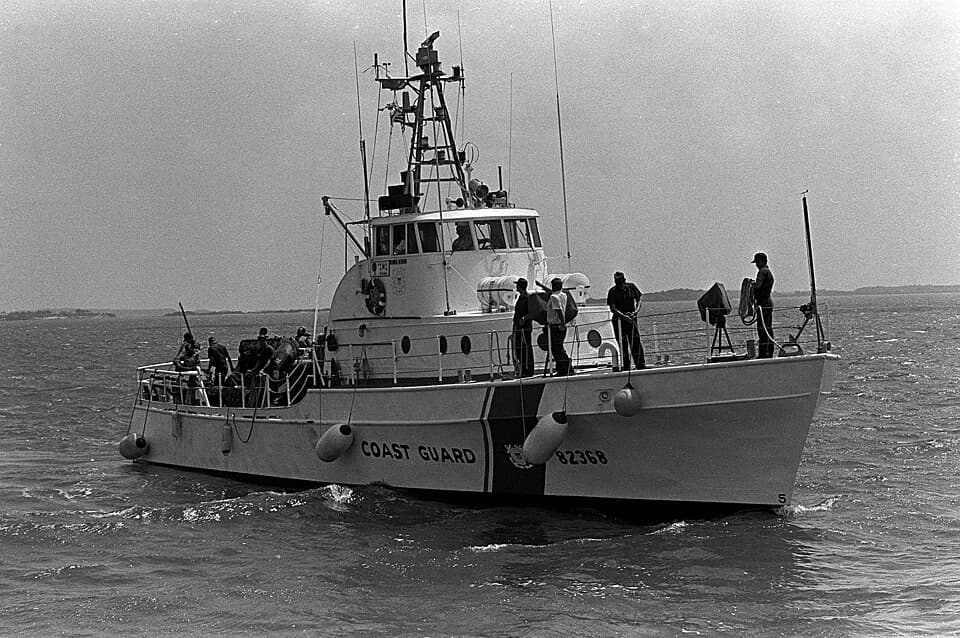
USCGC Point Warde (WPB-82368) during the source-dated Upward Key 1987 exercise; historical Point-class exterior, not a present operator claim.
Department of Defense · Public domain · Resized / optimised · Public domain · Source ↗ · ModifiedCoast Guard Yard 1960–1963, 1970; J.M. Martinac Shipbuilding Corp. 1966–1967
United States Coast Guard Panama Philippines
Cape class
Marine Protector class
1960–1970
1960–2003
79
79
Patrol boat (WPB)
60–69 tons
82 ft 10 in (25.25 m)
17 ft 7 in (5.36 m) max
5 ft 11 in (1.80 m)
Originally (2) 600 hp (450 kW) Cummins diesel, thru hull number 82330 ex. hulls 82314, 82318 (2) 800 hp (600 kW) Cummins diesel, hulls 82331 and up and hull 82318 (2) 1,000 hp (750 kW) gas turbine, hull 82314
16.8 kn (31.1 km/h; 19.3 mph) (1960)
577 miles at maximum sustained speed of 14.5 knots 1271 miles at 10.7 knots economic speed (1960)
domestic service, 1 officer and 9 enlisted; Vietnam service, 2 officers, 8 enlisted
1960 1 × Oerlikon 20 mm cannon Vietnam service 5 × M2 Browning machine guns 1 × 81 mm M29 mortar
The Point-class cutter was a class of 82-foot patrol vessels designed to replace the United States Coast Guard 's aging 83-foot wooden hull patrol boat being used at the time.
The Point-class cutter was a class of 82-foot patrol vessels designed to replace the United States Coast Guard 's aging 83-foot wooden hull patrol boat being used at the time. The boats had a mild steel hull and an aluminum superstructure. The Coast Guard Yard discontinued building the 95-foot Cape -class cutter to have the capacity to produce the 82-foot Point -class patrol boat in 1960. They served as patrol vessels used in law enforcement and search and rescue along the coasts of the United States and the Caribbean. They also served in Vietnam during the Vietnam War . They were replaced by the 87-foot Marine Protector -class patrol boats beginning in the late 1990s.
Following the Coast Guard custom in place in 1960 of not naming vessels under 100 feet in length, the first 44 Point-class patrol boats were only identified by their hull number using the scheme of WPB-823xx, where 82 was the design length of the hull. Beginning in January 1964, the Coast Guard started naming all vessels 65 feet in length and over. The 82-foot patrol boats were all given geographical "Point" names.
The design of the 82-foot patrol boat actually began in the early 1950s with the introduction of the 95-foot patrol boat, which was introduced to replace the aging wooden gasoline-powered 83-foot patrol boats produced during World War II. The 95-foot patrol boat was originally developed as a search and rescue boat to replace the less capable 83-foot boat. With the outbreak of the Korean War and the requirement by the Coast Guard to secure port facilities in the United States under the Moss-Magnuson Act, the complete replacement of the 83-foot boat was deferred and the 95-foot boat was used for harbor patrols.
With the goal of reducing manning requirements, the Point-class patrol boat was designed to accommodate an eight-man crew, a reduction from the 15-man crews of the Cape-class cutter. Production started in early 1960 at the Coast Guard Yard at Curtis Bay, Maryland and continued through late December 1963, producing 44 boats. The first 30 boats were powered by two 600 horsepower (450 kW) Cummins diesel engines, except for 82314 (later Point Thatcher ), which was powered by two 1,000 horsepower (750 kW) gas turbine engines with controllable pitch propellers and 82318 (later Point Herron ) which had two 800 horsepower (600 kW) Cummins diesels installed. Beginning in March 1962 with 82331 (later Point Marone ), all boats were equipped with two 800-horsepower Cummins diesel engines. All were equipped with twin propellers. Eventually all boats were upgraded to the same 800-horsepower main engines used in the later production.
In 1966 a contract for the production of 25 additional boats was awarded to J.M. Martinac Shipbuilding Corp. of Tacoma, Washington. All 25 were equipped with the twin 800-horsepower engines of the 1962 and later Yard production. In 1970, the last nine boats of the class were produced at the Yard utilizing the 800-horsepower design of the remainder of the class. Those boats in service in 1990 were refit with Caterpillar diesel main drive engines. Engine exhaust was ported through the transom rather than through a conventional stack permitting a 360-degree view from the bridge, a useful feature in search and rescue work.
The design specifications for the 82-foot cutter included a steel hull, an aluminum superstructure with a longitudinally framed construction to save weight. Controls were located on the bridge which allowed one-man operation and eliminated an engineer watch in the engine room. For short periods, a crew of four men could operate the cutter, however, the need for rest brought the practical crew to eight for normal service. Berthing spaces were provided for 13 so that requirements were met for passengers and extra wartime manning needs.
A clutch-in idle speed of three knots helped to conserve fuel on lengthy patrols and she had an eighteen knot maximum speed.
A watertight door at the front of the mess bulkhead led to the crew quarters which was ten feet long with six stowable bunks, three on each side.
Point-class PG-31 Petrel PG-32 Alcatraz PG-33 Albatros PG-34 Pelicano United States ~65t
Reference text from Wikipedia contributors, used under CC BY-SA 4.0.
True scale
Sourced dimensions beside a 1.75 m human reference.
See it in your room. Scan with your phone to open this model in 3D, then place it in your space.
Points represent sourced observations, including revisions. Revisions on the same effective date are not separate inventory events. Ranges appear in the table and are not plotted as exact points.
| Observation / report period | Value | Source | Claim state |
|---|---|---|---|
| 29 Sept 2026 | 5.36 m | Wikipedia contributors | superseded |
| 29 Sept 2026 | 5.36 m | Wikipedia contributors | approved |
Point-class cutter equipment records. Variants, orders and quantities are shown as reported in each inventory source; coverage is incomplete.
 Argentina
 Colombia
Coast Guard exact named equipment holdings: Point. Active, operational-reserve and training units excluding equipment in store; November 2025 IISS assessment. Named service only; no parent-force or national total inferred. Source role: PATROL AND COASTAL COMBATANTS / PB. Original estimates, ranges, reporting names, reserve, lease and employment scopes retained; nested included counts are not added. Missile-system quantities mean launchers, not rounds. No readiness, crew, carried weapon, payload, factory-production or future order count inherited.
 Costa Rica
Coast Guard Unit exact named equipment holdings: Point. Active, operational-reserve and training units excluding equipment in store; November 2025 IISS assessment. Named service only; no parent-force or national total inferred. Source role: PATROL AND COASTAL COMBATANTS / PB. Original estimates, ranges, reporting names, reserve, lease and employment scopes retained; nested included counts are not added. Missile-system quantities mean launchers, not rounds. No readiness, crew, carried weapon, payload, factory-production or future order count inherited.
 Dominican Republic
Navy exact named equipment holdings: Point. Active, operational-reserve and training units excluding equipment in store; November 2025 IISS assessment. Named service only; no parent-force or national total inferred. Source role: PATROL AND COASTAL COMBATANTS / PB. Original estimates, ranges, reporting names, reserve, lease and employment scopes retained; nested included counts are not added. Missile-system quantities mean launchers, not rounds. No readiness, crew, carried weapon, payload, factory-production or future order count inherited.
 Ecuador
Coast Guard exact named equipment holdings: Point. Active, operational-reserve and training units excluding equipment in store; November 2025 IISS assessment. Named service only; no parent-force or national total inferred. Source role: PATROL AND COASTAL COMBATANTS / PB. Original estimates, ranges, reporting names, reserve, lease and employment scopes retained; nested included counts are not added. Missile-system quantities mean launchers, not rounds. No readiness, crew, carried weapon, payload, factory-production or future order count inherited.
 El Salvador
 Georgia
Coast Guard exact named equipment holdings: Point. Active, operational-reserve and training units excluding equipment in store; November 2025 IISS assessment. Named service only; no parent-force or national total inferred. Source role: PATROL AND COASTAL COMBATANTS / PB. Original estimates, ranges, reporting names, reserve, lease and employment scopes retained; nested included counts are not added. Missile-system quantities mean launchers, not rounds. No readiness, crew, carried weapon, payload, factory-production or future order count inherited.
 Turkmenistan
Federal Border Guard Service exact named equipment holdings: Point. Active, operational-reserve and training units excluding equipment in store; November 2025 IISS assessment. Named service only; no parent-force or national total inferred. Source role: PATROL AND COASTAL COMBATANTS / PB. Original estimates, ranges, reporting names, reserve, lease and employment scopes retained; nested included counts are not added. Missile-system quantities mean launchers, not rounds. No readiness, crew, carried weapon, payload, factory-production or future order count inherited.
 Venezuela
Keep exploring
 Philippines
 Russia
 India
 Spain
 Latvia