FORCETALLY
Loading the evidence…
Preparing your view.


Preparing your view.
ArtilleryIn service
Self-propelled howitzer
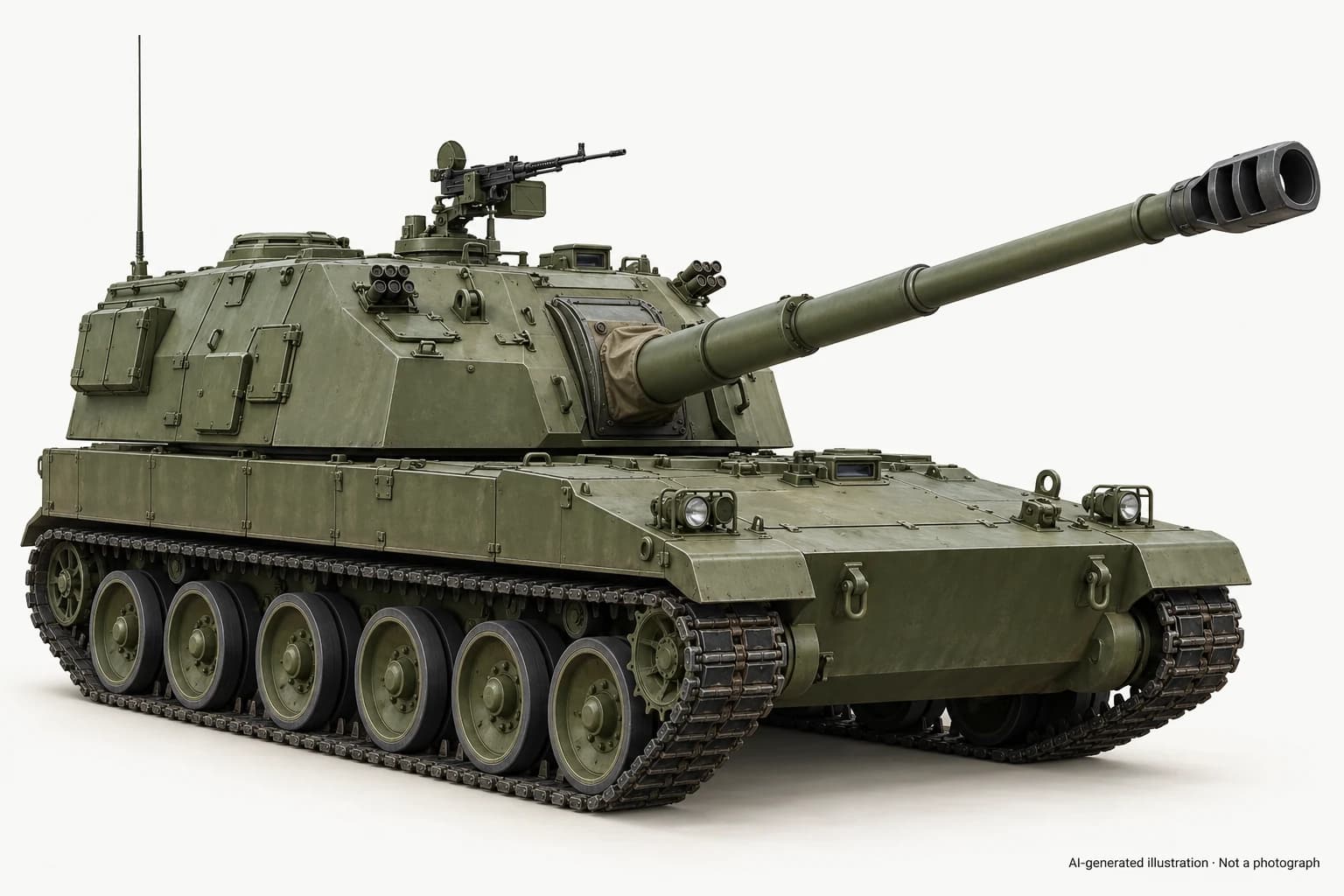
PLZ-89 is a self-propelled howitzer originating in China.

AI-generated illustration · Not a photograph — Representative exterior of PLZ-89; geometry is illustrative. Not evidence for specifications.
ForceTally · AI-generated illustration · Not a photograph · AI-generated · OpenAI output terms · Source ↗ · ModifiedSelf-propelled howitzer
China
See § Operators
20 t (20 long tons; 22 short tons)
11 m (36 ft)
3.4 m (11 ft)
2 m (6 ft 7 in)
5
122 mm (4.8 in)
360°
6–8 rounds/min
18 km (11 mi) for standard high-explosive 21 km (13 mi) for ERFB-BB
122 mm howitzer
12.7 mm anti-aircraft machine gun/2 sets of 4-barrel grenade launchers
12V150L12 liquid-cooled diesel 450 hp (340 kW)
Torsion bar
500 km (310 mi)
60 km/h (37 mph)
The Type 89 SPH is armed with a 122 mm/L32 howitzer.
The Type 89 self-propelled howitzer (military designation PLZ-89 ) is a 122 mm self-propelled howitzer used by China's People's Liberation Army to replace Type 85 and Type 70 122 mm self-propelled howitzer.
The Type 89 self-propelled howitzer (military designation PLZ-89 ) is a 122 mm self-propelled howitzer used by China's People's Liberation Army to replace Type 85 and Type 70 122 mm self-propelled howitzer. The PLZ-89 was first unveiled to the public during the 1999 Chinese National Day Parade .
Since the late 1970s, a number of 122 mm self-propelled howitzers (SPH) had been developed in China to meet Chinese army requirements. The People's Liberation Army (PLA) required a mobile artillery system to provide medium- to long-range indirect fire support for motorised infantry and armoured troops and capable of keeping pace with them. However, none of them could meet these requirements. The Type 89 self-propelled howitzer, also known as the PLZ-89, was developed in the late 1980s. It was a Chinese attempt to develop an indigenous SPH with similar capabilities to the Soviet 2S1 Gvozdika . The Type 89 is currently in service with the PLA and PLA Navy Marine Corps . Several hundred of these artillery systems were built.
The Type 89 SPH is armed with a 122 mm/L32 howitzer. The main armament is derived from the Type 86 (W-86) 122 mm/32-caliber towed howitzer, which itself is a Chinese licensed copy of the Soviet D-30 122 mm howitzer. The PLZ-89 carries 40 rounds inside the turret. The gun is equipped with semi-automatic loader with a maximum rate of fire of 6–8 rounds/min and fire accuracy is achieved by a digital fire-control system and a roof-mounted electro-optical sighting for day/night operations. This artillery system is compatible with Chinese and Russian 122 mm ammunition. Its maximum range of fire is 18 km (11 mi) using standard HE projectiles and 21 km (13 mi) with extended-range projectiles. The vehicle is fitted with a computerised fire-control system, night vision.
The secondary armament consists of a roof-mounted QJC-88 12.7 mm machine gun. For the safety of its crew of five, the vehicle is armoured against small-arms fire and artillery shell splinters, and fitted with NBC protection , fire detection and automatic fire suppression systems. Its tracked chassis, developed from the Type 77 amphibious armoured personnel carrier , is powered by a 450 hp (340 kW) 12V150L12 diesel engine. The Type 89 can also be fitted with a flotation kit for amphibious warfare .
Is an improved version of the Type 89, developed for export. It can be seen as a China's newly-built equivalent to the Soviet 2S1 Gvosdika. It offers greater mobility, improved fire control system and delivers greater firepower than the 2S1 or the Type 89 self-propelled howitzers. The SH3 has been exported to Rwanda.
Is a successor of the Type 89. This artillery system is widely used by the China's army. It utilizes a similar 122 mm howitzer, but has a new tracked chassis. It has greater mobility, improved fire control system and delivers greater firepower than its predecessor. This artillery system was adopted by the Chinese army in the late 2000s and is fielded in large numbers.
Is a version of the PLZ-07, developed for China's marine corps. This artillery system is fully-amphibious and can be launched at sea from amphibious assault ships and swim over short distances to shore.
PLZ-89; Type 89
Self-Propelled Howitzer
122 mm
Norinco
The Type 89 uses a tracked chassis
重量 约20吨(战斗全重)
操作人数 5 (驾驶员1,车长1,瞄准手1,装填手2)
速度 60千米/小时 水上行进速度6千米/小时
重量 约20吨(战斗全重)
操作人数 5 (驾驶员1,车长1,瞄准手1,装填手2)
速度 60千米/小时 水上行进速度6千米/小时
重量 约20吨(战斗全重)
操作人数 5 (驾驶员1,车长1,瞄准手1,装填手2)
速度 60千米/小时 水上行进速度6千米/小时
重量 约20吨(战斗全重)
操作人数 5 (驾驶员1,车长1,瞄准手1,装填手2)
速度 60千米/小时 水上行进速度6千米/小时
重量 约20吨(战斗全重)
操作人数 5 (驾驶员1,车长1,瞄准手1,装填手2)
Боевая масса, т 20
Экипаж , чел. 5
重量 20.5 t
速度 56 km/h
Reference text from Wikipedia contributors, used under CC BY-SA 4.0.
True scale
Sourced dimensions beside a 1.75 m human reference.
Points represent sourced observations, including revisions. Revisions on the same effective date are not separate inventory events. Ranges appear in the table and are not plotted as exact points.
| Observation / report period | Value | Source | Claim state |
|---|---|---|---|
| 28 Sept 2026 | 122 mm | Wikipedia contributors | superseded |
| 28 Sept 2026 | 122 mm | Wikipedia contributors | superseded |
| 28 Sept 2026 | 122 mm | Wikipedia contributors | superseded |
| 28 Sept 2026 | 122 mm | Wikipedia contributors | superseded |
| 28 Sept 2026 | 122 mm | Wikipedia contributors | superseded |
| 28 Sept 2026 | 122 mm | Wikipedia contributors | superseded |
| 28 Sept 2026 | 122 mm | Wikipedia contributors | superseded |
| 28 Sept 2026 | 122 mm | Wikipedia contributors | approved |
5
INA
INA
6.5 m
3.4 m
2 m
20 tons
12V150L12
Diesel
450
500
60
INA
The Type 89 can be fitted with floatation kit for amphibious operation. Once the kit is fitted it can ford water obstacles such as lakes and rivers.
60
30
0.8 m
2.5 m
1.0 m
Amphibious
INA
INA
INA
Yes
Armor of the Type 89 provides protection against small arms fire and artillery shell splinters.
Armor of the Type 89 provides protection against small arms fire and artillery shell splinters.
INA
No
No
No
No
Yes
INA
China, People's Republic of
速度 60千米/小时 水上行进速度6千米/小时
重量 约20吨(战斗全重)
操作人数 5 (驾驶员1,车长1,瞄准手1,装填手2)
速度 60千米/小时 水上行进速度6千米/小时
PLZ-89 equipment records. Variants, orders and quantities are shown as reported in each inventory source; coverage is incomplete.
ChinaStored Army exact named equipment holdings: PLZ-89. Explicit source inventory scope: stored; independently counted whole stock in store. November 2025 IISS assessment. Named service only; no operational holding, readiness or parent-force total inferred. Source role: ARTILLERY / 122mm. Original estimates, ranges, reporting names and exact storage declarations retained. Stored quantities earn no operational index points.
Marines exact named equipment holdings: PLZ-89. Active, operational-reserve and training units excluding equipment in store; November 2025 IISS assessment. Named service only; no parent-force or national total inferred. Source role: ARTILLERY / SP 122mm. Original estimates, ranges, reporting names, reserve, lease and employment scopes retained; nested included counts are not added. Missile-system quantities mean launchers, not rounds. No readiness, crew, carried weapon, payload, factory-production or future order count inherited.
Army exact named equipment holdings: PLZ-89. Active, operational-reserve and training units excluding equipment in store; November 2025 IISS assessment. Named service only; no parent-force or national total inferred. Source role: ARTILLERY / 122mm. Original estimates, ranges, reporting names, reserve, lease and employment scopes retained; nested included counts are not added. Missile-system quantities mean launchers, not rounds. No readiness, crew, carried weapon, payload, factory-production or future order count inherited.
 Rwanda
Army exact named equipment holdings: SH-3. Active, operational-reserve and training units excluding equipment in store; November 2025 IISS assessment. Named service only; no parent-force or national total inferred. Source role: ARTILLERY / 122mm. Original estimates, ranges, reporting names, reserve, lease and employment scopes retained; nested included counts are not added. Missile-system quantities mean launchers, not rounds. No readiness, crew, carried weapon, payload, factory-production or future order count inherited.
Keep exploring
Self-propelled howitzer
 IranCompare with PLZ-89
Self-propelled howitzer
 Israel
Self-propelled howitzer
 JapanCompare with PLZ-89
Self-propelled howitzer
JapanCompare with PLZ-89 Self-propelled howitzer
Compare with PLZ-89Self-propelled howitzer
 Ukraine