FORCETALLY
Loading the evidence…
Preparing your view.


Preparing your view.
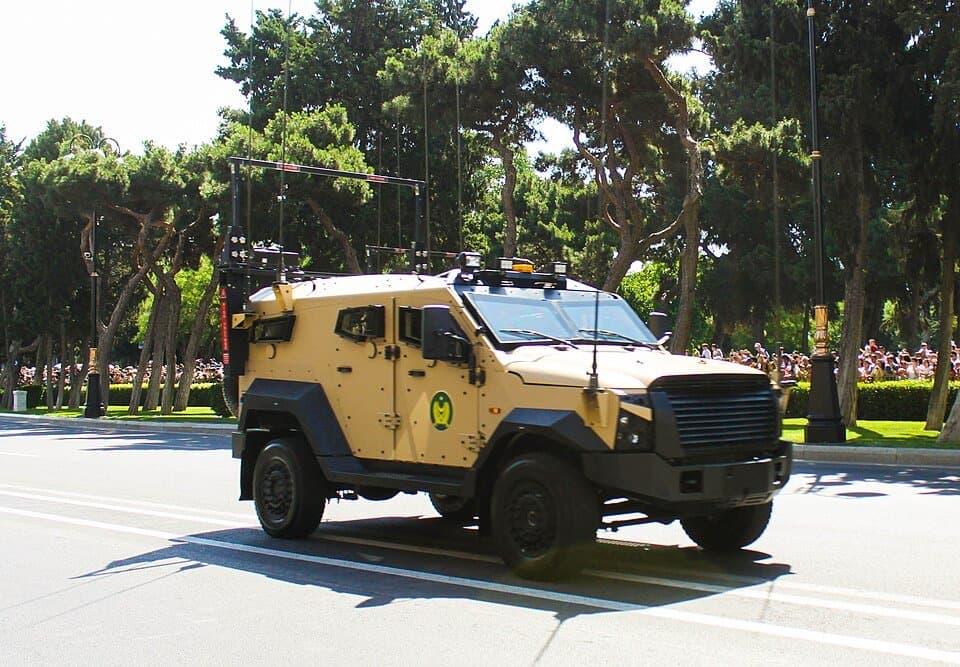
Armoured vehiclesIn production
Light armoured vehicle
Plasan SandCat is a light armoured vehicle originating in Israel. It was built by Plasan / Oshkosh Corporation / IBN Industrias Militares/IBN Military Industries.
 Israel
Technical data
Light armoured vehicle
Israel
See Operators
Mexican drug war Second Nagorno-Karabakh war
Nir Kahn
2004
Plasan / Oshkosh Corporation / IBN Industrias Militares/IBN Military Industries
2004-present
around 700
5.94 m (4th Generation M-LPV)
2.315 m (91.1 in)(4th Generation M-LPV)
2.54 m (4th Generation M-LPV)
up to 10 (variant dependent)
steel/ceramic/Kevlar; protection level to suit requirement
Remote weapon station (optional)
6.7 L Power Stroke diesel V8 (6.4 L in early variants)
up to 2,109 kg (generation and variant dependent)
Ford Torqshift six-speed automatic (five-speed in some early models)
coil springs and shock-absorbers at the front and leaf springs and shock-absorbers at the rear. Uprated as required (second generation had a Plasan-designed coil spring and trailing arm rear suspension)
280 mm (4th generation M-LPV)
150 litres (4th generation)
500-550 km (3rd and 4th generation)
110 km/h (4th generation)
Azerbaijan
Bulgaria
Canada
Chile
Colombia
Greece
El Salvador
Israel
Kazakhstan
Mexico
Nigeria
Poland
Romania
Republic of Korea
Sweden
Turkmenistan
Ukraine
Uganda
United Kingdom
The SandCat ( Hebrew : פלסן קרקל ) is a composite armored vehicle designed by the then Plasan Sasa (now Plasan) of Israel .
The original SandCat was designed around an approximate 4,000 kg gross vehicle weight (GVW) and four-man crew, although following feedback from early evaluations this was revised to around 5,000 kg and four- to five-man crew. The SandCat's then unusual and distinct trapezoidal side windows were optimised to reduce the mass of the heavy armoured glass, while maximising useful viewing angles. Now widely adopted, these were an early and distinct design feature of the SandCat, as was a feline theme in the design aesthetics.
The first-generation were mainly prototypes, although a small quantity were supplied to Israeli security forces. Sweden received a small quantity during 2008 in an eight-seat station wagon configuration for a Police/SWAT-type role. Prototypes and Israeli deliveries were in the original design configuration which featured an open rear stowage area. To differentiate between the original configuration, the longer bodied station wagon. configuration was initially known as the SandCat Plus. With the exception of the Swedish SandCats which are based on a Ford F450 chassis, all other developmental first generation SandCats were based on a Ford F350 chassis, this shortened from the standard 3.581 m wheelbase to a 2.946 m wheelbase. The original Caracal/SandCat prototype had a wheelbase shortened to 2.845 m. Prototypes were shortened by Manning Equipment of Louisville, Kentucky, United States.
The second-generation SandCat was introduced in 2008, and following an update of the commercial product by Ford. More than 300 second-generation SandCats were produced. At this point Plasan did not desire to bulk-manufacture so Oshkosh Defense was licensed to market the SandCat. Second-generation SandCats for the Israeli Border Police were based on a Ford F350 chassis (shortened from a 3.581 m to a 2.946 m wheelbase), All other second-generation and all subsequent generations of SandCat are based on a Ford F550 chassis. Second-generation F550-based SandCats have a 2.946 m wheelbase, and with an overall length of 5 m for both the Utility (five-seat) and Transport (eight-seat) configurations. Utility has the open rear cargo area, Transport is the station wagon configuration. GVW for both configurations is up to 8,845 kg, with a payload allowance of up to 2,109 kg depending on configuration and protection levels.
Third-generation SandCats were available with a 2.946 m wheelbase and 5 m overall length or a 3.429 m wheelbase and 5.5 m overall length, although no 2.946 m wheelbase models were ordered.
GVW of third-generation SandCats was up to 8845 kg, with payload allowance dependent on configuration and protection levels, but up to 2000 kg.
Automotives used in all SandCat generations have remain standard Ford wherever possible, the latest fourth-generation models powered by a Ford PowerStroke 6.7-litre V8 diesel developing 330 hp and coupled to a Ford TorqShift six-speed automatic transmission. Standard F550 drive axles are retained, however the front coil and rear leaf springs plus the brakes are uprated/tuned to suit operating weight. On second-generation models the rear leaf springs were swapped for a Plasan-designed coil spring and trailing arm set-up. Some elements of the electrical system are upgraded to suit specific requirements, with 24 V available if required.
The overall design of the SandCat is such that it can be adopted to perform a wide range of military and Police/internal security-related missions. The original SandCat featured a four- or five-seat protected crew citadel, this having two doors on each side plus two rear doors in the crew citadel that open into an open-topped rear stowage area. This stowage area which could be covered if required, is open-topped to save weight. First-generation ‘station wagon’ vehicles for Sweden could seat eight in an extended fully enclosed rear body. Second-generation models could seat up to five (Utility) or eight (Transport/TPV). Third-generation models seat up to 10.
Sweden received a small quantity of first-generation SandCats during 2008 in an eight-seat station wagon configuration for a Police/SWAT-type role.
Automotives used in all SandCat generations have remain standard Ford wherever possible, the latest fourth-generation models powered by a Ford PowerStroke 6.7-litre V8 diesel developing 330 hp and coupled to a Ford TorqShift six-speed automatic transmission. Standard F550 drive axles are retained, however the front coil and rear leaf springs plus the brakes are uprated/tuned to suit operating weight. On second-generation models the rear leaf springs were swapped for a Plasan-designed coil spring and trailing arm set-up. Some elements of the electrical system are upgraded to suit specific requirements, with 24 V available if required.
GVW of third-generation SandCats was up to 8845 kg, with payload allowance dependent on configuration and protection levels, but up to 2000 kg.
Reference text from Wikipedia contributors, used under CC BY-SA 4.0.
True scale
Sourced dimensions beside a 1.75 m human reference.
See it in your room. Scan with your phone to open this model in 3D, then place it in your space.
Points represent sourced observations, including revisions. Revisions on the same effective date are not separate inventory events. Ranges appear in the table and are not plotted as exact points.
| Observation / report period | Value | Source | Claim state |
|---|---|---|---|
| 28 Sept 2026 | 2.54 m | Wikipedia contributors | superseded |
| 28 Sept 2026 | 2.54 m | Wikipedia contributors | superseded |
| 28 Sept 2026 | 2.54 m | Wikipedia contributors | superseded |
| 28 Sept 2026 | 2.54 m | Wikipedia contributors | superseded |
| 28 Sept 2026 | 2.54 m | Wikipedia contributors | superseded |
| 28 Sept 2026 | 2.54 m | Wikipedia contributors | superseded |
| 28 Sept 2026 | 2.54 m | Wikipedia contributors | superseded |
| 28 Sept 2026 | 2.54 m | Wikipedia contributors | superseded |
| 28 Sept 2026 | 2.54 m | Wikipedia contributors | approved |
Plasan SandCat equipment records. Variants, orders and quantities are shown as reported in each inventory source; coverage is incomplete.
 Azerbaijan
Army exact named equipment holdings: SandCat. Active, operational-reserve and training units excluding equipment in store; November 2025 IISS assessment. Named service only; no parent-force or national total inferred. Source role: ARMOURED FIGHTING VEHICLES / AUV. Original estimates, ranges, reporting names, reserve, lease and employment scopes retained; nested included counts are not added. Missile-system quantities mean launchers, not rounds. No readiness, crew, carried weapon, payload, factory-production or future order count inherited.
 Bulgaria
Army exact named equipment holdings: Plasan SandCat. Active, operational-reserve and training units excluding equipment in store; November 2025 IISS assessment. Named service only; no parent-force or national total inferred. Source role: ARMOURED FIGHTING VEHICLES / AUV. Original estimates, ranges, reporting names, reserve, lease and employment scopes retained; nested included counts are not added. Missile-system quantities mean launchers, not rounds. No readiness, crew, carried weapon, payload, factory-production or future order count inherited.
 Canada
 Chile
 Colombia
Number column of the Wikipedia list table under "Infantry transport vehicles". The list's own wording applies; it is a compiled secondary source, not an official census.
 El Salvador
 Greece
Reported count for SandCat 350. Service scope: Hellenic Army; does not replace a national total. 1 distinct count cell(s) from the same source list; shared rowspan cells counted once. Excludes retired/reserve/on-order rows. Count column(s): quantity: 34. Origin: Israel. The listed variants/roles are the scope, not an immediately deployable count. The components do not establish one inventory census date; the stored date is the retrieved source snapshot.
Israel Kazakhstan
Reported count for Plasan SandCat. Service scope: Ground forces equipment; does not replace a national total. 1 distinct count cell(s) from the same source list; shared rowspan cells counted once. Retired, wholly reserve and on-order rows are excluded; the reported count retains any explicitly mixed stock scope in the quoted row. Count column(s): quantity: 100. Origin: Israel / Kazakhstan. The listed variants/roles are the scope, not an immediately deployable count. Dates are the count-cell citations' stated source period (2024), not the article revision. 2024 cited source edition. Edition or publication years do not claim an exact inventory census day.
 Mexico
Army exact named equipment holdings: SandCat; DN-XI. Active, operational-reserve and training units excluding equipment in store; November 2025 IISS assessment. Named service only; no parent-force or national total inferred. Source role: ARMOURED FIGHTING VEHICLES / AUV. Original estimates, ranges, reporting names, reserve, lease and employment scopes retained; nested included counts are not added. Missile-system quantities mean launchers, not rounds. No readiness, crew, carried weapon, payload, factory-production or future order count inherited.
 Nigeria
 Poland
 Romania
 South Korea
 Sweden
 Turkmenistan
 Uganda
 Ukraine
 United Kingdom
Azerbaijan, Bulgaria, Canada, Chile, Colombia, Greece, El Salvador, Israel, Kazakhstan, Mexico, Nigeria, Poland, Romania, Republic of Korea, Sweden, Turkmenistan, Ukraine, Uganda, United Kingdom
Equipment reference ↗Keep exploring
 United States
 Japan
 Netherlands
 South Africa