FORCETALLY
Loading the evidence…
Preparing your view.


Preparing your view.
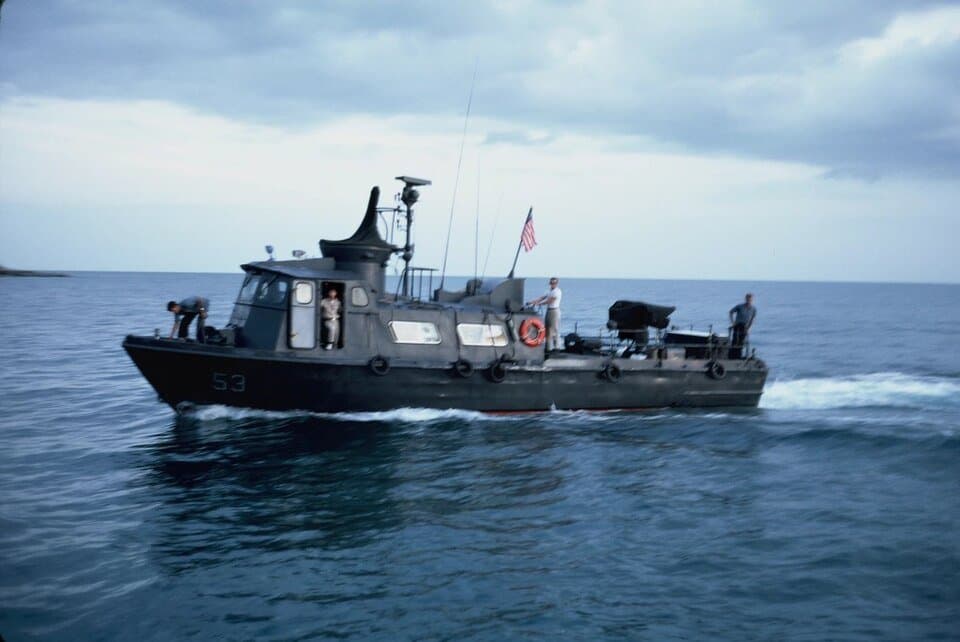
Patrol & mine warfare vesselsIn service
Riverine patrol boat
Patrol Craft Fast is documented in the equipment reference catalogue.
 United States
Patrol Craft Fast
Navy Expeditionary Combat Command · Public domain · Resized · Public domain · Source ↗ · ModifiedTechnical data
PCF (Patrol Craft Fast)
Sewart Seacraft (now Swiftships)
See Operators
PTF boat
1967-Present
193
5+
4 non-operational 2 operational
Riverine patrol boat
50 ft (15 m) (Mk I) 51 ft (16 m) (Mk II) 94.5 ft (28.8 m) ( Osprey-Class )
13 ft (4.0 m)
3 ft (0.91 m)
2x General Motors 12V71"N" Detroit marine diesels
32 knots (59 km/h; 37 mph) (Mk I)
800 km
2x 0.50 caliber machine gun (top) (US-based) 1x 81mm mortar (US-based) 1x Mk 19 (US-based) 1x NSV (Vietnamese-based) 1x DShK (Vietnamese-based) 1x AGS-17 (Vietnamese-based)
Quarter inch thick aluminum hull
Vietnam : Vietnam People's Navy , taken from the former South Vietnam Navy. M2 HMG and other American-installed components replaced with Soviet NSV or DShK and AGS-17 .
Khmer Republic : Khmer National Navy .
Malta : Maritime Squadron of the Armed Forces of Malta .
Panama : The MN GC-201 Comandante Torrijos and MN GC-202 Presidente Porras acquired from the US in the 1980s for the Panamanian Navy.
Philippines : Philippine Navy & Philippine Coast Guard .
South Vietnam : Republic of Vietnam Navy . Reportedly around 107 Swift boats lost in service with 99 boats captured by North Vietnam.
United States : U.S. Navy
Thailand : Royal Thai Navy .
The Patrol Craft Fast ( PCF ), also known as the Swift Boat , were all-aluminum, 50-foot (15 m) long, shallow- draft vessels operated by the United States Navy , initially to patrol the coastal areas and later for work in the interior waterways as part of the brown-water navy to interdict Vietcong movement of arms and munitions, transport South Vietnamese forces and insert SEAL teams for counterinsurgency (COIN) operations during the Vietnam War .
The Swift Boats had welded aluminum hulls about 50 feet (15 m) long with 13 feet (4.0 m) beam, and draft of about five feet (1.5 m). They were powered by a pair of General Motors 12V71"N" Detroit marine diesel engines rated at 480 horsepower (360 kW) each, with a design range from 320 nautical miles (590 km) at 21 knots (39 km/h) to about 750 nautical miles (1,390 km) at 10 knots (19 km/h). The normal complement for a Swift Boat was six: an officer in charge (skipper), a boatswains mate, a radar/radioman (radarman), an engineer (engineman), and two gunners (quartermaster and gunner's mate). In 1969, the crew was supplemented with a Vietnamese trainee.
The original water taxi design had been enhanced with two .50 caliber M2 Browning machine guns in a turret above the pilot house, an over-and-under .50-caliber machine gun – 81 mm mortar combination mounted on the rear deck, a mortar ammunition box on the stern, improved habitability equipment such as bunks, a refrigerator and freezer, and a sink.
The 81 mm combination mortar mounted on the rear deck was not a gravity firing mortar as used by the Army and Marine Corps , in which the falling projectile's primer struck the fixed firing pin at the base of the mortar tube, but a unique lanyard firing weapon in which the projectile was still loaded into the muzzle.
The first Swift Boats arrived in South Vietnam in October 1965. The boats were initially used as coastal patrol craft in Operation Market Time , interdicting seaborne supplies on their way to the Viet Cong (VC) and People's Army of Vietnam (PAVN) forces in South Vietnam. However, the design's shallow draft and low freeboard limited their seaworthiness in open waters. These limitations, plus the difficulties being encountered in the interior waterways by the smaller, more lightly armed PBRs , led to the incorporation of Swifts to patrol the 1,500 miles (2,400 km) of rivers and canals of Vietnam's interior waterways. Swift Boats continued to operate along the Vietnamese coastal areas, but with the start of Admiral Elmo Zumwalt 's " SEALORDS " riverway interdiction strategy, their primary area of operations soon centered upon the Cà Mau Peninsula and the Mekong Delta area in the southern tip of Vietnam. Here they patrolled the waterways and performed special operations, including gunfire support, troop insertion and evacuation, and raids into enemy territory.
Though most cruising and patrolling was done at 8 to 10 knots, the boats could reach a top speed of 32 knots.
The first Swift Boat to be lost during the war was PCF-4 , which was lost to a mine in 1966. Two boats, PCF-14 and PCF-76 , were lost in rough seas at the mouth of the Cua Viet River near the DMZ , and a third, PCF-77 , was lost in a rescue effort during a monsoon at the mouth of the Perfume River on the approach to Huế . All three of these boats were lost in 1966. PCF-41 was lost that same year in an ambush when it was hit by fire from a 57 mm recoilless rifle. Its controls destroyed and coxswain killed, it ran aground at speed. When the crew ran out of ammunition it had to be abandoned. It was recovered the next day but was too badly damaged to be repaired, so was salvaged instead.
On the night of 15/16 June 1968, U.S. Marine Corps aircraft spotters on the ground began reporting unidentified helicopters near the DMZ. The first report stated that four helicopters had been detected and were proceeding toward Tiger Island , just off the North Vietnamese coast at an altitude of 700–1,000 feet (210–300 m). These spotters observed the aircraft visually, using Starlight Scopes and by radar. Over the course of the night, Air Force pilots reported 19 additional helicopter sightings. On this same evening the guided missile heavy cruiser USS Boston , operating near the DMZ, also began reporting helicopter activity in the vicinity of Bến Hải , Cap Lay and Tiger Island. At 00:10 on the 16th, an unidentified aircraft fired three rockets or missiles at Boston , but none hit the vessel.
At 01:00 on 16 June 1968 in the same area, PCF-19 was struck by two missiles, one struck the cabin just below the pilothouse on the port side, the other hit the engine room.
The boat sank in four minutes.
When PCF-12 was 3 miles (4.8 km) from the river mouth, crewmembers observed two sets of aircraft lights off the port and starboard beam, about 300 yards (270 m) away and 100 feet (30 m) above the water.
The rocket passed a couple of feet over the main cabin and exploded in the water ten feet from the boat.
PCF-12 came about, increased speed and moved away from the kill zone while bringing its .50-caliber guns to bear against an aerial target hovering at 1,000 feet (300 m) with lights blinking.
At 02:40, Point Dume , now back on the scene was attacked by a fixed-wing aircraft, which made two attack runs against the vessel. Both the commanding officer of Point Dume and the commander of PCF-12 positively identified the aircraft as a "jet." The crews of Point Dume and PCF-12 then observed numerous lighted aircraft that appeared to be helicopters in the northern part of the area. These aircraft approached the U.S. vessels and made firing runs with their lights off. Point Dume received heavy caliber automatic weapons fire from these aircraft and returned fire. PCF-12 also returned fire intermittently for approximately 75 minutes. Neither vessel was damaged in the engagement; there were no personnel injured.
The jet fired two missiles at the ship: one exploded 200 yards (180 m) off the port beam; and the other close aboard to port, showering the ship with fragments.
At 03:09, while Hobart was searching a 5-mile radius area between the coast and Tiger Island with its radar, it detected a single aircraft tracking east.
Five minutes later a missile slammed into the chief petty officers' mess and nearby spaces, killing one sailor and wounding two others.
Later research of the incident with surviving veterans and a review of salvage reports from USS Acme , the ship that recovered the bodies and codebooks from PCF-19 shortly after the attack, found that the rocket entry holes in the hull of PCF-19 were 76.2mm in size—the size of a standard helicopter rocket carried by a Soviet -manufactured Mi-4 Hound helicopter and not Sparrow or Sidewinder holes, which would have been larger.
The M2 machine gun was replaced by a domestically produced 12.7 mm NSV gun, which had fewer jamming problems and was easier for the crews to maintain. The electronic and communication systems were also overhauled. Some PCFs captured have a DsHK HMG and an AGS-17 AGL mounted on top. The 81mm mortar was left untouched.
There are two operational PCFs in the United States today. R/V Matthew F. Maury is operated by Tidewater Community College in Virginia Beach, Virginia. Formerly PCF-2 , the vessel was awarded to the college in 1995 and has been used in oceanographic research and education since then. It is berthed at JEB Little Creek and operates in and around Chesapeake Bay. The second operational PCF, PCF-816 (formerly P-24 in the service of Malta) is operational in San Diego, California at the Maritime Museum of San Diego. The boat makes regular runs on weekends and is staffed with former Swift Boat sailors as narrators.
The Swift Boats had welded aluminum hulls about 50 feet (15 m) long with 13 feet (4.0 m) beam, and draft of about five feet (1.5 m). They were powered by a pair of General Motors 12V71"N" Detroit marine diesel engines rated at 480 horsepower (360 kW) each, with a design range from 320 nautical miles (590 km) at 21 knots (39 km/h) to about 750 nautical miles (1,390 km) at 10 knots (19 km/h). The normal complement for a Swift Boat was six: an officer in charge (skipper), a boatswains mate, a radar/radioman (radarman), an engineer (engineman), and two gunners (quartermaster and gunner's mate). In 1969, the crew was supplemented with a Vietnamese trainee.
Swift PCF United States Peterson PBI 1 1994–present
Swift PCF United States Peterson PBI 1 1994–present
2 x Detroit Diesel marine engines developing 480 horsepower each. Propulsion
21.0 kts 24.2 mph Surface Speed
318 nm 366 miles | 589 km Range
6 Personnel Complement
50.0 ft 15.24 meters O/A Length
13.0 ft 3.96 meters Beam
5.0 ft 1.52 meters Draught
Verdrängung 21,34 Tonnen
Länge 15,24 Meter
Breite 3,96 Meter
Tiefgang 1,53 Meter
Besatzung 1 Offizier, 5–6 Matrosen
Antrieb 2 Detroit- Dieselmotoren mit je 435 PS, 2 gegenläufige Schrauben
Geschwindigkeit 32 Knoten
Reichweite 260 Seemeilen
Deplacement 21,3 ton
Längd 15,24 meter
Bredd 3,96 meter
Djupgående 1,53 meter
Räckvidd 260 NM
Besättning 6 man
Reference text from Wikipedia contributors, used under CC BY-SA 4.0.
True scale
Sourced dimensions beside a 1.75 m human reference.
Points represent sourced observations, including revisions. Revisions on the same effective date are not separate inventory events. Ranges appear in the table and are not plotted as exact points.
| Observation / report period | Value | Source | Claim state |
|---|---|---|---|
| 28 Sept 2026 | 4 m | Wikipedia contributors | superseded |
Patrol Craft Fast equipment records. Variants, orders and quantities are shown as reported in each inventory source; coverage is incomplete.
 The Gambia
Reported count for Swift PCF. Service scope: Navy inventory; does not replace a national total. 1 distinct count cell(s) from the same source list; shared rowspan cells counted once. Retired, wholly reserve and on-order rows are excluded; the reported count retains any explicitly mixed stock scope in the quoted row. Count column(s): number: 1. Origin: United States. The listed variants/roles are the scope, not an immediately deployable count. The components do not establish one inventory census date; the stored date is the retrieved source snapshot.
 Vietnam
Keep exploring
Riverine patrol boat
 Philippines
Riverine patrol boat
United Statesriverine patrol craft
 Bangladesh
Patrol boat
United StatesPatrol boat
 Russia
Patrol boat
 India