FORCETALLY
Loading the evidence…
Preparing your view.


Preparing your view.
Armoured vehiclesIn service
Armored car
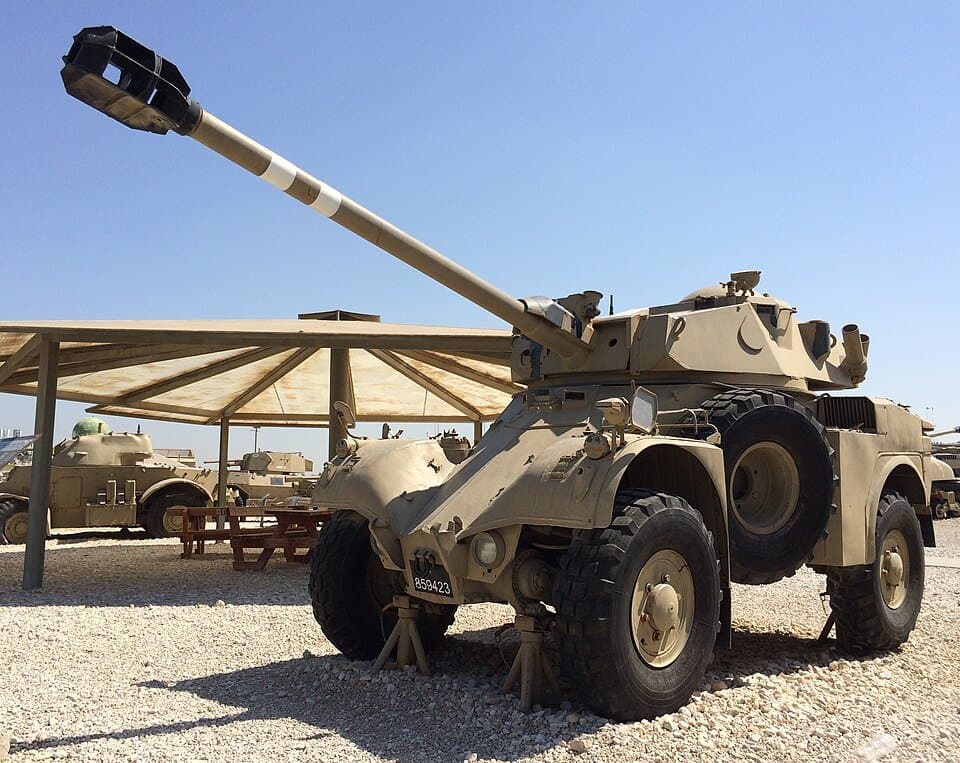
Panhard AML is a armored car originating in France. It was built by Panhard. Reported operators include Algeria, Argentina, Bahrain, Burkina Faso, Burundi, Cameroon, Chad, Democratic Republic of the Congo, Côte d'Ivoire, Djibouti, Ecuador, El Salvador, Gabon, Guinea, Kenya, Lebanon, Lesotho, Myanmar, Mauritania, Morocco, Niger, Nigeria, Rwanda, Sahrawi Republic, Saudi Arabia, Somaliland, Togo, Tunisia, United Arab Emirates, Venezuela, Yemen.

Armored car
France
See Operators
List of Conflicts Algerian War Portuguese Colonial War Six-Day War War of Attrition Angolan Civil War Cambodian Civil War Yom Kippur War Falklands War Lebanese Civil War Shaba II Ethiopian Civil War Eritrean War of Independence Salvadoran Civil War Western Sahara War Chadian–Libyan conflict Somali Civil War Iran–Iraq War Gulf War Djiboutian Civil War Rwandan Civil War First Congo War Second Congo War 2003 invasion of Iraq Second Sudanese Civil War Djiboutian–Eritrean border conflict 2004 French–Ivorian clashes First Ivorian Civil War Second Ivorian Civil War 2007 Lebanon conflict Internal conflict in Burma Operation Linda Nchi Yemeni Crisis (2011–present) Syrian Civil War spillover in Lebanon
1959
Panhard
1960–1987
4,812
See Variants
5.5 tonnes (6.1 short tons ; 5.4 long tons )
5.11 m (16 ft 9 in)
1.97 m (6 ft 6 in)
2.07 m (6 ft 9 in)
3 (commander, driver, gunner)
90 mm D921/ GIAT F1 (20 rounds) or 60mm Brandt mortar (53 rounds)
2 7.62 mm MAS coaxial machine guns (2,400–3,800 rounds)
Panhard 1.99 L (121 in 3 ) Model 4 HD flat 4 -cylinder air-cooled petrol 90 hp (67 kW) at 4,700 rpm
16.36 hp/tonne (11.9 kW/tonne)
Wheeled 4x4
0.33 m (1 ft 1 in)
156 L (41 US gal)
600 km (370 mi)
100 km/h (62 mph)
Algeria : 54 AML-60 received in 1965. All modernized in 2018.
Argentina : 50 AML-90 received between 1969-71.
Bahrain : 22 AML-90 operational in 2024.
Burkina Faso : 19 AML-60 and AML-90
Burundi : 6 AML-60 and 12 AML-90. 30 AML-60 and AML-90 received between 1966-83.
Cameroon : 31 AML-90; ex- Bosnian Army
Chad : 132 AML-60 and AML-90
Democratic Republic of the Congo : up to 17 AML-60 and 14 AML-90.
Côte d'Ivoire : 20
Djibouti : 4 AML-60 in 2024. Up to 24 were received in 1979.
Ecuador : 27 AML-60 and AML-90. All modernized in 2018 and 2020.
El Salvador : 6 AML-90 modernized by 2022. Originally 10 were in service.
Gabon : 24 AML-60 and AML-90
Guinea : 2 AML-90 Lynx received in 1990 for use in the Presidential Guard.
Kenya : 82 AML-60 and AML-90; refurbished by an Israeli firm in 2007.
Lebanon : 55 AML-90. 74 AML-90 originally in service.
Lesotho : 4 AML-90
Myanmar : 50 AML-90
Mauritania : 39 AML-90 and 20 AML-60
Morocco : 38 AML-60 and 190 AML-90
Niger : 35 AML-20 and AML-60 and 90 AML-90 operational as of 2024. 56 AML-60 and AML-90 received between 1983-91.
Nigeria : 137 Some in service with the Nigerian Armoured Corps in 2024.
Rwanda : 15
Sahrawi Republic
Saudi Arabia : 190 AML-90 and 110 AML-60.
Somaliland
Togo : 3 AML-60 and 7 AML-90 in active service as of 2024.
Tunisia : 40 AML-90 in service as of 2024.
United Arab Emirates : 49 AML-90 in active service as of 2024.
Venezuela : 10
Yemen : 185; 95 operational in 2013.
Angola : 5 AML-60s inherited from Portugal at Angolan independence.
Biafra : Some captured from Nigeria.
Bosnia and Herzegovina : 10 AML-90
Cambodia : 15 AML-60s in service between 1965 and 1975. Saw service during the Cambodian Civil War .
Egypt
Ethiopia 56 AML-60
France : 905
People's Republic of Kampuchea : 2 AML-60s in service during the early 1980s.
Iraq : 300; 10 operational in the mid 2000s.
Ireland : 32 AML-20, 20 AML-90
Israel : 29 AML-90
Libya : 20 AML-90
Malaysia : 140 AML-60 and AML-90s
Pakistan : 5 AML 60-12
Portugal : 50 AML-60
Senegal : 54 AML-60 and AML-90
Somalia : Received up to 20 AML-90s from Saudi Arabia in 1984.
South Africa : 100 AMLs procured in 1962, swiftly replaced by Eland Mk2 .
Spain : 140 AML-60 and AML-90s
Sudan : 5-6 AML-90
United Kingdom : 1 AML-90 captured during the Falklands War ; used as a workshop vehicle by 2 Field Workshop REME after the conflict.
Zaire : 155, 95 AML-60 and 60 AML-90
The Panhard AML ( automitrailleuse légère , or "light armoured car") is an armoured car with reconnaissance capability.
The Panhard AML ( automitrailleuse légère , or "light armoured car") is an armoured car with reconnaissance capability. Designed by Panhard on a lightly armoured 4×4 chassis, it weighs an estimated 5.5 tonnes, and is thus suitable for airborne deployment. Since 1959, AMLs have been marketed on up to five continents; several variants remained in continuous production for half a century. These have been operated by fifty-four national governments and other entities worldwide, seeing regular combat.
The AML-245 was once regarded as one of the most heavily armed scout vehicles in service, fitted with a low velocity DEFA D921 90 mm (3.54 in) rifled cannon firing conventional high explosive and high explosive anti-tank shells, or a 60 mm (2.36 in) breech loading mortar with 53 rounds and dual 7.5mm MAS AA-52 NF-1 machine guns with 3,800 rounds, all mounted coaxially in the turret. An AML is capable of destroying targets at 1,500 meters with its D921 main gun. In this configuration it is considered a match for second-line and older main battle tanks .
During World War II , the French Army and their Free French successors used a wide variety of vehicles for reconnaissance duties, ranging from the compact Laffly S15 to the Panhard 178 , which could mount the same 75 mm armament as contemporary heavy tanks, and multi-wheeled designs such as the Type 201 . After the war it became less desirable to maintain this plethora of armoured cars. In July 1945 Paris issued a requirement for a postwar design combining those features of previous assets – especially the Type 201 – that had shown potential both during and before the Battle of France . This led to the 8x8 Panhard EBR ( Type 212 ) which entered service in 1950. Similarly, in 1956 the French Ministry of Defense was persuaded to commission a replacement for the Daimler Ferret scout car. Also manufactured by Panhard, the successor was the AML ( Type 245 ) which entered service in 1961.
The AML was equipped with a 60mm Brandt gun-mortar and two medium MAS AA-52 NF-1 machine guns.
A more primary concern was the conventional threat posed by Soviet airborne armoured vehicles such as the ASU-85 in the event of a Warsaw Pact invasion by air, which was then a major concern of French military strategists.
This and the adoption of a highly effective 90 mm rifled cannon led to all new AML-245 "C"s being refitted with the H-90 turret sporting the new gun.
It fired fin-stabilised, shaped charge, projectiles boasting a muzzle velocity of 760 m/s and more than capable of penetrating 320 mm of rolled homogeneous armour .
In addition to its high explosive anti-tank (HEAT) shells the H-90 also carries fin-stabilised high-explosive (HE) projectiles, the total number of rounds stored being 20, compared with the 53 of the original 60 mm mortar version.
To provide a complete family of wheeled armoured cars, Panhard used AML components to engineer a small personnel carrier, the Véhicule Transport de Troupes , better known as the Panhard M3 . The M3 consisted of a boxy, all-welded, hull with an engine relocated behind the driver in order to provide a large troop compartment at its rear. Its wheelbase was also increased from the AML's 2.5m to a higher 2.7m. and the track from 1.62 to 2.5m. In spite of this, maintenance alongside the AML fleet is rather simplified, given that both vehicles share a 95% interchangeability in automotive parts. The export success of the AML and M3 led directly to the development of the Panhard ERC 90 Sagaie and Panhard VCR , respectively, which were six-wheeled and could carry a wider range of heavy weapon systems.
An AML's crankshaft is carried in three ball bearings to reduce motor friction. Powerplant design was inspired by the Panhard EBR and incorporates an air-cooled 1.99 litre four cylinder engine developing 67 kW (90 hp). The Panhard engine was somewhat underpowered for the five to six tonne armoured car, and remained prone to mechanical failure in humid climates. Under temperate conditions it was capable of providing good operational service up to 26,000 kilometres before needing replacement. AMLs may also be fitted with a variety of liquid-cooled engines, although as demonstrated by its Eland Mk7 counterpart this requires a costly reconstruction of the rear hull to accommodate the new cooling apparatus.
The AML uses nitrogen inner tubes (in this case Hutchinson V.P.-P.V.s) adopted from the EBR, providing run flat capability on 41 cm (16 in.)-diameter wheels; its 280 mm (11 in.) wide Michelin tyres can be deflated to reduce ground pressure to as low as 70 to 110 kPa (10 to 16 psi). These have been replaced in some Anglophone armies by the Dunlop Trak Grips also favoured in Bedford and Alvis military vehicles.
An order of 29 AML-90s placed by the Israel Defense Forces (IDF) in 1960 marked the first sale of AMLs to a foreign power, ushered in a new era of French arms sales to Jerusalem, and helped cement Panhard's success on the export market. The IDF armoured cars had been received by the end of 1963 and were first displayed publicly on the eve of Yom Ha'atzmaut , 1966. Israeli units were primarily impressed by their high mobility and ergonomic nature, which was deemed ideal for airborne operations. Nevertheless, the AML-90's envisaged deployment by new Aérospatiale SA 321 Super Frelons also purchased from France did not materialise, as the helicopters could not handle its 5,500 kg combat weight.
The Arab–Israeli conflict marked some of the highest armour-to-armour kill ratios achieved with the AML platform to date, including the destruction of at least 13 Egyptian and Jordanian tanks. Especially notable were several T-54 kills credited to an AML-90 platoon in the Sinai Peninsula : as late as the 1980s, military scholars continued to maintain that the 90 mm DEFA cannon lacked the muzzle velocity to penetrate the thick steel hull of a T-54/55. More well-documented cases have since verified this was possible, though only with multiple shots or a direct hit on the turret rim near the driver's hatch. Israeli AML crews also sustained losses of their own during this engagement, and some AML-90s may have been captured intact by the Egyptian defenders.
The AML-90s' immense firepower at close quarters soon resulted in great structural damage to portside Beirut; a number of fortified buildings were wrecked by 90 mm HE shells, and those struck by multiple HEAT volleys demolished on their foundations.
Christian Phalangist militiamen deployed twelve AML-90s as assault guns during the Siege of Tel al-Zaatar , using their elevated 90 mm cannon to knock out second or third storey fortifications shielding Palestinian guerrillas. AML-90s of the Druze Progressive Socialist Party 's (PSP) People's Liberation Army (PLA) militia also swung into action against five Staghounds of the Lebanese Internal Security Forces during a raid on Fayadiyeh barracks in mid-1976. The armoured cars were incompetently handled by the leftist forces, and later abandoned near Kahale with an AMX-13 due to mechanical problems.
On August 12, 1980, SLA militiamen attacked an Irish UNIFIL checkpoint at the village of At Tiri in southern Lebanon, having been antagonised by a statement made by Brian Lenihan Snr , Ireland's minister for foreign affairs, which they perceived as supportive of the PLO. One peacekeeper was mortally wounded, nine others taken prisoner, and the checkpoint overrun. The SLA then deployed four M9 Half-tracks equipped with Browning HB heavy machine guns, which they used to harass UNIFIL convoys. Two days later, Irish AML-90s counterattacked and retook the village. One half-track was immobilised, and a second destroyed after receiving a direct hit from a 90 mm shell. A third was abandoned when its Browning was disabled by warning fire from an AML's coaxial machine gun. The armoured cars also held a tense standoff with SLA M50 "Super" Sherman tanks on the outskirts of At Tiri, although the latter ultimately declined to intervene in the fighting and were not engaged by Irish forces. They withdrew upon the arrival of Dutch UNIFIL reinforcements armed with BGM-71 TOW missiles.
Egypt first encountered Israeli AML-90s in the Sinai Peninsula during the Six-Day War, where at least one platoon was deployed against Egyptian T-54 tanks on several occasions. Some were captured by the defending Egyptian forces during the Israeli campaign, with individual examples being pressed into service. Their performance sufficiently impressed the Egyptian Army that it later issued its own requirement for an armoured car with a turret-mounted 90 mm gun, preferably firing discarding sabot projectiles for improved anti-tank purposes. Bids were accepted from six European contractors (including Panhard), for the programme, although it is unclear what vehicle was adopted.
Known more formally as the AML HE 60-7 , or by its manufacturer's code AML-245B , the AML-60 was Panhard's initial production model and included a rounded turret with twin 7.62mm machine guns on the left and a breech-loaded 60 mm (2.36 in.) mortar on the right, with 3,800 stored rounds of 7.62mm ammunition and 43 to 53 mortar projectiles, respectively.
It has an elevation of +80° and a depression of −15°.
Both can be fired on a flat trajectory and are effective at no more than 300 m (980 ft) in the direct role, or 1.7 km (1.1 mi) in the indirect role.
The number of stored ammunition is reduced to 32 mortar bombs and 3,200 7.62mm rounds, respectively.
Known as the AML HE 60-20 , the AML 60-20 replaced both co-axial 7.62mm machine guns with an M621 20 mm autocannon with 500 stored rounds. The 20 mm autocannon was based on the MG 151 and has an elevation of +50° and a depression of −8°, allowing it to engage low-flying aircraft as necessary. It fires both armour-piercing and high-explosive rounds with a muzzle velocity of 1,040 m/s (3,400 ft/s). An optional 7.62mm pintle-mounted machine gun can be mounted on the turret roof as necessary, although only 1,000 rounds of ammunition may be stored.
The AML-60-20 Serval mated an AML-60 chassis to the much larger and more sophisticated Serval turret designed by Hispano-Suiza CNMP, with considerable improvements to the firepower, sights, and ammunition stowage of the original AML 60-20 concept. Two types of 20 mm autocannon were offered: the M693, or the Oerlikon KAD B-16 ( Hispano-Suiza HS.820 ). The original CS DTAT or CM60A1 mortars were replaced by the long-barelled Brandt 60 mm LR gun-mortar , which more than doubled the range of the main armament. The Brandt LR also fired a unique armour-piercing projectile. Due to interior space taken up by the larger mortar, the autocannon and a 7.62mm machine gun were shifted to a new position at the rear of the turret.
Known as the AML HE 60-12 , the AML 60-12 was identical in every manner to the AML 60-20 but replaced the 20 mm autocannon with a single 12.7mm heavy machine gun. Its turret had an ammunition capacity of 1,200 rounds of 12.7mm in 12 boxes of 100 rounds and 41 rounds of 60 mm.
Formally known as the AML H-90 , or by its manufacturer's code AML-245C , the AML-90 was designed for carrying out rearguard duties and substituting for the heavier tanks and armoured fighting vehicles deployed in a more linear fashion at the front. Its major feature was its DEFA low-pressure 90 mm rifled gun, which permitted the anti-tank and reconnaissance elements of French territorial units to be combined into a new component capable of knocking out the heaviest vehicle likely to be ranged against it, the Soviet ASU-57 and ASU-85 . This was a direct response to Soviet airborne doctrine—Moscow's tacticians then attached great significance to the deployment of paratroopers , with their own artillery and armour, deep behind enemy lines.
The DEFA D921 was the first 90 mm low-pressure gun to be mass-produced in France. It was specifically designed for vehicles weighing under ten tonnes in mind, and the successful mating of such a large calibre weapon on the five tonne AML chassis was then considered a major engineering achievement. This made an AML-90 exceptionally well-armed in proportion to its weight, and offered the advantage of easier recoil loads over conventional tank cannon. The weapon was developed by the Etablissement d'Etudes et de Fabrications d'Armement de Bourges (EFAB) in the 1950s and partly modelled after the Mecar series of lightweight 90 mm KEnerga guns from Belgium. Unlike the Belgian guns however, the DEFA D921 lacked a smoothbore barrel, instead utilising shallow rifling with a rather slow twist to impart a low rate of spin to the discharging projectile. Its ammunition was also fin-stabilised, but improved on the Mecar ammunition by incorporating the fins as a direct extension of the individual shell, making it much shorter.
As mounted on the AML-90, the D921 has an elevation of +15° and a depression of −8°.
It is provided with a co-axial 7.62mm machine gun to the left of the main armament.
Cranking the turret through a full 360° takes approximately twenty-five seconds.
A total of 20 90 mm shells and 2,400 rounds of machine gun ammunition are carried.
The 90 mm high-explosive anti-tank round possesses a muzzle velocity of 750 m/s (2,500 ft/s) and will penetrate 320 mm (13 in) of armour at an incidence of 0°, or 120 mm (4.7 in) of armour at 60°.
The high-explosive round has a muzzle velocity of 650 m/s (2,100 ft/s).
The D921 recoils approximately 58 cm and is then returned to the firing position by a hydropneumatic recuperator. It is fitted with a double-baffle muzzle brake which reduces the magnitude of the firing impulses and consequently, the average recoil forces. However, the deflection of propellant gases rearward and the resulting overpressure may cause whiplash to the crew. During runout the breech is opened and an empty shell casing ejected; the breech then remains open for reloading.
Like the H-90, the D-90 Lynx turret mounted the same D921 90 mm gun on the right and a co-axial 7.62mm machine gun on the left.
The main armament now had an improved elevation gear and could be elevated from −8° to +35°.
The new sights were designed around a light intensifier tube with automatic gain control to enable sighting in the darkness without the need for artificial illumination, and had a range of nearly 2 km (1.2 mi).
This somewhat compensated for low hit probability from the first 90 mm round at long range, allowing for the automatic engagement of moving targets.
One of the defining characteristics of the AML-90 Lynx was the large searchlight mounted co-axially with its 90 mm gun, a domed commander's cupola with vision blocks reminiscent of the Eland Mk7, and a boxlike laser rangefinder on the gun mantlet . Two types of French laser rangefinders were available as standard, although several foreign designs such as the Avimo LV3 could also be fitted: the TCV 107 and the TCV 29. Both rangefinders automatically calculate the range to target and feed this information to the crew commander, eliminating the need for rough estimation as before.
AML-90 Lynxes were offered with a variety of new power plants, namely a Peugeot XD 3T diesel engine developing 71 kW (95 hp) for an extended range of 1,000 km (620 mi). In 1979, one AML-90 Lynx prototype was showcased with a Mercedes-Benz OM617 developing 86 kW (115 hp) but it remains unclear if this model entered production. The armament as fitted to the D-90 Lynx turret could be also configured greatly, including the modification of the D921 gun to fire APFSDS ammunition with a muzzle velocity of 1,350 m/s (4,400 ft/s), or its replacement with the considerably more powerful Cockerill Mk. III medium pressure 90 mm gun as mounted on the EE-9 Cascavel . Many of these turrets were equipped with hydraulic traverse, eliminating the necessity for manual operation. Traversing a powered Lynx turret through a full 360° takes less than fifteen seconds.
The first export sales of the AML-90 Lynx were to Burundi, which ordered 12 in 1982. Morocco purchased 20 in 1988, and another 23 were accepted by the Chadian National Armed Forces (FANT) as military aid during the final stage of the Chadian–Libyan conflict. Small quantities were also donated by the French government to Senegal, Togo, and Guinea. An undisclosed number of Lebanese and Kenyan AML-90s have been upgraded with Lynx turrets as well.
It carries twin M621 20 mm autocannon, with 600 stored rounds.
The autocannons have an elevation of +70° and a depression of −10°.
The sight has been modified for anti-aircraft purposes and has a vertical field of view of 20°.
It has a sun filter, a collimator with an adjustable illumination feature for night firing, an adjustable display lead for tracking fast or slow moving targets and aircraft either flying horizontally or diving, and automatic fire range estimation effective up to 1.3 km (0.81 mi).
Both 20 mm guns are equipped with an ammunition feed mechanism storing 260 rounds each.
They can fired either on semi-automatic, fully automatic, or in short bursts, with a cyclic rate of fire of 750 rounds per minute per barrel.
The 20 mm armour-piercing round possesses a muzzle velocity of 1,000 m/s and will penetrate 23 mm of armour at an incidence of 0°.
The high explosive and incendiary rounds have a muzzle velocity of 1,026 m/s (3,370 ft/s).
The AML H-20 had a turret with full power traverse and elevation and was armed with a single 20 mm M693 F2 autocannon; a 7.62mm machine gun was also mounted co-axially with the main armament and a similar weapon could be fitted to the turret roof for anti-aircraft defence. The M693 could be elevated from −8° to +50°. Unlike the M621 mounted on the AML 60-20 and AML S530, this weapon employed cartridges with mechanical priming and was paired to a dual-feed ammunition supply system, allowing more than one type of ammunition to be loaded at once, with gunners being able to switch between the two. It can fire all Hispano-Suiza HS.820 20 mm rounds as well as a specially developed French Type 693 sub-calibre armour-piercing round. The armour-piercing ammunition will kill any other light armoured car at ranges of up to 1 km (0.62 mi), and also damage the sides of an older main battle tank. Like the M621 single shots, limited bursts, or continuous bursts can be fired.
Two separate turrets were offered for the AML-20: the French TL-120 SO by the Societe d'Applications des Machines Motrices (SAMM), and the South African LCT-20 by Denel Land Systems , which was originally designed for the Ratel-20 infantry fighting vehicle. The TL-120 SO turret was open-topped and 1,000 rounds of 20 mm ammunition were carried. It was one of the most well-protected turrets fitted to the AML chassis to date, with a maximum armour plate thickness of 20 mm. This turret was also hydraulically powered and could be rotated through a full 360° in ten seconds or less. The gunner's optical sights were adopted from the AML S530 and a secondary periscope optimised specifically for anti-aircraft purposes also fitted. No sights were provided for the crew commander, leaving the gunner responsible for acquiring targets.
The LCT-20 turret was considerably more sophisticated, incorporating a range of night vision equipment and a laser rangefinder. About 300 rounds of 20 mm and 1,000 rounds of ready use 7.62mm ammunition were carried. The LCT-20 was not open-topped, although for observation purposes there was a domed cupola with four direct observation windows. Denel sights provided for both the gunner and commander were effective up to 4 km (2.5 mi).
A prototype trialled during early 1970s, the AML H-30 mated an AML-90 chassis and turret to a single 30 mm Hispano-Suiza HS.831 anti-aircraft gun and was the first AML to be offered with powered turret controls. The 30 mm cannon could be fired on semiautomatic, in bursts, or fully automatic. A co-axial 7.62mm machine gun could be mounted to the left of the main armament. Stored ammunition was 200 30 mm rounds, and 2,200 7.62mm rounds for the machine gun.
Due to the increasing obsolescence of low pressure, direct fire weapons in the anti-tank role, Panhard manufactured at least one dedicated anti-tank guided missile carrier variant of the AML-90—the same chassis with its turret removed and replaced by a launching system for four SS.11 or two SS.12/AS.12 missiles. Two 7.62mm machine guns were mounted to the centre of the new system for self-defence.
Over a dozen variants of the Panhard AML were developed to meet a wide range of mission requirements, including border patrol, airfield security, light raiding duties, and liaison purposes. At some point Panhard developed four other vehicles for these roles based on the AML chassis but designated them EPF , EPA , ERA , and EPR , respectively. The liaison model, the EPR, was turretless and carried only a ring-mounted 12.7mm heavy machine gun. The ERA marketed for the role of raiding and harassing larger armoured or mechanised forces was similar to the AML-20, but could also carry a mount for six MILAN missiles in place of the 20 mm autocannon. The EPF and EPA carried up to three 7.62mm general-purpose machine guns apiece. Yet another variant, the AML Eclairage , was identical to the AML-20 and ERA.
The AML-30 and AML-90 spawned amphibious models, which bore propellers and form-fitting, watertight boxes over their hulls. These were then inflated with polyurethane , allowing the armoured car to float. The polyurethane lining had the advantage of being self-extinguishing if ignited by flame, and of providing a detonation point for a hollow charge shell before it could reach the armour plate. Amphibious AMLs were propelled through the water at 7 km/h (4.3 mph) and were steered by their front wheels. The amphibious box increased the weight of the chassis by about ten percent.
Individual armies have also retrofitted existing AMLs with new armament adopted from other armoured vehicles, such as the complete turret and 30 mm RARDEN autocannon of the FV107 Scimitar light tank.
Several companies currently offer upgrades or comprehensive rebuild packages for AMLs, particularly with regards to the elderly Panhard Model 4 HD engine, for which spare parts are difficult and expensive to source. Saymar, an Israeli firm, has proposed replacing it with a two-litre Toyota diesel engine developing 76 kW (102 hp). Another extensive AML modernisation programme is being marketed by a subsidiary of the Saudi Military Industries Corporation . Overhauled Saudi AML engines are supported on a horizontal sliding frame, allowing them to be replaced by a trained maintenance team in twenty minutes.
Reference text from Wikipedia contributors, used under CC BY-SA 4.0.
True scale
Sourced dimensions beside a 1.75 m human reference.
See it in your room. Scan with your phone to open this model in 3D, then place it in your space.
Points represent sourced observations, including revisions. Revisions on the same effective date are not separate inventory events. Ranges appear in the table and are not plotted as exact points.
| Observation / report period | Value | Source | Claim state |
|---|---|---|---|
| 28 Sept 2026 | 3 people | Wikipedia contributors | superseded |
Panhard AML equipment records. Variants, orders and quantities are shown as reported in each inventory source; coverage is incomplete.
 Algeria
Army exact named equipment holdings: AML-60. Active, operational-reserve and training units excluding equipment in store; November 2025 IISS assessment. Named service only; no parent-force or national total inferred. Source role: ARMOURED FIGHTING VEHICLES / RECCE. Original estimates, ranges, reporting names, reserve, lease and employment scopes retained; nested included counts are not added. Missile-system quantities mean launchers, not rounds. No readiness, crew, carried weapon, payload, factory-production or future order count inherited.
 Argentina
Army exact named equipment holdings: AML-90. Active, operational-reserve and training units excluding equipment in store; November 2025 IISS assessment. Named service only; no parent-force or national total inferred. Source role: ARMOURED FIGHTING VEHICLES / RECCE. Original estimates, ranges, reporting names, reserve, lease and employment scopes retained; nested included counts are not added. Missile-system quantities mean launchers, not rounds. No readiness, crew, carried weapon, payload, factory-production or future order count inherited.
 Bahrain
Army exact named equipment holdings: AML-90. Active, operational-reserve and training units excluding equipment in store; November 2025 IISS assessment. Named service only; no parent-force or national total inferred. Source role: ARMOURED FIGHTING VEHICLES / RECCE. Original estimates, ranges, reporting names, reserve, lease and employment scopes retained; nested included counts are not added. Missile-system quantities mean launchers, not rounds. No readiness, crew, carried weapon, payload, factory-production or future order count inherited.
 Benin
Army exact named equipment holdings: AML-90. Active, operational-reserve and training units excluding equipment in store; November 2025 IISS assessment. Named service only; no parent-force or national total inferred. Source role: ARMOURED FIGHTING VEHICLES / RECCE. Original estimates, ranges, reporting names, reserve, lease and employment scopes retained; nested included counts are not added. Missile-system quantities mean launchers, not rounds. No readiness, crew, carried weapon, payload, factory-production or future order count inherited.
 Burkina Faso
Number column of the Wikipedia list table under "Armoured fighting vehicles". The list's own wording applies; it is a compiled secondary source, not an official census.
 Burundi
Army exact named equipment holdings: AML-90; AML-60. Active, operational-reserve and training units excluding equipment in store; November 2025 IISS assessment. Named service only; no parent-force or national total inferred. Source role: ARMOURED FIGHTING VEHICLES / RECCE. Original estimates, ranges, reporting names, reserve, lease and employment scopes retained; nested included counts are not added. Missile-system quantities mean launchers, not rounds. No readiness, crew, carried weapon, payload, factory-production or future order count inherited.
 Cameroon
Army exact named equipment holdings: AML-90. Active, operational-reserve and training units excluding equipment in store; November 2025 IISS assessment. Named service only; no parent-force or national total inferred. Source role: ARMOURED FIGHTING VEHICLES / RECCE. Original estimates, ranges, reporting names, reserve, lease and employment scopes retained; nested included counts are not added. Missile-system quantities mean launchers, not rounds. No readiness, crew, carried weapon, payload, factory-production or future order count inherited.
 Chad
Number column of the Wikipedia list table under "Reconnaissance". The list's own wording applies; it is a compiled secondary source, not an official census.
 Democratic Republic of the Congo
Army exact named equipment holdings: AML-60. Active, operational-reserve and training units excluding equipment in store; November 2025 IISS assessment. Named service only; no parent-force or national total inferred. Source role: ARMOURED FIGHTING VEHICLES / RECCE. Original estimates, ranges, reporting names, reserve, lease and employment scopes retained; nested included counts are not added. Missile-system quantities mean launchers, not rounds. No readiness, crew, carried weapon, payload, factory-production or future order count inherited. Source upper bound only; no minimum or exact inventory census is reported. The endpoint is not an operational ranking count.
 Djibouti
Army exact named equipment holdings: AML-90; AML-60†. Active, operational-reserve and training units excluding equipment in store; November 2025 IISS assessment. Named service only; no parent-force or national total inferred. Source role: ARMOURED FIGHTING VEHICLES / RECCE. Original estimates, ranges, reporting names, reserve, lease and employment scopes retained; nested included counts are not added. Missile-system quantities mean launchers, not rounds. No readiness, crew, carried weapon, payload, factory-production or future order count inherited.
 Ecuador
 El Salvador
Army exact named equipment holdings: AML-90 (4 more in store). Active, operational-reserve and training units excluding equipment in store; November 2025 IISS assessment. Named service only; no parent-force or national total inferred. Source role: ARMOURED FIGHTING VEHICLES / RECCE. Original estimates, ranges, reporting names, reserve, lease and employment scopes retained; nested included counts are not added. Missile-system quantities mean launchers, not rounds. No readiness, crew, carried weapon, payload, factory-production or future order count inherited.
 Gabon
Army exact named equipment holdings: AML-90; AML-60. Active, operational-reserve and training units excluding equipment in store; November 2025 IISS assessment. Named service only; no parent-force or national total inferred. Source role: ARMOURED FIGHTING VEHICLES / RECCE. Original estimates, ranges, reporting names, reserve, lease and employment scopes retained; nested included counts are not added. Missile-system quantities mean launchers, not rounds. No readiness, crew, carried weapon, payload, factory-production or future order count inherited.
 Guinea
Army exact named equipment holdings: AML-90. Active, operational-reserve and training units excluding equipment in store; November 2025 IISS assessment. Named service only; no parent-force or national total inferred. Source role: ARMOURED FIGHTING VEHICLES / RECCE. Original estimates, ranges, reporting names, reserve, lease and employment scopes retained; nested included counts are not added. Missile-system quantities mean launchers, not rounds. No readiness, crew, carried weapon, payload, factory-production or future order count inherited.
 Ivory Coast
 Kenya
Reported count for Panhard AML-60/90. Service scope: Kenya Army; does not replace a national total. 1 distinct count cell(s) from the same source list; shared rowspan cells counted once. Retired, wholly reserve and on-order rows are excluded; the reported count retains any explicitly mixed stock scope in the quoted row. Count column(s): quantity: 72. Origin: France. The listed variants/roles are the scope, not an immediately deployable count. Dates are the count-cell citations' stated source period (2021), not the article revision. 2021 cited publication year. Edition or publication years do not claim an exact inventory census day.
 Lebanon
Army exact named equipment holdings: AML. Active, operational-reserve and training units excluding equipment in store; November 2025 IISS assessment. Named service only; no parent-force or national total inferred. Source role: ARMOURED FIGHTING VEHICLES / RECCE. Original estimates, ranges, reporting names, reserve, lease and employment scopes retained; nested included counts are not added. Missile-system quantities mean launchers, not rounds. No readiness, crew, carried weapon, payload, factory-production or future order count inherited.
 Lesotho
Army exact named equipment holdings: AML-90. Active, operational-reserve and training units excluding equipment in store; November 2025 IISS assessment. Named service only; no parent-force or national total inferred. Source role: ARMOURED FIGHTING VEHICLES / RECCE. Original estimates, ranges, reporting names, reserve, lease and employment scopes retained; nested included counts are not added. Missile-system quantities mean launchers, not rounds. No readiness, crew, carried weapon, payload, factory-production or future order count inherited.
 Mauritania
Army exact named equipment holdings: AML-90; AML-60. Active, operational-reserve and training units excluding equipment in store; November 2025 IISS assessment. Named service only; no parent-force or national total inferred. Source role: ARMOURED FIGHTING VEHICLES / RECCE. Original estimates, ranges, reporting names, reserve, lease and employment scopes retained; nested included counts are not added. Missile-system quantities mean launchers, not rounds. No readiness, crew, carried weapon, payload, factory-production or future order count inherited.
 Morocco
Army exact named equipment holdings: AML-90. Active, operational-reserve and training units excluding equipment in store; November 2025 IISS assessment. Named service only; no parent-force or national total inferred. Source role: ARMOURED FIGHTING VEHICLES / RECCE. Original estimates, ranges, reporting names, reserve, lease and employment scopes retained; nested included counts are not added. Missile-system quantities mean launchers, not rounds. No readiness, crew, carried weapon, payload, factory-production or future order count inherited.
 Myanmar
Army exact named equipment holdings: AML-90. Active, operational-reserve and training units excluding equipment in store; November 2025 IISS assessment. Named service only; no parent-force or national total inferred. Source role: ARMOURED FIGHTING VEHICLES / RECCE. Original estimates, ranges, reporting names, reserve, lease and employment scopes retained; nested included counts are not added. Missile-system quantities mean launchers, not rounds. No readiness, crew, carried weapon, payload, factory-production or future order count inherited.
 Niger
Army exact named equipment holdings: AML-90. Active, operational-reserve and training units excluding equipment in store; November 2025 IISS assessment. Named service only; no parent-force or national total inferred. Source role: ARMOURED FIGHTING VEHICLES / RECCE. Original estimates, ranges, reporting names, reserve, lease and employment scopes retained; nested included counts are not added. Missile-system quantities mean launchers, not rounds. No readiness, crew, carried weapon, payload, factory-production or future order count inherited.
 Nigeria
Army exact named equipment holdings: AML-90; AML-60. Active, operational-reserve and training units excluding equipment in store; November 2025 IISS assessment. Named service only; no parent-force or national total inferred. Source role: ARMOURED FIGHTING VEHICLES / RECCE. Original estimates, ranges, reporting names, reserve, lease and employment scopes retained; nested included counts are not added. Missile-system quantities mean launchers, not rounds. No readiness, crew, carried weapon, payload, factory-production or future order count inherited.
 Rwanda
 Saudi Arabia
Reported count for Panhard AML · AML-60 AML-90. Service scope: Saudi Arabian Army; does not replace a national total. 1 distinct count cell(s) from the same source list; shared rowspan cells counted once. Retired, wholly reserve and on-order rows are excluded; the reported count retains any explicitly mixed stock scope in the quoted row. Count column(s): quantity: 300. Origin: France. The listed variants/roles are the scope, not an immediately deployable count. Explicitly named source subset; this is not a whole-family total and does not cover other listed designs. Dates are the count-cell citations' stated source period (2024), not the article revision. Cited source 2024-02-13. Edition or publication years do not claim an exact inventory census day.
 Senegal
Reported count for Panhard AML. Service scope: Army; does not replace a national total. 1 distinct count cell(s) from the same source list; shared rowspan cells counted once. Retired, wholly reserve and on-order rows are excluded; the reported count retains any explicitly mixed stock scope in the quoted row. Count column(s): quantity: 53. Origin: France. The listed variants/roles are the scope, not an immediately deployable count. The components do not establish one inventory census date; the stored date is the retrieved source snapshot.
 Togo
Army exact named equipment holdings: AML-90; AML-60. Active, operational-reserve and training units excluding equipment in store; November 2025 IISS assessment. Named service only; no parent-force or national total inferred. Source role: ARMOURED FIGHTING VEHICLES / RECCE. Original estimates, ranges, reporting names, reserve, lease and employment scopes retained; nested included counts are not added. Missile-system quantities mean launchers, not rounds. No readiness, crew, carried weapon, payload, factory-production or future order count inherited.
 Tunisia
Army exact named equipment holdings: AML-90. Active, operational-reserve and training units excluding equipment in store; November 2025 IISS assessment. Named service only; no parent-force or national total inferred. Source role: ARMOURED FIGHTING VEHICLES / RECCE. Original estimates, ranges, reporting names, reserve, lease and employment scopes retained; nested included counts are not added. Missile-system quantities mean launchers, not rounds. No readiness, crew, carried weapon, payload, factory-production or future order count inherited.
 United Arab Emirates
Army exact named equipment holdings: AML-90. Active, operational-reserve and training units excluding equipment in store; November 2025 IISS assessment. Named service only; no parent-force or national total inferred. Source role: ARMOURED FIGHTING VEHICLES / RECCE. Original estimates, ranges, reporting names, reserve, lease and employment scopes retained; nested included counts are not added. Missile-system quantities mean launchers, not rounds. No readiness, crew, carried weapon, payload, factory-production or future order count inherited.
 Venezuela
 Yemen
Algeria, Argentina, Bahrain, Burkina Faso, Burundi, Cameroon, Chad, Democratic Republic of the Congo, Côte d'Ivoire, Djibouti, Ecuador, El Salvador, Gabon, Guinea, Kenya, Lebanon, Lesotho, Myanmar, Mauritania, Morocco, Niger, Nigeria, Rwanda, Sahrawi Republic, Saudi Arabia, Somaliland, Togo, Tunisia, United Arab Emirates, Venezuela, Yemen
Equipment reference ↗Army exact named equipment holdings: AML-90. Active, operational-reserve and training units excluding equipment in store; November 2025 IISS assessment. Named service only; no parent-force or national total inferred. Source role: ARMOURED FIGHTING VEHICLES / RECCE. Original estimates, ranges, reporting names, reserve, lease and employment scopes retained; nested included counts are not added. Missile-system quantities mean launchers, not rounds. No readiness, crew, carried weapon, payload, factory-production or future order count inherited.
Keep exploring
Armored Car
FranceArmored car
 IndonesiaCompare with Panhard AML
Armored car
 United StatesCompare with Panhard AML
Armored car
United StatesCompare with Panhard AML Armored car
IndonesiaCompare with Panhard AML Armoured car
 United KingdomCompare with Panhard AML