Design and configuration
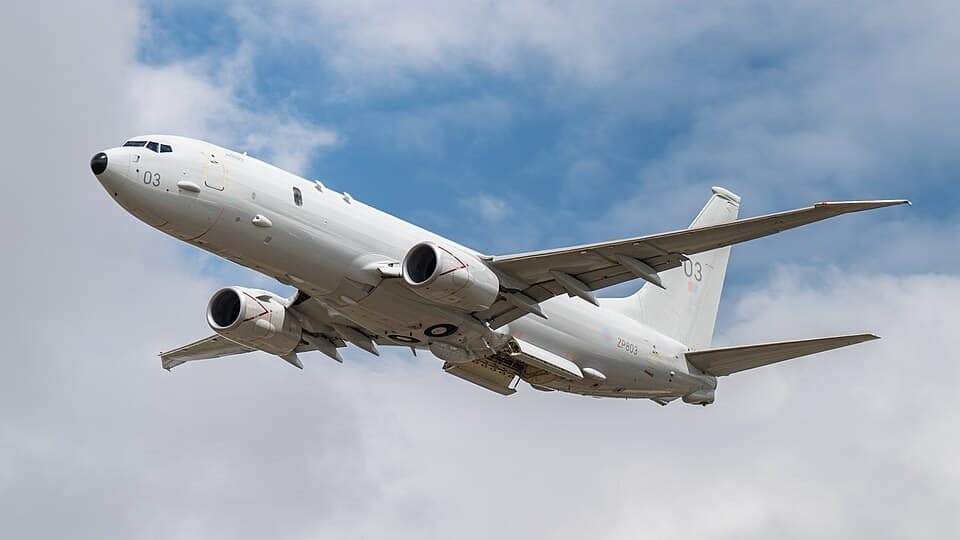
The airframe uses raked wingtips, reinforced structures and a weapons bay. Its external appearance differs from both a passenger 737 and the Indian P-8I mission configuration.1


Preparing your view.
Support aircraftIn serviceProfile in progress
The P-8A Poseidon is a land-based maritime patrol aircraft derived from the 737. It combines long-distance transit with sensors and mission systems for surveillance and anti-submarine work.
 United States
Royal Air Force (RAF) Boeing Poseidon MRA1 (P-8A) 'Sqn Ldr Terence Bulloch DSO DFC' (reg. ZP803) at the Royal International Air Tattoo 2025. Historical equipment reference photograph. It does not establish current availability or every detail of the named variant.
Julian Herzog (Website) · CC BY 4.0 · Wikimedia Commons · CC BY 4.0 · Source ↗ · ModifiedMaritime patrol aircraft
United States
Boeing
In service
United States Navy Royal Australian Air Force Indian Navy Royal Air Force
187 as of 31 January 2026
2009–present
November 2013
25 April 2009
Boeing 737 Next Generation
Flight crew: 2; Mission crew: 7
19,800 lb (9,000 kg)
129 ft 5 in (39.47 m)
123 ft 6 in (37.64 m)
42 ft 1 in (12.83 m)
138,300 lb (62,730 kg)
189,200 lb (85,820 kg)
2 × CFM56-7B27A turbofans, 27,300 lbf (121 kN) thrust each
564 mph (907 km/h, 490 kn)
509 mph (815 km/h, 440 kn)
1,383 mi (2,225 km, 1,200 nmi) radius with 4 hours on station for anti-submarine warfare mission
5,200 mi (8,300 km, 4,500 nmi)
41,000 ft (12,500 m)
11 total
The Boeing P-8 Poseidon is an American maritime patrol and reconnaissance aircraft developed and produced by Boeing Defense, Space & Security .
The P-8's first flight was on 25 April 2009. The second and third P-8s had flown and were in flight testing in early August 2010. On 11 August 2010, low-rate production of the P-8 was approved. A P-8 released sonobuoys for the first time on 15 October 2010, dropping six in three separate low-altitude passes. In 2011, the ice detection system was found to be defective due to the use of counterfeit components ; allegedly these parts were poorly refurbished and sold to subcontractor BAE Systems as new by a Chinese supplier.
In January 2014, Naval Air Systems Command proceeded with full-rate production of the P-8A. Increment 1 systems include persistent anti-submarine warfare (ASW) capabilities and an integrated sensor suite; in 2016, Increment 2 upgrades will add multi-static active coherent acoustics, an automated identification system, and high-altitude anti-submarine weapons. Increment 3 in 2020 shall enable "net-enabled anti-surface warfare".
In July 2014, Fred Smith, business development director for the P-8, noted that the program had: "saved $2.1 billion on 2004 estimates of the cost of production... the aircraft is now selling for $150 million, down from the forecasted $216 million". The halving of USN orders from 16 aircraft per year down to eight in 2015 due to the expiration of the Bipartisan Budget Act of 2013 was expected to be partially offset by commercial 737 sales and P-8 export sales. The DoD wanted to follow a program template for the P-8 similar to the Joint Strike Fighter (JSF) program, with international cooperation from prospective users.
After the aircraft roll off the assembly line, five operator stations (two naval flight officers plus three enlisted Aviation Warfare Operators/naval aircrewman) are mounted in a sideways row, along the port side of the cabin. Other than one large window on each side of the forward cabin for two observers, none of the other crew stations have windows. A short bomb bay for torpedoes and other stores opens behind the wing. The P-8 is to be equipped with the High-Altitude Anti-Submarine Warfare Weapon Capability (HAAWC) Air Launch Accessory (ALA), turning a Mark 54 torpedo into a glide bomb for deploying from up to 30,000 ft (9,100 m).
In February 2012, the P-8 made its mission debut during " Bold Alligator " 2012, an annual littoral warfare exercise. In April 2012, it took part in Exercise Joint Warrior , flying out of RAF Lossiemouth . During RIMPAC 2012 in the Hawaiian area, two P-8As participated in 24 scenarios as part of Air Test and Evaluation Squadron One ( VX-1 ) while forward deployed to Marine Corps Base Hawaii . On 29 November 2013, its inaugural deployment began when six aircraft and 12 air crews of squadron VP-16 departed its home station of NAS Jacksonville, Florida, for Kadena Air Base in Okinawa, Japan. This deployment was a pre-planned regional re-balancing action, but occurred shortly after China's establishment of the East China Sea Air Defense Identification Zone , heightening tensions.
A second squadron, VP-5 , completed its transition to the P-8 in August 2013. During mid-2014, a pair of P-8s were dispatched to Perth, Australia for two months for an international search for the missing Malaysia Airlines Flight 370 . On 2 October 2015, USN P-8s stationed at Naval Air Station Jacksonville, Florida, alongside U.S. Coast Guard HC-144A Ocean Sentry , HC-130H and USAF Reserve HC-130P Combat Shadow aircraft, searched the Eastern Caribbean Sea for the missing SS El Faro cargo ship that sank on 1 October in the Category 3 Hurricane Joaquin near Crooked Island in the Bahamas . On 20 February 2018, a P-8 of Patrol Squadron Eight (VP-8) rescued three fishermen whose vessel had been adrift in the South Pacific Ocean for eight days, deploying a search and rescue (SAR) kit containing supplies and communications equipment, the first time that a P-8 deployed a SAR kit in a real operation.
On 19 August 2014, a Chinese Shenyang J-11 fighter came within 30 feet (9.1 m) of a USN P-8A of VP-5 about 135 miles (217 km) east of Hainan Island while patrolling the South China Sea . The J-11 flew past the P-8's nose and performed a barrel roll at close proximity. A Pentagon spokesperson said the J-11's unit had made close intercepts earlier that year. The U.S. sent a diplomatic note to China about the behavior of the Chinese fighter groups' commander. China stated that the claims were "totally groundless", and that the root cause was U.S. surveillance of China. In November 2016, a Russian Su-30 fighter intercepted a P-8 over the Black Sea , coming within 5 feet (1.5 m) of it, forcing the P-8 through its jet wash , causing "a 15-degree roll and violent turbulence".
On 1 January 2009, India's Ministry of Defence signed a US$2.1 billion (~$2.98 billion in 2024) agreement with Boeing for eight P-8Is to replace the Indian Navy's aging Tupolev Tu-142 M maritime surveillance turboprops. The contract was signed after negotiations and clearance for the same from the Cabinet Committee on Security (CCS). While the P-8I contract was a direct agreement with Boeing, some end-user verifications are yet to be clarified with the US Government . Boeing will deliver the first of eight P-8I aircraft within 48 months of contract signing. The agreement included an additional purchase of four aircraft through Option Clause . It was Boeing's first military sale to India and the P-8's first international customer.
On 29 September 2011, the first P-8I completed its initial flight from Boeing Field . The aircraft took off at 12:02 pm local time and landed after a two hour and 31 minute long sortie. Multiple airborne systems checks including engine accelerations & decelerations and autopilot flight modes were conducted before the aircraft was take to an altitude of up to 41,000 ft (12,000 m). Boeing would now begin mission systems installation and checkout work on this aircraft at its Renton facility. In July 2012, Boeing conducted another P-8I flight testing from the same airfield. The sortie was 3 hours 49 minutes long where the aircraft fulfilled all its requirements. Further flight testing would be conducted in a US Navy range in the Neah Bay, Washington and a joint US-Canadian range. The first aircraft was expected to be delivered by January 2013 followed by the remaining units by 2016.
In October 2012, Australia formalized its participation, committing A$ 73.9m (US$81.1m) in an agreement with the USN. In July 2013, Air Marshal Geoff Brown , head of the RAAF, said Australia was considering buying more P-8As and fewer MQ-4C Triton UAVs than earlier planned. On 21 February 2014, Prime Minister Tony Abbott announced the intention to procure eight P-8As plus options for four more; entry into service is planned for 2021.
In July 2014, negotiations commenced between Boeing and the US Department of Defense to integrate the AGM-84 Harpoon Block 1G anti-ship missile onto the P-8A on Australia's behalf. In August 2014, the USN concluded an advanced acquisition contract on the first four of up to 12 P-8As to be bought by Australia, with delivery expected from 2017. In January 2016, Australia ordered a further four P-8As. The 2016 Defence White Paper stated that eight P-8As would be in service in the early 2020s and that 15 P-8As are planned for by the late 2020s. Including support facilities, the first group of eight aircraft's total cost is estimated at $3.6 billion (AU$4 billion).
Capacity: 19,800 lb (9,000 kg)
Length: 129 ft 5 in (39.47 m)
Wingspan: 123 ft 6 in (37.64 m)
Height: 42 ft 1 in (12.83 m)
Empty weight: 138,300 lb (62,730 kg)
Max takeoff weight: 189,200 lb (85,820 kg)
Powerplant: 2 × CFM56-7B27A turbofans, 27,300 lbf (121 kN) thrust each
Maximum speed: 564 mph (907 km/h, 490 kn)
Cruise speed: 509 mph (815 km/h, 440 kn)
Combat range: 1,383 mi (2,225 km, 1,200 nmi) radius with 4 hours on station for anti-submarine warfare mission
Ferry range: 5,200 mi (8,300 km, 4,500 nmi)
Service ceiling: 41,000 ft (12,500 m)
Internal bay with 5 hardpoints and 6 external hardpoints for a variety of conventional weapons, e.g. AGM-84 Harpoon , AGM-84H/K SLAM-ER , AGM-88G AARGM-ER , AGM-158C LRASM , Mark 54 torpedo , Sting Ray torpedo , naval mines , depth charges , and the High Altitude Anti-Submarine Warfare Weapon Capability (HAAWC) system
Reference text from Wikipedia contributors, used under CC BY-SA 4.0.
The system in detail
The airframe uses raked wingtips, reinforced structures and a weapons bay. Its external appearance differs from both a passenger 737 and the Indian P-8I mission configuration.1
Radar, electro-optical sensing and sonobuoy processing support complementary search tasks. Mission workstations integrate the information; radar range alone cannot describe underwater search performance.1
This record is limited to P-8A. Customer communications, self-protection and later mission-system updates require their own configuration notes.1
Maritime patrol comparisons need transit distance, search altitude and on-station endurance. Cruise range alone omits the time and equipment needed to investigate contacts.1
P-8A Poseidon equipment records. Variants, orders and quantities are shown as reported in each inventory source; coverage is incomplete.
 Australia
Air Force exact named equipment holdings: P-8A Poseidon. Active, operational-reserve and training units excluding equipment in store; November 2025 IISS assessment. Named service only; no parent-force or national total inferred. Source role: AIRCRAFT / ASW. Original estimates, ranges, reporting names, reserve, lease and employment scopes retained; nested included counts are not added. Missile-system quantities mean launchers, not rounds. No readiness, crew, carried weapon, payload, factory-production or future order count inherited.
 Canada
Number column of the Wikipedia list table under "Maritime patrol". The list's own wording applies; it is a compiled secondary source, not an official census.
 Denmark
Reported count for P-8 Poseidon · P-8A. Service scope: Royal Danish Air Force; does not replace a national total. 1 distinct quantity component(s) from the same source list; shared rowspan cells counted once. Explicit source inventory scope: active; no other stock status or total inferred. Count column(s): in service: 0. Origin: United States. The listed variants/roles are the scope, not an immediately deployable count. Explicitly named source subset; this is not a whole-family total and does not cover other listed designs. The components do not establish one inventory census date; the stored date is the retrieved source snapshot.
 Germany
P-8A aircraft holdings as of 23 April 2026, explicitly dated in the source to a statement by the Inspector of the Navy. Later expected deliveries and the overall purchase contract are excluded. Specialist-reported holdings; not an independently audited readiness count.
 India
Reported count for Boeing P-8 · P-8I Neptune. Service scope: Naval Air Arm; does not replace a national total. 1 distinct count cell(s) from the same source list; shared rowspan cells counted once. Retired, wholly reserve and on-order rows are excluded; the reported count retains any explicitly mixed stock scope in the quoted row. Count column(s): in service: 12. Origin: USA. The listed variants/roles are the scope, not an immediately deployable count. Dates are the count-cell citations' stated source period (2026), not the article revision. 2026 cited source edition. Edition or publication years do not claim an exact inventory census day.
 New Zealand
Air Force exact named equipment holdings: P-8A Poseidon. Active, operational-reserve and training units excluding equipment in store; November 2025 IISS assessment. Named service only; no parent-force or national total inferred. Source role: AIRCRAFT / ASW. Original estimates, ranges, reporting names, reserve, lease and employment scopes retained; nested included counts are not added. Missile-system quantities mean launchers, not rounds. No readiness, crew, carried weapon, payload, factory-production or future order count inherited.
 Norway
Air Force exact named equipment holdings: P-8A Poseidon. Active, operational-reserve and training units excluding equipment in store; November 2025 IISS assessment. Named service only; no parent-force or national total inferred. Source role: AIRCRAFT / ASW. Original estimates, ranges, reporting names, reserve, lease and employment scopes retained; nested included counts are not added. Missile-system quantities mean launchers, not rounds. No readiness, crew, carried weapon, payload, factory-production or future order count inherited.
 South Korea
Naval Aviation exact named equipment holdings: P-8A Poseidon. Active, operational-reserve and training units excluding equipment in store; November 2025 IISS assessment. Named service only; no parent-force or national total inferred. Source role: AIRCRAFT / ASW. Original estimates, ranges, reporting names, reserve, lease and employment scopes retained; nested included counts are not added. Missile-system quantities mean launchers, not rounds. No readiness, crew, carried weapon, payload, factory-production or future order count inherited.
 United Kingdom
Total reported holdings of the named fixed-wing or uncrewed platform, across reported variants. Includes aircraft outside the in-service fleet; not an active-only or readiness count. Platforms included: Poseidon.
United StatesNaval Aviation Reserve exact named equipment holdings: P-8A Poseidon. Active, operational-reserve and training units excluding equipment in store; November 2025 IISS assessment. Named service only; no parent-force or national total inferred. Source role: AIRCRAFT / ASW. Original estimates, ranges, reporting names, reserve, lease and employment scopes retained; nested included counts are not added. Missile-system quantities mean launchers, not rounds. No readiness, crew, carried weapon, payload, factory-production or future order count inherited.
United States Navy Royal Australian Air Force Indian Navy Royal Air Force
Equipment reference ↗Reported count for P-8 Poseidon · P-8A. Service scope: Royal Danish Air Force; does not replace a national total. 1 distinct quantity component(s) from the same source list; shared rowspan cells counted once. Explicit source inventory scope: ordered; no other stock status or total inferred. Count column(s): in service: +2. Origin: United States. The listed variants/roles are the scope, not an immediately deployable count. The components do not establish one inventory census date; the stored date is the retrieved source snapshot.