FORCETALLY
Loading the evidence…
Preparing your view.


Preparing your view.
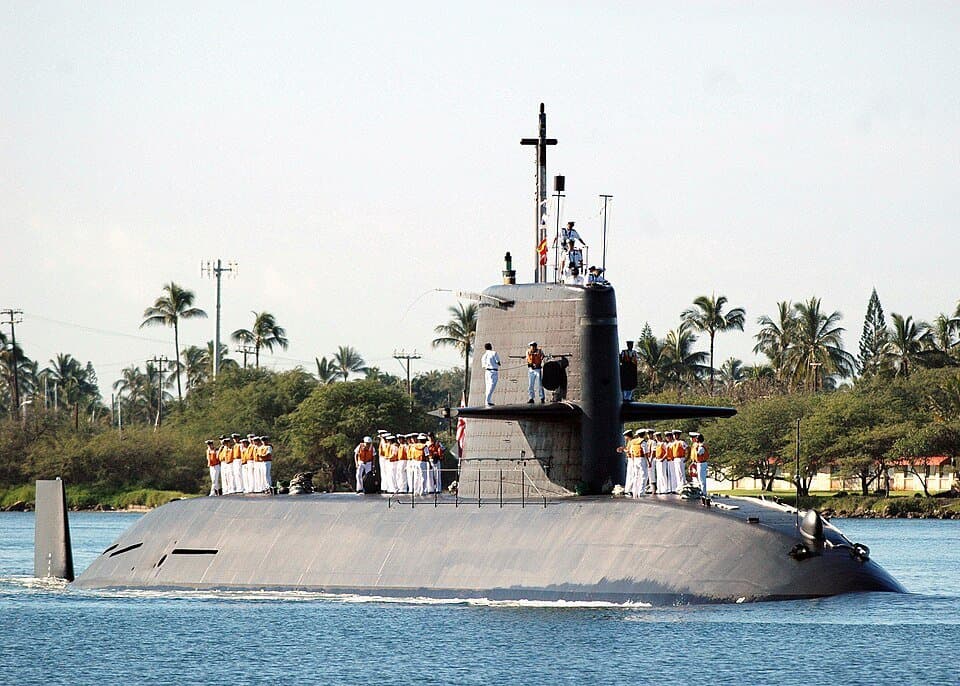
Submarines1998–present
Attack submarine
Oyashio-class submarine is a attack submarine. It was built by Kawasaki Shipbuilding Corporation Mitsubishi Heavy Industries. Reported operators include Japan Maritime Self-Defense Force.
 Japan
JapanOyashio-class submarine
JO2 Ryan C. McGinley, USN · Public domain · Resized · Public domain · Source ↗ · ModifiedOyashio (おやしお, Oyashio Current )
Kawasaki Shipbuilding Corporation Mitsubishi Heavy Industries
Japan Maritime Self-Defense Force
Harushio class
Sōryū class
1994–2008
1998–present
11
11
8 (2 converted to training ships)
3
Attack submarine
2,750 tonnes (surfaced) 3,500 tonnes (submerged)
81.7 m (268 ft 1 in )
8.9 m (29 ft 2 in )
7.4 m (24 ft 3 in )
Diesel-electric 2 Kawasaki 12V25S diesel engines 2 Kawasaki alternators 2 Toshiba motors 3,400 hp (2,500 kW) surfaced 7,750 hp (5,780 kW) submerged
12 knots (22 km/h; 14 mph) (surfaced) 20 knots (37 km/h; 23 mph) (submerged)
70 (10 officers)
Sonar : Hughes/Oki ZQQ-6 hull-mounted sonar, flank arrays, 1 towed array Radar : JRC ZPS 6 I-band search radar.
6 × HU-605 21 in (533 mm) torpedo tubes with 20 reloads for: Type 89 torpedoes UGM-84 Harpoon missiles
{"datatype": "wikibase-item", "datavalue": {"type": "wikibase-entityid", "value": {"entity-type": "item", "id": "Q17", "numeric-id": 17}}, "hash": "e9d62405b1bb9b7b979f00006a344891e4c4f072", "property": "P495", "snaktype": "value"}
Reference text from Wikipedia contributors, used under CC BY-SA 4.0.
True scale
Sourced dimensions beside a 1.75 m human reference.
Points represent sourced observations, including revisions. Revisions on the same effective date are not separate inventory events. Ranges appear in the table and are not plotted as exact points.
| Observation / report period | Value | Source | Claim state |
|---|---|---|---|
| 28 Sept 2026 | 81.7 m | Wikipedia contributors | superseded |
| 28 Sept 2026 | 81.7 m | Wikipedia contributors | approved |
Oyashio-class submarine equipment records. Variants, orders and quantities are shown as reported in each inventory source; coverage is incomplete.
JapanMaritime Self-Defense Force exact named equipment holdings: Oyashio (of which 2 in trg role). Active, operational-reserve and training units excluding equipment in store; November 2025 IISS assessment. Named service only; no parent-force or national total inferred. Source role: SUBMARINES / SSK. Original estimates, ranges, reporting names, reserve, lease and employment scopes retained; nested included counts are not added. Missile-system quantities mean launchers, not rounds. No readiness, crew, carried weapon, payload, factory-production or future order count inherited.
Maritime Self-Defense Force exact named equipment holdings of Oyashio (of which 2 in trg role). Active, operational-reserve and training units excluding equipment in store; November 2025 IISS assessment. Named service only, not a national or parent-force total or combat-readiness measure. Source role(s): SUBMARINES / SSK. No heading aggregate, carried armament, crew, payload, factory production or future order count inherited. The leading printed inventory count is retained; separately stated extra reserve, nonoperational or repair quantities inside parentheses are not added to it and remain verbatim in the excerpt. Source parentheses retain employment, lease, reporting designation, alternate model, or included-subset scopes exactly. Own fetched primary and alternate/model identity declarations are retained. Numbers inside an included subset are part of the printed count and are never added again; no sibling or parent specification is copied.
Reported count for Oyashio- class. Service scope: Japan Maritime Self-Defense Force ships; does not replace a national total. 2 distinct quantity component(s) from the same source list; shared rowspan cells counted once. Explicit source inventory scope: active; no other stock status or total inferred. Count column(s): in service: 6 / in service: 2. Origin: unstated. The listed variants/roles are the scope, not an immediately deployable count. The components do not establish one inventory census date; the stored date is the retrieved source snapshot.