FORCETALLY
Loading the evidence…
Preparing your view.


Preparing your view.
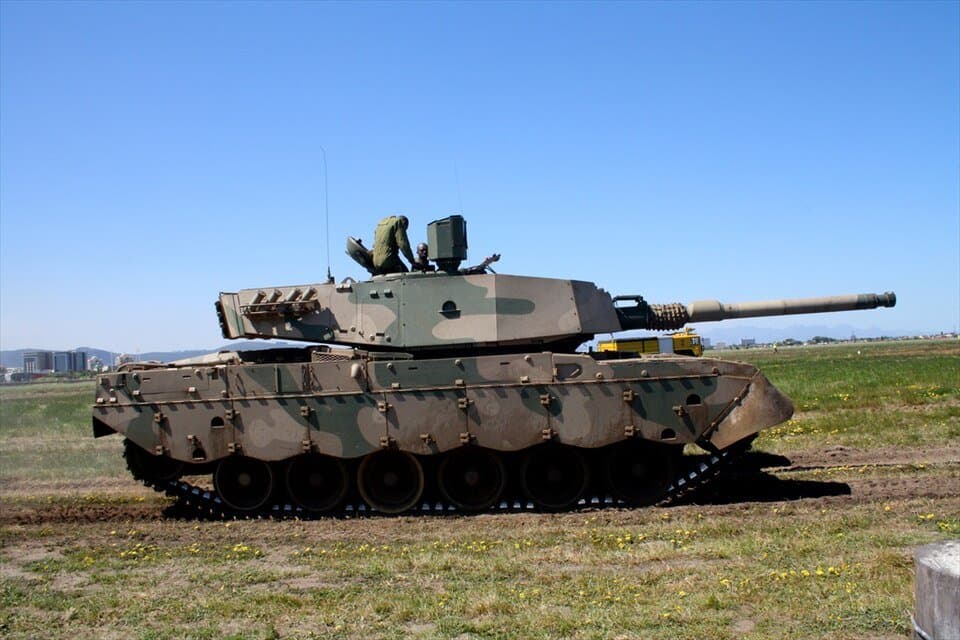
Tanks1976–present
Main battle tank
Olifant (tank) is a main battle tank originating in United Kingdom South Africa.
 United Kingdom South Africa
Olifant (tank)
Bob Adams from George, South Africa · CC BY-SA 2.0 · Resized · CC BY-SA 2.0 · Source ↗ · ModifiedMain battle tank
United Kingdom South Africa
1976–present
South African Border War : Operation Moduler Operation Packer
Centurion (tank)
The Olifant led to the TTD also known as The Loggim program (TTD Program)
224
57 long tons (58 t )
Hull only 24 ft 9.5 in (7.557 m) With gun forward 32 ft 3 in (9.83 m)
11 ft 1 in (3.38 m) with side plates 10 ft 9 in (3.28 m) without side plates
9 ft 7.75 in (2.94 m)
4 (commander, gunner, loader, driver)
51–152 mm (2.0–6.0 in)
Ordnance QF 20 pounder 84 mm " GT-1 " (Mk.1) 105 mm L7 rifled gun " GT-3 " (others)
Co-axial machine gun .30 cal
Rolls-Royce Meteor 4B (Mk.1) V-12 air-cooled Continental AV1790 turbo diesel engine (others) 650 hp (480 kW) at 2550rpm (Meteor) others up to 1,040 hp (780 kW) (Mk.2)
5-speed Merrit-Brown Z51R Mk. F gearbox (Mk.1) automatic gearbox (Mk.1A, Mk.1B, Mk.2)
Modified Horstmann (Mk.1 and Mk.1A) Torsion Bar (Mk.1B and Mk.2)
1 ft 8 in (0.51 m)
21.5 mph (34.6 km/h) (Mk.1) 35 mph (56 km/h) (Mk.1A, Mk.1B, Mk.2)
The South African government was obliged by the arms embargo to finance the creation of a new private sector enterprise, the Olifant Manufacturing Company (OMC), to refurbish the Centurions. The Semel program in 1974 counted a total of 35 conversions, soon used operationally. Information from the Sho't program – the Israeli Centurion conversion program – helped to start a more ambitious project. These refurbished tanks were named Olifant Mk.1.
The Olifant ( Afrikaans for Elephant) is the primary main battle tank of South Africa . It was developed from the British Centurion tank since 1976. These tanks were heavily redesigned and rebuilt by South Africa since 1976 with some help from Israel . Although based on a Centurion tank hull, it has a domestically-produced gun, power pack, transmission, tracks, wheels and fire control system.
Performance: Top speed: Range on single refuelling: Acceleration: Turning circle: Ground pressure: Power/mass ratio: Capability: 58km/h. 350km (road), 200km (cross country). Not known. Within own length. 1.01kg/cm sq 10.4kW/t. Can climb a 0.914m vertical step. Can cross a 3.45m wide trench. Can ford water 1.2m deep without preparation and 2.74m deep with preparation. Can climb a gradient of 60 degrees. Can traverse a gradient of 30 degrees.
Reference text from Wikipedia contributors, used under CC BY-SA 4.0.
True scale
Sourced dimensions beside a 1.75 m human reference.
Points represent sourced observations, including revisions. Revisions on the same effective date are not separate inventory events. Ranges appear in the table and are not plotted as exact points.
| Observation / report period | Value | Source | Claim state |
|---|---|---|---|
| 28 Sept 2026 | 7.557 m | Wikipedia contributors | superseded |
| 28 Sept 2026 | 7.557 m | Wikipedia contributors | superseded |
| 28 Sept 2026 | 7.557 m | Wikipedia contributors | superseded |
| 28 Sept 2026 | 7.557 m | Wikipedia contributors | superseded |
| 28 Sept 2026 | 7.557 m | Wikipedia contributors | superseded |
| 28 Sept 2026 | 7.557 m | Wikipedia contributors | approved |
| 28 Sept 2026 | 7.557 m | Wikipedia contributors | superseded |
| 28 Sept 2026 | 7.557 m | Wikipedia contributors | superseded |
Olifant (tank) equipment records. Variants, orders and quantities are shown as reported in each inventory source; coverage is incomplete.
South AfricaApproximate count for Olifant. Service scope: South African Army; does not replace a national total. 1 distinct count cell(s) from the same source list; shared rowspan cells counted once. Retired, wholly reserve and on-order rows are excluded; the reported count retains any explicitly mixed stock scope in the quoted row. Count column(s): number: ~ 266 acquired ~ 203 retained (2026 est.). Origin: United Kingdom South Africa. The listed variants/roles are the scope, not an immediately deployable count. Dates are the count-cell citations' stated source period (2024), not the article revision. Cited source 2024-03-11. Edition or publication years do not claim an exact inventory census day.