FORCETALLY
Loading the evidence…
Preparing your view.


Preparing your view.
ArtilleryIn service
Autocannon
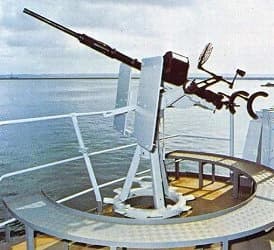
Oerlikon 20 mm cannon is a autocannon originating in Switzerland. It was built by Oerlikon Oerlikon Contraves.
 Switzerland
Oerlikon 20 mm · source-pictured whole pedestal gun on a French warship
Fotograf/Photographe/Photographer: Jean-Michel Roche · CC BY-SA 3.0 · Resized / optimised · CC BY-SA 3.0 · Source ↗ · ModifiedTechnical data
Autocannon
Switzerland
1937–present
World War II Nigerian Civil War
Reinhold Becker
1935
Oerlikon Oerlikon Contraves
1937−1995
124,734
Oerlikon FF MG FF cannon
L70 Total gun barrel weight: 68.04 kilograms (150.0 lb ) Minus breech mechanism: 20.865 kg (46.00 lb) L85 Empty: 92.0 kilograms (202.8 lb ) Loaded with 200 rounds: 182.0 kg (401.2 lb)
L70 Overall: 2,210 mm (87 in) Barrel length: 1,400 mm (55 in) L85 Overall: n/a Barrel length: 1,700 mm (67 in)
L70: 20×110mmRB L85: 20×128mm
HE: 123 g (4.3 oz) HE/T: 116 g (4.1 oz)
20 mm (0.79 in)
Single barrel (progressive RH parabolic twist, 9 grooves)
API blowback Gas operated, power reserve loading
Manual, -15°/+90°
Manual, full 360°
L70: Cyclic: 450 rounds per minute Practical: 250-320 rounds per minute L85: Cyclic: 900 to 1,000 rounds per minute
L70: 820 m/s (2,700 ft/s) L85: 1,050 m/s (3,400 ft/s)
Against low-flying aircraft (HE round) L70: 914 m (1,000 yd) L85: 1,500 m (1,600 yd)
HE round at 45° L70: 4,389 m (4,800 yd) L85: 6,800 m (7,400 yd)
Cylindrical magazine holding 60 rounds; later adjusted for belt-fed gun
The Oerlikon 20 mm cannon is a series of autocannons based on an original German Becker Type M2 20 mm cannon design that appeared very early in World War I .
The Oerlikon 20 mm cannon is a series of autocannons based on an original German Becker Type M2 20 mm cannon design that appeared very early in World War I . Widely produced by Oerlikon Contraves and by others, its various models saw service with both Allied and Axis forces during World War II . Versions of the cannon were still in use in 2026.
During World War I , German industrialist Reinhold Becker developed a 20 mm caliber cannon, known now as the 20 mm Becker using the advanced primer ignition blowback (API blowback) method of operation. This used a 20×70mmRB cartridge and had a cyclic rate of fire of 300 rpm. It was used on a limited scale as an aircraft gun on Luftstreitkräfte warplanes, and an anti-aircraft gun towards the end of that war.
Because the Treaty of Versailles banned further production of such weapons in Germany, the patents and design works were transferred in 1919 to the Swiss firm SEMAG ( Seebach Maschinenbau Aktien Gesellschaft ) based near Zürich . SEMAG continued development of the weapon, and in 1924 had produced the SEMAG L , a heavier weapon (43 kg) that fired more powerful 20×100mmRB ammunition at a slightly higher rate of fire, 350 rpm.
In 1927 the Oerlikon S was added to the existing product line. This fired a still larger cartridge (20×110mmRB) to achieve a muzzle velocity of 830 m/s (versus 490 m/s for the original Becker 20×70mmRB gun), at the cost of increased weight and a reduced rate of fire (280 rpm). The purpose of this development was to improve the performance of the gun as an anti-tank and anti-aircraft weapon, which required a higher muzzle velocity. An improved version known as the 1S followed in 1930.
In 1935 it made an important step by introducing a series of guns designed to be mounted in or on the wings of fighter aircraft. Designated with FF for Flügelfest meaning 'wing-mounted', these weapons were again available in the three sizes, with designations FF , FFL and FFS . The FF fired a slightly larger cartridge than the AF, 20×72mmRB, but the major improvement in these weapons was a significant increase in rate of fire. The FF weighed 24 kg and achieved a muzzle velocity of 550 to 600 m/s with a rate of fire of 520 rpm. The FFL of 30 kg fired a projectile at a muzzle velocity of 675 m/s with a rate of fire of 500 rpm. And the FFS, which weighed 39 kg, delivered a high muzzle velocity of 830 m/s at a rate of 470 rpm.
The incorporation of the improvements of the FFS in a new anti-aircraft gun produced, in 1938, the Oerlikon SS . Oerlikon realized further improvements in rate of fire on the 1SS of 1942, and the 2SS of 1945 which achieved 650 rpm. However, it was the original SS gun which was widely adopted as anti-aircraft gun, being especially widely used by Allied navies during World War II .
This gun used a 400-grain (26-gram) charge of IMR 4831 smokeless powder to propel a 2,000-grain (130-gram) projectile at 2,800 feet (850 meters) per second.
The Oerlikon became best known in its naval applications. Initially the Oerlikon was not looked upon favorably by the Royal Navy as a short-range anti-aircraft gun. In 1937–1938 Lord Louis Mountbatten , then a captain in the Royal Navy, advocated within the Royal Navy to set up an unprejudiced trial for the Oerlikon 20 mm gun, but was unsuccessful. It was not until the Commander-in-Chief of the Home Fleet , Admiral Sir Roger Backhouse , was appointed First Sea Lord that Mountbatten's efforts bore fruit. During the first half of 1939 a contract for 1,500 guns was placed in Switzerland. However, due to delays and then later the fall of France in June 1940, only 109 guns reached the United Kingdom. All Oerlikon guns imported from Switzerland, in 1940, were mounted on various gun carriages to serve as light AA-guns on land.
Just a few weeks before the fall of France, the Oerlikon factory approved manufacture of their gun in the United Kingdom, under licence. The Royal Navy managed to smuggle out the necessary drawings and documents from Zürich . The production of the first British-made Oerlikon guns started in Ruislip , London , at the end of 1940. The first guns were delivered to the Royal Navy in March or April, 1941. The RAF Regiment made extensive use of Oerlikon guns in the anti-aircraft role. These were the principal armament for its light anti-aircraft squadrons in North Africa, the Middle East, Italy, and north western Europe, until the introduction of the Bofors 40/L60 40 mm gun from 1943, although many squadrons retained a mix of guns until the end of World War 2. Squadrons in the Far East were equipped exclusively with Oerlikons.
The Oerlikon gun was installed aboard United States Navy ships from 1942, replacing the M2 Browning machine gun , which lacked range and firepower, and largely superseding the 1.1"/75 caliber gun , which was heavier and had less mechanical reliability. It became famous in the naval anti-aircraft role, providing an effective defense at short ranges (in practice up to 1.5 km) at which heavier guns had difficulty tracking a target. The gun was eventually abandoned as a major anti-air weapon due to its lack of stopping power against heavy aircraft and against Japanese kamikaze attacks during the Pacific War . It was largely superseded by the Bofors 40 mm gun and the 3"/50 Mark 22 gun . It provided a useful increase in firepower over the .50 cal machine gun when adapted and fitted to some aircraft. However, it had some problems with jamming in the ammunition feed.
In the Vietnam War , the US Navy used a mix of 20 mm weapons. The original Oerlikons were still in use aboard some vessels early in the conflict, especially on Riverine patrol boats , but were increasingly replaced by the belt-fed Colt Mk 12 and Mk 16 cannons , which were derived from the Hispano-Suiza HS.404.
During the 1980s Tanker war phase of the Iran–Iraq war , Oerlikon 20 mm guns were used by smaller Gulf navies & some Western escorts. These weapons were often mounted on fast patrol boats & used to fire warning shots or deter Iranian small-boat harassment. Though largely obsolete against air threats by this point, the Oerlikon remained viable against soft targets at sea.
In the 1982 Falklands War , the Royal Navy found itself short of modern Close-in weapon system (CIWS). As a result, several auxiliary vessels, including some requisitioned ships, were hastily fitted with WWII era Oerlikon 20 mm mounts for defence. Some Royal Fleet Auxiliary (RFA) ships also received twin mounts of gas-operated Oerlikon GAM-BO1 . Their limited ability during the conflict reinforced the Royal Navy’s urgent need for modern radar-guided defensive systems.
In contrast, 20mm cartridges are far too powerful, and efficient autocannon barrels too long, for this basic system to be practical; so the Oerlikon uses Advanced Primer Ignition (API) to augment the resistance of the bolt.
Shortly after the War, Oerlikon began development of another gas-operated autocannon, 204-Gk, presently KAA . Both 5TG (KAB) and 204-Gk (KAA) uses 20mm×128 ammunition cartridge being developed by Oerlikon in 1943.
Crew: 6.
Reference text from Wikipedia contributors, used under CC BY-SA 4.0.
Points represent sourced observations, including revisions. Revisions on the same effective date are not separate inventory events. Ranges appear in the table and are not plotted as exact points.
| Observation / report period | Value | Source | Claim state |
|---|---|---|---|
| 28 Sept 2026 | 2.21 m | Wikipedia contributors | superseded |
| 28 Sept 2026 | 2.21 m | Wikipedia contributors | superseded |
| 28 Sept 2026 | 2.21 m | Wikipedia contributors | superseded |
| 28 Sept 2026 | 2.21 m | Wikipedia contributors | superseded |
| 28 Sept 2026 | 2.21 m | Wikipedia contributors | approved |
Oerlikon 20 mm cannon equipment records. Variants, orders and quantities are shown as reported in each inventory source; coverage is incomplete.
 Argentina
Reported count for Oerlikon 20 mm cannon. Service scope: Argentine Army; does not replace a national total. 1 distinct count cell(s) from the same source list; shared rowspan cells counted once. Excludes retired/reserve/on-order rows. Count column(s): quantity: 230. Origin: Switzerland. The listed variants/roles are the scope, not an immediately deployable count. The components do not establish one inventory census date; the stored date is the retrieved source snapshot.
 India
 Indonesia
 Malaysia
 Mexico
 Philippines
 Portugal
Reported count for Oerlikon 20mm L/65. Service scope: Portuguese Navy ships; does not replace a national total. 2 distinct count cell(s) from the same source list; shared rowspan cells counted once. Excludes retired/reserve/on-order rows. Count column(s): quantity: 1 / quantity: 4. Origin: Switzerland. The listed variants/roles are the scope, not an immediately deployable count. The components do not establish one inventory census date; the stored date is the retrieved source snapshot.
 Thailand
 Türkiye
Reported count for Oerlikon 20 mm. Service scope: Turkish Land Forces; does not replace a national total. 1 distinct count cell(s) from the same source list; shared rowspan cells counted once. Retired, wholly reserve and on-order rows are excluded; the reported count retains any explicitly mixed stock scope in the quoted row. Count column(s): quantity: 439. Origin: Switzerland Turkey. The listed variants/roles are the scope, not an immediately deployable count. Dates are the count-cell citations' stated source period (2023), not the article revision. 2023 cited source edition. Edition or publication years do not claim an exact inventory census day.
 Sweden
 United States