FORCETALLY
Loading the evidence…
Preparing your view.


Preparing your view.
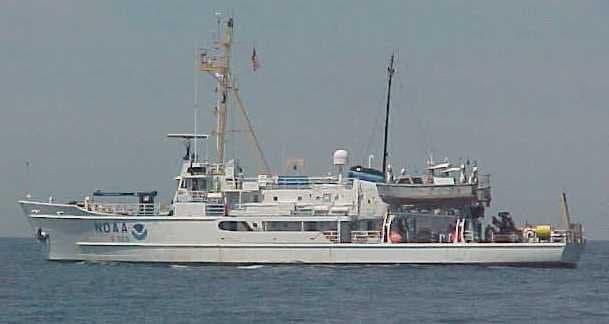
Naval support & landing craftIn service
S1-MT-59a
NOAAS Whiting is a s1-MT-59a originating in United States. It was built by Marietta Manufacturing Company , Point Pleasant , West Virginia.
 United States
NOAAS Whiting
National Oceanic and Atmospheric Administration photo · Public domain · Resized · Public domain · Source ↗ · ModifiedUSC&GS Whiting (CSS 29)
Henry Laurens Whiting (1821-1897), U.S. Coast Survey and U.S. Coast and Geodetic Survey employee (1838-1897) and renowned topographic surveyor
Marietta Manufacturing Company , Point Pleasant , West Virginia
20 November 1962
July 1963 (delivery)
8 July 1963
Transferred to National Oceanic and Atmospheric Administration 3 October 1970
2 May 2003
Norfolk , Virginia
IMO number : 6601973 Radio call sign WTEW
ARM Amealco (BI-07), 2023
Active
S1-MT-59a
Survey ship
696 gross register tons 151 net tons
907 tons
49.7 m (163 ft)
10.1 m (33 ft)
3.4 m (11 ft) (maximum) 3.7 m (12 ft) (with IDSSS dome)
Two geared 800- bhp (597- kW ) General Motors diesel engines , two shafts, 4,300 U.S. gallons (16,277 liters fuel)
12.0 knots
5,700 nm
20 days
33 (8 officers, 25 other crew, 2 scientists) plus up to 6 temporarily embarked personnel
NOAAS Whiting (S 329) , was an American survey ship that was in commission in the National Oceanic and Atmospheric Administration (NOAA) from 1970 to 2003.
Whiting was built at a cost of $2,300,000 ( USD ) as a "coastal survey ship" (CSS) for the U.S. Coast and Geodetic Survey by the Marietta Manufacturing Company at Point Pleasant , West Virginia . She was launched on 20 November 1962 and delivered in July 1963. The Coast and Geodetic Survey commissioned her on 8 July 1963 in a ceremony at New Orleans , Louisiana , as USC&GS Whiting (CSS 29) , the first and only Coast and Geodetic Survey ship of the name. When the Coast and Geodetic Survey and other United States Government agencies merged to form NOAA on 3 October 1970, Whiting became a part of the NOAA fleet as NOAAS Whiting (S 329) , thus far the only NOAA ship to bear the name.
Whiting had a two-drum bathythermograph winch with a maximum pull of 1,000 pounds (454 kg ). The lower drum had 3/16-inch (4.75-mm) wire rope, while the upper drum had 13,123 feet (4,000 meters) of 1/4-inch (6.4-mm) wire rope. She had a 27-foot (8.2-meter) telescoping boom with a lifting capacity of 2,500 pounds (1,100 kg) and a 27-foot (8.2-meter) articulating boom with a lifting capacity of 2,768 pounds (1,256 kg), as well as a 16-foot A-frame with a maximum load of 6,250 pounds (2,830 kg) and a working load of 5,000 pounds (2,300 kg).
For acoustic hydrography and bathymetry, Whiting had 12- Khz deep-water echosounder , a 100-kHz shallow-water echosounder-lOOKhz, a 24- and 100-kHz hydrographic survey sounder, and the Intermediate Depth Swath Survey System (IDSSS), which is a 36-kHz sidescan sonar . In 1989 she underwent a major upgrade involving the installation of Hydrochart II , which employed a Microvax computer system to acquire and process hydrographic data. Hydrochart II gave her the capability to generate bottom contour charts with a swath width of approximately two-and-a-half times the water depth, ranging from 10 to 1,000 meters (33 to 3,281 ft), in real time.
Whiting carried two 29-foot (8.8-meter) aluminum-hulled diesel -powered Jensen survey launches . For utility and rescue purposes, she also carried two open boats with gasoline -powered outboard motors , a 16-foot (4.9-meter) Boston Whaler fiberglass -hulled boat and 17-foot (5.2-meter) Monark aluminum -hulled boat.
Glang , interrupted her survey operations in the Delaware Bay on 18 July to make a 24-hour voyage at about 12 knots (14 mph; 22 km/h) to the search area and participate in the search for the aircraft and its passengers.
... for exceptionally meritorious service from 17 July 1999 to 23 July 1999 in the search and recovery of the downed aircraft carrying John F. Kennedy, Jr.; his wife, Carolyn Bessette-Kennedy ; and her sister Lauren Bessette . Members of the Unified Command distinguished themselves during this complex operation with their professional expertise and poise.
Whiting again was operating in the Delaware Bay under Lieutenant Commander Glang's command when Egyptair Flight 990 , a Boeing 767-300ER , crashed in the Atlantic Ocean about 40 miles (64 kilometers) south of Nantucket Island , Massachusetts, on 31 October 1999.
Arriving on the scene early on 2 November, she put her sidescan sonar to use and discovered the debris field of the crash on the ocean bottom on her first surveying pass, only 12 hours after arriving.
After only a day of search operations, however, a gale with 50-knot (58-mph; 93-km/h) winds and 20-foot (6.1-meter) seas forced Whiting and U.S.
Navy submarine USS S-5 (SS-110) , which sank 15 nautical miles (28 kilometres) off Cape May , New Jersey , in September 1920.
After eight hours of searching, Whiting found the wreck of S-5 directly over one of the suspected targets, made a sonar image of the wreck, and recorded its exact location.
Reference text from Wikipedia contributors, used under CC BY-SA 4.0.
True scale
Sourced dimensions beside a 1.75 m human reference.
Points represent sourced observations, including revisions. Revisions on the same effective date are not separate inventory events. Ranges appear in the table and are not plotted as exact points.
| Observation / report period | Value | Source | Claim state |
|---|---|---|---|
| 2 Oct 2026 | 10.1 m | Wikipedia contributors | superseded |
| 2 Oct 2026 | 10.1 m | Wikipedia contributors | approved |
NOAAS Whiting equipment records. Variants, orders and quantities are shown as reported in each inventory source; coverage is incomplete.
 Mexico
Navy exact named equipment holdings: Rio Tuxpan. Active, operational-reserve and training units excluding equipment in store; November 2025 IISS assessment. Named service only; no parent-force or national total inferred. Source role: LOGISTICS AND SUPPORT / AGS. Original estimates, ranges, reporting names, reserve, lease and employment scopes retained; nested included counts are not added. Missile-system quantities mean launchers, not rounds. No readiness, crew, carried weapon, payload, factory-production or future order count inherited.
Keep exploring
Multi-purpose ship
 Germany
special mission-support ship
Large, Medium-Speed Roll-on/Roll-off
United StatesMultipurpose research ship (AGE)
 China
Cargo ship
 Argentina
Support ship
 Malaysia