FORCETALLY
Loading the evidence…
Preparing your view.


Preparing your view.
Rockets & launchersIn service
Multi-role (anti-fortification, anti-armor ) rocket launcher
Mk 153 Shoulder-Launched Multipurpose Assault Weapon is a multi-role (anti-fortification, anti-armor ) rocket launcher originating in United States. It was built by Nammo Talley (formerly Talley Defense Systems). Reported operators include Ukraine, United States.
 United States
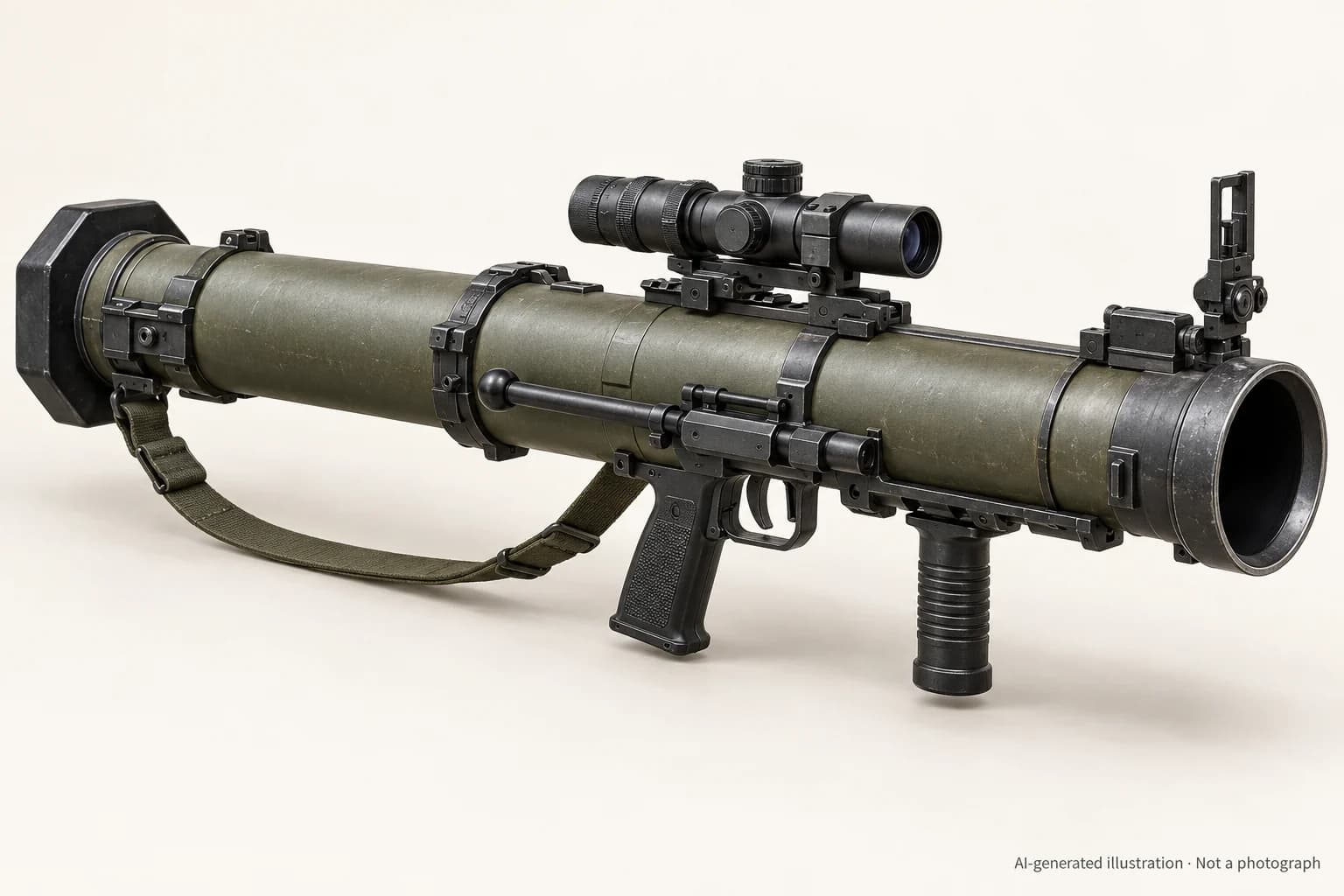
AI-generated illustration · Not a photograph. Representative exterior illustration; details are illustrative and do not establish specifications.
ForceTally · AI-generated illustration · Not a photograph · AI-generated · OpenAI output terms · Source ↗ · ModifiedTechnical data
Multi-role (anti-fortification, anti-armor ) rocket launcher
United States
1984–present
See Operators
Operation Just Cause Gulf War War in Afghanistan Iraq War Yemeni Civil War Russo-Ukrainian War
McDonnell Douglas
Nammo Talley (formerly Talley Defense Systems)
US$13,000
M141 Bunker Defeat Munition
16.92 lb (7.67 kg ) (empty) 29.34 lb (13.31 kg) (loaded with HEDM)
760 mm (30 in ) (unloaded) 1,371 mm (54.0 in) (loaded)
2 (can be operated by one person, but at lower rate of fire)
12.9 lb (5.9 kg) (HEDM) 14.25 lb (6.46 kg) (HEAA) 18.5 lb (8.4 kg) (SMAW-NE)
83.5 mm (3.29 in) (bore diameter) 83.0 mm (3.27 in) (rocket diameter)
True scale
Sourced dimensions beside a 1.75 m human reference.
Points represent sourced observations, including revisions. Revisions on the same effective date are not separate inventory events. Ranges appear in the table and are not plotted as exact points.
| Observation / report period | Value | Source | Claim state |
|---|---|---|---|
| 28 Sept 2026 | 83 mm | Wikipedia contributors | superseded |
| 28 Sept 2026 | 83 mm | Wikipedia contributors | superseded |
| 28 Sept 2026 | 83 mm | Wikipedia contributors | superseded |
| 28 Sept 2026 | 83 mm | Wikipedia contributors | superseded |
| 28 Sept 2026 | 83 mm | Wikipedia contributors | superseded |
| 28 Sept 2026 | 83 mm | Wikipedia contributors | superseded |
| 28 Sept 2026 | 83 mm | Wikipedia contributors | superseded |
| 28 Sept 2026 | 83 mm | Wikipedia contributors | approved |
3 rounds per minute (practical)
220 m/s (720 ft/s ) (HEDM) 208 m/s (680 ft/s ) (HEAA) 150 m/s (490 ft/s ) (SMAW-NE)
250 m (820 ft ) (HEDM) 500 m (1,600 ft) (HEAA) 250 m (820 ft ) (SMAW-NE) Arming distance: 17 m (56 ft ) (HEDM/HEAA) 8.23 m (27.0 ft ) (SMAW-NE)
1,800 m (5,900 ft)
Detachable single-rocket casing
Iron sights (250 m; 820 ft) Mk 42 Day Sight (3.8× magnification telescopic sight ) RCO / ACOG (4×) AN/PEQ-15 or AN/PEQ-16 AN/PVS-17C (4.5×) AN/PAS-13G Light Weapon Thermal Sight (LWTS)
HEDM: 2.4 lb (1.1 kg) Aluminized Comp A-3 HEAA: 1.89 lb (0.86 kg) Sedimentation Cast Octol SMAW-NE: 4 lb (1.8 kg) PBXN-113
Ukraine
United States
United States : United States Army borrowed 125 Mk 153 Mod 0 SMAWs from the Marine Corps and later returned them.
The Mk 153 Shoulder-Launched Multipurpose Assault Weapon ( SMAW ) is a smoothbore shoulder-fired rocket launcher .
The Mk 153 Shoulder-Launched Multipurpose Assault Weapon ( SMAW ) is a smoothbore shoulder-fired rocket launcher . Primarily used as a portable assault weapon, or " bunker buster ", it also possesses secondary anti-armor capabilities. Developed from the Israeli B-300 , the SMAW was introduced to the United States Armed Forces in 1984. While it retains similar external characteristics to the B-300, the American-redesigned SMAW features a key distinction: the integration of a 9×51mm spotting rifle , which is an evolution of the one developed for the LAW 80 . The spotting rifle's purpose is to enhance target acquisition and improve hit probability.
The SMAW's main purpose is to destroy bunkers , buildings, and light armored vehicles during assault operations, using high-explosive dual mode (HEDM) rockets. The SMAW can also engage armored vehicles using high-explosive anti-armor (HEAA) rockets, which has a maximum effective range of 500 m (550 yards) against a tank -sized target. Operations in Iraq also saw use of the SMAW-NE (Novel Explosive) rocket, a thermobaric rocket used to collapse buildings and cave openings.
The SMAW can also engage armored vehicles using high-explosive anti-armor (HEAA) rockets, which has a maximum effective range of 500 m (550 yards) against a tank -sized target.
In 2008, a replacement program was again initiated and titled the SMAW II. It was developed in tandem with a round capable of being fired from an enclosed area without ill effects on the environment and personnel. Its combined weight is 13.5 kilograms (29.7 lb)—5.3 kg (11.7 lb) for the launcher, 8.2 kg (18 lb) for the rocket. The contract was worth up to US$ 51.7 million .
The development reduced the over-all weight by four and a half pounds (2.0 kg) from the older SMAW launcher. The Serpent fires the same rounds as the standard SMAW and supports new and improved/enhanced rounds. The Serpent was never adopted for service. Instead the USMC eventually adopted the Mk 153 Mod 2 to replace the service's SMAW launchers by 2020.
The Mk 153 Mod 0 SMAW fires 83 mm (3.27-inch) rockets through an 83.5 mm (3.29-inch) diameter launch tube. The system can fire a variety of encased rockets, such as the Mk 3 Mod 0 High-Explosive Dual Mode (HEDM) Rocket, the Mk 6 Mod 0 High-Explosive Anti-Armor (HEAA) Rocket, the Mk 7 Mod 0 Common Practice Rocket, and the Mk 80 Mod 0 Novel Explosive (NE) Rocket. The rocket encasements are loaded into the rear of the launcher, and the launch tube is constructed from a durable fiberglass - epoxy composite material with a gel coated bore.
The launcher consists of the launch tube, spotting rifle, electro-mechanical firing mechanism, mounting brackets, open battle sights and an optic mount for the Mk 42 Mod 0 day sight , RCO , AN/PVS-4 or AN/PVS-17C night sights . The system can also be aimed at night with an infrared aiming laser from the AN/PEQ-15 or AN/PEQ-16 in conjunction with night vision, since the IR laser is attached to the optic mount that can change elevation based on the range it is set to. The firing mechanism mechanically fires the spotting rifle and uses a magneto to fire the rocket.
The 9×51mm Mk 217 Mod 0 spotting round is ballistically matched with the rocket, improving the gunner's first-round hit probability. Spotting cartridges are stored in a six-round magazine located in the cap of the encased rocket. Each spotting round features a special 9mm projectile containing a tracer compound, which is crimped into a 7.62×51mm NATO casing, with a .22 Hornet primer.
The Mk 153 Mod 2 is an enhanced variant, featuring an electronic modular ballistic sight (MBS) in place of the 9 mm spotting system.
The MBS system consists of the AN/PSQ-23A laser rangefinder and the AN/PAS-13G Light Weapon Thermal Sight (LWTS).
To engage a target, the gunner first acquires the target using the thermal sight (AN/PAS-13G), which allows them to see the target in various environmental conditions.
The Mod 2 also has a reduced weight of 13 lb (5.9 kg) with the MBS attached, along with other improvements, like increased pad size on the forward grip and foldable backup iron sights.
The HEDM round can penetrate 20 cm (7.9 inches) of double-reinforced concrete walls, 30 cm (12 inches) of brick, up to 20 mm (0.79 inches) of rolled homogenous armor, or up to 210 cm (6.9 feet) of wood-reinforced sandbags.
The Mk 6 Mod 0 Encased High-Explosive, Anti-Armor (HEAA) rocket is effective against current tanks without added armor, and uses a standoff rod on the detonator, allowing the explosive force to be focused on a small point and for maximum damage against targets. The HEAA rocket uses a shaped charge warhead with 1.89 lb (0.86 kilograms) octol explosive, which can penetrate up to the equivalent of 600 mm (24 in) of rolled homogeneous armor. The unit cost of the Mk 6 HEAA round is $25,000. The HEAA rocket was not initially fielded with the SMAW.
The Mk 80 Mod 0 Encased Novel Explosive (SMAW-NE) rocket is effective against caves, buildings, and bunkers. The SMAW-NE has an enhanced-blast warhead with a 4 lb (1.8 kilograms) charge of PBXN -113 and a slightly modified version of the dual mode fuze used by the HEDM rocket, the Mk 420 Mod 1. The Indian Head Naval Surface Warfare Center teamed with Marine Corps Systems Command and Talley Defense Systems to respond to an urgent U.S. Marine Corps need for a shoulder-launched enhanced-blast warhead in 2003. It was used in combat during both the first and second offensives in Fallujah , in 2004.
As with all recoilless rocket launchers, the backblast generated upon firing is a significant safety concern. When the rocket is fired, the propellant is fully expelled within the rocket's encasement, resulting in a loud and forceful backblast. This backblast extends in a 90 m (300 ft), 60° cone behind the weapon. It is lethal out to 30 m (98 ft) and still extremely dangerous to 90 m (300 ft).
Feed system Detachable single-rocket casing
Reference text from Wikipedia contributors, used under CC BY-SA 4.0.
Mk 153 Shoulder-Launched Multipurpose Assault Weapon equipment records. Variants, orders and quantities are shown as reported in each inventory source; coverage is incomplete.
Keep exploring
 Mexico
 Pakistan
 Ukraine
 China
 Egypt
 Spain