FORCETALLY
Loading the evidence…
Preparing your view.


Preparing your view.
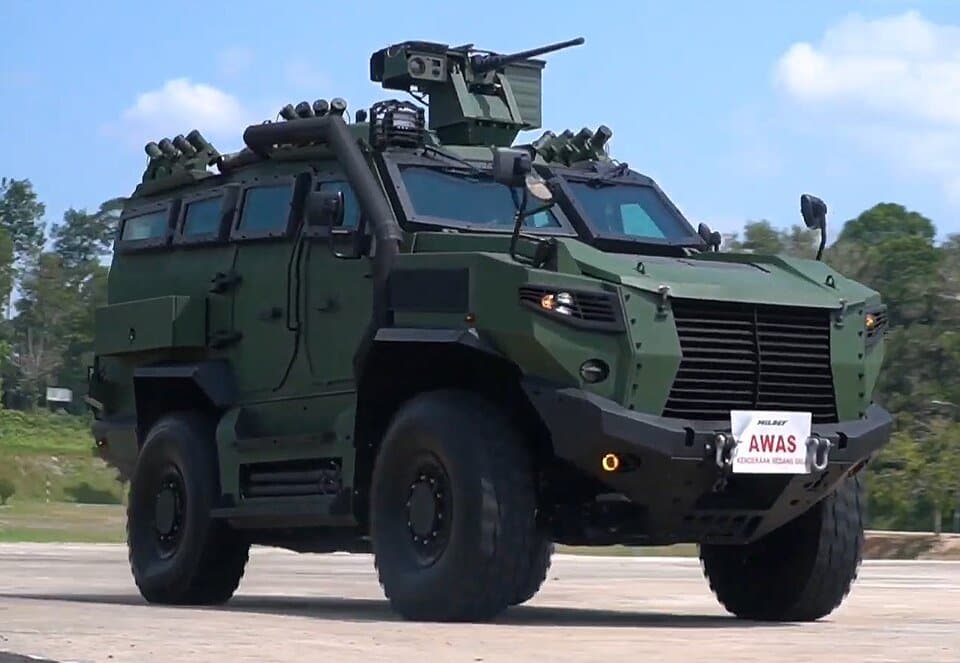
Armoured vehiclesIn production
Armoured personnel carrier / Mine-resistant ambush protected
Mildef Tarantula HMAV is a armoured personnel carrier / Mine-resistant ambush protected originating in Malaysia. It was built by Mildef International Technologies.
 Malaysia
Technical data
Armoured personnel carrier / Mine-resistant ambush protected
Malaysia
2013
Mildef International Technologies
2021 – present
2 prototypes
14 tonnes (gross weight), 11 tonnes (empty weight)
5.6 metres
2.5 metres
2.5 metres
10 person
Composite armor, STANAG 4569 level 2A hull protection STANAG 4569 level 2B belly protection
Aselsan SIPER 12.7mm RCWS
True scale
Sourced dimensions beside a 1.75 m human reference.
Caterpillar engine 330 hp
23.57 hp/ton
Allison automatic transmission
4×4
430 mm
110 km/h
The Mildef Tarantula HMAV is a Malaysian 4×4 V-hull mine-resistant infantry mobility vehicle that provides high-level protection against a variety of battlefield threats such as mines and improvised explosive devices .
The Tarantula measures 5.6 metres in length, 2.5 metres in width, and 2.5 metres in height. The first prototype weighed 13.2 tonnes, and was powered by a Caterpillar diesel engine producing 330hp, giving it a power-to-weight ratio of 24hp/ton, and a maximum speed of 110km/h. The second prototype reportedly featured a Caterpillar engine that produced 340hp and allowed it to achieve a maximum speed of 120km/h.
The initial prototype featured a 12.7mm remote controlled weapon station (RCWS) and smoke grenade dischargers . The Tarantula's second prototype featured a dual 7.62mm and 12.7mm RCWS configuration.
Mildef has also highlighted the possibility of specialized variants built on the same base platform, such as recovery, ambulance, and reconnaissance vehicles. Export‑oriented configurations may differ in armor level, armament, and communications gear to suit foreign customers and mission profiles. Nonetheless, the core automotive components and mine‑resistant hull architecture remain common across variants to simplify production and logistics.
Tarantula
High Mobility Armored Vehicle (HMAV)
MILDEF International Technologies
4x4
2
8
6,300 mm
2,500 mm
3,000 mm
3,200 mm
16,000 kg
Caterpillar
Turbocharged Diesel
330 hp
700 km
110 km/h
No
60%
30%
500 mm
700 mm
10,000 mm
430 mm
33 deg
30 deg
8,000 mm
The baseline Tarantula configuration is typically shown with a roof‑mounted Remote‑Controlled Weapon Station (RCWS) capable of mounting a 12.7 mm heavy machine gun. The RCWS allows the gunner to operate the weapon from within the protected cabin, improving survivability compared with open cupola mounts. Depending on customer requirements, the platform can integrate alternative armament suites, including multiple grenade launchers or anti‑tank guided missiles, as well as non‑lethal options for peacekeeping operations. Mission equipment options include battle management systems, secure communications suites, and 360‑degree camera systems to increase situational awareness. The modular roof structure and internal wiring provisions are intended to support future upgrades or country‑specific weapon and sensor fits without major redesign. This flexibility supports roles beyond basic troop transport, such as command post, surveillance, or convoy escort vehicle configurations.
The Tarantula is built to NATO STANAG 4569 Level 2 ballistic protection, with Level 2B under‑belly mine protection and Level 2A hull protection against mines under the wheels. STANAG Level 2 ballistic standards correspond to protection against 7.62 mm armor‑piercing rounds fired from specified distances, along with fragments from artillery and mortar threats. The vehicle employs composite armor to meet these thresholds while controlling weight, and Mildef has indicated the armor package and hull design have been validated through live‑fire trials in Thailand and South Africa. To mitigate blast effects, the Tarantula uses a pronounced V‑shaped hull combined with energy‑attenuating crew seats and under‑belly reinforcement designed to limit the transmission of blast forces into the cabin. Testing by STRIDE and other institutions included under‑belly explosion trials to ensure compliance with the specified STANAG levels. The design focus on mine and IED resistance positions the Tarantula closer to MRAP‑style vehicles than to lightly armored soft‑skin trucks.
INA
Yes
INA
Malaysia
Tarantula HMAV Mine-resistant ambush protected vehicle Malaysia 0+(136) 136 on order. Armed with Aselsan SIPER RWS.
Reference text from Wikipedia contributors, used under CC BY-SA 4.0.
Keep exploring
Mine-Resistant Ambush Protected Vehicle
Mine-Resistant Ambush Protected Vehicle
 FranceCompare with Mildef Tarantula HMAV
Mine-Resistant Ambush Protected Vehicle
 South Africa
Mine-Resistant Ambush Protected Vehicle
Mine-resistant ambush protected vehicle
Mine-Resistant Ambush Protected Vehicle