FORCETALLY
Loading the evidence…
Preparing your view.


Preparing your view.
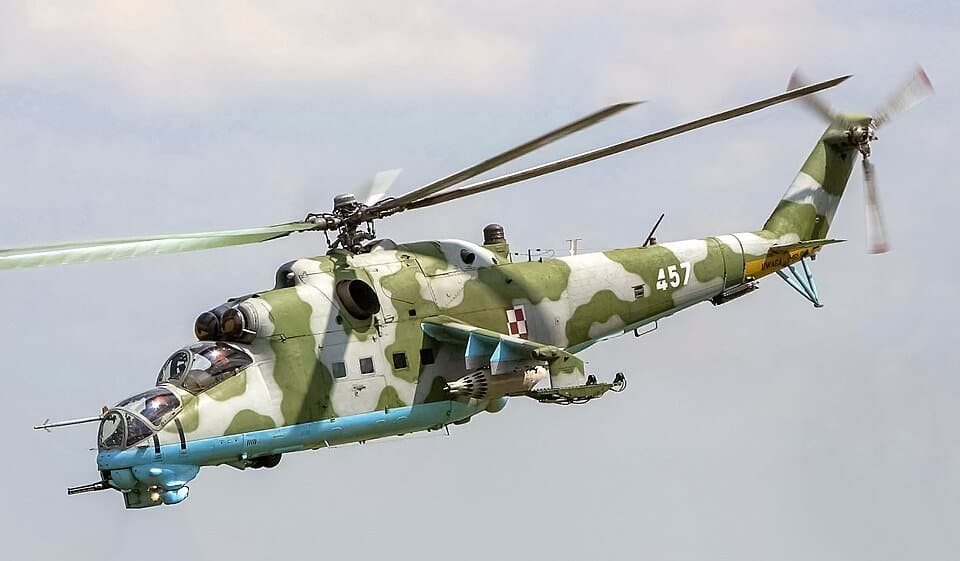
HelicoptersIn service
Attack helicopter with transport capabilities, helicopter gunship
Mil Mi-24 is a attack helicopter with transport capabilities, helicopter gunship originating in Soviet Union / Russia. It was built by Mil. Reported operators include Russian Aerospace Forces 58 other users (see Operators section below).
 Soviet Union / Russia
Mil Mi-24
File:Mi24CP (modified).jpg : Cezary Piwowarski modified by FOX 52 derivative work: Georgfotoart · CC BY-SA 4.0 · Resized · CC BY-SA 4.0 · Source ↗ · ModifiedAttack helicopter with transport capabilities, helicopter gunship
Soviet Union / Russia
Mil
In service
Russian Aerospace Forces 58 other users (see Operators section below)
2,648
1969–present
1972
19 September 1969
Mil Mi-8
2 pilots, 1 weapons system officer and 1 technician (optional)
8 troops / 4 stretchers / 2,400 kg (5,291 lb) cargo on an external sling
17.5 m (57 ft 5 in) fuselage only
6.5 m (21 ft 4 in) stub wings
6.5 m (21 ft 4 in)
8,500 kg (18,739 lb)
12,000 kg (26,455 lb)
2 × Isotov TV3-117 turboshaft engines, 1,600 kW (2,200 shp) each
17.2 m (56 ft 5 in)
227 m 2 (2,440 sq ft)
320 km/h (200 mph, 170 kn)
270 km/h (170 mph, 150 kn)
450 km (280 mi, 240 nmi)
5,750 m (18,860 ft)
15 m/s (3,000 ft/min)
The Mil Mi-24 ( Russian : Миль Ми-24 ; NATO reporting name : Hind ) is a large helicopter gunship , attack helicopter and low-capacity troop transport with room for eight passengers.
The Mil Mi-24 ( Russian : Миль Ми-24 ; NATO reporting name : Hind ) is a large helicopter gunship , attack helicopter and low-capacity troop transport with room for eight passengers. It is produced by Mil Moscow Helicopter Plant and was introduced by the Soviet Air Force in 1972. As of 2026 , the helicopter is used worldwide by 52 countries.
During the early 1960s, it became apparent to Soviet designer Mikhail Mil that the trend towards ever-increasing battlefield mobility would result in the creation of flying infantry fighting vehicles , which could be used to perform both fire support and infantry transport missions. The first expression of this concept was a mock-up unveiled in 1966 in the experimental department of the Ministry of Aircraft's factory number 329, where Mil was head designer. The mock-up designated V-24 was based on another project, the V-22 utility helicopter, which never flew. The V-24 had a central infantry compartment that could hold eight troops sitting back to back, and a set of small wings positioned to the top rear of the passenger cabin, capable of holding up to six missiles or rockets and a twin-barreled GSh-23L cannon fixed to the landing skid.
Mil engineers prepared two basic designs: a 7-ton single-engine design and a 10.5-ton twin-engine design, both based on the 1,300 kW (1,700 hp) Izotov TV3-177A turboshaft . Later, three complete mock-ups were produced, along with five cockpit mock-ups to allow the pilot and weapon station operator positions to be fine-tuned.
The Kamov design bureau suggested an army version of their Ka-25 ASW helicopter as a low-cost option. This was considered but later dropped in favor of the new Mil twin-engine design. A number of changes were made at the insistence of the military, including the replacement of the 23 mm cannon with a rapid-fire heavy machine gun mounted in a chin turret, and the use of the 9K114 Shturm (AT-6 Spiral) antitank missile.
Acceptance testing for the design began in June 1970, continuing for 18 months. Changes made in the design addressed structural strength, fatigue problems and vibration levels. Also, a 12-degree anhedral was introduced to the wings to address the aircraft's tendency to Dutch roll at speeds in excess of 200 km/h (124 mph), and the Falanga missile pylons were moved from the fuselage to the wingtips. The tail rotor was moved from the right to the left side of the tail, and the rotation direction reversed. The tail rotor now rotated up on the side towards the front of the aircraft, into the downwash of the rotor, which increased its efficiency. A number of other design changes were made until the production version Mi-24A ( izdeliye 245 ) entered production in 1970, obtaining its initial operating capability in 1971 and was officially accepted into the state arsenal in 1972.
In 1972, following completion of the Mi-24, development began on a unique attack helicopter with transport capability. The new design had a reduced transport capability (three troops instead of eight) and was called the Mi-28 , and that of the Ka-50 attack helicopter, which is smaller and more maneuverable and does not have the large cabin for carrying troops. In October 2007, the Russian Air Force announced it would replace its Mi-24 fleet with Mi-28Ns and Ka-52s by 2015. However, after the successful operation of the type in Syria it was decided to keep it in service and upgrade it with new electronics, sights, arms and night vision goggles.
The core of the aircraft was derived from the Mil Mi-8 (NATO reporting name "Hip") with two top-mounted turboshaft engines driving a mid-mounted 17.3 m (57 ft) five-blade main rotor and a three-blade tail rotor. The engine configuration gave the aircraft its distinctive double air intake. Original versions have an angular greenhouse-style cockpit; Model D and later have a characteristic tandem cockpit with a "double bubble" canopy . Other airframe components came from the Mi-14 "Haze". Two mid-mounted stub wings provide weapon hardpoints , each offering three stations, in addition to providing lift . The loadout mix is mission dependent; Mi-24s can be tasked with close air support, antitank operations, or aerial combat.
The Mi-24's titanium rotor blades are resistant to 12.7 mm (.50 caliber) rounds. The cockpit is protected by ballistic-resistant windscreens and a titanium-armored tub. The cockpit and crew compartment are overpressurized to protect the crew in NBC conditions .
Considerable attention was given to making the Mi-24 fast. The airframe was streamlined, and fitted with retractable tricycle undercarriage landing gear to reduce drag. At high speed, the wings provide considerable lift (up to a quarter of total lift). The main rotor was tilted 2.5° to the right from the fuselage to compensate for translating tendency at a hover. The landing gear was also tilted to the left so that the rotor would still be level when the aircraft was on the ground, making the rest of the airframe tilt to the left. The tail was also asymmetrical to give a side force at speed, thus unloading the tail rotor.
A modified Mi-24B, named A-10, was used in several speed and time-to-climb world record attempts. The helicopter had been modified to reduce weight as much as possible—one measure was the removal of the stub wings. The previous official speed record was set on 13 August 1975 over a closed 1,000 km (620 mi) course of 332.65 km/h (206.70 mph); many of the female-specific records were set by the all-female crew of Galina Rastorguyeva and Lyudmila Polyanskaya. On 21 September 1978, the A-10 set the absolute speed record for helicopters with 368.4 km/h (228.9 mph) over a 15/25 km course. The record stood until 1986, when it was broken by the current official record holder, a modified British Westland Lynx .
The Libyan air force used Mi-24A and Mi-25 units during their numerous interventions in Chad's civil war . The Mi-24s were first used in October 1980 in the battle of N'Djamena , where they helped the People's Armed Forces seize the capital.
It is difficult to find the total number of Mi-24s used in Afghanistan. At the end of 1990, the whole Soviet Army had 1,420 Mi-24s. During the Afghan war, sources estimated the helicopter strength to be as much as 600 units, with up to 250 being Mi-24s, whereas a (formerly secret) 1987 Central Intelligence Agency (CIA) report says that the number of Mi-24s in theatre increased from 85 in 1980 to 120 in 1985.
The Mi-24's favoured munition was the 80-millimetre (3.1 in) S-8 rocket , the 57 mm (2.2 in) S-5 having proven too light to be effective.
The 23 mm (0.91 in) gun pod was also popular.
The Mi-24 could carry ten 100-kilogram (220 lb) iron bombs for attacks on camps or strongpoints, while harder targets could be dealt with a load of four 250-kilogram (550 lb) or two 500-kilogram (1,100 lb) iron bombs.
The war in Afghanistan brought with it losses by attrition. The environment itself, dusty and often hot, was rough on the machines; dusty conditions led to the development of the twin PZU ('PyleZashchitnoe Ustroystvo') air intake filters. The rebels' primary air-defence weapons early in the war were heavy machine guns and antiaircraft cannons, though anything smaller than a 23 millimetre shell generally did not do much damage to an Mi-24. The cockpit glass panels were resistant to 12.7 mm (.50 in calibre) rounds.
Initially, the attack doctrine of the Mi-24 was to approach its target from high altitude and dive downwards. After the introduction of the Stinger, doctrine changed to " nap of the earth " flying, where they approached very low to the ground and engaged more laterally, popping up to only about 200 ft (61 m) in order to aim rockets or cannons. Countermeasure flares and missile warning systems would be installed in all Soviet Mil Mi-2 , Mi-8, and Mi-24 helicopters, giving pilots a chance to evade missiles fired at them. Heat dissipation devices were also fitted to exhausts to decrease the Mi-24's heat signature. Tactical and doctrinal changes were introduced to make it harder for the enemy to deploy these weapons effectively. These reduced the Stinger threat, but did not eliminate it.
Afghan Air Force Mi-24s in the hands of the ascendant Taliban gradually became inoperable, but a few flown by the Northern Alliance , which had Russian assistance and access to spares, remained operational up to the US invasion of Afghanistan in late 2001. In 2008, the Afghan Air Force took delivery of six refurbished Mi-35 helicopters, purchased from the Czech Republic. The Afghan pilots were trained by India and began live firing exercises in May 2009 in order to escort Mi-17 transport helicopters on operations in restive parts of the country. India would also supply four upgraded Mil-35s to the Afghan Air Force in 2015.
Three Mi-24s were used by Mobutu's army and were later acquired by the new Air Force of the Democratic Republic of the Congo . These were supplied to Zaire in 1997 as part of a French-Serbian contract. At least one was flown by Serbian mercenaries. One hit a power line and crashed on 27 March 1997, killing the three crew and four passengers. Zimbabwean Mi-24s were also operated in coordination with the Congolese Army.
Two second-hand Mi-24Vs procured from Ukraine earlier in the 1990s were used by the Yugoslav Special Operation Unit (JSO) against Kosovo Albanian rebels during the Kosovo War .
During the Ivorian Civil War , five Mil Mi-24s piloted by mercenaries were used in support of government forces. They were later destroyed by the French Army in retaliation for an air attack on a French base that killed nine soldiers.
The Polish contingent in Iraq used six Mi-24Ds after December 2004. One of them crashed on 18 July 2006 in an air base in Al Diwaniyah . Polish Mi-24Ds used in Iraq were not returned to Poland due to their age, condition, low combat value of the Mi-24D variant, and high shipping costs; depending on their condition, they were transferred to the new Iraqi Army or scrapped.
The Myanmar Air Force used the Mi-24 in the Kachin conflict against the Kachin Independence Army . Two Mi-35 helicopters were shot down by the Kachin Independence Army during the heavy fighting in the mountains of northern Burma in 2012 and early 2013.
On 3 October 2014, ISIL militants reportedly used a FN-6 shoulder-launched missile in Baiji to shoot down an Iraqi Army Mi-35M attack helicopter. Video footage released by ISIL militants shows at least another two Iraqi Mi-35s brought down by light antiaircraft artillery.
In 2018, Pakistan received 4 Mi-35M Hind-E Gunships from Russia under the $153 million deal. They are now stationed at the Army Aviation Corps base at Quetta Cantonment . The gunships have since been used in several counter insurgency operations against various militant groups in the Balochistan province of Pakistan. In early 2022, a base in Nushki and a check-post in Panjgur belonging to the Frontier Corps Balochistan Paramilitary were attacked by BLA terrorists. The attack in Nushki was swiftly repulsed but the situation in Panjgaur was not good to which Mi-35 Hind and AH-1F Cobra gunships were called in for support. It provided much needed ground support and reconnaissance in the counter offensive which led to success.
During the 2022 Russian invasion of Ukraine , both Ukraine and Russia have used Mi-24 helicopters. On 1 March 2022, Ukrainian forces shot down a Russian Mi-35M helicopter with MANPADS, in the Kyiv Reservoir (see also Battle of Kyiv ). On 5 May 2022, the helicopter was retrieved by Ukrainian engineers in Vyshgorod . Two Russian Mi-35 were shot down by a MANPADS on 5 March 2022. On 6 March, one Mi-24P with registration number RF-94966 was shot down by Ukrainian MANPADS in Kyiv Oblast. On 8 March 2022 one Ukrainian Mil Mi-24 from the Ukrainian 16th Army Aviation Brigade was lost over Brovary , Kyiv. Pilots Col. Oleksandr Maryniak and Cptn. Ivan Bezzub were killed. On 17 March a Russian Mi-35M was reported destroyed by Ukrainian Ministry of Defence , unknown location. On 1 April 2022, two Ukrainian Mi-24s reportedly entered Russia and attacked an oil storage facility in Belgorod .
As of 27 May 2025, claimed losses compiled by Oryx blog are listed as following: 4 Mi-24P, 4 Mi-24V/P/35M, 10 Mi-35M for the Russian side, and 2 Mi-24P and 7 Mi-24 of unknown variant for the Ukrainian side.
Serbian Air Force 4 Mi-35M, 11 Mi-35P
Capacity: 8 troops / 4 stretchers / 2,400 kg (5,291 lb) cargo on an external sling
Length: 17.5 m (57 ft 5 in) fuselage only
19.79 m (65 ft) including rotors
Wingspan: 6.5 m (21 ft 4 in) stub wings
Height: 6.5 m (21 ft 4 in)
Empty weight: 8,500 kg (18,739 lb)
Max takeoff weight: 12,000 kg (26,455 lb)
Powerplant: 2 × Isotov TV3-117 turboshaft engines, 1,600 kW (2,200 shp) each
Main rotor diameter: 17.2 m (56 ft 5 in)
Main rotor area: 227 m 2 (2,440 sq ft)
Maximum speed: 320 km/h (200 mph, 170 kn)
Cruise speed: 270 km/h (170 mph, 150 kn)
Range: 450 km (280 mi, 240 nmi)
Service ceiling: 5,750 m (18,860 ft)
Rate of climb: 15 m/s (3,000 ft/min)
flexible 12.7 mm Yakushev-Borzov Yak-B Heavy machine gun . (Original variant) flexible twin-barrel GSh-23L autocannon on the Mi-24VP, Mi-24VM and Mi-35M with 450 rounds. (Most variants) fixed twin-barrel GSh-30K autocannon on the Mi-24P. (Hind-F) PKB passenger compartment window mounted machine guns
Total payload claimed is up to 2,400 kg of external stores from Mi-24P. Inner hardpoints can carry 500 kg. Outer hardpoints can carry 250 kg Wing-tip pylons can only carry the 9M17 Phalanga (in the Mi-24A-D), the 9K114 Shturm complex (in the Mi-24V-F) per each side.
Bombs within weight range, up to 500 kg MBD multiple ejector racks KGMU2V submunition/mine dispenser pods
GUV-8700 gunpod (with a 12.7 mm Yak-B + 2 × 7.62 mm GShG-7.62 mm combination or one 30 mm AGS-17 ) UB-16 S-5 rocket launchers UB-32 S-5 rocket launchers S-24 240 mm rocket 9M17 Fleyta (a pair on each wingtip pylon)
R-60, R-60M Infrared missiles
Reference text from Wikipedia contributors, used under CC BY-SA 4.0.
True scale
Sourced dimensions beside a 1.75 m human reference.
See it in your room. Scan with your phone to open this model in 3D, then place it in your space.
Points represent sourced observations, including revisions. Revisions on the same effective date are not separate inventory events. Ranges appear in the table and are not plotted as exact points.
| Observation / report period | Value | Source | Claim state |
|---|---|---|---|
| 28 Sept 2026 | 6.5 m | Wikipedia contributors | superseded |
| 28 Sept 2026 | 6.5 m | Wikipedia contributors | superseded |
| 28 Sept 2026 | 6.5 m | Wikipedia contributors | superseded |
| 28 Sept 2026 | 6.5 m | Wikipedia contributors | approved |
Mil Mi-24 equipment records. Variants, orders and quantities are shown as reported in each inventory source; coverage is incomplete.
 Afghanistan
Reported count for Mil Mi-24 · Mi-25. Service scope: Afghan Air Force; does not replace a national total. 1 distinct quantity component(s) from the same source list; shared rowspan cells counted once. Explicit source inventory scope: active; no other stock status or total inferred. Count column(s): in service: 4. Origin: Russia. The listed variants/roles are the scope, not an immediately deployable count. Explicitly named source subset; this is not a whole-family total and does not cover other listed designs. Dates are the count-cell citations' stated source period (2025), not the article revision. 2025 cited publication year. Edition or publication years do not claim an exact inventory census day.
 Algeria
Number column of the Wikipedia list table under "Attack helicopters". The list's own wording applies; it is a compiled secondary source, not an official census.
 Angola
Reported count for Mil Mi-24 · Mi-35. Service scope: National Air Force of Angola; does not replace a national total. 1 distinct quantity component(s) from the same source list; shared rowspan cells counted once. Explicit source inventory scope: active; no other stock status or total inferred. Count column(s): in service: 14. Origin: Russia. The listed variants/roles are the scope, not an immediately deployable count. Explicitly named source subset; this is not a whole-family total and does not cover other listed designs. Dates are the count-cell citations' stated source period (2025), not the article revision. 2025 cited publication year. Edition or publication years do not claim an exact inventory census day.
 Armenia
Air and Air Defence Aviation Forces exact named equipment holdings: Mi-24P Hind. Active, operational-reserve and training units excluding equipment in store; November 2025 IISS assessment. Named service only; no parent-force or national total inferred. Source role: HELICOPTERS / ATK. Original estimates, ranges, reporting names, reserve, lease and employment scopes retained; nested included counts are not added. Missile-system quantities mean launchers, not rounds. No readiness, crew, carried weapon, payload, factory-production or future order count inherited.
 Azerbaijan
Air Force and Air Defence exact named equipment holdings: Mi-24 Hind; Mi-35M Hind. Active, operational-reserve and training units excluding equipment in store; November 2025 IISS assessment. Named service only; no parent-force or national total inferred. Source role: HELICOPTERS / ATK. Original estimates, ranges, reporting names, reserve, lease and employment scopes retained; nested included counts are not added. Missile-system quantities mean launchers, not rounds. No readiness, crew, carried weapon, payload, factory-production or future order count inherited.
 Belarus
Air Force and Air Defence Forces exact named equipment holdings: Mi-24 Hind; Mi-35M Hind. Active, operational-reserve and training units excluding equipment in store; November 2025 IISS assessment. Named service only; no parent-force or national total inferred. Source role: HELICOPTERS / ATK. Original estimates, ranges, reporting names, reserve, lease and employment scopes retained; nested included counts are not added. Missile-system quantities mean launchers, not rounds. No readiness, crew, carried weapon, payload, factory-production or future order count inherited.
 Brazil
Number column of the Wikipedia list table under "1970s-". The list's own wording applies; it is a compiled secondary source, not an official census.
 Bulgaria
Dated directory active-fleet estimate for Mi-24, grouped under Mil Mi-24. Only the explicitly listed service/role Active cells are included. Ordered, stored and upgrade aircraft are excluded. This is the directory coverage of these source types, not a national total, complete owned-fleet census or readiness count.
 Burkina Faso
Air Force exact named equipment holdings: Mi-35 Hind. Active, operational-reserve and training units excluding equipment in store; November 2025 IISS assessment. Named service only; no parent-force or national total inferred. Source role: HELICOPTERS / ATK. Original estimates, ranges, reporting names, reserve, lease and employment scopes retained; nested included counts are not added. Missile-system quantities mean launchers, not rounds. No readiness, crew, carried weapon, payload, factory-production or future order count inherited.
 Burundi
Air Wing exact named equipment holdings: Mi-24 Hind. Active, operational-reserve and training units excluding equipment in store; November 2025 IISS assessment. Named service only; no parent-force or national total inferred. Source role: HELICOPTERS / ATK. Original estimates, ranges, reporting names, reserve, lease and employment scopes retained; nested included counts are not added. Missile-system quantities mean launchers, not rounds. No readiness, crew, carried weapon, payload, factory-production or future order count inherited.
 Cameroon
Air Force exact named equipment holdings: Mi-24 Hind. Active, operational-reserve and training units excluding equipment in store; November 2025 IISS assessment. Named service only; no parent-force or national total inferred. Source role: HELICOPTERS / ATK. Original estimates, ranges, reporting names, reserve, lease and employment scopes retained; nested included counts are not added. Missile-system quantities mean launchers, not rounds. No readiness, crew, carried weapon, payload, factory-production or future order count inherited.
 Central African Republic
Stored Air Force exact named equipment holdings: Mi-24V Hind E. Explicit source inventory scope: stored; independently counted whole stock in store. November 2025 IISS assessment. Named service only; no operational holding, readiness or parent-force total inferred. Source role: HELICOPTERS / ATK. Original estimates, ranges, reporting names and exact storage declarations retained. Stored quantities earn no operational index points.
 Chad
Air Force exact named equipment holdings: Mi-24V Hind. Active, operational-reserve and training units excluding equipment in store; November 2025 IISS assessment. Named service only; no parent-force or national total inferred. Source role: HELICOPTERS / ATK. Original estimates, ranges, reporting names, reserve, lease and employment scopes retained; nested included counts are not added. Missile-system quantities mean launchers, not rounds. No readiness, crew, carried weapon, payload, factory-production or future order count inherited.
 Cuba
Number column of the Wikipedia list table under "ATK". The list's own wording applies; it is a compiled secondary source, not an official census.
 Czechia
Air Force exact named equipment holdings: Mi-35 Hind E. Active, operational-reserve and training units excluding equipment in store; November 2025 IISS assessment. Named service only; no parent-force or national total inferred. Source role: HELICOPTERS / ATK. Original estimates, ranges, reporting names, reserve, lease and employment scopes retained; nested included counts are not added. Missile-system quantities mean launchers, not rounds. No readiness, crew, carried weapon, payload, factory-production or future order count inherited.
 Democratic Republic of the Congo
Reported count for Mil Mi-24 · Mi-35. Service scope: Air Force of the Democratic Republic of the Congo; does not replace a national total. 1 distinct quantity component(s) from the same source list; shared rowspan cells counted once. Explicit source inventory scope: active; no other stock status or total inferred. Count column(s): in service: 9. Origin: Soviet Union. The listed variants/roles are the scope, not an immediately deployable count. Explicitly named source subset; this is not a whole-family total and does not cover other listed designs. Dates are the count-cell citations' stated source period (2025), not the article revision. 2025 cited publication year. Edition or publication years do not claim an exact inventory census day.
 Djibouti
Stored Air Force exact named equipment holdings: Mi-35 Hind. Explicit source inventory scope: stored; independently counted whole stock in store. November 2025 IISS assessment. Named service only; no operational holding, readiness or parent-force total inferred. Source role: HELICOPTERS / ATK. Original estimates, ranges, reporting names and exact storage declarations retained. Stored quantities earn no operational index points.
 Egypt
Air Force exact named equipment holdings: Mi-24V Hind E. Active, operational-reserve and training units excluding equipment in store; November 2025 IISS assessment. Named service only; no parent-force or national total inferred. Source role: HELICOPTERS / ATK. Original estimates, ranges, reporting names, reserve, lease and employment scopes retained; nested included counts are not added. Missile-system quantities mean launchers, not rounds. No readiness, crew, carried weapon, payload, factory-production or future order count inherited.
 Equatorial Guinea
Reported count for Mil Mi-24 · Mi-24P/V. Country-wide list; no individual service specified. 1 distinct quantity component(s) from the same source list; shared rowspan cells counted once. Explicit source inventory scope: active; no other stock status or total inferred. Count column(s): in service: 7. Origin: Soviet Union. The listed variants/roles are the scope, not an immediately deployable count. Explicitly named source subset; this is not a whole-family total and does not cover other listed designs. Dates are the count-cell citations' stated source period (2025), not the article revision. 2025 cited source edition. Edition or publication years do not claim an exact inventory census day.
 Eritrea
Air Force exact named equipment holdings: Mi-24 Hind. Active, operational-reserve and training units excluding equipment in store; November 2025 IISS assessment. Named service only; no parent-force or national total inferred. Source role: HELICOPTERS / ATK. Original estimates, ranges, reporting names, reserve, lease and employment scopes retained; nested included counts are not added. Missile-system quantities mean launchers, not rounds. No readiness, crew, carried weapon, payload, factory-production or future order count inherited.
 Ethiopia
Air Force exact named equipment holdings: Mi-24 Hind; Mi-35 Hind. Active, operational-reserve and training units excluding equipment in store; November 2025 IISS assessment. Named service only; no parent-force or national total inferred. Source role: HELICOPTERS / ATK. Original estimates, ranges, reporting names, reserve, lease and employment scopes retained; nested included counts are not added. Missile-system quantities mean launchers, not rounds. No readiness, crew, carried weapon, payload, factory-production or future order count inherited.
 Georgia
Aviation and Air Defence Command exact named equipment holdings: Mi-24 Hind. Active, operational-reserve and training units excluding equipment in store; November 2025 IISS assessment. Named service only; no parent-force or national total inferred. Source role: HELICOPTERS / ATK. Original estimates, ranges, reporting names, reserve, lease and employment scopes retained; nested included counts are not added. Missile-system quantities mean launchers, not rounds. No readiness, crew, carried weapon, payload, factory-production or future order count inherited.
 Guinea
Stored Air Force exact named equipment holdings: Mi-24 Hind. Explicit source inventory scope: stored; independently counted whole stock in store. November 2025 IISS assessment. Named service only; no operational holding, readiness or parent-force total inferred. Source role: HELICOPTERS / ATK. Original estimates, ranges, reporting names and exact storage declarations retained. Stored quantities earn no operational index points.
 Hungary
Air Component exact named equipment holdings: Mi-24V Hind E; Mi-24P Hind F. Active, operational-reserve and training units excluding equipment in store; November 2025 IISS assessment. Named service only; no parent-force or national total inferred. Source role: HELICOPTERS / ATK. Original estimates, ranges, reporting names, reserve, lease and employment scopes retained; nested included counts are not added. Missile-system quantities mean launchers, not rounds. No readiness, crew, carried weapon, payload, factory-production or future order count inherited.
 India
Reported count for Mil Mi-24 · Mil Mi-25 / Mil Mi-24 · Mil Mi-35. Service scope: Air Force; does not replace a national total. 1 distinct quantity component(s) from the same source list; shared rowspan cells counted once. Explicit source inventory scope: active; no other stock status or total inferred. Count column(s): in service: 15. Origin: USSR / Russia. The listed variants/roles are the scope, not an immediately deployable count. Dates are the count-cell citations' stated source period (2026), not the article revision. 2026 cited source edition. Edition or publication years do not claim an exact inventory census day.
 Indonesia
Army exact named equipment holdings: Mi-35P Hind. Active, operational-reserve and training units excluding equipment in store; November 2025 IISS assessment. Named service only; no parent-force or national total inferred. Source role: HELICOPTERS / ATK. Original estimates, ranges, reporting names, reserve, lease and employment scopes retained; nested included counts are not added. Missile-system quantities mean launchers, not rounds. No readiness, crew, carried weapon, payload, factory-production or future order count inherited.
 Iraq
Army exact named equipment holdings: Mi-35M Hind†. Active, operational-reserve and training units excluding equipment in store; November 2025 IISS assessment. Named service only; no parent-force or national total inferred. Source role: HELICOPTERS / ATK. Original estimates, ranges, reporting names, reserve, lease and employment scopes retained; nested included counts are not added. Missile-system quantities mean launchers, not rounds. No readiness, crew, carried weapon, payload, factory-production or future order count inherited.
 Ivory Coast
Air Force exact named equipment holdings: Mi-24V Hind E. Active, operational-reserve and training units excluding equipment in store; November 2025 IISS assessment. Named service only; no parent-force or national total inferred. Source role: HELICOPTERS / ATK. Original estimates, ranges, reporting names, reserve, lease and employment scopes retained; nested included counts are not added. Missile-system quantities mean launchers, not rounds. No readiness, crew, carried weapon, payload, factory-production or future order count inherited.
 Kazakhstan
Air Force exact named equipment holdings: Mi-35M Hind. Active, operational-reserve and training units excluding equipment in store; November 2025 IISS assessment. Named service only; no parent-force or national total inferred. Source role: HELICOPTERS / ATK. Original estimates, ranges, reporting names, reserve, lease and employment scopes retained; nested included counts are not added. Missile-system quantities mean launchers, not rounds. No readiness, crew, carried weapon, payload, factory-production or future order count inherited.
 Kyrgyzstan
Air Force exact named equipment holdings: Mi-24 Hind. Active, operational-reserve and training units excluding equipment in store; November 2025 IISS assessment. Named service only; no parent-force or national total inferred. Source role: HELICOPTERS / ATK. Original estimates, ranges, reporting names, reserve, lease and employment scopes retained; nested included counts are not added. Missile-system quantities mean launchers, not rounds. No readiness, crew, carried weapon, payload, factory-production or future order count inherited.
 Liberia
Reported count for Mil Mi-24. Country-wide list; no individual service specified. 1 distinct quantity component(s) from the same source list; shared rowspan cells counted once. Explicit source inventory scope: active; no other stock status or total inferred. Count column(s): in service: 1. Origin: Russia. The listed variants/roles are the scope, not an immediately deployable count. The components do not establish one inventory census date; the stored date is the retrieved source snapshot.
 Libya
Dated directory active-fleet estimate for Mi-24/35, grouped under Mil Mi-24. Only the explicitly listed service/role Active cells are included. Ordered, stored and upgrade aircraft are excluded. This is the directory coverage of these source types, not a national total, complete owned-fleet census or readiness count.
 Mali
Dated directory active-fleet estimate for Mi-24/35, grouped under Mil Mi-24. Only the explicitly listed service/role Active cells are included. Ordered, stored and upgrade aircraft are excluded. This is the directory coverage of these source types, not a national total, complete owned-fleet census or readiness count.
 Mongolia
Air Force exact named equipment holdings: Mi-24 Hind. Active, operational-reserve and training units excluding equipment in store; November 2025 IISS assessment. Named service only; no parent-force or national total inferred. Source role: HELICOPTERS / ATK. Original estimates, ranges, reporting names, reserve, lease and employment scopes retained; nested included counts are not added. Missile-system quantities mean launchers, not rounds. No readiness, crew, carried weapon, payload, factory-production or future order count inherited.
 Mozambique
Air Force exact named equipment holdings: Mi-24V Hind E. Active, operational-reserve and training units excluding equipment in store; November 2025 IISS assessment. Named service only; no parent-force or national total inferred. Source role: HELICOPTERS / ATK. Original estimates, ranges, reporting names, reserve, lease and employment scopes retained; nested included counts are not added. Missile-system quantities mean launchers, not rounds. No readiness, crew, carried weapon, payload, factory-production or future order count inherited.
 Myanmar
Air Force exact named equipment holdings: Mi-35P Hind. Active, operational-reserve and training units excluding equipment in store; November 2025 IISS assessment. Named service only; no parent-force or national total inferred. Source role: HELICOPTERS / ATK. Original estimates, ranges, reporting names, reserve, lease and employment scopes retained; nested included counts are not added. Missile-system quantities mean launchers, not rounds. No readiness, crew, carried weapon, payload, factory-production or future order count inherited.
 Namibia
Air Force exact named equipment holdings: Mi-25 Hind D. Active, operational-reserve and training units excluding equipment in store; November 2025 IISS assessment. Named service only; no parent-force or national total inferred. Source role: HELICOPTERS / ATK. Original estimates, ranges, reporting names, reserve, lease and employment scopes retained; nested included counts are not added. Missile-system quantities mean launchers, not rounds. No readiness, crew, carried weapon, payload, factory-production or future order count inherited.
 Niger
Air Force exact named equipment holdings: Mi-35P Hind. Active, operational-reserve and training units excluding equipment in store; November 2025 IISS assessment. Named service only; no parent-force or national total inferred. Source role: HELICOPTERS / ATK. Original estimates, ranges, reporting names, reserve, lease and employment scopes retained; nested included counts are not added. Missile-system quantities mean launchers, not rounds. No readiness, crew, carried weapon, payload, factory-production or future order count inherited.
 Nigeria
Air Force exact named equipment holdings: Mi-35M Hind; Mi-35P Hind; Mi-35 Hind; Mi-24P Hind; Mi-24V Hind. Active, operational-reserve and training units excluding equipment in store; November 2025 IISS assessment. Named service only; no parent-force or national total inferred. Source role: HELICOPTERS / ATK. Original estimates, ranges, reporting names, reserve, lease and employment scopes retained; nested included counts are not added. Missile-system quantities mean launchers, not rounds. No readiness, crew, carried weapon, payload, factory-production or future order count inherited.
 North Korea
Reported count for Mil Mi-24 · D/P Mi-35. Service scope: Korean People's Army Air Force; does not replace a national total. 1 distinct count cell(s) from the same source list; shared rowspan cells counted once. Excludes retired/reserve/on-order rows. Count column(s): in service: 20. Origin: Soviet Union. The listed variants/roles are the scope, not an immediately deployable count. Dates are the count-cell citations' stated source period (2025), not the article revision. 2025 cited source edition. Edition or publication years do not claim an exact inventory census day.
 North Macedonia
Dated directory active-fleet estimate for Mi-24, grouped under Mil Mi-24. Only the explicitly listed service/role Active cells are included. Ordered, stored and upgrade aircraft are excluded. This is the directory coverage of these source types, not a national total, complete owned-fleet census or readiness count.
 Pakistan
Army exact named equipment holdings: Mi-35M Hind. Active, operational-reserve and training units excluding equipment in store; November 2025 IISS assessment. Named service only; no parent-force or national total inferred. Source role: HELICOPTERS / ATK. Original estimates, ranges, reporting names, reserve, lease and employment scopes retained; nested included counts are not added. Missile-system quantities mean launchers, not rounds. No readiness, crew, carried weapon, payload, factory-production or future order count inherited.
 Peru
Air Force exact named equipment holdings: Mi-25 Hind D†; Mi-35P Hind E. Active, operational-reserve and training units excluding equipment in store; November 2025 IISS assessment. Named service only; no parent-force or national total inferred. Source role: HELICOPTERS / ATK. Original estimates, ranges, reporting names, reserve, lease and employment scopes retained; nested included counts are not added. Missile-system quantities mean launchers, not rounds. No readiness, crew, carried weapon, payload, factory-production or future order count inherited.
 Poland
Directory active-fleet estimate for the source types Mi-24, grouped under Mil Mi-24. Sums only the listed service and role rows; includes training and special-mission versions where explicitly listed. Excludes the separate Ordered column, aircraft in storage, aircraft undergoing or awaiting upgrades, and the directory's other exclusions. This is the dated directory coverage of these types, not a complete owned-fleet census or a readiness count.
 Republic of the Congo
Stored Air Force exact named equipment holdings: Mi-35P Hind. Explicit source inventory scope: stored; independently counted whole stock in store. November 2025 IISS assessment. Named service only; no operational holding, readiness or parent-force total inferred. Source role: HELICOPTERS / ATK. Original estimates, ranges, reporting names and exact storage declarations retained. Stored quantities earn no operational index points.
RussiaAerospace Forces exact named equipment holdings: Mi-35 Hind; Mi-24D/V/P Hind. Active, operational-reserve and training units excluding equipment in store; November 2025 IISS assessment. Named service only; no parent-force or national total inferred. Source role: HELICOPTERS / ATK. Original estimates, ranges, reporting names, reserve, lease and employment scopes retained; nested included counts are not added. Missile-system quantities mean launchers, not rounds. No readiness, crew, carried weapon, payload, factory-production or future order count inherited.
 Rwanda
Air Force exact named equipment holdings: Mi-24V Hind E; Mi-24P Hind. Active, operational-reserve and training units excluding equipment in store; November 2025 IISS assessment. Named service only; no parent-force or national total inferred. Source role: HELICOPTERS / ATK. Original estimates, ranges, reporting names, reserve, lease and employment scopes retained; nested included counts are not added. Missile-system quantities mean launchers, not rounds. No readiness, crew, carried weapon, payload, factory-production or future order count inherited.
 Senegal
Air Force exact named equipment holdings: Mi-35P Hind; Mi-24V Hind D. Active, operational-reserve and training units excluding equipment in store; November 2025 IISS assessment. Named service only; no parent-force or national total inferred. Source role: HELICOPTERS / ATK. Original estimates, ranges, reporting names, reserve, lease and employment scopes retained; nested included counts are not added. Missile-system quantities mean launchers, not rounds. No readiness, crew, carried weapon, payload, factory-production or future order count inherited.
 Serbia
Air Force and Air Defence exact named equipment holdings: Mi-24 Hind†. Active, operational-reserve and training units excluding equipment in store; November 2025 IISS assessment. Named service only; no parent-force or national total inferred. Source role: HELICOPTERS / ATK. Original estimates, ranges, reporting names, reserve, lease and employment scopes retained; nested included counts are not added. Missile-system quantities mean launchers, not rounds. No readiness, crew, carried weapon, payload, factory-production or future order count inherited.
 South Sudan
Reported count for Mil Mi-24 · Mi-35. Service scope: South Sudan Air Force; does not replace a national total. 1 distinct quantity component(s) from the same source list; shared rowspan cells counted once. Explicit source inventory scope: active; no other stock status or total inferred. Count column(s): in service: 6. Origin: Soviet Union. The listed variants/roles are the scope, not an immediately deployable count. Explicitly named source subset; this is not a whole-family total and does not cover other listed designs. Dates are the count-cell citations' stated source period (2025), not the article revision. 2025 cited publication year. Edition or publication years do not claim an exact inventory census day.
 Sri Lanka
Dated directory active-fleet estimate for Mi-24/35, grouped under Mil Mi-24. Only the explicitly listed service/role Active cells are included. Ordered, stored and upgrade aircraft are excluded. This is the directory coverage of these source types, not a national total, complete owned-fleet census or readiness count.
 Sudan
Reported count for Mil Mi-24 · Mi-35. Service scope: Sudanese Air Force; does not replace a national total. 1 distinct quantity component(s) from the same source list; shared rowspan cells counted once. Explicit source inventory scope: active; no other stock status or total inferred. Count column(s): in service: 35. Origin: Russia. The listed variants/roles are the scope, not an immediately deployable count. Explicitly named source subset; this is not a whole-family total and does not cover other listed designs. Dates are the count-cell citations' stated source period (2025), not the article revision. 2025 cited publication year. Edition or publication years do not claim an exact inventory census day.
 Syria
Reported count for Mil Mi-24 · Mi-24D Mi-24P. Service scope: Syrian Air Force; does not replace a national total. 1 distinct count cell(s) from the same source list; shared rowspan cells counted once. Excludes retired/reserve/on-order rows. Count column(s): inventory: 2. Origin: Soviet Union. The listed variants/roles are the scope, not an immediately deployable count. The components do not establish one inventory census date; the stored date is the retrieved source snapshot.
 Tajikistan
Air Force/Air Defence exact named equipment holdings: Mi-24 Hind. Active, operational-reserve and training units excluding equipment in store; November 2025 IISS assessment. Named service only; no parent-force or national total inferred. Source role: HELICOPTERS / ATK. Original estimates, ranges, reporting names, reserve, lease and employment scopes retained; nested included counts are not added. Missile-system quantities mean launchers, not rounds. No readiness, crew, carried weapon, payload, factory-production or future order count inherited.
 Togo
Air Force exact named equipment holdings: Mi-35M Hind. Active, operational-reserve and training units excluding equipment in store; November 2025 IISS assessment. Named service only; no parent-force or national total inferred. Source role: HELICOPTERS / ATK. Original estimates, ranges, reporting names, reserve, lease and employment scopes retained; nested included counts are not added. Missile-system quantities mean launchers, not rounds. No readiness, crew, carried weapon, payload, factory-production or future order count inherited.
 Turkmenistan
Air Force exact named equipment holdings: Mi-24P Hind F. Active, operational-reserve and training units excluding equipment in store; November 2025 IISS assessment. Named service only; no parent-force or national total inferred. Source role: HELICOPTERS / ATK. Original estimates, ranges, reporting names, reserve, lease and employment scopes retained; nested included counts are not added. Missile-system quantities mean launchers, not rounds. No readiness, crew, carried weapon, payload, factory-production or future order count inherited.
 Uganda
Reported count for Mil Mi-24 · Mi-35. Service scope: Uganda Air Force; does not replace a national total. 1 distinct quantity component(s) from the same source list; shared rowspan cells counted once. Explicit source inventory scope: active; no other stock status or total inferred. Count column(s): in service: 5. Origin: Soviet Union. The listed variants/roles are the scope, not an immediately deployable count. Explicitly named source subset; this is not a whole-family total and does not cover other listed designs. Dates are the count-cell citations' stated source period (2025), not the article revision. 2025 cited publication year. Edition or publication years do not claim an exact inventory census day.
 Ukraine
Directory active-fleet estimate for the source types Mi-24, grouped under Mil Mi-24. Sums only the listed service and role rows; includes training and special-mission versions where explicitly listed. Excludes the separate Ordered column, aircraft in storage, aircraft undergoing or awaiting upgrades, and the directory's other exclusions. This is the dated directory coverage of these types, not a complete owned-fleet census or a readiness count.
 United States
Directory active-fleet estimate for the source types Mi-24, grouped under Mil Mi-24. Sums only the listed service and role rows; includes training and special-mission versions where explicitly listed. Excludes the separate Ordered column, aircraft in storage, aircraft undergoing or awaiting upgrades, and the directory's other exclusions. This is the dated directory coverage of these types, not a complete owned-fleet census or a readiness count.
 Uzbekistan
Air Force exact named equipment holdings: Mi-24 Hind; Mi-35M Hind. Active, operational-reserve and training units excluding equipment in store; November 2025 IISS assessment. Named service only; no parent-force or national total inferred. Source role: HELICOPTERS / ATK. Original estimates, ranges, reporting names, reserve, lease and employment scopes retained; nested included counts are not added. Missile-system quantities mean launchers, not rounds. No readiness, crew, carried weapon, payload, factory-production or future order count inherited.
 Venezuela
Army holdings of the exact named Mi-35M2 Hind component, counted as equipment units: active, operational reserve and training equipment, excluding equipment in store. Service-scoped IISS observation, not a national total or combat-readiness figure. No parent, sibling, mounted-weapon or heading aggregate quantity inherited.
 Yemen
Reported count for Mil Mi-24 · Mi-24D / Mi-25 , Mi-35. Service scope: Yemeni Air Force; does not replace a national total. 1 distinct quantity component(s) from the same source list; shared rowspan cells counted once. Explicit source inventory scope: active; no other stock status or total inferred. Count column(s): in service: 14. Origin: Soviet Union. The listed variants/roles are the scope, not an immediately deployable count. Explicitly named source subset; this is not a whole-family total and does not cover other listed designs. Dates are the count-cell citations' stated source period (2025), not the article revision. 2025 cited publication year. Edition or publication years do not claim an exact inventory census day.
 Zimbabwe
Air Force exact named equipment holdings: Mi-35P Hind; Mi-35 Hind. Active, operational-reserve and training units excluding equipment in store; November 2025 IISS assessment. Named service only; no parent-force or national total inferred. Source role: HELICOPTERS / ATK. Original estimates, ranges, reporting names, reserve, lease and employment scopes retained; nested included counts are not added. Missile-system quantities mean launchers, not rounds. No readiness, crew, carried weapon, payload, factory-production or future order count inherited.
Russian Aerospace Forces 58 other users (see Operators section below)
Equipment reference ↗Keep exploring
Anti-submarine warfare helicopter (Ka-27/Ka-28) Attack helicopter with transport capabilities (Ka-29) Civilian utility helicopter (Ka-32)
Compare with Mil Mi-24Utility , transport , armed capable helicopter
Compare with Mil Mi-24Transport helicopter
Compare with Mil Mi-24Transport helicopter
 FranceCompare with Mil Mi-24
Transport helicopter
United StatesCompare with Mil Mi-24 Reported count for Mil Mi-24 · Mi-24V /Mi-35M. Service scope: Azerbaijani Air Forces; does not replace a national total. 1 distinct quantity component(s) from the same source list; shared rowspan cells counted once. Explicit source inventory scope: active; no other stock status or total inferred. Count column(s): in service: 16. Origin: Russia. The listed variants/roles are the scope, not an immediately deployable count. The components do not establish one inventory census date; the stored date is the retrieved source snapshot.
Reported count for Mil Mi-24 · Mi-24V Mi-24P. Service scope: Belarusian Air Force; does not replace a national total. 1 distinct quantity component(s) from the same source list; shared rowspan cells counted once. Explicit source inventory scope: active; no other stock status or total inferred. Count column(s): in service: 29. Origin: Russia / Soviet Union. The listed variants/roles are the scope, not an immediately deployable count. The components do not establish one inventory census date; the stored date is the retrieved source snapshot.
Reported count for Mil Mi-24 · Mi-35. Service scope: Chadian Air Force; does not replace a national total. 1 distinct quantity component(s) from the same source list; shared rowspan cells counted once. Explicit source inventory scope: active; no other stock status or total inferred. Count column(s): in service: 3. Origin: Soviet Union. The listed variants/roles are the scope, not an immediately deployable count. Explicitly named source subset; this is not a whole-family total and does not cover other listed designs. Dates are the count-cell citations' stated source period (2024), not the article revision. 2024 cited publication year. Edition or publication years do not claim an exact inventory census day.
Dated directory active-fleet estimate for Mi-24, grouped under Mil Mi-24. Only the explicitly listed service/role Active cells are included. Ordered, stored and upgrade aircraft are excluded. This is the directory coverage of these source types, not a national total, complete owned-fleet census or readiness count.
Reported count for Mil Mi-24 · Mi-25. Service scope: Air Force; does not replace a national total. 1 distinct quantity component(s) from the same source list; shared rowspan cells counted once. Explicit source inventory scope: active; no other stock status or total inferred. Count column(s): in service: 3. Origin: Russia. The listed variants/roles are the scope, not an immediately deployable count. Explicitly named source subset; this is not a whole-family total and does not cover other listed designs. Dates are the count-cell citations' stated source period (2023), not the article revision. 2023 cited publication year. Edition or publication years do not claim an exact inventory census day.
Air Force exact named equipment holdings: Mi-24V Hind (some upgraded). Active, operational-reserve and training units excluding equipment in store; November 2025 IISS assessment. Named service only; no parent-force or national total inferred. Source role: HELICOPTERS / ATK. Original estimates, ranges, reporting names, reserve, lease and employment scopes retained; nested included counts are not added. Missile-system quantities mean launchers, not rounds. No readiness, crew, carried weapon, payload, factory-production or future order count inherited.
Reported count for Mil Mi-24 · Mi-25. Service scope: Mozambique Air Force; does not replace a national total. 1 distinct quantity component(s) from the same source list; shared rowspan cells counted once. Explicit source inventory scope: active; no other stock status or total inferred. Count column(s): in service: 2. Origin: Russia. The listed variants/roles are the scope, not an immediately deployable count. Explicitly named source subset; this is not a whole-family total and does not cover other listed designs. Dates are the count-cell citations' stated source period (2023), not the article revision. 2023 cited source edition. Edition or publication years do not claim an exact inventory census day.
Reported count for Mil Mi-24 · Mi-35 / Mil Mi-24 · SuperHind Mk.III. Service scope: Air Force; does not replace a national total. 2 distinct quantity component(s) from the same source list; shared rowspan cells counted once. Explicit source inventory scope: active; no other stock status or total inferred. Count column(s): in service: 1 / in service: 2. Origin: Russia. The listed variants/roles are the scope, not an immediately deployable count. The components do not establish one inventory census date; the stored date is the retrieved source snapshot.
Dated directory active-fleet estimate for Mi-24, grouped under Mil Mi-24. Only the explicitly listed service/role Active cells are included. Ordered, stored and upgrade aircraft are excluded. This is the directory coverage of these source types, not a national total, complete owned-fleet census or readiness count.
Naval Aviation exact named equipment holdings: Mi-24P Hind. Active, operational-reserve and training units excluding equipment in store; November 2025 IISS assessment. Named service only; no parent-force or national total inferred. Source role: HELICOPTERS / ATK. Original estimates, ranges, reporting names, reserve, lease and employment scopes retained; nested included counts are not added. Missile-system quantities mean launchers, not rounds. No readiness, crew, carried weapon, payload, factory-production or future order count inherited.
Reported count for Mil Mi-24 · Mi-35. Service scope: Rwandan Air Force; does not replace a national total. 1 distinct quantity component(s) from the same source list; shared rowspan cells counted once. Explicit source inventory scope: active; no other stock status or total inferred. Count column(s): in service: 5. Origin: Soviet Union / Russia. The listed variants/roles are the scope, not an immediately deployable count. Explicitly named source subset; this is not a whole-family total and does not cover other listed designs. Dates are the count-cell citations' stated source period (2024), not the article revision. 2024 cited publication year. Edition or publication years do not claim an exact inventory census day.
Reported count for Mil Mi-24 · Mi-35. Service scope: Senegalese Air Force; does not replace a national total. 1 distinct quantity component(s) from the same source list; shared rowspan cells counted once. Explicit source inventory scope: active; no other stock status or total inferred. Count column(s): in service: 5. Origin: Russia. The listed variants/roles are the scope, not an immediately deployable count. Explicitly named source subset; this is not a whole-family total and does not cover other listed designs. Dates are the count-cell citations' stated source period (2024), not the article revision. 2024 cited publication year. Edition or publication years do not claim an exact inventory census day.
Reported count for Mil Mi-24 · Mi-35. Service scope: Serbian Air Force and Air Defence; does not replace a national total. 1 distinct quantity component(s) from the same source list; shared rowspan cells counted once. Explicit source inventory scope: active; no other stock status or total inferred. Count column(s): in service: 15. Origin: Russia. The listed variants/roles are the scope, not an immediately deployable count. Explicitly named source subset; this is not a whole-family total and does not cover other listed designs. Dates are the count-cell citations' stated source period (2023), not the article revision. Cited source 2023-11-23. Edition or publication years do not claim an exact inventory census day.
Reported count for Mil Mi-24 · Mi-24V( Mil Mi-35 ). Service scope: Tajik Air Force; does not replace a national total. 1 distinct quantity component(s) from the same source list; shared rowspan cells counted once. Explicit source inventory scope: active; no other stock status or total inferred. Count column(s): in service: 6. Origin: Soviet Union. The listed variants/roles are the scope, not an immediately deployable count. Explicitly named source subset; this is not a whole-family total and does not cover other listed designs. Dates are the count-cell citations' stated source period (2024), not the article revision. 2024 cited publication year. Edition or publication years do not claim an exact inventory census day.
Transport helicopter
United States