FORCETALLY
Loading the evidence…
Preparing your view.


Preparing your view.
HelicoptersIn serviceProfile in progress
Aerial crane
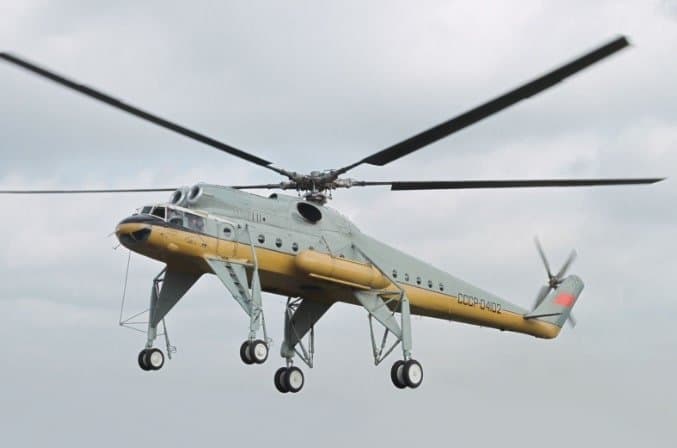
Mil Mi-10 is a aerial crane originating in Russia. It was built by Mil Moscow Helicopter Plant.
 Russia
Mil Mi-10
Unknown author Unknown author · Public domain · Resized · Public domain · Source ↗ · ModifiedAerial crane
Russia
Mil Moscow Helicopter Plant
Active as of 2014 (Mi-10K)
55
1964–69
1963
15 June 1960
Mil Mi-6
3 (pilot, copilot and flight engineer, navigator/radio operator and optional technician)
28 passengers or 3 t (3,000 kg; 6,600 lb) internally up to 15 t (15,000 kg; 33,000 lb) payload on platform or 8 t (8,000 kg; 18,000 lb) max slung payload
32.86 m (107 ft 10 in) (fuselage only), 41.89 m (137 ft 5 in) (overall length, rotors turning)
27,100 kg (59,745 lb) , Mi-10K 25,450 kg (56,110 lb)
43,550 kg (96,011 lb) , Mi-10K 37,000 kg (82,000 lb)
43,700 kg (96,342 lb) , Mi-10K 38,000 kg (84,000 lb)
2 × Soloviev D-25V turboshaft, 4,100 kW (5,500 hp) each
35.00 m (114 ft 10 in)
335 km/h (208 mph, 181 kn)
180 km/h (110 mph, 97 kn)
430 km (270 mi, 230 nmi)
3.75 m (12 ft 4 in)
962 m 2 (10,350 sq ft)
3,000 m (9,840 ft)
The Mil Mi-10 ( NATO reporting name Harke ), given the product number izdeliye 60 , is a Soviet military transport helicopter of flying crane configuration, developed from the Mi-6 , entering service in 1963 .
The advent of the Mi-6 gave the Soviet Union the very useful ability to move and place large, bulky or heavy loads with precision. Limitations of the Mi-6 in the flying crane role included a weight to payload ratio and the inability of the crew to easily see the load and its intended final position. A Council of Ministers directive of 20 February 1958 tasked OKB-329 (OKB Mil) with the development of a dedicated flying crane helicopter for carrying bulky loads unable to be carried in the hold of an Mi-6.
The Mil OKB's response drew heavily on the Mi-6, utilising the dynamic components and 4,100 kW (5,500 hp) Soloviev D-25V turboshaft engines, on a slim fuselage sitting on four tall strut braced undercarriage legs, with a wide track allowing the helicopter to taxi over loads, or for mobile loads to be moved underneath. The fuselage can carry 28 passengers inside the cabin as well as 3 t (6,600 lb) of cargo loaded through a side door in the aft fuselage, by an integral boom and winch. Underslung loads can be attached directly to the fuselage by hydraulically operated clamps, or carried on a 8.5 m × 3.6 m (28 ft × 12 ft) pallet lifted by the winch and braced by cables and/or struts to the undercarriage legs. The external sling system of the Mi-6, with a capacity of 8 t (18,000 lb) could also be fitted under the centre fuselage.
The limitations of the Mi-10 in the slung load mission soon became obvious, chiefly, the loss of payload due to the heavy and complicated undercarriage, and more importantly the almost complete lack of oversight of the slung load, despite the inclusion of a CCTV (closed circuit television) system intended for observation of slung loads.
(RVK - raketno-vertolyotnyy kompleks - heliborne missile system) Numerous variations of heliborne missile systems were envisaged, but only the 9K74 (aka S-5V) system reached the flight test stage. Missiles on launchers were carried complete with tractor units to be deployed on landing. Due to the increased take-off weight of 44.6 t (44,600 kg; 98,000 lb), the VRK was fitted with low-pressure tyres. Development was abandoned when the 4K95 cruise missile element was discontinued.
A single prototype modified with 4,800 kW (6,500 hp) Soloviev D-25VF engines, new equipment and an up-rated transmission system.
Capacity: 28 passengers or 3 t (3,000 kg; 6,600 lb) internally up to 15 t (15,000 kg; 33,000 lb) payload on platform or 8 t (8,000 kg; 18,000 lb) max slung payload
Length: 32.86 m (107 ft 10 in) (fuselage only), 41.89 m (137 ft 5 in) (overall length, rotors turning)
Empty weight: 27,100 kg (59,745 lb) , Mi-10K 25,450 kg (56,110 lb)
Gross weight: 43,550 kg (96,011 lb) , Mi-10K 37,000 kg (82,000 lb)
Max takeoff weight: 43,700 kg (96,342 lb) , Mi-10K 38,000 kg (84,000 lb)
Ground clearance under fuselage: 3.75 m (12 ft 4 in)
Powerplant: 2 × Soloviev D-25V turboshaft, 4,100 kW (5,500 hp) each
Main rotor diameter: 35.00 m (114 ft 10 in)
Main rotor area: 962 m 2 (10,350 sq ft)
Maximum speed: 335 km/h (208 mph, 181 kn)
Cruise speed: 180 km/h (110 mph, 97 kn)
Range: 430 km (270 mi, 230 nmi)
Hovering ceiling out of ground effect: 3,000 m (9,840 ft)
Высота : 9,9 м (с остановленным хвостовым винтом)
Практический потолок : 3000 м
Reference text from Wikipedia contributors, used under CC BY-SA 4.0.
True scale
Sourced dimensions beside a 1.75 m human reference.
Points represent sourced observations, including revisions. Revisions on the same effective date are not separate inventory events. Ranges appear in the table and are not plotted as exact points.
| Observation / report period | Value | Source | Claim state |
|---|---|---|---|
| 28 Sept 2026 | 3 people | Wikipedia contributors | superseded |
| 28 Sept 2026 | 3 people | Wikipedia contributors | superseded |
| 28 Sept 2026 | 3 people | Wikipedia contributors | superseded |
| 28 Sept 2026 | 3 people | Wikipedia contributors | superseded |
| 28 Sept 2026 | 3 people | Wikipedia contributors | superseded |
| 28 Sept 2026 | 3 people | Wikipedia contributors | approved |
Country inventory links have not yet been documented for this equipment.
Keep exploring
 United States