FORCETALLY
Loading the evidence…
Preparing your view.


Preparing your view.
Military transport & logisticsIn production
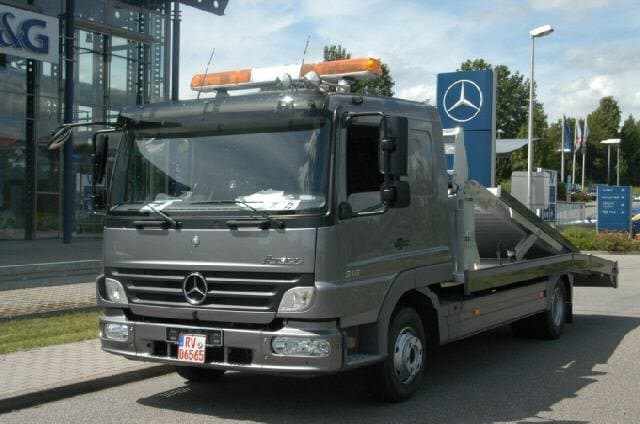
Mercedes-Benz Atego is documented in the equipment reference catalogue. It was built by DaimlerChrysler AG (1998–2007) Daimler AG (2007–2019) Daimler Truck (2019–present).
 Germany
DaimlerChrysler AG (1998–2007) Daimler AG (2007–2019) Daimler Truck (2019–present)
1998–present
Large goods vehicle ( N2, N3 )
Cab over engine (L/S)
Mercedes-Benz Axor
Mercedes-Benz LK
Turkey: Aksaray Germany: Wörth Brazil: São Bernardo do Campo
The Mercedes-Benz Atego is a range of general-purpose rigid trucks introduced by Daimler Truck in 1998. A new model was introduced in 2004, followed by a facelift in 2010 and another new model in 2013. The latest version is available in gross vehicle weights of 6.5 to 16 tonnes (t) and is powered by a straight 4- or 6-cylinder engine.
In 2000, a new 240 kW (326 hp) top-of-the-range version of the heavy Atego chassis was brought onto the market. In 2001, the new Axor model series emerged from the heavy-duty Atego weight class with gross vehicle weights of 18 to 40 tonnes. The Axor combined the heavy chassis of the Actros with the long Atego cab.
The second generation Atego debuted in 2004 at the International Commercial Vehicle Show. The front section was redesigned, with new H7 clear-glass headlamps, high-set white-glass indicators, wind deflectors and new exterior mirrors. The interior of the four different cab variants was also completely redesigned, with the cockpit more grouped around the driver and a new climate control system which was more similar to the heavy-duty Actros models. A new nine-speed transmission replaced the previous twelve-speed transmission. The new Telligent automated gearshift was also introduced as an optional extra up to 175 kW (238 hp) along with a roll-back lock built into the Telligent brake system. Soon after launch, the Atego was linked to the Fleetboard telematics system.
In 2005, a 12-ton payload-optimised model was introduced, which had a low chassis, 17.5-inch tyres and a new 160 kW (218 hp) four-cylinder engine. Also in the same year, Atego models over 18 tonnes were renamed Mercedes-Benz Axor . In 2006, dump truck versions of the Atego were fitted with high-performance disc brake technology on all axles. The 250,000th Atego was delivered in June 2008. From March 2010 the entire Mercedes-Benz Atego series was made available with EEV (Enhanced Environmentally Friendly Vehicle) compliant engine versions.
The second generation Atego was initially available with three basic engine variants. The 4,250 cc inline-four OM 904 LA with 130 kW (177 hp) power, 675 N⋅m (498 lb⋅ft) torque, 17.75 to 1 compression ratio, and Unit-Pump System (UPS) technology single-nozzle fuel-injection pumps. The 6,374 cc inline-six OM 906 LA with 170 kW (231 hp) power and 810 N⋅m (597 lb⋅ft) torque or 205 kW (279 hp) power and 1,100 N⋅m (811 lb⋅ft) torque. Both variants with Unit-Pump System technology with single-plunger fuel-injection pumps and centrally arranged 6-hole injection nozzles.
The chassis was available in wheelbase lengths between 3,260 mm and 5,360 mm at standard spacing of 300 mm.
The frame rails featured a continuous hole spacing of 50 mm.
The new facelifted Atego appeared in 2010. The design of the front section was given more resemblance to the current Actros. With regards to the interior, a multifunction steering wheel was made standard on all versions of the Atego, the instrument cluster was redesigned and seats received new fabrics. There were three BlueTec Euro V standards compliant engines to choose from, with power output ranging from 95 kW (129 hp) to 210 kW (286 hp). The new model could also be fitted with a new permanent magnet retarder with up to 180 kW braking power (maximum torque 650 Nm) to help reduce brake and tyre wear on demanding roads.
The initial hybrid truck was based on the 12-ton Atego 1222 L EEV and featured a 160 kW (218 hp) OM 924 LA turbodiesel engine and a 44-kW water-cooled AC permanent magnet electric motor. The engine also featured a start/stop system. It used a G85-6 automatic transmission. The electric motor was located behind the internal combustion engine and clutch, but in front of the transmission. Electrical energy was stored in lithium-ion batteries, which was fed via the electric motor when braking and allowed moving off under electric power, but also helped optimise the diesel engine's characteristic map. Additional components included a converter, hybrid control system and cooling system. The additional weight compared to a regular Atego was around 350 kg. According to Daimler the Atego hybrid could achieve fuel savings of around 10 - 15 percent compared with an equivalent conventional diesel-powered vehicle.
The third generation Atego was introduced in 2013 with gross vehicle weight ranging from 6.5 t to 16 t . It was made available with seven new engines based on the inline four-cylinder OM 934 model with 5.1 L displacement and inline six-cylinder OM 936 model with 7.7 L displacement. Performance for the four new OM 934 engines range from 115 kW (156 hp) to 170 kW (231 hp) and for the three new OM 936 engines from 175 kW (238 hp) to 220 kW (299 hp). The engines conform to the Euro VI emissions standard and feature common rail injection, cooled exhaust gas recirculation , an exhaust box with an integrated selective catalytic reduction system and closed particulate filter . The trucks are available with six or eight speed Mercedes PowerShift 3 automatic transmission and six- or nine-speed power-assisted manual transmissions. Electronic stability control is also available along with a permanent magnet retarder. Furthermore, it features a newly designed bumper with integrated daytime running lamps.
Ludovic Faure won the FIA European Truck Racing Championship in 1998 using an Atego Renntruck. FIA ETRC vehicles develop 1200 hp and 5,600 Nm of torque. Minimum weight is 5400 kg, and the trucks have 6-speed ZF transmissions, with water-cooled disc brakes. This gives a similar power-to-weight ratio as a World Rally Car .
In 2008, a Mercedes-Benz Atego 1725 race truck took a part in the Brazilian rally raid Rally dos Sertões . The vehicle won this rally in its class (T4.2, for trucks with full weight from 4801 to 5800 kg). This truck develops more than 400 hp and torque of 1800 Nm.
Length 6015–9665 mm
Width 2323–2441 mm
Height 2557–2949 mm
Curb weight 3652–5653 kg
In 2000, a new 240 kW (326 hp) top-of-the-range version of the heavy Atego chassis was brought onto the market.
In 2005, a 12-ton payload-optimised model was introduced, which had a low chassis, 17.5-inch tyres and a new 160 kW (218 hp) four-cylinder engine.
The 4,250 cc inline-four OM 904 LA with 130 kW (177 hp) power, 675 N⋅m (498 lb⋅ft) torque, 17.75 to 1 compression ratio, and Unit-Pump System (UPS) technology single-nozzle fuel-injection pumps.
The 6,374 cc inline-six OM 906 LA with 170 kW (231 hp) power and 810 N⋅m (597 lb⋅ft) torque or 205 kW (279 hp) power and 1,100 N⋅m (811 lb⋅ft) torque.
There were three BlueTec Euro V standards compliant engines to choose from, with power output ranging from 95 kW (129 hp) to 210 kW (286 hp).
The initial hybrid truck was based on the 12-ton Atego 1222 L EEV and featured a 160 kW (218 hp) OM 924 LA turbodiesel engine and a 44-kW water-cooled AC permanent magnet electric motor.
Performance for the four new OM 934 engines range from 115 kW (156 hp) to 170 kW (231 hp) and for the three new OM 936 engines from 175 kW (238 hp) to 220 kW (299 hp).
Максимальная скорость 130 км/ч (90 с ограничителем)
Engine • High-torque 4 and 6-cylinder engines
Mercedes-Benz Atego Germany Mobile field hospital Mercedes-Benz Atego 1528 (4x2) Unknown Used as mobile surgical field hospital by medical battalion of first Kostrad's infantry division.
Mercedes-Benz Atego Germany 4×4 general-purpose truck
Mercedes-Benz Atego Germany 4x4 wheeled (without trailer) Mounts missile systems like Ghauri-I and Ghauri-II .
Mercedes-Benz Atego Chassis platform Germany Use as chassis platform for various vehicles.
Mercedes-Benz Atego Germany 4x4 wheeled (without trailer) Mounts missile systems like Ghauri-I and Ghauri-II .
Reference text from Wikipedia contributors, used under CC BY-SA 4.0.
Mercedes-Benz Atego equipment records. Variants, orders and quantities are shown as reported in each inventory source; coverage is incomplete.
 Argentina
Reported count for Mercedes-Benz Atego. Service scope: Argentine Army; does not replace a national total. 1 distinct count cell(s) from the same source list; shared rowspan cells counted once. Retired, wholly reserve and on-order rows are excluded; the reported count retains any explicitly mixed stock scope in the quoted row. Count column(s): quantity: 800. Origin: Germany Argentina. The listed variants/roles are the scope, not an immediately deployable count. The components do not establish one inventory census date; the stored date is the retrieved source snapshot.
 Azerbaijan
Lower-bound count for Mercedes-Benz Atego. Service scope: Azerbaijani Land Forces; does not replace a national total. 1 distinct count cell(s) from the same source list; shared rowspan cells counted once. Retired, wholly reserve and on-order rows are excluded; the reported count retains any explicitly mixed stock scope in the quoted row. Count column(s): number: 150+. Origin: unstated. The listed variants/roles are the scope, not an immediately deployable count. The components do not establish one inventory census date; the stored date is the retrieved source snapshot.
 Brazil
 Brunei
 Estonia
 Finland Germany
 Indonesia
 Mali
 Pakistan
 Portugal
Approximate count for Mercedes-Benz Atego 715. Service scope: Portuguese Army; does not replace a national total. 1 distinct count cell(s) from the same source list; shared rowspan cells counted once. Retired, wholly reserve and on-order rows are excluded; the reported count retains any explicitly mixed stock scope in the quoted row. Count column(s): quantity: ~ 80. Origin: Germany. The listed variants/roles are the scope, not an immediately deployable count. The components do not establish one inventory census date; the stored date is the retrieved source snapshot.
 Taiwan
Argentina, Azerbaijan, Brazil, Brunei, Estonia, Finland, Germany, Indonesia, Mali, Pakistan, Portugal, Taiwan
Equipment reference ↗Keep exploring
 Switzerland
 United Kingdom