FORCETALLY
Loading the evidence…
Preparing your view.


Preparing your view.
Bombs, grenades & minesIn service
Anti-runway bomb
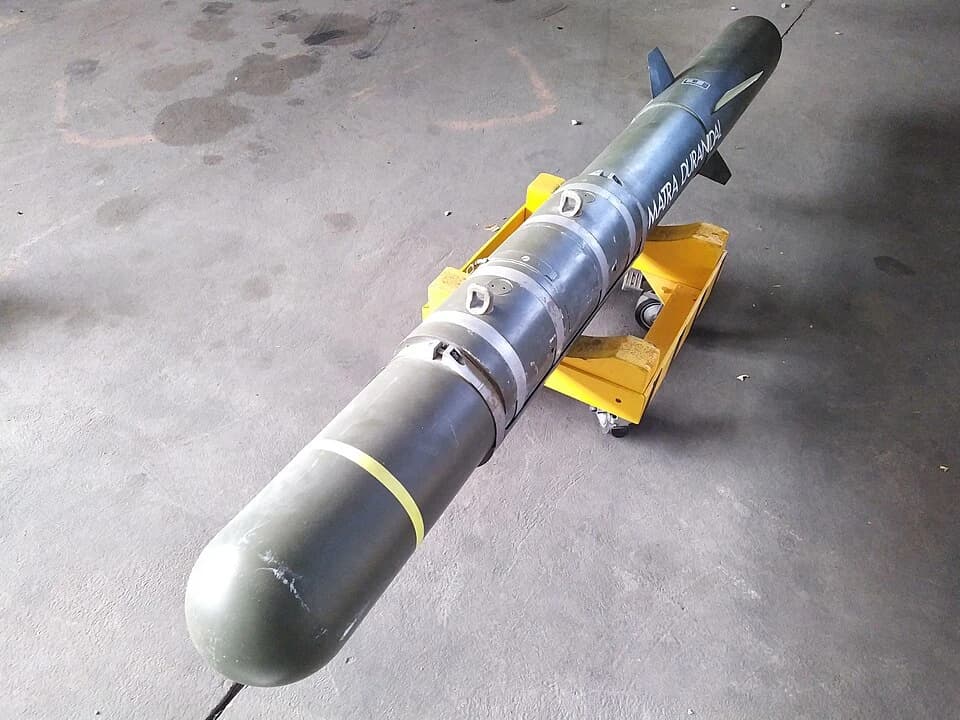
Matra Durandal is a anti-runway bomb originating in France. It was built by Matra (now MBDA ). Reported operators include United States, France, Israel.
 France
Anti-runway bomb
France
1977–present
United States, France, Israel
Gulf War (1991)
Matra (now MBDA )
200 kg (440 lb)
2.7 m (8 ft 10 in)
22.3 cm (8.8 in)
100 kg (220 lb) primary charge 15 kg (33 lb) secondary charge
Argentina
Brazil
China
Ecuador
Egypt
France
Greece
Jordan
Libya
Nigeria
Oman
Pakistan
Serbia
South Korea
Turkey
United States
Venezuela
Yugoslavia
The Durandal is an anti-runway penetration bomb developed by the French company Matra (now MBDA ), designed to destroy airport runways and exported to several countries.
Designed to be dropped from low altitudes, the bomb's fall is slowed by a parachute . The maximum release speed is 550 knots (1,020 km/h; 630 mph) and the minimum release altitude is 200 feet (61 m). When the bomb has reached a 40° angle due to the parachute's drag, it fires a rocket booster that accelerates it into the runway surface. The 100-kilogram (220 lb) primary charge explodes after the weapon has penetrated the concrete and drives the secondary charge even deeper. The 15-kilogram (33 lb) secondary charge then explodes after a one-second delay. Later production weapons have a programmable fuse that can delay the secondary detonation up to several hours.
The weapon can penetrate up to 40 centimetres (16 in) of concrete , and creates a crater 2 metres (6 ft 7 in) deep and approximately 5 metres (16 ft) in diameter. In addition, concrete slabs around the crater are disturbed in an area approximately 15 metres (49 ft) in diameter. The disturbed slabs are displaced up to 50 centimetres (20 in) above the original surface, making repair more difficult than the simple crater from a conventional bomb.
The Durandal was adopted by the US in a slightly modified form (with a steeper impact angle and a higher 630 knot deployment speed) as the BLU-107/B in the 1980s, and carried by F-111 and F-15E strike aircraft.
Lenkung: keine
Origin France
Type Penetration bomb
Weight 185 kg boosted warhead section only
Weight 185 kg boosted warhead section only 219 kg with parachute section
Length 2.49 m
Diameter 0.223 m for parachute section
Diameter 0.223 m for parachute section 0.212 m for warhead section
Wingspan 0.42 m
Reference text from Wikipedia contributors, used under CC BY-SA 4.0.
True scale
Sourced dimensions beside a 1.75 m human reference.
Points represent sourced observations, including revisions. Revisions on the same effective date are not separate inventory events. Ranges appear in the table and are not plotted as exact points.
| Observation / report period | Value | Source | Claim state |
|---|---|---|---|
| 12 Oct 2026 | 0.223 m | Weaponsystems.net | approved |
Lug spacing 356 mm
Guidance mode None, free fall bomb
Maneuvering Parachute air brakes ensure vertical position before rocket motor downward boost
Warhead type Penetrator with HE blast
Warhead weight 100 kg with 15 kg HE filler
Fuse Delayed impact
Effect Penetrates 0.38 m of concrete
Effect Penetrates 0.38 m of concrete Crater of 2 m wide and 5 m deep
Release altitude Up to 10 km
Release speed Up to Mach 1.8
Engine type Solid propellant rocket motor
Engine model Snecma RP30
Thrust 92.4 kN for 0.45 second
Max speed 260 to 270 m/s
Air brake 2 parachutes
Matra Durandal equipment records. Variants, orders and quantities are shown as reported in each inventory source; coverage is incomplete.
Keep exploring
 Argentina
 Brazil
 China
 Ecuador
 Egypt
 Greece
 Jordan
 Libya
 Nigeria
 Oman
 Pakistan
 Serbia
 South Korea
 Türkiye
 United States
 Venezuela
 Russia