FORCETALLY
Loading the evidence…
Preparing your view.


Preparing your view.
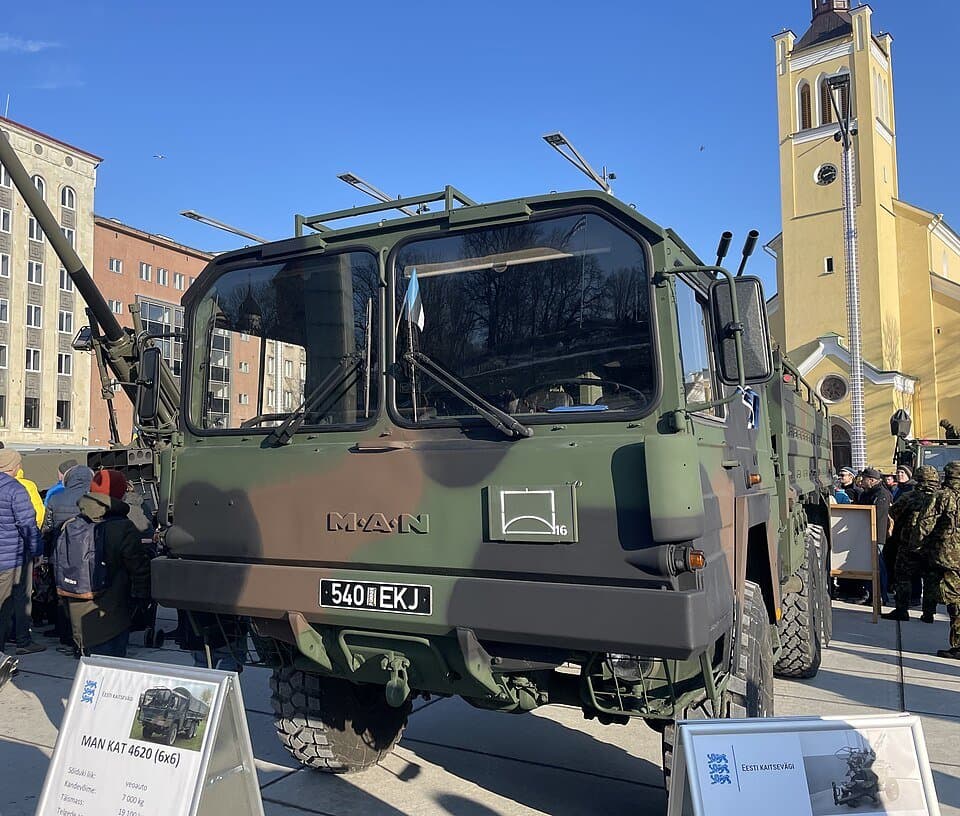
Military transport & logisticsIn service
8×8, 6×6, and 4×4 off-road trucks
MAN KAT1 is a 8×8, 6×6, and 4×4 off-road trucks originating in West Germany. It was built by MAN SE ; RMMV would now be the design parent. Reported operators include West Germany, Belgium, France, Canada, Austria, USA, Estonia, The Netherlands, Denmark and probably others.
Technical data
True scale
Sourced dimensions beside a 1.75 m human reference.
8×8, 6×6, and 4×4 off-road trucks
West Germany
West Germany, Belgium, France, Canada, Austria, USA, Estonia, The Netherlands, Denmark and probably others
MAN SE ; RMMV would now be the design parent
1976-1981 (Category 1)
9110 (approx)
1 + 1
MAN water-cooled diesel (KHD air-cooled diesel in early models) varied by model
5,000 kg (4×4), 7,000 kg (6×6), 10,000 kg (8×8); Category 1 A1 increased 8×8 payload to 15,000 kg
usually ZF manual with torque convertor and two-speed transfer case
coil springs and dampers for each axle
power-assisted on front axle(s)
In the late 1950s and early 1960s the West German Technical Office for Armament and Military Purchases drew up requirements for a new range (or second generation) of vehicles for the army. Covering all weight classes and mobility levels, the Bundeswehrʼs second-generation requirement originally called for 62,000 vehicles (of all classes including cars and buses) including four-tonne 4×4, seven-tonne 6×6, and 10-tonne 8×8 trucks; 4×4 and 6×6 armoured amphibious load carriers; and an 8×8 amphibious reconnaissance vehicle.
To meet development and production demands, a joint venture led by MAN and including Klöckner-Humboldt-Deutz (KHD), Rheinstahl-Henschel, Krupp (which later dropped out), and Büssing (acquired by MAN in 1971) was set up. The first prototype vehicles were shown at the end of the 1960s, and a further two prototype series were developed before the first genuine pre-production vehicles were designed and built. Along the development trail it became clear that the highly technical vehicles would simply not be affordable as originally specified, so many of the more ambitious 'wish list' features were dropped. The total number to procure was also cut down to 18,000. In 1972, the amphibious specification and the requirement for the vehicles to be powered by an air-cooled multifuel engine were dropped. In 1975, the four-tonne rating was uprated to five-tonne while stretching that model’s bed, along with increasing the wheelbase from 4.3 to 4.5 m.
In December 1975, MAN was awarded a contract to build 8,385 4×4, 6×6, and 8×8 Category 1 vehicles at a cost of DM 1.4 million; this production total was further reduced to 7,925 in 1979. The umbrella corporation to make these trucks was now Rheinmetall MAN Military Vehicles (RMMV).
The 8×8 version was the first Category 1 model to enter production and started to be delivered in 1976. A 6×6 tipper and the 4×4 cargo truck followed in 1977. Deliveries of the 6×6 cargo truck began in January 1979; the final units were supplied in 1981. By 1983, 8,617 vehicles of all Category 1 configurations had been delivered to the West German armed forces, and while exact totals are unknown, the Bundeswehr did receive a total of seven 5,000 kg 4×4 variants, 14 variants of the 7,000 kg 6×6, and nine 8×8 10,000 kg variants. The complete range of Category 1 vehicles were produced at MAN’s Watenstedt plant in Germany.
All Category 1 (and follow-on series) share a modular design. They have a torsionally rigid box-section chassis frame with rigid hub-reduction axles sprung by coil springs and shock-absorbers. The engine is mounted inside the forward-control cab, which is separated into a driver and engine compartment by a firewall. The engine is located to the rear of the driver compartment instead of beneath it to keep the overall height below 2.9 m and make the trucks rail-mobile on standard flatcars. The characteristic, cut-away corners of the otherwise box-shaped cab serve to keep dimensions within the railway loading gauge . The cab of early production examples does not tilt forward for maintenance because these vehicles were still based on the amphibious prototypes. The tilting cab was only introduced in the mid-80s.
Truck Tractor w/Crane, 10-ton, 8×8 M1001 (NSN 2320-12-191-5422)
Truck Tractor w/Crane, 10-ton, 8×8, M1002 (NSN 2320-12-191-5423)
Truck Tractor w/Crane, 10-ton, 8×8, M1013 (NSN 2320-12-191-5424)
Truck Tractor w/o Crane, 10-ton, 8×8, M1014 (NSN 2320-12-191-5425)
The M1001 was used by the US Army as the prime mover for the Pershing II nuclear missile. The tractor was configured with a fifth wheel to tow the erector launcher, an Atlas Maschinen GmbH 8-ton crane for handling missile components and a 30 kW generator to power the erector launcher. The M1002 was configured as a recovery vehicle with a Rotzler recovery unit, earth spades, Atlas Maschinen GmbH AK4300 M5 crane, and carriers for two erector launcher spare tires.
The M1013 was used by the US Air Force as the prime mover for the Gryphon Ground Launched Cruise Missile (GLCM). The tractor was configured with a fifth wheel to tow the launcher, a 2-ton material handling crane and a self-recovery winch. The M1014 was also configured as a prime mover and had a tire carrier for a launcher spare tire.
In April 1985 MAN presented the first of the revised Category I A1 models to the German Federal Office for Military Technology and Procurement (BWB) and to the Test Centre 41 facility. It was planned that there would be 35 test vehicles of all configurations, including an extra wide 8×8 version for the Patriot and Roland systems. Production of the new category vehicles began in 1987. The Category I A1 generation was a development of the Category I with improved performance on- and off-road owing to higher power output engines and an improved design of chassis and cab. Category 1 A1 included a new (as a direct replacement for the earlier Kat 1 10,000 kg) 15,000 kg 8×8 weight class.
A range of high performance airfield crash tenders were produced on the Cat 1 A1 extra-wide (2.9 m) chassis, and continued to be produced on the successor SX range 2.9 m wide chassis.
MAN Category I Type 464 LKW 10t mil gl MW Pritsche Kran 10,000 kg 8×8 cargo truck of the German Bundeswehr fitted with a self-recovery winch and body-mounted materials handling crane
MAN Category I Type 464 LKW 10t mil gl MW Pritsche Kran 10,000 kg 8×8 cargo truck of the German Bundeswehr fitted with a self-recovery winch and body-mounted materials handling crane; the Atlas-Weyhausen 1-ton loading crane is deployed
The order called for 252 trucks (161 5-tonne and 91 15-tonne) and was valued at EUR 92 million.
Of the latest order, 675 trucks are 5,000 kg payload and the remaining 325 are 15,000 kg payload.
The engine is located to the rear of the driver compartment instead of beneath it to keep the overall height below 2.9 m and make the trucks rail-mobile on standard flatcars.
Der Verbrennungsmotor gibt seine Leistung über Wandlerschaltkupplung , Schaltgetriebe und das Verteilergetriebe auf die Vorder- und Hinterachse(n) ab. In der ersten Baureihe KAT I bilden diese drei Komponenten eine Einheit und sind somit ein Sonderbauteil. Für die späteren Baureihen KAT I A1 werden günstigere Großserienteile aus der laufenden Lkw-Produktion verwendet. Damit ließ sich auch die Anzahl der Gänge von 6 auf 16 erhöhen, was die theoretische Höchstgeschwindigkeit von 90 auf rund 130 km/h steigert.
Der Verbrennungsmotor gibt seine Leistung über Wandlerschaltkupplung , Schaltgetriebe und das Verteilergetriebe auf die Vorder- und Hinterachse(n) ab. In der ersten Baureihe KAT I bilden diese drei Komponenten eine Einheit und sind somit ein Sonderbauteil. Für die späteren Baureihen KAT I A1 werden günstigere Großserienteile aus der laufenden Lkw-Produktion verwendet. Damit ließ sich auch die Anzahl der Gänge von 6 auf 16 erhöhen, was die theoretische Höchstgeschwindigkeit von 90 auf rund 130 km/h steigert. Bei der üblicherweise gefahrenen Geschwindigkeit von 80 km/h reduziert sich somit die Motordrehzahl erheblich, was den Kraftstoffverbrauch senkt. Die Bordnetzspannung beträgt 24 V und entspricht so dem Standard in der Bundeswehr. Eine Besonderheit ist die Anhängerkupplung . Im Gegensatz zu einem zivilen Fahrzeug verfügt der MAN mil gl wie jeder Bundeswehr-Lkw über eine Hakenkupplung (auch „NATO-Kupplung“ genannt). Diese ermöglicht den Anhängerbetrieb auch in schwerem Gelände, erfordert aber den Einsatz von Anhängern mit passender Zugöse.
Da der MAN mil gl schon über die neuere automatisch schließende Version der Hakenkupplung verfügt, kann sie bei ziviler Zulassung des Fahrzeugs uneingeschränkt weiterbenutzt werden, sofern die Anhänger mit einer entsprechenden Zugöse ausgerüstet sind.
Angetrieben von einem Deutz-V8-Dieselmotor F8L413F mit 256 PS wurden 1976 bis 1985 zwei Varianten (Typ 451, 461) eingeführt. Hauptsächlich dienten diese Fahrzeuge als Pritschenlastkraftwagen mit und ohne Plane für Personen- und Materialtransport, als Trägerfahrzeug für die Kabine II, als Träger des Feuerleitradars (FERA) des leichten Artillerie-Raketen-Systems (LARS) und als Bergefahrzeug mit 1-t-Kran der Firma Atlas-Weyhausen für das Kleinfluggerät KZO „Brevel“ .
10.27 metre 1 reference stated in Military Transport: Trucks & Transporters page(s) 56-57
2.5 metre 1 reference stated in Military Transport: Trucks & Transporters page(s) 56-57
2.93 metre 1 reference stated in Military Transport: Trucks & Transporters page(s) 56-57
13,400 kilogram 1 reference stated in Military Transport: Trucks & Transporters page(s) 56-57
Reference text from Wikipedia contributors, used under CC BY-SA 4.0.
MAN KAT1 equipment records. Variants, orders and quantities are shown as reported in each inventory source; coverage is incomplete.
Angetrieben von einem Deutz-V8-Dieselmotor F8L413F mit 256 PS wurden 1976 bis 1985 zwei Varianten (Typ 451, 461) eingeführt. Hauptsächlich dienten diese Fahrzeuge als Pritschenlastkraftwagen mit und ohne Plane für Personen- und Materialtransport, als Trägerfahrzeug für die Kabine II, als Träger des Feuerleitradars (FERA) des leichten Artillerie-Raketen-Systems (LARS) und als Bergefahrzeug mit 1-t-Kran der Firma Atlas-Weyhausen für das Kleinfluggerät KZO „Brevel“ .
Die LKW mit Nutzlast 7 t bilden das zweite Fahrzeug der MAN-Familie der zweiten Generation. Angetrieben von einem stärkeren, luftgekühlten 320-PS-Deutz-Motor mit Abgasturbolader und Ladeluftkühlung entsprechen sie im Aufbau dem 5 Tonner. Der Antrieb der zweiten Hinterachse erfolgt über einen Durchtrieb an der ersten Hinterachse.
Die LKW mit Nutzlast 7 t bilden das zweite Fahrzeug der MAN-Familie der zweiten Generation. Angetrieben von einem stärkeren, luftgekühlten 320-PS-Deutz-Motor mit Abgasturbolader und Ladeluftkühlung entsprechen sie im Aufbau dem 5 Tonner. Der Antrieb der zweiten Hinterachse erfolgt über einen Durchtrieb an der ersten Hinterachse.
Der vierachsige LKW bildet den Abschluss der KAT-I-Familie. Ausgerüstet mit einem 320-PS-Deutz-Motor, Abgasturbolader und Ladeluftkühlung wird dieser LKW von den Versorgungseinheiten der Divisionen , Brigaden und Korpsverbände des Heeres eingesetzt. Durch die verlängerte Ladefläche wird dieses Fahrzeug für den Transport von Mengenverbrauchsgütern wie Munition und Kraftstoff genutzt und dient der Versorgung der Kampfeinheiten. MAN baute in den Jahren 1976 bis 1985 zwei Versionen. Typ 454 verfügte nur über eine 5-Tonnen-Seilwinde der Firma Rotzler und war auf Umschlaggeräte wie Gabelstapler angewiesen. Dagegen verfügte der Typ 464 über einen 1-Tonnen-Ladekran von Atlas-Weyhausen , montiert auf der linken Seite der Ladenflächenmitte. Bedingt durch den Ladekran kann dieser Typ nur neun statt zehn Europaletten laden.
Der vierachsige LKW bildet den Abschluss der KAT-I-Familie. Ausgerüstet mit einem 320-PS-Deutz-Motor, Abgasturbolader und Ladeluftkühlung wird dieser LKW von den Versorgungseinheiten der Divisionen , Brigaden und Korpsverbände des Heeres eingesetzt. Durch die verlängerte Ladefläche wird dieses Fahrzeug für den Transport von Mengenverbrauchsgütern wie Munition und Kraftstoff genutzt und dient der Versorgung der Kampfeinheiten. MAN baute in den Jahren 1976 bis 1985 zwei Versionen. Typ 454 verfügte nur über eine 5-Tonnen-Seilwinde der Firma Rotzler und war auf Umschlaggeräte wie Gabelstapler angewiesen. Dagegen verfügte der Typ 464 über einen 1-Tonnen-Ladekran von Atlas-Weyhausen , montiert auf der linken Seite der Ladenflächenmitte. Bedingt durch den Ladekran kann dieser Typ nur neun statt zehn Europaletten laden.
Angetrieben wird der vierachsige LKW von einem Deutz-8-Zylinder-Dieselmotor mit 360 PS, Abgasturbolader und Ladeluftkühler. Wie auch die 5-, 7- und 10-Tonner verfügt er zum Teil über eine Seilwinde von Rotzler.
Angetrieben wird der vierachsige LKW von einem Deutz-8-Zylinder-Dieselmotor mit 360 PS, Abgasturbolader und Ladeluftkühler. Wie auch die 5-, 7- und 10-Tonner verfügt er zum Teil über eine Seilwinde von Rotzler.
 Croatia
Approximate count for MAN KAT1 4×4 , 6×6, 8×8. Service scope: Croatian Army; does not replace a national total. 1 distinct count cell(s) from the same source list; shared rowspan cells counted once. Retired, wholly reserve and on-order rows are excluded; the reported count retains any explicitly mixed stock scope in the quoted row. Count column(s): quantity: 80~. Origin: Germany. The listed variants/roles are the scope, not an immediately deployable count. The components do not establish one inventory census date; the stored date is the retrieved source snapshot.
 Germany
Reported count for MAN KAT1. Service scope: modern equipment of the German Army; does not replace a national total. 1 distinct count cell(s) from the same source list; shared rowspan cells counted once. Retired, wholly reserve and on-order rows are excluded; the reported count retains any explicitly mixed stock scope in the quoted row. Count column(s): quantity: 8,000. Origin: West Germany. The listed variants/roles are the scope, not an immediately deployable count. The components do not establish one inventory census date; the stored date is the retrieved source snapshot.
 Greece
Lower-bound count for MAN KAT1. Service scope: Hellenic Army; does not replace a national total. 1 distinct count cell(s) from the same source list; shared rowspan cells counted once. Retired, wholly reserve and on-order rows are excluded; the reported count retains any explicitly mixed stock scope in the quoted row. Count column(s): quantity: 24+. Origin: Germany. The listed variants/roles are the scope, not an immediately deployable count. The components do not establish one inventory census date; the stored date is the retrieved source snapshot.
 Paraguay
Reported count for MAN KAT1. Service scope: Paraguayan Army; does not replace a national total. 1 distinct count cell(s) from the same source list; shared rowspan cells counted once. Retired, wholly reserve and on-order rows are excluded; the reported count retains any explicitly mixed stock scope in the quoted row. Count column(s): quantity: 20. Origin: Germany. The listed variants/roles are the scope, not an immediately deployable count. The components do not establish one inventory census date; the stored date is the retrieved source snapshot.
 Portugal
Reported count for MAN KAT1 (MAN 4520 6×6 FSB). Service scope: Portuguese Army; does not replace a national total. 1 distinct count cell(s) from the same source list; shared rowspan cells counted once. Retired, wholly reserve and on-order rows are excluded; the reported count retains any explicitly mixed stock scope in the quoted row. Count column(s): quantity: 16. Origin: Austria West Germany. The listed variants/roles are the scope, not an immediately deployable count. The components do not establish one inventory census date; the stored date is the retrieved source snapshot.
 Ukraine
Lower-bound count for MAN KAT1 · 6x6 8x8. Country-wide list; no individual service specified. 1 distinct count cell(s) from the same source list; shared rowspan cells counted once. Retired, wholly reserve and on-order rows are excluded; the reported count retains any explicitly mixed stock scope in the quoted row. Count column(s): number: 6+. Origin: West Germany. The listed variants/roles are the scope, not an immediately deployable count. The components do not establish one inventory census date; the stored date is the retrieved source snapshot.
West Germany, Belgium, France, Canada, Austria, USA, Estonia, The Netherlands, Denmark and probably others
Equipment reference ↗Keep exploring
8×8 heavy-duty off-road truck
 Russia
Soviet and Russian 4x4 all-road (off-road) military truck
Medium/Heavy truck (4×4 and 6×6)
 India
off-road truck 6x6 for extreme operations
off-road truck 6x6 for extreme operations
off-road truck 4x4 for extreme operations
Ukraine Albania
 Estonia
 Indonesia
 Iran
 Mali
 Namibia
 Singapore
 South Africa