FORCETALLY
Loading the evidence…
Preparing your view.


Preparing your view.
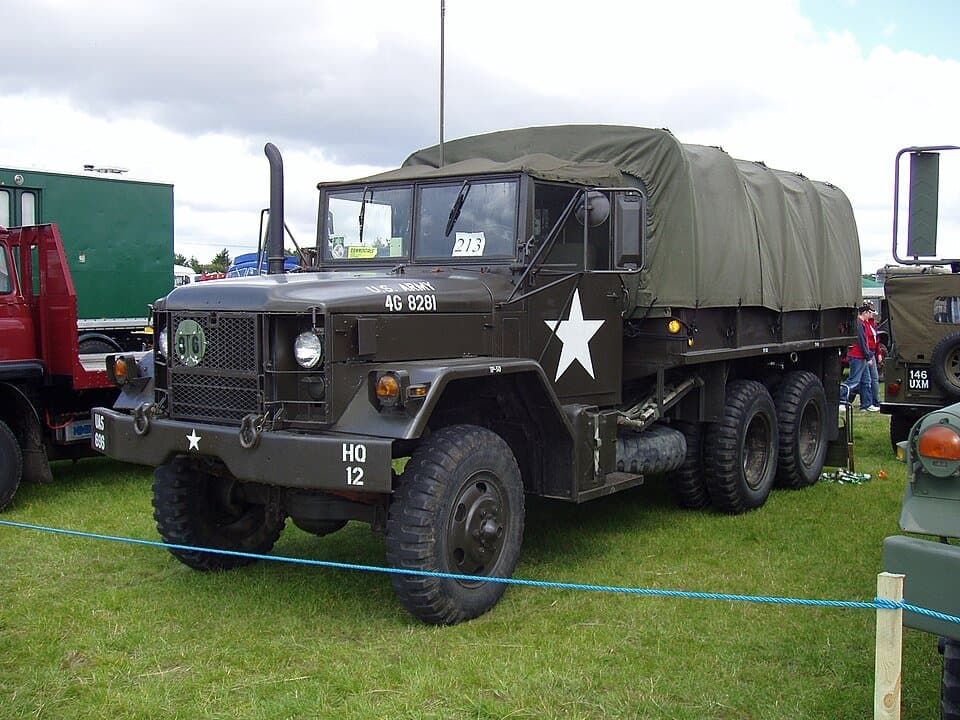
Military transport & logisticsIn service
2½-ton (2,268kg) 6×6 cargo truck
M35 series 2½-ton 6×6 cargo truck is a 2½-ton (2,268kg) 6×6 cargo truck originating in United States. It was built by REO , Kaiser , Studebaker , AM General , Kia and Ssangyong (South Korea only), Bombardier (Canada only). Reported operators include Argentina, Austria, Bolivia, Brazil, Cambodia, Canada, Chad, Chile, Colombia, Democratic Republic of Congo, Denmark, Djibouti, Dominican Republic, Ecuador, Egypt, El Salvador, Fiji, Georgia, Germany, Greece, Guatemala, Honduras, Indonesia, Iran, Israel, Jordan, Laos, Lebanon, Liberia, Mexico, Morocco, Nicaragua, Norway, Moldova, Pakistan, Panama, Philippines, Portugal, South Korea, Saudi Arabia, Sudan, Sweden, Taiwan, Thailand, Tunisia, Turkey, United States, Venezuela, Vietnam.
 United States
M35 series 2½-ton 6×6 cargo truck
Steve F-E-Cameron ( Merlin-UK ) · CC BY-SA 3.0 · Resized · CC BY-SA 3.0 · Source ↗ · ModifiedTechnical data
2½-ton (2,268kg) 6×6 cargo truck
United States
1949–2000s (still in limited service by some National Guard units)
REO
1944
REO , Kaiser , Studebaker , AM General , Kia and Ssangyong (South Korea only), Bombardier (Canada only)
1948–2006 1948–1988 (M34, M35A1, M35A2) 1994–2006 (M35A3)
M35A1, M35A2, M35A3
14,880 lb (6,750 kg) empty 17,880 lb (8,110 kg) loaded
274 + 3 ⁄ 4 in (6.98 m)
93 in (2.36 m)
True scale
Sourced dimensions beside a 1.75 m human reference.
Points represent sourced observations, including revisions. Revisions on the same effective date are not separate inventory events. Ranges appear in the table and are not plotted as exact points.
| Observation / report period | Value | Source | Claim state |
|---|---|---|---|
| 28 Sept 2026 | 6.98 m | Wikipedia contributors | superseded |
| 28 Sept 2026 | 6.98 m | Wikipedia contributors | superseded |
| 28 Sept 2026 | 6.98 m | Wikipedia contributors | approved |
| 28 Sept 2026 | 6.98 m | Wikipedia contributors | superseded |
| 28 Sept 2026 | 6.98 m | Wikipedia contributors | superseded |
| 28 Sept 2026 | 6.98 m | Wikipedia contributors | superseded |
| 28 Sept 2026 | 6.98 m | Wikipedia contributors | superseded |
| 28 Sept 2026 | 6.98 m | Wikipedia contributors | superseded |
111 in (2.82 m) to cab
REO OA-331 127 hp (95 kW)
5 spd. × 2 range trf. case
Beam axles on leaf springs
500 mi (800 km)
58 mph (93 km/h)
Argentina
Austria
Bolivia
Brazil
Cambodia
Canada ( Canadian Army replaced them with the MSVS )
Chad
Chile (Used by the Chilean Army and the Chilean Marine Corps )
Colombia
Democratic Republic of Congo
Denmark
Djibouti
Dominican Republic
Ecuador
Egypt
El Salvador
Fiji
Georgia
Germany
Greece
Guatemala
Honduras
Indonesia
Iran
Israel
Jordan
Laos
Lebanon
Liberia
Mexico
Morocco
Nicaragua
Norway
Moldova
Pakistan
Panama
Philippines
Portugal
South Korea called K-511, K-511A1
Saudi Arabia
Sudan
Sweden (evaluation only)
Taiwan (gradually replace with International 7400 4x4 trucks)
Thailand
Tunisia
Turkey
United States (replaced by LMTV)
Venezuela
Vietnam
The M35 2½-ton cargo truck is a long-lived 2½-ton 6×6 cargo truck initially used by the United States Army and subsequently utilized by many nations around the world.
The M35 started as a 1949 M34 REO Motor Car Company design for a 2½-ton 6×6 off-road truck. This original 6-wheel M34 version with a single wheel tandem was quickly superseded by the 10-wheel M35 design with a dual tandem. The basic M35 cargo truck is rated to carry 5,000 pounds (2,300 kg) off-road or 10,000 pounds (4,500 kg) on roads. Trucks in this weight class are considered medium duty by the military and the Department of Transportation .
An M35A2 cargo truck with a 10,000 pounds-force (44 kN) PTO -driven Garwood front winch is 112 inches (2.8 m) tall, 96 inches (2.4 m) wide and 277 inches (7.0 m) long, and 13,030 pounds (5,910 kg) empty (13,530 pounds (6,140 kg) empty when equipped with the front mount winch, according to dashboard dataplates). The standard wheelbase cargo bed is 8 feet wide by 12 feet long (2.4 × 3.6 m), with only 7.25 feet of this width being flat floorspace between the stake-pockets, the tailgate rising 16 inches above the floor and the side-walls/stake-pockets rising 12 inches above the floor. The M35A2 was available with a canvas soft top or a metal hard top. Metal hard-top configurations are most often found on vehicles that have been equipped with cold-weather gear, including additional insulation in the cab, as well as engine coolant or multifuel-fired cab personnel heaters.
The curb weight of an M35 is between 13,000 pounds (5,900 kg) and 16,000 pounds (7,300 kg) empty, depending on configuration (cargo, wrecker, tractor, etc.). Its top speed is 56 mph (90 km/h), though maximum cruising speed is approximately 48 mph (77 km/h). Fuel economy is 11 mpg ‑US (21 L/100 km; 13 mpg ‑imp ) highway and 8 mpg ‑US (29 L/100 km; 9.6 mpg ‑imp ) city, giving the vehicle a 400–500-mile (600–800 km) range on its 50 U.S. gallons (190 L; 42 imp gal) single fuel tank. Most operators experience an average of 10 mpg ‑US (24 L/100 km; 12 mpg ‑imp ) for an unladen vehicle.
The M35A2 is commonly powered by an LDT 465 engine, made by either Continental Motors Company , Hercules, or White Motor Company . It is an in-line, 478-cubic-inch (7.8 L), six-cylinder, turbocharged multifuel engine developing 134 bhp (100 kW) and 330 pound-feet (447 N⋅m) of torque . This is coupled with a 5-speed manual transmission and divorced 2-speed transfer case( note -hidden gear in low range, shift up to 4th in high range, shift transfer to low, trans to 5th then transfer to high 5th again).(either a sprag -operated transfer case Rockwell 136-21 or air-operated selectable transfer case Rockwell 136–27). Multifuel engines are designed to operate reliably on a wide variety of fuels, including diesel fuel, kerosene, heating oil or gasoline. Gasoline may be used only in an emergency because it does not properly lubricate the injector pump. While using gasoline, common practice calls for the addition of at least 1 U.S. quart of clean motor oil per 15 U.S. gallons of gasoline (1 imp qt/13 imp gal; 1 L/60 L) for proper pump lubrication where available.
Although the A2 version is the most common, there are four different iterations: Standard, A1, A2, and A3. These changes mainly had to do with the engine and transmission components. Standard M35 had a REO "Gold Comet" or Continental OA331 inline-6 gasoline engine. Some had 4-speed transmissions but most had "direct 5th" transmissions. The gasoline-powered deuces were built primarily by REO Motors, however, Studebaker also had a manufacturing contract from at least 1951 into the early 1960s. Curtis-Wright also had a contract in at least 1958 to build dump trucks with the Continental gas engine. The A1's had Continental LDS-427-2 turbo engines, equipped with either a model 4-450 Schwitzer turbo or a 4D454C Schwitzer turbo on later models, and 5th gear was an overdrive. The 140 hp engines were not reliable, suffering frequent headgasket failures.
The first A2 trucks received the bigger LD-465-1 naturally aspirated 478 CID multifuel engines, keeping the OD transmission of the A1s. Through the years the trucks were upgraded to LD 465-1c engines, with 60Amp alternator instead of the 25Amp generator. With the addition of a turbocharger , the engine evolved into the LDT 465-1c (turbo clean air). The turbo was added more to clean up the black exhaust on the Non Turbo engines, than to add power; the HP was raised from 130 to only 135 HP. Turbo models used: 3LD305 (early engines only) and 3LJ319 (the "whistler") The LDT-465-1D was the last version of the Multi Fuel, it had the same 3LJ319 Turbo (whistler), or the quieter 3LM39 (non-whistler), better head gasket sealing and head cooling.
The brake system is air-assisted-hydraulic six-wheel drum brakes with a driveline parking brake , although gladhands exist on the rear of the vehicle for connection to trailers with full air service and emergency brakes. Braking performance of the truck is similar to other power drum brake vehicles of this size. Each drum was designed with maximum efficiency in mind, and individual drums can dissipate up to 12 kilowatts (16 hp) of braking heat. Due to this brake system and GVWR under 26,001 pounds (11,794 kg), the M35 can be driven without a commercial driver's license in most states.
As noted the original basic gasoline-powered truck variants were first the M34, and then the M35. An extra long wheel-base variant, designated the M36, was also developed (featuring a 16-foot (4.9 m) cargo bed). Variants with a C suffix (such as M35A2C or M36A2C) featured a straight drop-side cargo bed. M44, M45, and M46 simply designated the long single tandem, long double tandem, and extra long double tandem chassis for the M35 2 + 1 ⁄ 2 -ton series of trucks; there was also a short tandem chassis without an M designation. These cab/chassis would serve as the basis for many more specialized variants.
The M49 fuel tanker and M50 water tanker variants were initially based on the M45 chassis. The M49C series, however, were vehicles converted from C series drop-side cargo variants. M49s have 1,200-gallon tanks. Early models had triple compartments (200g front, 400g mid, baffled 600g rear), but most models have two 600-gallon baffled tanks. The M50 had a 1,000-U.S.-gallon (3,800 L; 830 imp gal) water tank, of which later variants had internal baffles to combat weight transfer during motion. In some areas the M35 is still used today as a wildland firefighting truck with a portable water supply and fully operational pump.
A number of variants with van bodies, primarily for use as maintenance shop vans, were also created. The basic model was the M109, with a variant that could mount the PTO winch was designated M185. The M185 was a machine shop version of the M109 that carried a light duty crane, tools, other items. It often towed a M105 trailer. An expandable van variant with hydraulic lift gate was designated M292. Another expandable van variant carried a water purification unit for supplying potable water. The M46 chassis could be used for mounting the expandable "Bat-Wing" machine shop body, but because of the weight of the machinery the preferred mount was by far the M809 5-ton chassis. Two variants of the M109 van were specifically developed as service vehicles for the MGM-18 Lacrosse missile system, the XM411 for the Ground Guidance Electronic Equipment, and the XM412 with special tools and test equipment for the electronic guidance and control system. A medical van variant was designated M132.
A wrecker based on the M45 chassis was designated as the M60, while the similar M108 crane truck was used for many tasks, but primarily to handle guided missiles such as the Lacrosse. Two tractor variants for towing semi-trailers were developed, the M48 and M275. The M48 featured a full-length M45 chassis (178 inch wheelbase, identical to the M35 cargo), while the M275 featured a shortened M45 chassis (166 in wheelbase) for reduced weight and greater maneuverability. However, due to the smaller size and lower power of the 2 + 1 ⁄ 2 -ton trucks, most heavier loads were handled by their respective 5-ton counterparts. As a result, few were produced.
A number of specialized construction variants were developed. The M47 and M59 dump trucks were developed, based on a shortened 166 inch wheelbase M44 and M45 chassis respectively. An improved dump truck based on the full length 178 inch wheelbase M45 chassis, designated the M342, was designed to replace both the M47 and the M59, as well as the M135-based M215.
The simplest examples were produced by simply placing an existing light gun mount directly onto the cargo bed of the truck, and securing it in place. No armouring or special support equipment was installed. One such conversion was performed in Congo-Leopoldville in 1965, using an Oerlikon GAI 20 mm anti-aircraft gun. Another conversion in the Congo entailed mounting pods with 2.75" aircraft rockets on a pedestal on the cargo bed, but this proved unsuccessful.
The Philippine Marine Corps also began converting M35 type trucks to an armored configuration by 2004. The first vehicle, dubbed "Talisman," utilized armor fabricated from derelict LVTP5 amphibious personnel carriers. Later gun trucks were built using more standard components and bear some resemblance to U.S. military vehicles of the Vietnam era. The Philippine Marine Corps had also begun the creation of an anti-aircraft element by 2006, utilizing M35 based vehicles. Two types of vehicles have been seen so far. One utilizes the Mk 56 Mod 0 mount from the Patrol Boat, River , with two M2 Browning machine guns , while the other features another former naval mount with a single Oerlikon 20 mm cannon .
Colombia maintains a fleet of REO M35 "Meteoro" armored trucks. These locally fabricated armored vehicles are used to guard tourist bus caravans as well as mobile checkpoints. Early vehicles were not fabricated to any particular standard and typically hosted three weapon stations that could be fitted with a 7.62 mm (.308-cal) or .50-caliber (12.7 mm) machine gun. The weapon stations may or may not have had a gun shield on any particular vehicle. More recent examples follow a pattern with the cab and fuel tanks armored and the drop side cargo bed converted to an armored box, atop which is a "gun tower," a set of four heavily armored weapon stations, one facing each direction. .50-caliber machine guns are mounted front and back, with 7.62 mm machine guns mounted to the sides. Losses in the Meteoro fleet instigated the purchase of the BTR-80 Caribe .
In addition to the basic cargo version, tank water and fuel models were used. The CEMABLIN-(Centro de Mantenimiento de Blindados del Ejército Venezolano) locally manufactured a version of anti-air defense operations and support, thanks to all the necessary parts were stored and in perfect condition. 6 units were produced in early 1998. The "Fénix" system was assigned to the 1103º BDAA 40mm. based at Fort Yaurepara in Zulia state. But they had problems with the tower's weight and shoot on the move. They were retired in 1998 and substituted by the AMX-13 M55/M4E1 "Ráfaga" 40mm also produced locally stored material advantage and in good condition. The "Fénix" is a M4E1 tower, recovered from a car M42 Duster and 2 M50 machine guns .30 caliber for Protective Part (a cylindrical tower made of welded armor plate with open top with twin mounting Bofors 40 mm gun ), mounted on a tactical platform Truck 6x6 2 + 1 ⁄ 2 -ton Reo M-35.
^ a b c d e f g h i Without winch, with winch add 14 in (35.5 cm).
^ a b c d e Without winch, with winch add approx. 400 lb (186 kg).
^ a b c Without winch, with winch add 12 in (31 cm).
^ a b c d e Without winch, with winch add 520 lb (2336 kg).
M35 2½-ton cargo truck United States Multi-purpose vehicle M35 Unknown
Reference text from Wikipedia contributors, used under CC BY-SA 4.0.
M35 series 2½-ton 6×6 cargo truck equipment records. Variants, orders and quantities are shown as reported in each inventory source; coverage is incomplete.
 Argentina
Approximate count for M35 series 2½-ton 6×6 cargo truck. Service scope: Argentine Army; does not replace a national total. 1 distinct count cell(s) from the same source list; shared rowspan cells counted once. Excludes retired/reserve/on-order rows. Count column(s): quantity: ~200. Origin: United States. The listed variants/roles are the scope, not an immediately deployable count. The components do not establish one inventory census date; the stored date is the retrieved source snapshot.
 Austria
 Bolivia
 Brazil
 Cambodia
 Canada
 Chad
Chad Chile
Chile Colombia
 Denmark
 Djibouti
Reported count for M35. Service scope: Djiboutian Army; does not replace a national total. 1 distinct count cell(s) from the same source list; shared rowspan cells counted once. Excludes retired/reserve/on-order rows. Count column(s): quantity: 10. Origin: United States. The listed variants/roles are the scope, not an immediately deployable count. The components do not establish one inventory census date; the stored date is the retrieved source snapshot.
 Dominican Republic
 Ecuador
Number column of the Wikipedia list table under "Truck". The list's own wording applies; it is a compiled secondary source, not an official census.
 Egypt
Egypt El Salvador
Number column of the Wikipedia list table under "Trucks". The list's own wording applies; it is a compiled secondary source, not an official census.
 Fiji
Fiji Georgia
 Germany
 Greece
Reported count for M35. Service scope: Hellenic Army; does not replace a national total. 1 distinct count cell(s) from the same source list; shared rowspan cells counted once. Excludes retired/reserve/on-order rows. Count column(s): quantity: 135. Origin: United States. The listed variants/roles are the scope, not an immediately deployable count. The components do not establish one inventory census date; the stored date is the retrieved source snapshot.
 Guatemala
 Honduras
 Indonesia
Reported count for M35 2½-ton cargo truck. Service scope: Indonesian Army; does not replace a national total. 1 distinct count cell(s) from the same source list; shared rowspan cells counted once. Excludes retired/reserve/on-order rows. Count column(s): quantity: 500. Origin: United States. The listed variants/roles are the scope, not an immediately deployable count. The components do not establish one inventory census date; the stored date is the retrieved source snapshot.
 Iran
Iran Israel
 Jordan
 Laos
Laos Lebanon
 Liberia
 Mexico
 Moldova
 Morocco
 Nicaragua
 Norway
 Pakistan
 Panama
 Philippines
 Portugal
 Saudi Arabia
 South Korea
 Sudan
Sudan Sweden
Army exact named equipment holdings: M35 (Amfibiebro 400). Active, operational-reserve and training units excluding equipment in store; November 2025 IISS assessment. Named service only; no parent-force or national total inferred. Source role: ENGINEERING & MAINTENANCE VEHICLES / VLB. Original estimates, ranges, reporting names, reserve, lease and employment scopes retained; nested included counts are not added. Missile-system quantities mean launchers, not rounds. No readiness, crew, carried weapon, payload, factory-production or future order count inherited.
 Taiwan
 Thailand
 Tunisia
Reported count for M49. Service scope: Tunisian Army; does not replace a national total. 1 distinct count cell(s) from the same source list; shared rowspan cells counted once. Retired, wholly reserve and on-order rows are excluded; the reported count retains any explicitly mixed stock scope in the quoted row. Count column(s): number: 56. Origin: United States. The listed variants/roles are the scope, not an immediately deployable count. The components do not establish one inventory census date; the stored date is the retrieved source snapshot.
 Türkiye United States
 Venezuela
 Vietnam
Argentina, Austria, Bolivia, Brazil, Cambodia, Canada, Chad, Chile, Colombia, Democratic Republic of Congo, Denmark, Djibouti, Dominican Republic, Ecuador, Egypt, El Salvador, Fiji, Georgia, Germany, Greece, Guatemala, Honduras, Indonesia, Iran, Israel, Jordan, Laos, Lebanon, Liberia, Mexico, Morocco, Nicaragua, Norway, Moldova, Pakistan, Panama, Philippines, Portugal, South Korea, Saudi Arabia, Sudan, Sweden, Taiwan, Thailand, Tunisia, Turkey, United States, Venezuela, Vietnam
Equipment reference ↗