FORCETALLY
Loading the evidence…
Preparing your view.


Preparing your view.
Armoured vehiclesIn service
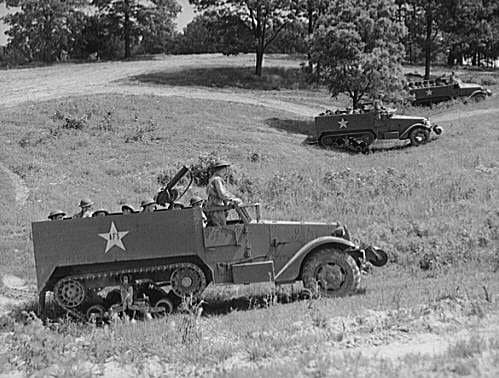
Half-track armored personnel carrier
M3 half-track is a half-track armored personnel carrier originating in United States. It was built by Autocar Diamond T White Motor Company. Reported operators include Argentina, Austria, Belgium, Cambodia, Cameroon, Chile, Czechoslovakia, Denmark, Dominican Republic, El Salvador, France, West Germany, Greece, Israel, Italy, India, South Korea, Liberia, Madagascar, Mali, Mexico, Morocco, Netherlands, New Zealand, Nicaragua, Norway, Pakistan, Paraguay, Peru, Portugal, Poland, Senegal, Soviet Union, Togo, Türkiye, United Kingdom, South Vietnam, Vietnam.
 United States
Technical data
Half-track armored personnel carrier
United States
World War II Chinese Civil War 1948 Arab–Israeli War Greek Civil War Korean War First Indochina War Costa Rican Civil War Vietnam War Laotian Civil War Algerian War Cambodian Civil War Suez Crisis 1958 Lebanon crisis Six-Day War 1973 Arab–Israeli War Lebanese Civil War Salvadoran Civil War Nicaraguan Revolution
1940–1941
Autocar Diamond T White Motor Company
$10,310
1941-1945
53,000 (including variants)
17,650 pounds (8.01 t) (M3), 18,425 pounds (8.357 t) (M3A1)
20 ft 3 in (6.17 m) with roller
7 ft 3.5 in (2.223 m)
7 ft 5 in (2.26 m)
1
12
6–12 mm (0.25–0.50 in)
.30 caliber Browning M1919A4 machine gun (M3, M3A1), .50 caliber Browning M2HB machine gun (M3A1)
White 160AX 148 hp (110 kW) at 3,000 rpm
18.5 hp/metric ton (M3), 17.7 hp/metric ton (M3A1)
Spicer 3461 constant mesh
Front: semi-elliptic longitudinal leaf spring Rear: Vertical volute spring
60 US gallons (230 litres)
200 mi (320 km)
45 mph (72 km/h) on road
Argentina (ex-British surplus M3s)
Austria – Bundesheer
Belgium – Belgian Army
Brazil – Brazilian Expeditionary Force
Cambodia – Royal Cambodian Army
Cameroon
Canada – Canadian Army
Chile
China – National Revolutionary Army
Czechoslovakia
Denmark – Danish Army
Dominican Republic – Dominican Army : 16 still in service in 1994.
El Salvador – Salvadoran Army : 5 in service in 1988.
France – French Army
Germany – The German Wehrmacht used captured vehicles in North Africa and on the Western front during World War II.
West Germany – West German Bundeswehr
Greece – Greek Army
Israel – Israel Defense Forces (IDF)
Italy – Italian Army
India – Indian Army
Japan – GSDF
South Korea
Kingdom of Laos – Royal Lao Army
Liberia
Madagascar
Mali – Malian Army
Mexico
Morocco
Netherlands
New Zealand
Nicaragua
Norway
Pakistan – Pakistani Army
Paraguay – Paraguayan Army
Peru – Peruvian Army
Philippines – Philippine Army and Philippine Constabulary
Portugal – Portuguese Army
Poland
Senegal
Soviet Union – Soviet Army
Togo
Turkey – Turkish Army
United Kingdom – British Army
United States – United States Army
South Vietnam – Army of the Republic of Vietnam
Vietnam – People's Army of Vietnam
Yugoslavia – Yugoslav People's Army
Zaire – Forces Armées Zaïroises , used into the 1980s
The M3 half-track is an American armored personnel carrier half-track widely used by the Allies during World War II and in the Cold War .
The M3 half-track was 20 ft 3 in (6.17 m) long, 7 ft 3.5 in (2.223 m) wide, 7 ft 5 in (2.26 m) high and had a gross weight of either 17,650 pounds (8.01 t) (M3) or 18,425 pounds (8.357 t) (M3A1). The wheelbase was 135.5 in (3.44 m) long. The suspension consists of a leaf spring for the two front wheels, while the rear treads had vertical volute springs . With a fuel capacity of 60 US gallons (230 L), the M3 could carry its crew (one driver) and a squad of 12 soldiers 220 miles (350 km) before refueling, while protecting them from small arms with light armor (6–12 mm of armor ). The vehicle was powered by a 148 hp (110 kW) White 160AX, 386 in 3 (6,330 cc), 6-cylinder gasoline engine.
The M3 half-track was 20 ft 3 in (6.17 m) long, 7 ft 3.5 in (2.223 m) wide, 7 ft 5 in (2.26 m) high and had a gross weight of either 17,650 pounds (8.01 t) (M3) or 18,425 pounds (8.357 t) (M3A1).
The M3 half-track was 20 ft 3 in (6.17 m) long, 7 ft 3.5 in (2.223 m) wide, 7 ft 5 in (2.26 m) high and had a gross weight of either 17,650 pounds (8.01 t) (M3) or 18,425 pounds (8.357 t) (M3A1).
The M3 half-track was 20 ft 3 in (6.17 m) long, 7 ft 3.5 in (2.223 m) wide, 7 ft 5 in (2.26 m) high and had a gross weight of either 17,650 pounds (8.01 t) (M3) or 18,425 pounds (8.357 t) (M3A1).
Early vehicles had a pintle mount just behind the front seats that mounted a .50-caliber (12.7 mm) M2 Browning machine gun . The later M3A1 adopted a raised, armored "pulpit" mount for the .50-caliber machine gun over the front passenger seat, and additional mounts for .30-caliber (7.62 mm) machine guns along the sides of the passenger compartment. Many M3s were later converted to M3A1s. The vehicle body was fully armored, with an adjustable armored shutter for the engine radiator, and adjustable bulletproof panels with vision slits for the windshield, driver windows, and passenger windows.
The development of an armored half-track began with ordnance directive OCM 14188 to convert an M3 Scout Car into a half-track. The prototype was built at Rock Island Arsenal with help from White Motor Company and was designated the T7. It had the same chassis and engine as the M3, but had larger front wheels and a shorter front clip. The armor consisted of 1/4-inch thick hardened armor plate, and it was armed with two M1919 machine guns and one M2 Browning machine gun operated by a crew of eight. Tests at Aberdeen Proving Ground in 1938 demonstrated unsatisfactory performance due to the front-wheel drive. The T7 was converted back into a scout car and returned to the Army.
In US service, it was intended that the M3 would be issued to armored infantry regiments. It was also quickly put into action with the Provisional Tank Group when the Japanese Army began their invasion of the Philippines . At first, there were multiple complaints due to several mechanical difficulties. These were rectified by the Ordnance Department after receiving field reports from the Philippines. The M3s first use in its intended role was during Operation Torch . Each armored division had 433 M2s or M3s, 200 in the armored regiments and 233 in the armored infantry regiment.
M3 – White and Autocar half-track with White 386 in 3 (6,330 cc) 160AX engine. Fitted with either an M32 anti-aircraft machine gun mount or a pedestal mount, both featuring an M2HB machine gun. M3A1 – A M3 with the improved M49 machine gun ring mount over the right hand front seat. Between 1942 and 1943 all M3 half-tracks (standard and A1s) were continually upgraded. These improvements included a number of drive train, engine, and stowage improvements. T29/M3A2 – Developed in 1943 to combine features such that existing M2 and M3 production could be switched to a common vehicle. The need for additional half-tracks was not as large as predicted, and the M3A2 was never built.
The M5 personnel carrier M3E2/ M5 half-track – International Harvester half-track, externally largely identical to the M3, but with 450 in 3 (7,400 cc), IHC RED-450-B engine, different drive train and fuel and electrical system.
It could fit one .50-caliber (12.7 mm) and two .30-caliber (30.06) machine guns.
The IHC models had a slightly lower top speed (only 42 mph (68 km/h)) and lower range (125 mi (201 km)).
T12/M3 75 mm GMC – M3 based gun motor carriage equipped with the M1897A5 75 mm gun. Also fitted with the M2A3 gun carriage and shield. M3A1 75 mm GMC – The M2A2 gun carriage was substituted for the A3, as stocks of the former were exhausted. Later variants featured a purpose-built gun shield (59 rounds).
T19 105 mm HMC – M3 based howitzer motor carriage equipped with the M2A1 105 mm howitzer (8 rounds).
T19/ M21 81 mm MMC – M3-based mortar motor carriage equipped with the M1 mortar (81 mm) (97 rounds), designed to allow the mortar to be fired from within the vehicle.
T21 – M3 based mortar carrier fitted with a 4.2 inch mortar . Never adopted. T21E1 – The T21's mortar could only fire rearward as with the M2 based M4 MMC . The T21E1 reoriented to the mortar to fire forward.
T30 75 mm HMC – M3 based howitzer motor carriage equipped with the M1A1 75 mm howitzer in a simple box mount (60 rounds). Used by the US Army. Also provided to the Free French Army , later used in Indochina .
T38 105 mm HMC – M3 based howitzer motor carriage equipped with the M3 105 mm howitzer . Cancelled with the success of the T19 105 mm HMC.
T48 gun motor carriage – M3 based gun motor carriage equipped with the M1 57 mm gun, an American copy of the British QF 6 pounder anti-tank gun. A total of 962 T48s were produced during the war. Of these, 60 were supplied under lend lease to Britain, and 650 to the USSR who designated it SU-57 (99 rounds). A total of 31 were converted into M3A1s, while one entered service with the U.S. Army.
T28E1 CGMC – M3 based combination gun motor carriage equipped with one M1A2 37 mm autocannon (240 rounds) flanked by 2 M2WC machine guns (3,400 rounds). The original T28 was built on the M2 half-track car chassis. Prototype only. M15 half-track – T28E1 variant, equipped with an armored superstructure on the turreted mount to provide crew protection, and switched to M2HB machine guns. M15A1 CGMC – Reorganization of the weapons, with the M2HB machine guns being fitted under the M1A2 37 mm autocannon instead of above.
T10E1 – Variant to test the feasibility of mounting US made copies of the Hispano-Suiza HS.404 20 mm cannon on modified Maxson mounts. All were later rebuilt as M16s. The original T10 was based on the M2 half-track car chassis.
Various attempts were made to mate the 40 mm Bofors L/50 gun to the M3 chassis. In most cases the weapon's recoil was too severe or the mounting too heavy, and the attempts were finally stopped with the adoption of the M19 MGMC on the M24 light tank chassis .
T60/E1 – Similar to the T54 and the T59, but featured two .50 caliber M2 machine guns flanking the 40 mm cannon (the mounting's designation was T65). The T60E1 featured an armor configuration similar to that of the T54E1. Suffered from the same stability issues as previous attempts. Prototype only.
T68 – Perhaps the most radical of the experiments, the T68 featured two 40 mm cannons, one mounted on top of the other, plus a stabilizer on top of the two guns. The recoil force proved to be too much for the mount, and the idea was abandoned. Prototype only.
M15 "Special" – Field conversions by US Army depots in Australia of standard M3s, not M15s, fitted with turreted 40 mm Bofors L/50 guns. These were the only successful mating of this weapon to the M3 chassis, and were used more for direct fire support than for anti-aircraft purposes.
M34 – Like the M15 "Special" above, 102 M15s were converted to M34s in Japan in 1951. The M34 mounted a single 40 mm Bofors gun in place of the M15's combination gun mount. This was due primarily to a shortage of 37 mm ammunition, which was no longer manufactured. M34s served with at least two AAA (automatic weapons) battalions (the 26th and 140th) in the Korean War.
M3 Mk. C (M3 Degem Gimel) – Similar to M21 MMC, an M3 type (assumed from the common use of the White 160AX engine) Half-track with an M1 81 mm Mortar. Development began in 1950. A prototype underwent trials in December 1951. First vehicles were issued to units in September 1953.
M3 Mk. D (M3 Degem Dalet) – Another M3 based mortar carrier, fitted with the 120 mm Soltam mortar . Development began in 1952. Entered service in 1960.
M3 Mk. E (M3 Degem He) - M3 fitted with Krupp 75 mm gun. A single prototype was built in May 1951 and underwent trials in July 1951 and August 1953. By 1955, the IDF Artillery Corps lost interest in the project.
M3 Mk. F (M3 Degem Waw) - A proposed configuration of M3 with two 20 mm anti-aircraft cannons. The project was abandoned in 1952 after a preliminary check.
M3 TCM-20 – M3/M5 half-tracks fitted with the Israeli TCM-20 armament turret with two 20 mm Hispano-Suiza HS.404 cannon fitted to old Maxson turrets. The right-hand vision port was often replaced with a ball mount for a machine gun. They proved to be very effective in fighting anti-tank missile teams; their cannons forced the teams to take cover or suppressed them so they could not use their missiles accurately.
Reference text from Wikipedia contributors, used under CC BY-SA 4.0.
True scale
Sourced dimensions beside a 1.75 m human reference.
See it in your room. Scan with your phone to open this model in 3D, then place it in your space.
Points represent sourced observations, including revisions. Revisions on the same effective date are not separate inventory events. Ranges appear in the table and are not plotted as exact points.
| Observation / report period | Value | Source | Claim state |
|---|---|---|---|
| 28 Sept 2026 | 1 people | Wikipedia contributors | superseded |
M3 half-track equipment records. Variants, orders and quantities are shown as reported in each inventory source; coverage is incomplete.
 Argentina
 Austria
 Belgium
 Cambodia
 Cameroon
Army exact named equipment holdings: M3 half-track. Active, operational-reserve and training units excluding equipment in store; November 2025 IISS assessment. Named service only; no parent-force or national total inferred. Source role: ARMOURED FIGHTING VEHICLES / APC (T). Original estimates, ranges, reporting names, reserve, lease and employment scopes retained; nested included counts are not added. Missile-system quantities mean launchers, not rounds. No readiness, crew, carried weapon, payload, factory-production or future order count inherited.
 Chile
 Denmark
 Dominican Republic
Reported count for M3 half-track. Service scope: Dominican Army; does not replace a national total. 1 distinct count cell(s) from the same source list; shared rowspan cells counted once. Retired, wholly reserve and on-order rows are excluded; the reported count retains any explicitly mixed stock scope in the quoted row. Count column(s): quantity: 4. Origin: United States. The listed variants/roles are the scope, not an immediately deployable count. The components do not establish one inventory census date; the stored date is the retrieved source snapshot.
 El Salvador
 France
 Greece
 India
 Israel
 Italy
 Liberia
 Madagascar
 Mali
 Mexico
 Morocco
 Netherlands
 New Zealand
 Nicaragua
 Norway
 Pakistan
 Paraguay
Reported count for M3 half-track. Service scope: Paraguayan Army; does not replace a national total. 1 distinct count cell(s) from the same source list; shared rowspan cells counted once. Retired, wholly reserve and on-order rows are excluded; the reported count retains any explicitly mixed stock scope in the quoted row. Count column(s): quantity: 20. Origin: United States. The listed variants/roles are the scope, not an immediately deployable count. The components do not establish one inventory census date; the stored date is the retrieved source snapshot.
 Peru
 Poland
 Portugal
 Senegal
Reported count for M3 half-track. Service scope: Army; does not replace a national total. 1 distinct count cell(s) from the same source list; shared rowspan cells counted once. Retired, wholly reserve and on-order rows are excluded; the reported count retains any explicitly mixed stock scope in the quoted row. Count column(s): quantity: 12. Origin: United States. The listed variants/roles are the scope, not an immediately deployable count. The components do not establish one inventory census date; the stored date is the retrieved source snapshot.
 South Korea
 Togo
 Türkiye
 United Kingdom
 Vietnam
Argentina, Austria, Belgium, Cambodia, Cameroon, Chile, Czechoslovakia, Denmark, Dominican Republic, El Salvador, France, West Germany, Greece, Israel, Italy, India, South Korea, Liberia, Madagascar, Mali, Mexico, Morocco, Netherlands, New Zealand, Nicaragua, Norway, Pakistan, Paraguay, Peru, Portugal, Poland, Senegal, Soviet Union, Togo, Türkiye, United Kingdom, South Vietnam, Vietnam
Equipment reference ↗Keep exploring
Half-track armored personnel carrier
United StatesCompare with M3 half-track Armored personnel carrier
United StatesArmored personnel carrier
FranceArmored personnel carrier
 RussiaCompare with M3 half-track
armored personnel carrier
United KingdomCompare with M3 half-track Armored personnel carrier
Poland