FORCETALLY
Loading the evidence…
Preparing your view.


Preparing your view.
Small armsIn service
Sniper rifle
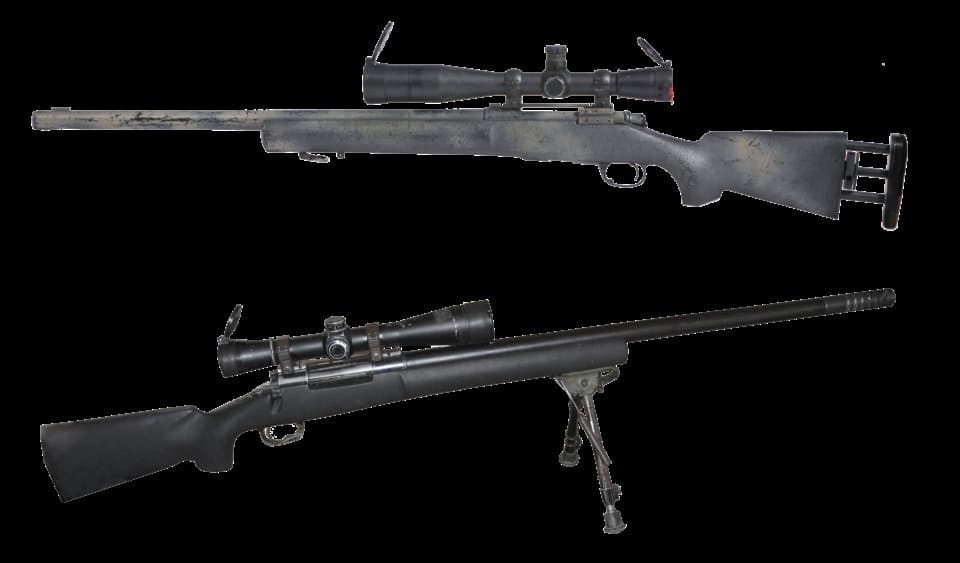
M24 Sniper Weapon System is a sniper rifle originating in United States. It was built by Remington Arms. Reported operators include Algeria, Brazil, Colombia, El Salvador, Georgia, Hungary, Iraq, Israel, Japan, Kosovo, Lebanon, Mexico, Philippines, Ukraine, United States.
 United States
M24 Sniper Weapon System
User:MathKnight , User:Bukvoed and PEO Soldier, US Army website · Public domain · Resized · Public domain · Source ↗ · ModifiedSniper rifle
United States
1988–present
See Users
Salvadoran Civil War Gulf War War in Afghanistan (2001–2021) Iraq War Syrian Civil War War in Iraq (2013–2017)
1988
Remington Arms
1988 – mid 2010s
M24A2, M24A3, M24E1
5.4 kg (12 lb) empty, without scope (M24) 7.3 kg (16 lb) with optical sight, sling swivels, carrying strap, fully loaded magazine 5.6 kg (12 lb) empty, without scope (M24A3).
1,092 mm (43.0 in) (M24A1, M24A2); 1,181 mm (46.5 in) (M24A3)
610 mm (24 in) (M24A1, M24A2); 685.8 mm (27.00 in) (M24A3)
7.62×51mm NATO (M24, M24A2) .338 Lapua Magnum (M24A3)
Bolt-action
20 rounds/min
2,580 ft/s (790 m/s) w/M118LR Sniper load (175 gr.)
800 metres (875 yd) ( 7.62×51mm ) 1,500 metres (1,640 yd) ( .338 Lapua Magnum )
Estimated 4,400 metres (4,812 yd) w/M118LR Sniper load (175 gr.)
5-round internal magazine (M24), 5-round, 10-round detachable box magazine (M24A2, M24A3)
Telescopic ; detachable backup iron sights
Algeria : Used by the People's National Army .
Brazil : Used by Brazilian Special Operations Brigade and BOPE .
Colombia : Used by the Colombian Army, Colombian Navy and Colombian Air Force.
El Salvador
Georgia
Hungary : Bercsény László Különleges Műveleti Zászlóalj
Iraq : Iraqi Army , Iraqi special forces and Popular Mobilisation Units .
Israel : Israel Defense Forces
Japan : Used by Japan Ground Self-Defense Force (JGSDF) snipers, the paratroopers of the 1st Airborne Brigade , and the Special Forces Group as its main sniper rifle. Being replaced by the HK G28.
Kosovo
Lebanon
Mexico : Cuerpo de Fuerzas Especiales and Federal Police of Mexico
Philippines : Philippine Army and Philippine Marine Corps
Ukraine : Part of the United States military aid.
United States : Used by the United States Army and United States Air Force . Also used by various police SWAT teams.
Islamic Republic of Afghanistan : Standard issue sniper rifle of the Afghan National Army .
The M24 SWS has the "long action" bolt version of the Remington 700 receiver but is chambered for the 7.62×51mm NATO "short action" cartridge that has an overall length of 2.750 inches (69.85 mm). The "long action" allows the rifle to be re-configured for dimensionally larger cartridges up to 3.340 inches (84.84 mm) in overall length.
The M24 originally came tapped for the Leupold Ultra M3A 10×42mm fixed-power scope, which came with a circle-shaped mil-dot glass-etched reticle. This was later replaced in 1998 by the Leupold Mk 4 LR/T M1 10×40mm fixed-power scope with an elongated-shaped mil-dot wire reticle. The rifle also comes with a detachable Harris 9–13" 1A2-LM or Harris 9–13" 1A2-L bipod unit.
Scope : Leupold Ultra M3A 10×42mm fixed power, or Leupold Mk 4 LR/T M3 10×40mm fixed power scope . Detachable emergency Redfield-Palma International back-up iron sights , they are attached to iron sight bases that are screwed into drilled and tapped holes machined into the front of the barrel and back on the left side of the receiver. In 2001 when Remington had the second contract to the U.S. military, minor changes were done to the M24. These changes included two piece Leupold Mark 4 scope ring bases instead of the one piece on the first series rifles, and a switch from Redfield-Palma International iron sights to another manufacturer OK Weber. Redfield was out of business by then, necessitating a change.
Barrel : Made of 416R stainless steel . The bore twist is 1-turn-in-11.25 inches [1:285.75 mm] and the rifling is five radial lands and grooves (5-R) with a right-hand (RH) twist. Because of the odd number of lands, none of the lands are 180° apart, i.e. in direct opposition. This results in less bullet deformation, which (at least in theory) produces more consistent point of impact. In 5-R rifling, the "side" of the land is cut at a 65° angle, rather than 90° in conventional rifling. This results in less barrel fouling, and more consistent point of impact, compared to conventional rifling when relatively high numbers of rounds are fired between cleaning, as might be expected in military applications.
Stock : H-S Precision PST-024, the model with the fixed cheek piece, adjustable LOP and hinged floorplate. The stock secures the action via an aluminum bedding block to keep it rigid. The barrel is free floating. A twin-strut extension that pulls out of the butt allows a 2-inch (51 mm) adjustment to length-of-pull, as well as allowing for the weapon to fit inside the M-1950 Weapon Container for Airborne Operations. This is effected by a thick wheel on a central grooved pillar for adjusting the length and a thin locking ring behind it locks the thick wheel in place. The stock is primarily made from a polymer foam reinforced with fiberglass, carbon fiber, and Kevlar to reduce weight and then painted with a heavy duty polane paint. They were rigorously tested before being approved by Remington and the military.
Accuracy : According to MIL-R-71126(AR), 3.15.7 Targeting and Accuracy, The rifle shall achieve the dispersion set forth below when fired from a Government approved machine rest. The average mean radius shall be less than or equal to the values stated below. The minimum rate of fire for conducting this test shall be three rounds per minute.
200 yards (183 m): 1.3 inches
273 yards (250 m): 1.4 inches
300 yards (274 m): 1.9 inches
The radial distance from the calculated center of impact of the first target compared to the calculated center of impacts of the subsequent targets shall be less or equal to 1.086 MOA (3.3 inches @ 300 yards, 2.2 inches @ 200 yards, 2.4 inches @ 200 meters) on an average basis.
Maximum effective range is given as 800 meters (875 yd), but record shots have been made with the M24 at over 1,000 meters (1,094 yd). Meanwhile, the standard optical sight has a maximum elevation adjustment of 1,000 meters (1,094 yd).
An experimental variant re-chambered for the .300 Winchester Magnum (7.62×67mm) round. It was not adopted by the US Army due to concerns that operators would not be able to acquire the special ammo. Also, the available .300 Winchester Magnum ammo that was procured sometimes misfired due to incompletely-burned propellant in the longer cartridge. Redick Arms Development further researched this concept, which eventually grew into the RAD M91A1 (7.62x51mm NATO) and M91A2 (.300 Winchester Magnum). These rifles were adopted by the US Navy SEALs .
Remington developed the M24A3 SWS, a variant of the M24 chambered for the .338 Lapua Magnum round (8.58×70mm) and feeding from a 5-round detachable box magazine. It comes tapped for the Leupold Mk 4 M1LR/T 8.5–25×50mm Variable Power day scope . It can also use detachable front and rear Back-Up Iron Sights in an emergency (BUIS units are standard accessories that can be fitted to the Picatinny Rail that runs on the top of the receiver and along the barrel).
The US government purchased MK 248 MOD 1 .300 Winchester Magnum match-grade ammunition in 2009 for use in .300 Winchester Magnum sniper rifles like the U.S. Navy MK 13 MOD 5 rifle or reconfigured M24 SWSs. This ammunition was developed as a .300 Winchester Magnum Match Product Improvement (PIP) and uses the 14.26 g (220 gr) Sierra MatchKing Hollow Point Boat Tail (HPBT) very-low-drag bullet fired at a nominal muzzle velocity of 869 metres per second (2,850 ft/s) ± 15.2 metres per second (50 ft/s). According to the U.S. Navy, this ammunition should increase the maximum effective range of .300 Winchester Magnum sniper rifle systems to 1,370 m (1,500 yd), decrease wind deflection on bullets in flight and use a reduced muzzle flash propellant that remains temperature stable across an operational temperature range of −32 to 74 °C (−26 to 165 °F).
In September 2010, the United States Army's Joint Munitions and Lethality Contracting Center awarded Remington a Firm Fixed Price Indefinite Delivery/Indefinite Quantity contract (W15QKN-10-R-0403) for the upgrade of up to 3,600 M24 Sniper Weapon Systems currently fielded to the Army pending type classification as the M24E1 Enhanced Sniper Rifle (ESR). Later, the Enhanced Sniper Rifle was classified as the XM2010 . The major configuration change for this system is the conversion from 7.62×51mm NATO to dimensionally larger .300 Winchester Magnum ammunition exploiting the M24's "long action" bolt to provide additional precision and range.
The M24E1/XM2010 is considered a "total conversion upgrade", by which the barrel, stock, magazines, muzzle brake, suppressor, and even the optics will be changed. Besides the rechambering and rebarreling with a 610 mm (24 in) long, 254 mm (1 in 10 inch) twist rate (5R) hammer-forged barrel the main reconfiguration changes compared to 7.62×51mm NATO chambered M24 rifles are:
Fitting a Leupold Mark 4 6.5–20×50mm ER/T M5 Front Focal variable power telescopic sight featuring a 30 mm tube diameter, first focal plane Horus Vision H-37 grid system range estimation reticle and Bullet Drop Compensation.
According to Remington Arms, each rifle is tested to meet (and typically exceeds) the requirement to fire ≤ 1 MOA (less than a 2-inch shot group at 200 yards) before being released for fielding.
The U.S. Marine Corps also uses the Remington 700/40x action as the basis for its M40 Sniper Weapon System . The primary difference between the U.S. Army and the U.S. Marine Corps rifles is that while the U.S. Marine Corps M40 variants use the short-action version of the Remington 700/40x (which is designed for shorter cartridges such as the .308 Winchester /7.62×51 mm NATO), the U.S. Army M24 uses the Remington 700 Long Action. Despite the fact that the M24 comes fitted with a 7.62×51mm NATO barrel upon issue, retaining the longer action allows them to reconfigure the rifle in dimensionally larger cartridge chamberings if necessary (which has been the case during the longer engagement distances during Operation Enduring Freedom ). Long actions also increase reliability and reduce jamming by reducing the angle of cartridges leaving the magazine and permit long, low-drag heavy-for-caliber bullets to be loaded in short-action cartridges that otherwise would not fit in short-action cartridges, magazines and receivers.
The U.S. Army reconfigured their M24 rifles to M2010 Enhanced Sniper Rifles rechambering the original M24 rifles to .300 Winchester Magnum. The USMC M40A3 uses a 25 inches (635 mm) Schneider barrel and the U.S. Army M24 used a 24 inches (610 mm) Rock Creek 5R barrel.
Reference text from Wikipedia contributors, used under CC BY-SA 4.0.
True scale
Sourced dimensions beside a 1.75 m human reference.
See it in your room. Scan with your phone to open this model in 3D, then place it in your space.
Points represent sourced observations, including revisions. Revisions on the same effective date are not separate inventory events. Ranges appear in the table and are not plotted as exact points.
| Observation / report period | Value | Source | Claim state |
|---|---|---|---|
| 28 Sept 2026 | 0.61 m | Wikipedia contributors | superseded |
| 28 Sept 2026 | 0.61 m | Wikipedia contributors | superseded |
| 28 Sept 2026 | 0.61 m | Wikipedia contributors | superseded |
| 28 Sept 2026 | 0.61 m | Wikipedia contributors | approved |
M24 Sniper Weapon System equipment records. Variants, orders and quantities are shown as reported in each inventory source; coverage is incomplete.
 Algeria
 Argentina
 Brazil
 Colombia
 Ecuador
 Egypt
 El Salvador
 Georgia
 Hungary
 Indonesia
 Iraq
 Israel
 Japan
 Kosovo
 Lebanon
 Mexico
 Morocco
 Philippines
 Taiwan
 Tonga
Reported count for M24 Sniper Weapon System. Country-wide list; no individual service specified. 1 distinct count cell(s) from the same source list; shared rowspan cells counted once. Retired, wholly reserve and on-order rows are excluded; the reported count retains any explicitly mixed stock scope in the quoted row. Count column(s): number: 10. Origin: USA. The listed variants/roles are the scope, not an immediately deployable count. The components do not establish one inventory census date; the stored date is the retrieved source snapshot.
 Ukraine United States
Algeria, Brazil, Colombia, El Salvador, Georgia, Hungary, Iraq, Israel, Japan, Kosovo, Lebanon, Mexico, Philippines, Ukraine, United States
Equipment reference ↗ Russia
 France