FORCETALLY
Loading the evidence…
Preparing your view.


Preparing your view.
Small armsIn service
Heavy machine gun
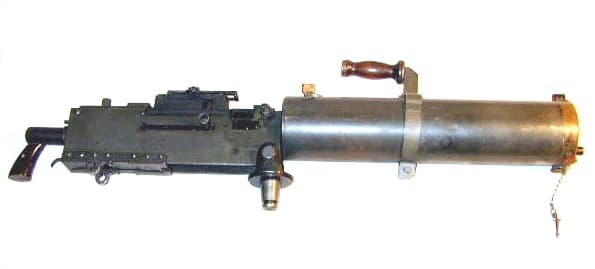
M1917 Browning machine gun is a heavy machine gun originating in United States. Reported operators include Argentina, Belgium, Bolivia, Cuba, France, Guatemala, South Korea, Netherlands, Norway, Paraguay, Philippines, Poland, Sweden, Thailand, United Kingdom, United States.
 United States
Source-pictured Browning M1917A1 receiver and complete water-cooled barrel-jacket assembly without tripod or ammunition; exact historical display configuration, not a contemporary operational claim.
US Army Center for Military History image · Public domain · Resized / optimised · Public domain · Source ↗ · ModifiedHeavy machine gun
United States
1917–1970s
See Users
World War I Mexican Revolution Banana Wars Chaco War World War II Chinese Civil War Korean War First Indochina War Congo Crisis Vietnam War Cambodian Civil War
John M. Browning
1917
1917–45
128,369
M1917, M1917A1, Colt models
103 lb (47 kg) (gun, tripod, water, and ammunition)
980 mm
24 in (609 mm)
.30-06 Springfield Other cartridges 6.5×54mm Greek 6.5×55mm Swedish 7.5×54mm French 7×57mm Mauser 7.62×51mm NATO 7.65×53mm Mauser 7.92×57mm Mauser 7.92×61mm 8×52mmR Siam 8×63mm
Recoil-operated automatic
450 round/min, 600 round/min for M1917A1
2,800 ft/s (853.6 m/s)
250 round fabric belt
Argentina : Colt Model 1928 and FN Model 30 in 7.65×53mm Mauser
Belgium : locally produced
Bolivia : bought 256 MG38s between 1920 and 1938 and 207 MG40s in 1933–1934, all in 7.65×53mm Mauser .
China : "Type Triple-Ten" a.k.a. "Type 30", a Chinese copy of the M1917 in 7.92×57mm Mauser used in the Second Sino-Japanese War
Cuba
Ethiopia
France : used airborne variant in 7.5×54mm as the Modèle 1938 . The M1917 HMG was also used by the BF-ONU and during the First Indochina War .
Greece : FN30 variant in 6.5×54mm Mannlicher–Schönauer
Guatemala : Model 1924 in 7×57mm Mauser
South Korea : The Armed Forces received 316 M1917A1s before the Korean War , and 751 were in service with the Army by the end of the war.
Mexico : Model 1919 in 7×57mm Mauser
Netherlands : Used by KNIL troops (as seen in the image above).
Norway : m/29
Paraguay : bought 144 MG38s between 1928 and 1934
Philippines
Poland
Sweden (designated as Kulspruta (Ksp) m/36)
Thailand : FN Model 30 in 8x52mmR, designated as the Type 66
United Kingdom : Acquired through Lend-Lease
United States : was the standard medium machine gun until it was replaced a few years after WWII. It was used in the Army Reserve and Army National Guard until the late 1960s and early 1970s.
Viet Cong : Captured and used early in the war by Main Force & Local
The M1917 Browning machine gun is a heavy machine gun used by the United States armed forces in World War I , World War II , the Korean War , and the Vietnam War ; it has also been used by other nations.
The M1917 Browning machine gun is a heavy machine gun used by the United States armed forces in World War I , World War II , the Korean War , and the Vietnam War ; it has also been used by other nations. It was a crew-served, belt-fed, water-cooled machine gun that served alongside the much lighter air-cooled Browning M1919 . It was used at the battalion level, and often mounted on vehicles (such as a jeep ). There were two main iterations: the M1917, which was used in World War I and the M1917A1, which was used thereafter. The M1917, which was used on some aircraft as well as in a ground role, had a cyclic rate of 450 rounds per minute. The M1917A1 had a cyclic rate of 450 to 600 rounds per minute.
The Browning is a water-cooled heavy machine gun, though some experimental versions were made that did not use a water jacket; the air-cooled M1919 was later developed as a medium machine gun. Unlike many other early machine guns, the M1917 had nothing to do with Maxim 's toggle lock design. At 47 pounds (21 kg), it was much lighter than contemporary Maxim type guns such as the first 137-pound (62 kg) German Maschinengewehr 08 (08/15 model: 43 lb (20 kg)) and similar to the British Vickers machine gun , while still being highly reliable. The similarities with the Maxim and the Vickers are the principles of recoil operation , T-slot breechblock, "pull-out" belt feed, water cooling, and forward ejection. The Browning's sliding-block locking mechanism, used in many previous Browning design, saved weight and complexity. The belt fed left-to-right, and the cartridges were stacked closer together than Maxim/Vickers.
The Army Ordnance Department showed little interest in machine guns until war was declared in April 1917. At that time, the U.S. arsenal included only 1,100 machine guns, and most of those were outmoded. The government asked several designers to submit weapons. Browning arranged a test at the Springfield Armory in May 1917. In the first test, the weapon fired 20,000 rounds with only a few malfunctions mostly related to poorly loaded cloth belts. The reliability was so exceptional that Browning fired another 20,000 rounds through the weapon for only one broken part: a sear failed at about 39,500 rounds fired. The Ordnance Board was impressed, but was unconvinced that the same level of performance could be achieved in a production model. Consequently, Browning used a second gun that not only duplicated the original trial, but it also fired continuously for 48 minutes and 12 seconds (over 21,000 rounds).
Until the start of World War I, the Army had used a variety of older machine guns, including the Browning-designed M1895 "Potato Digger", the Maxim Gun , the Benet–Mercie M1909 , and the Hotchkiss M1914 machine gun . Although the Model 1917 was intended to be the principal US Army heavy machine gun in the war, the Army was forced to purchase many foreign weapons—the French-produced Hotchkiss 8 mm machine gun was actually the most common heavy machine gun used by the American Expeditionary Force .
In 1926, the Browning's rear sight was revised to incorporate scales for both the new M1 Ball (172-grain boat-tail bullet) and the M1906 (150-grain flat-base bullet) ammunition. With M1 ball, the M1917 had a maximum range of about 5,500 yd (5,000 m); with M2 ammunition, about 3,500 yd (3,200 m). The rear sight had a battle sight as well as a raised leaf-type sight suitable for employment against either ground or air targets.
The Model 1917 was called to service again in the Korean War . On at least one occasion, U.S. soldiers in the Korean War urinated on the gun when water-cooling had failed in the frigid temperatures of the Korean winter. The Model 1917 was slowly phased out of military service in the late-1960s in favor of the much lighter M60 machine gun chambered in the new 7.62 mm NATO cartridge.
Kulspruta m/14-29 was the Swedish designation for the licensed M1917A1, produced by Carl Gustafs Gevärsfaktori in Eskilstuna, for infantry support. The main differences was that it was chambered in the standard caliber 6.5×55mm , had spade-grips and used the cooling jacket and tripod of the m/14 (Schwarzlose) tripod, the machine gun the Ksp m/14-29 replaced. The reason for adoption of the Browning was cost: 50 machine guns using the Browning mechanism could be made for the same price as 30 Schwarzlose, which was discovered during the manufacture of Kulspruta m/22 .
The 6.5mm bullet was found to be too light for long-range fire support and anti-aircraft use, so in 1932 the heavier 8×63mm patron m/32 cartridge was developed.
Until 1966, the m/14-29 and m/36 machine guns could use both the 6.5mm and the 8 mm ammunition.
In 1966, most were converted to 7.62×51mm NATO . Some old models were retained in training use to use up the stores of obsolete ammunition. After the stocks were expended in the 1970s, all guns were re-barreled to 7.62mm NATO. The weapons were finally taken out of service in 1995.
The Ckm wz.30 was an unlicensed Polish-built modification of the Colt Model of 1924 chambered in 7.92×57mm Mauser . The modifications included new iron sights (V-notch rather than loophole), lengthened butt handle, lengthened barrel, simplified rifle lock for easier exchange of used-up barrels and better handling, mounting adapted for both anti-personnel and AA fire and sights and grips adapted to suit both purposes. Roughly 8,000 were built by Państwowa Fabryka Karabinów .
Norwegian designation for the Colt MG 38 (mentioned in the following section) in 7.92×61mm , used as the standard heavy machine gun and anti-aircraft weapon for the Norwegian Army from 1929 to 1940. The Colt mitraljøse m/29 replaced the Hotchkiss M1914 machine gun in Norwegian service. In all, 1,800 m/29 s were in Norwegian service by the time of 9 April 1940 German invasion. The m/29 saw service in the 1940 Norwegian Campaign , often deployed as the only heavy weapon of Norwegian front line units.
The Army adopted the weapon as its principal heavy machine gun, utilizing the M1906 .30-06 cartridge with a 150-grain, flat-base bullet. Production was complex as the several manufacturers producing the guns needed to establish assembly lines and create tooling. By 30 June 1918, Westinghouse had made only 2,500 and Remington had made only 1,600. By the time of the Armistice, Westinghouse had made 30,150, Remington 12,000, and Colt 600.
The Army adopted the weapon as its principal heavy machine gun, utilizing the M1906 .30-06 cartridge with a 150-grain, flat-base bullet. Production was complex as the several manufacturers producing the guns needed to establish assembly lines and create tooling. By 30 June 1918, Westinghouse had made only 2,500 and Remington had made only 1,600. By the time of the Armistice, Westinghouse had made 30,150, Remington 12,000, and Colt 600.
The Army adopted the weapon as its principal heavy machine gun, utilizing the M1906 .30-06 cartridge with a 150-grain, flat-base bullet. Production was complex as the several manufacturers producing the guns needed to establish assembly lines and create tooling. By 30 June 1918, Westinghouse had made only 2,500 and Remington had made only 1,600. By the time of the Armistice, Westinghouse had made 30,150, Remington 12,000, and Colt 600.
Reference text from Wikipedia contributors, used under CC BY-SA 4.0.
True scale
Sourced dimensions beside a 1.75 m human reference.
See it in your room. Scan with your phone to open this model in 3D, then place it in your space.
Points represent sourced observations, including revisions. Revisions on the same effective date are not separate inventory events. Ranges appear in the table and are not plotted as exact points.
| Observation / report period | Value | Source | Claim state |
|---|---|---|---|
| 1 Oct 2026 | 0.609 m | Wikipedia contributors | superseded |
| 1 Oct 2026 | 0.609 m | Wikipedia contributors | approved |
M1917 Browning machine gun equipment records. Variants, orders and quantities are shown as reported in each inventory source; coverage is incomplete.
 Argentina
 Belgium
 Bolivia
 Cuba
 Dominican Republic
 France
 Guatemala
 Netherlands
 Norway
 Paraguay
 Philippines
 Poland
 South Korea
 Sweden
 Thailand
 United Kingdom United States
Argentina, Belgium, Bolivia, Cuba, France, Guatemala, South Korea, Netherlands, Norway, Paraguay, Philippines, Poland, Sweden, Thailand, United Kingdom, United States
Equipment reference ↗ China