FORCETALLY
Loading the evidence…
Preparing your view.


Preparing your view.
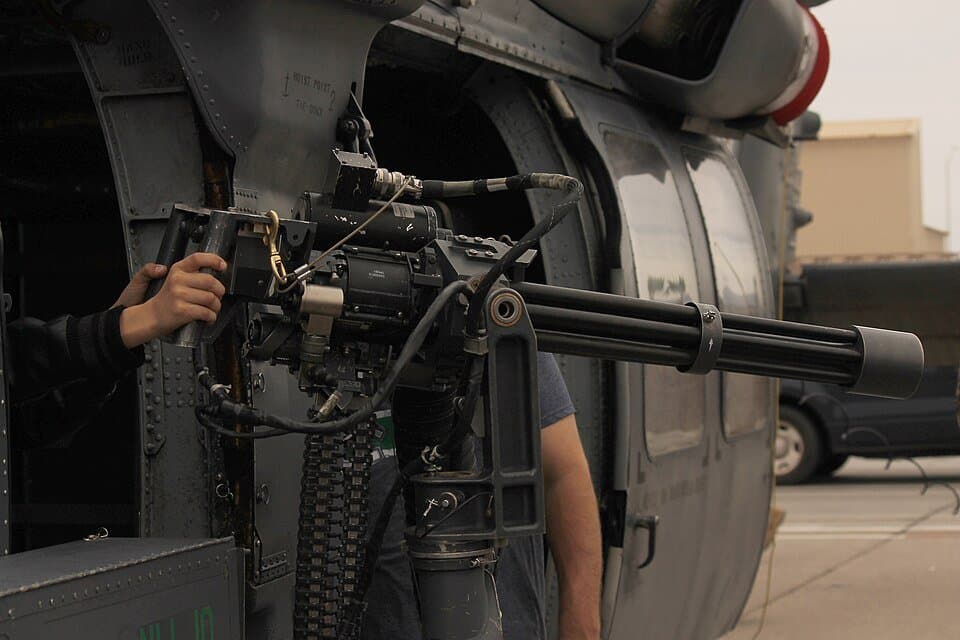
Small armsIn service
Rotary medium machine gun
M134 Minigun is a rotary medium machine gun originating in United States. It was built by General Electric Dillon Aero Garwood Industries Profense. Reported operators include Afghanistan, Argentina, Australia, Austria, Brazil, Brunei, Canada, Chile, Colombia, Czech Republic, Egypt, France, Finland, Georgia, Germany, India, Indonesia, Iraq, Iran, Israel, Italy, Japan, Jordan, Malaysia, Mexico, Morocco, Netherlands, New Zealand, Norway, Pakistan, Paraguay, Peru, Philippines, Poland, South Korea, Romania, Saudi Arabia, Serbia, Sierra Leone, Spain, Sweden, Thailand, Türkiye, Ukraine, United Kingdom, United States, Vietnam.
 United States
Technical data
Rotary medium machine gun
United States
1963–present
See Users
Vietnam War Third Indochina War United States invasion of Grenada United States invasion of Panama Soviet–Afghan War Falklands War Gulf War Operation Restore Hope War in Afghanistan (2001–2021) Iraq War
General Electric
1960
General Electric Dillon Aero Garwood Industries Profense
1962–present
See Design and variants
True scale
Sourced dimensions beside a 1.75 m human reference.
See it in your room. Scan with your phone to open this model in 3D, then place it in your space.
Points represent sourced observations, including revisions. Revisions on the same effective date are not separate inventory events. Ranges appear in the table and are not plotted as exact points.
| Observation / report period | Value | Source | Claim state |
|---|---|---|---|
| 28 Sept 2026 | 0.5588 m | Wikipedia contributors | superseded |
85 lb (39 kg), 41 lb (19 kg) lightweight mod.
801.6 mm (31.56 in)
558.8 mm (22.00 in)
7.62×51mm NATO
6
Electrically driven rotary breech
Variable, 2,000–6,000 rounds/min
2,800 ft/s (853 m/s)
3,280 ft (1,000 m; 1,090 yd)
Disintegrating M13 linked belt or linkless feed; dependent on installation (500–5,000-round belt)
Dependent on installation; no fixed sights
Afghanistan
Argentina
Australia
Austria
Brazil
Brunei
Canada
Chile
Colombia – Used on UH-60L , Mi-17 , and UH-1N helicopters.
Czech Republic
Egypt
France
Finland
Georgia
Germany
India
Indonesia
Iraq
Iran
Israel
Italy
Japan
Jordan
Malaysia
Mexico
Morocco
Netherlands
New Zealand (testing)
Norway
Pakistan
Paraguay
Peru
Philippines
Poland
South Korea
Romania – Used on IAR 330 helicopters
Saudi Arabia
Serbia
Sierra Leone
Spain
Sweden
Thailand
Turkey
Ukraine
United Kingdom
United States
Vietnam
The M134 Minigun is an American 7.62×51mm NATO six-barrel rotary machine gun with a high rate of fire (2,000 to 6,000 rounds per minute ).
The M134 Minigun is an American 7.62×51mm NATO six-barrel rotary machine gun with a high rate of fire (2,000 to 6,000 rounds per minute ). It features a Gatling -style rotating barrel assembly with an external power source, normally an electric motor . The "Mini" in the name is in comparison to larger-caliber designs that use a rotary barrel design, such as General Electric's earlier 20 mm M61 Vulcan , and "gun" for the use of rifle ammunition as opposed to autocannon shells.
The ancestor to the modern minigun was the hand cranked mechanical Gatling gun invented in the 1860s by Richard Jordan Gatling . He later replaced the hand-cranked mechanism with an electric motor , a relatively new invention at the time. Even after Gatling slowed the mechanism, the new electrically powered Gatling gun had a theoretical rate of fire of 3,000 rounds per minute, roughly three times the rate of a typical modern, single-barreled machine gun. Gatling's design received U.S. Patent #502,185 on July 25, 1893. Despite his improvements, the Gatling gun fell into disuse after cheaper, lighter-weight, recoil and gas operated machine guns were invented; Gatling himself went bankrupt for a period.
During World War I , several German companies were working on externally powered guns for use in aircraft. One of these designs was the Fokker-Leimberger , an externally powered 12-barrel rotary gun using the 7.92×57mm Mauser round; it was claimed to be capable of firing over 7,000 rpm, but suffered from frequent cartridge-case ruptures due to its "nutcracker" rotary split-breech design, which is different from that of conventional rotary gun designs. None of these German guns went into production during the war, although a competing Siemens prototype (possibly using a different action), which was tried on the Western Front , scored a victory in aerial combat. The British also experimented with this type of split-breech during the 1950s, but they were also unsuccessful.
To develop a more reliable weapon with a higher rate of fire, General Electric designers scaled down the rotary-barrel 20 mm M61 Vulcan cannon for 7.62×51mm NATO ammunition. The resulting weapon, designated M134 and known as the "Minigun", could fire up to 6,000 rounds per minute without overheating. The gun has a variable (i.e. selectable) rate of fire, specified to fire at rates of up to 6,000 rpm with most applications set at rates between 3,000 and 4,000 rounds per minute.
The core of the M134D was a steel housing and rotor. To focus on weight reduction, a titanium housing and rotor were introduced, creating the M134D-T which had reduced weight from 62 lb (28 kg) to 41 lb (19 kg). The gun housing had a 500,000-round lifespan before it wore out, which was far higher than a conventional machine gun's 40,000-round lifespan but lower than that of other rotary guns. A hybrid of the two weapons resulted in the M134D-H , which had a steel housing and titanium rotor. It was cheaper with the steel component and only 1 lb (0.45 kg) heavier than the M134D-T, and restored its lifespan to 1.5 million rounds. The M134D-H is currently in use on various 160th Regiment platforms.
Garwood Industries created the M134G version with several modifications to the original GE system. The optimum rate of fire was determined by Garwood to be around 3,200 rounds per minute (rpm). The M134G is being produced with this firing rate as well as 4,000 rpm and the previous standard 3,000 rpm rate. Garwood Industries made several other modifications to the 1960s Minigun design in order to meet modern-day military and ISO standards. This includes modifications to the drive motor, feeder and barrel clutch assembly.
Another variant was developed by the USAF specifically for flexible installations, beginning primarily with the Bell UH-1N Twin Huey helicopter, as the GAU-17/A. Produced by General Dynamics , this version has a slotted flash hider. The primary end users of the GAU-17/A have been the USN and the United States Marine Corps (USMC), which mount the gun as defensive armament on a number of helicopters and surface ships. GAU-17/As from helicopters were rushed into service for ships on pintle mountings taken from Mk16 20 mm guns for anti-swarm protection in the Gulf ahead of the 2003 Iraq War - 59 systems were installed in 30 days. The GAU-17/A is designated Mk 44 in the machine gun series and is generally known as the Mk 44 when installed on British warships.
The weapon is part of both the A/A49E-11 armament system on the UH-1N; and of the A/A49E-13 armament subsystem on the USAF Sikorsky HH-60H Pave Hawk helicopter. The weapons on these systems feature a selectable fire rate of either 2,000 or 4,000 rpm. There is mention of a possible GAUSE-17 designation (GAU-Shipboard Equipment-17), in reference to the system when mounted on surface ships, though this would not follow the official ASETDS designation system's format.
The first AC-130A Gunship IIs did away with the MXU-470/A mounts and instead used GAU-2/As, and not only had four 7.62mm GAU-2/A minigun mounts, but added four 20mm M61 Vulcan 6-barrel rotary cannons; this configuration was upgraded two years later in 1969 by removing two each of the GAU-2/As and M61s and adding two 40 mm (1.58 in) L/60 Bofors cannons in the aptly named AC-130A 'Surprise Package'.
This configuration lasted two more years until, in late 1971, the AC-130E Pave Aegis arrived, which did away with the miniguns altogether and one of the 40mm Bofors and instead went to the configuration of two 20mm M61 Vulcan, one 40mm L/60 Bofors and one 105 mm (4.13 in) M102 howitzer , a configuration that lasted until the early 2000s when the AC-130Hs (the AC-130Es had had an avionics upgrade and redesignated to H models) underwent a refit and the two M61 Vulcans were removed and replaced with one General Dynamics 25 mm (0.984 in) GAU-12/U Equalizer 5-barrel rotary cannon (while still retaining the H suffix).
The improved MXU-470/As were even being proposed for lighter aircraft such as the Cessna O-2 Skymaster used by Forward Air Controllers but proved too heavy and cumbersome. A fit of two MXU-470/As was also tested on the Fairchild AU-23A Peacemaker , though the Royal Thai Air Force later elected to use another configuration with the M197 20 mm cannon.
Reference text from Wikipedia contributors, used under CC BY-SA 4.0.
M134 Minigun equipment records. Variants, orders and quantities are shown as reported in each inventory source; coverage is incomplete.
 Afghanistan
 Argentina
 Australia
 Austria
 Brazil
 Brunei
 Canada
 Chile
 Colombia
 Czechia
 Egypt
 Finland
 France
 Georgia
 Germany
 India
 Indonesia
 Iran
 Iraq
 Israel
 Italy
 Japan
 Jordan
 Malaysia
 Mexico
 Morocco
 Netherlands
 New Zealand
 Norway
 Pakistan
 Paraguay
 Peru
 Philippines
Reported count for M134 Minigun · M134D. Service scope: Philippine Marine Corps; does not replace a national total. 1 distinct quantity component(s) from the same source list; shared rowspan cells counted once. Explicit source inventory scope: active; no other stock status or total inferred. Count column(s): in service: 4. Origin: United States. The listed variants/roles are the scope, not an immediately deployable count. The components do not establish one inventory census date; the stored date is the retrieved source snapshot.
 Poland
Reported count for M134 Minigun · M134G. Service scope: Polish Land Forces; does not replace a national total. 1 distinct count cell(s) from the same source list; shared rowspan cells counted once. Retired, wholly reserve and on-order rows are excluded; the reported count retains any explicitly mixed stock scope in the quoted row. Count column(s): quantity: 10. Origin: United States. The listed variants/roles are the scope, not an immediately deployable count. Explicitly named source subset; this is not a whole-family total and does not cover other listed designs. Dates are the count-cell citations' stated source period (2020), not the article revision. Cited source 2020-03-31. Edition or publication years do not claim an exact inventory census day.
 Romania
 Saudi Arabia
 Serbia
 Sierra Leone
 South Korea
 Spain
 Sweden
 Thailand
 Türkiye
 Ukraine
 United Kingdom United States
 Vietnam
Afghanistan, Argentina, Australia, Austria, Brazil, Brunei, Canada, Chile, Colombia, Czech Republic, Egypt, France, Finland, Georgia, Germany, India, Indonesia, Iraq, Iran, Israel, Italy, Japan, Jordan, Malaysia, Mexico, Morocco, Netherlands, New Zealand, Norway, Pakistan, Paraguay, Peru, Philippines, Poland, South Korea, Romania, Saudi Arabia, Serbia, Sierra Leone, Spain, Sweden, Thailand, Türkiye, Ukraine, United Kingdom, United States, Vietnam
Equipment reference ↗Keep exploring