FORCETALLY
Loading the evidence…
Preparing your view.


Preparing your view.
Drones & UAVsIn service
Unmanned Aerial Vehicle
Lockheed Martin Stalker is a unmanned Aerial Vehicle originating in United States of America. It was built by Lockheed Martin Skunk Works. Reported operators include United States Special Operations Command.
 United States
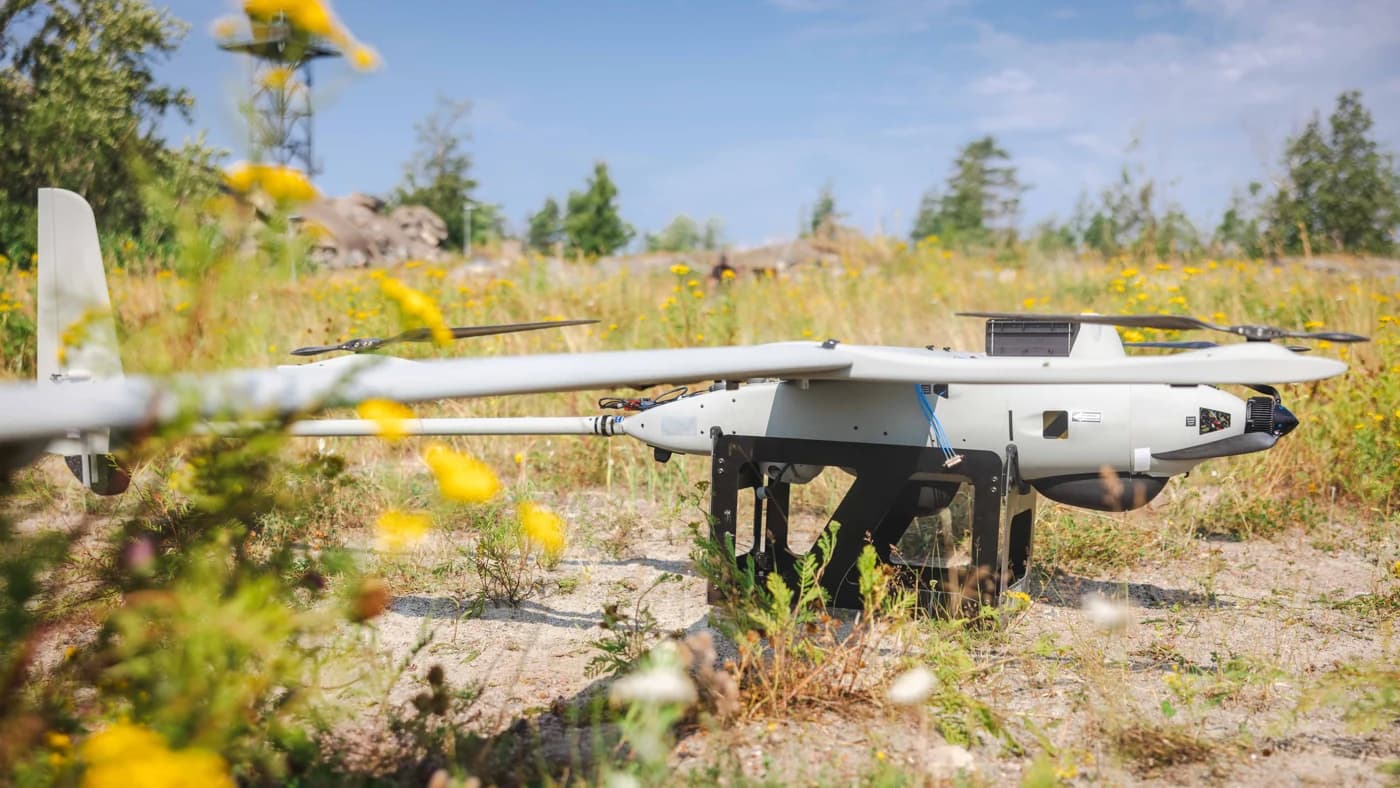
Pictured Stalker VXE30 staged in southern Finland, 31 July 2025; fuselage, tail and VTOL installation visible, with wing extremities outside the source frame and foreground flowers. Family-representative VXE30 configuration; no basic-Stalker fitted-equipment claim.
U.S. Marine Corps photo by Lance Cpl. Frank Sepulveda Torres · Public domain · Resized · Public domain · Source ↗ · ModifiedTechnical data
Unmanned Aerial Vehicle
United States of America
Lockheed Martin Skunk Works
United States Special Operations Command
2006
2006
none
10 ft (3.0 m)
14.5 lb (7 kg)
17.5 lb (8 kg)
1 × Hush Drive Electric
2-bladed
50 mph (80 km/h, 43 kn) (dash)
True scale
Sourced dimensions beside a 1.75 m human reference.
Points represent sourced observations, including revisions. Revisions on the same effective date are not separate inventory events. Ranges appear in the table and are not plotted as exact points.
| Observation / report period | Value | Source | Claim state |
|---|---|---|---|
| 29 Sept 2026 | 2 h | Wikipedia contributors | superseded |
| 29 Sept 2026 | 2 h | Wikipedia contributors | approved |
2 hours
15,000 ft (4,600 m)
The Lockheed Martin Stalker was a hand-launched, electrically powered unmanned aerial vehicle designed and built by Edge Autonomy and originally sold by Lockheed Martin Skunk Works for an unspecified customer, presumably United States Special Operations Command .
A propane fuel cell powered version of the Stalker with 8 hours endurance (quadruple the 2 hours available on battery power) was developed. The fuel cell powered Stalker was in over 80 missions in Afghanistan. The Army was hoping to create a fuel cell that runs on JP8 fuel rather than propane, as it was more common in the logistics inventory.
In July 2012, a Stalker demonstrated, in a wind tunnel test, a capability of in excess of 48 hours continuous flight while being powered by a ground-based laser system. Following the wind tunnel test, Lockheed and LaserMotive Inc. performed a series of outdoor tests with the laser powering system the next month. The flight tests went successfully, and accomplishments included:
Demonstrating net positive power to the Stalker in flight, at ranges up to 600 meters.
The beam director tracking the receiver for long periods, with centimeter accuracy at 500 meters, despite turbulence and aircraft maneuvers.
In August 2013, Lockheed revealed an improvement of the Stalker XE with an endurance of 13 hours. The previous version used a 2.2 liter liquid propane tank, while the new version used a 3.2 liter tank. Both versions used the same fuel cell. Stalker UAVs were used by Army and Marine Special Forces in Afghanistan to detect improvised explosive devices . Users haven't requested changes to the airframe, but have requested endurance changes, with aircraft being put in the air two to three times a day, every day. Several potential foreign sales were under negotiation, with customers and numbers of systems being undisclosed. Lockheed also revealed that they planned to continue testing the laser -charged Stalker. The laser apparatus, built by LaserMotive , was about the size of a horse trailer , and they were working to reduce its size to something that could be used for tactical operations. Ideal size was about the same as "two travel suitcases put together."
The 350 W prototypes, manufactured by the Adaptive Energy LLC headquartered in Ann Arbor, MI. , were designed to provide 40% more power while packaged in the same physical power system (size, weight, shape) as the 245 W system. Researchers at ARL evaluated two 350 W systems; one for its thermal cycling capability, and the other for long term operation performance. It was shown that the first system displayed 55 thermal cycles without experiencing performance decay and the second system demonstrated continuous operation for 2,000 hours. Limitations of these systems included fractures of the electrolyte, made of thin ceramic material, and carbon deposition within the fuel cell. Further development of the technology resulted in a commercial product.
Wingspan: 10 ft (3.0 m)
Empty weight: 14.5 lb (7 kg)
Max takeoff weight: 17.5 lb (8 kg)
Maximum speed: 50 mph (80 km/h, 43 kn) (dash)
Endurance: 2 hours
Service ceiling: 15,000 ft (4,600 m)
Wing Span....................................................................................16.0 ft.
Length............................................................................................8.5 ft.
Payload Weight................................................................... Up to 5.5 lb.
Propulsion.......................................................... Propane fuel cell with rechargeable hybrid battery/dual rechargeable batteries
Reference text from Wikipedia contributors, used under CC BY-SA 4.0.
Lockheed Martin Stalker equipment records. Variants, orders and quantities are shown as reported in each inventory source; coverage is incomplete.
Keep exploring
Unmanned aerial vehicle
 Iran
Unmanned aerial vehicle
United StatesUnmanned aerial vehicle
 Poland
Unmanned aerial vehicle
United StatesUnmanned aerial vehicle
United StatesUnmanned aerial vehicle
 Mexico
 United Kingdom